









The main difference between Datadog, New Relic, and CubeAPM lies in pricing models, deployment flexibility, and OpenTelemetry-native architecture.
Datadog and New Relic are leading SaaS-based platforms, but their host- and user-based pricing can become expensive as environments scale. CubeAPM, in contrast, offers predictable ingestion-based pricing and self-hosting options, helping teams reduce observability costs while retaining full control over their data.
In this comparison, we’ll evaluate Grafana, Datadog, and CubeAPM across their core features, scalability, and pricing to find which platform delivers the best full-stack visibility.
Grafana vs Datadog vs CubeAPM Comparison
| Features | CubeAPM | Grafana | Datadog |
| Known | OpenTelemetry-native full-stack observability, | Open, flexible observability with strong visualization. | Enterprise-grade, all-in-one cloud observability. |
| Multi-Agent Support | Yes (OTel, New Relic, Datadog, Elastic) | Partial(Not full multi-agent) | Partial(Proprietery agents) |
| MELT Support | Full MELT coverage | Full MELT coverage | Full MELT coverage |
| Setup | Self-hosted(vendor-managed) | Self-hosted & SaaS | SaaS only |
| Pricing | Ingestion-based pricing of $0.15/GB | Pro Plan: $19/month + usage Logs: $0.50/GB Traces:$0.50/GB APM:$0.04/host/hour | APM: $35/host/month Infra: $15/host/month Logs: $0.10/GB/month ingested |
| Sampling Strategy | Smart sampling (95 % compression) | Tail + Head-based sampling | Head-based + Tail-based + Probabilistic |
| Log Retention | Infinite Retention (no extra cost) | Free Plan: 15-day Pro Plan: 30-day | APM: 15-30 days |
| Support TAT | < 10 mins | 2hrs to 6hrs | <30mins to 48hrs |
Grafana vs Datadog vs CubeAPM: Feature-by-Feature Breakdown
Multi-Agent Support
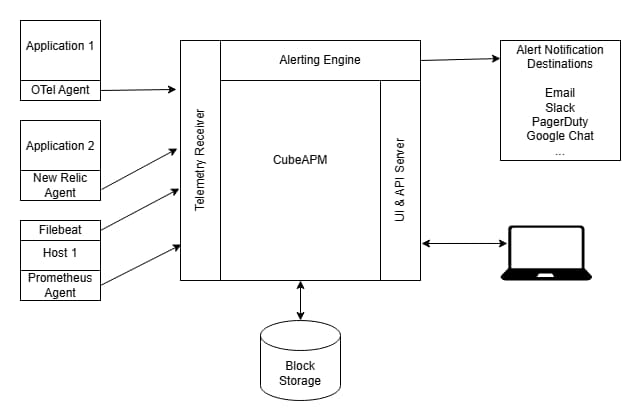
CubeAPM: Designed for interoperability, CubeAPM supports multiple agents out of the box — OpenTelemetry, Prometheus, Datadog, New Relic, and Elastic. This flexibility lets teams migrate existing pipelines without changing instrumentation or collectors.
Grafana: Grafana supports interoperability at the collector layer through Grafana Alloy and the OpenTelemetry Collector, which can ingest data from multiple protocols and formats. However, it does not directly ingest or operate third-party APM agents as first-class inputs.
Datadog: Datadog is centered around the Datadog Agent and its own SDKs. While it supports OpenTelemetry ingestion, it does not natively ingest telemetry from other commercial APM agents such as New Relic or Dynatrace.
MELT Coverage (Metrics, Events, Logs, Traces)
CubeAPM: Provides full MELT observability in one backend — Metrics, Events, Logs, and Traces are correlated automatically. This unified view cuts MTTR and eliminates the need to maintain multiple data stores.
Grafana: Achieves MELT visibility only when combined with separate tools — Loki for logs, Tempo for traces, and Mimir for metrics. Though flexible, running these services independently can increase operational complexity and storage costs.
Datadog: Delivers full MELT observability within a single SaaS platform, with metrics, logs, traces, and events integrated and correlated across applications and infrastructure.
Deployment Options
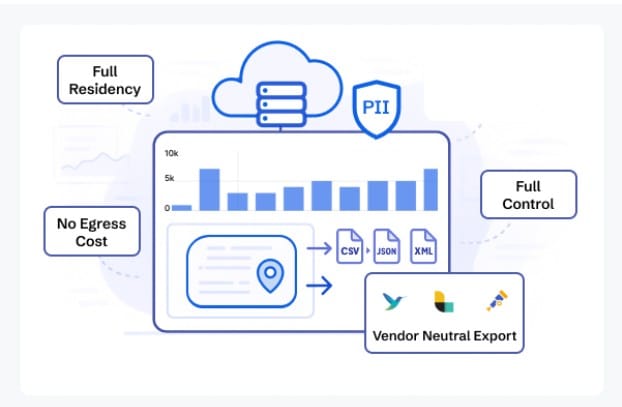
CubeAPM: Offers self-hosting and BYOC (Bring Your Own Cloud) options. Teams can deploy CubeAPM inside their own VPC or on-prem environment, maintaining full data sovereignty while CubeAPM manages scaling and updates remotely.
Grafana: Supports both SaaS and Self-hosted options. Self-hosting gives flexibility but demands infrastructure expertise to manage updates and scaling.
Datadog: Entirely SaaS-based, with no self-hosting option. However, you still incur the data-out cost (charged by your cloud provider, like AWS) because you first send your telemetry data out from your cloud to Datadog’s cloud.
Pricing and Cost for Different Team Sizes
*Disclaimer: Pricing comparisons are based on standardized Small/Medium/Large team profiles defined in our internal benchmarking sheet. Actual costs may vary by usage, region, and plan. Please verify current pricing with each vendor.
An APM host is a host that is actively generating traces data and an Infra host is any physical or virtual OS instance that you monitor with any observability tool.
CubeAPM offers the most transparent and predictable model at $0.15 per GB ingested — flat, unified, and consistent across all telemetry types. Below is a cost comparison for small, mid-sized, and large teams.
Cost for Small Teams (~30 hosts):
- CubeAPM: $2,080/month
- Grafana: ~$3,870/month
- Datadog: ~$8,185/month
Cost for Mid-Sized Teams (~125 hosts):
- CubeAPM: $7,200/month
- Grafana: ~$11,875/month
- Datadog: ~$27,475/month
Cost for Large Teams (~250 hosts):
- CubeAPM: $15,200/month
- Grafana: ~$26,750/month
- Datadog: ~$59,050/month
Teams switching to CubeAPM typically achieve +60% lower total observability costs compared to Datadog’s per-host billing.
CubeAPM: Cost for Small, Medium, and Large Teams
Based on real customer data, CubeAPM simplifies pricing through a single ingestion-based plan at $0.15/GB, covering logs, traces, metrics, and events. There are no per-user licenses, data-transfer charges, or retention add-ons.
CubeAPM Pricing:
- $0.15/GB ingested
Estimated Monthly Costs:
- Small teams (~30 hosts): $2,080
- Mid-sized teams (~125 hosts): $7,200
- Large teams (~250 hosts): $15,200
This structure gives DevOps and SRE teams full budget predictability, especially for large Kubernetes and hybrid environments where data ingestion can spike.
Grafana Cloud: Cost for Small, Medium, and Large Teams
Grafana follows a modular billing model where each service — Logs, Metrics, and Traces — is priced separately. While this flexibility benefits smaller setups, costs scale as usage grows.
Grafana Cloud Pricing:
- Logs: $0.50/GB ingested
- Traces: $0.50/GB ingested
- Pro Base: $19/user/month
Estimated Monthly Costs:
- Small teams (~30 hosts): ~$3,870
- Mid-sized teams (~125 hosts): ~$11,875
- Large teams (~250 hosts): ~$26,750
Grafana Cloud is ideal for teams primarily focused on visualization and dashboards, but it becomes harder to budget for as data volume grows.
Datadog: Cost for Small, Medium, and Large Teams
Datadog’s pricing is host-based, which means costs rise with infrastructure size. Each module — APM, Infrastructure, and Logs — is billed separately.
Datadog Pricing:
- APM: $31/host/month
- Infrastructure: $15/host/month
- Data Transfer: $0.10/GB
Estimated Monthly Costs:
- Small teams (~30 hosts): $8,185
- Mid-sized teams (~125 hosts): $27,475
- Large teams (~250 hosts): $59,050
While Datadog offers excellent out-of-the-box monitoring, its per-host billing makes cost forecasting challenging for teams with dynamic scaling or large microservice fleets.
In total cost and simplicity, CubeAPM remains the most predictable option — delivering unified observability at one flat rate without the layered billing models of Grafana or Datadog.
Sampling Strategy
CubeAPM: Implements Smart Sampling with ~95 % compression. It keeps latency and error-related traces intact while discarding noise, reducing telemetry volume by up to 70 % and keeping analysis accurate at scale.
Grafana: Supports both head-based and tail-based sampling via the OpenTelemetry Collector. Head-based sampling decides at the start of a trace using simple rules, while tail-based sampling evaluates completed traces to keep important ones based on errors or latency.
Datadog: Supports both head-based and tail-based sampling with OpenTelemetry. Head-based sampling makes decisions at trace start and is lightweight, but can miss errors or slow requests. Tail-based sampling evaluates completed traces to retain important ones, though it requires more resources and all spans to reach the same collector for accurate decisions.
Data Retention
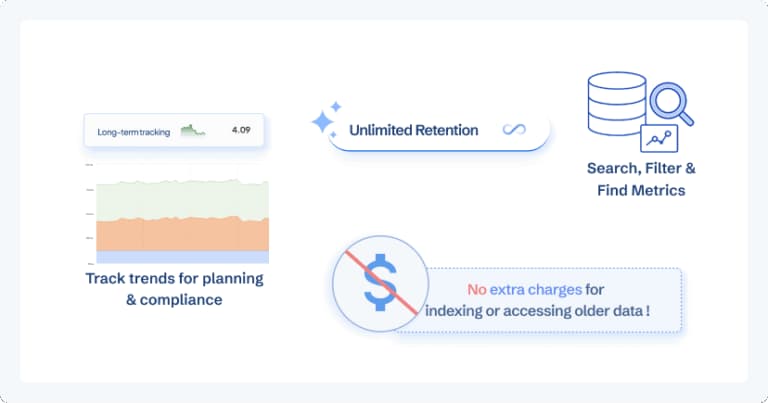
CubeAPM: Retains data indefinitely at no extra cost, with all telemetry stored inside the customer’s cloud. This makes it ideal for teams needing long-term analytics, SLA reviews, or compliance audits.
Grafana: Data retention in Grafana Cloud is plan-based. The Free tier retains metrics, logs, traces, profiles, and k6 data for 14 days. The Pro tier retains metrics for 13 months and logs, traces, profiles, and k6 data for 30 days. Enterprise plans support custom retention periods based on contract.
Datadog: APM data retention is split by data type. APM errors are retained for 15 days, indexed spans for 15 or 30 days depending on the plan, and service and resource statistics for 30 days. Viewed traces are retained for the lifetime of the account, but raw trace data is not stored long-term beyond these limits.
Support TAT
CubeAPM: Provides direct Slack and WhatsApp access to core engineers with average response times under five minutes — invaluable for teams resolving production incidents.
Grafana: provides support via tickets and email, with SLAs based on the plan. Paid tiers offer 24/7 support, with initial response times ranging from 2 business hours for critical issues to 6 hours for general issues, and down to 30 minutes on Enterprise plans. In contrast, free users rely on community support.
Datadog: offers in-app chat, email, and Slack support (for eligible plans). On paid tiers, response time SLAs are clearly defined: business-critical issues are handled in under 2 hours while general issues are 48 hours on Standard support and under 30 minutes on Premier support, with 24/7 coverage on higher plans.
Known for
CubeAPM: Recognized for its OpenTelemetry-native architecture, self-hosting flexibility, unlimited retention, and predictable pricing — delivering full-stack observability without vendor lock-in.
Grafana: Known for world-class dashboards, visualization flexibility, and an open-source ecosystem ideal for teams already managing their telemetry pipelines.
Datadog: Known for its mature SaaS platform and extensive integrations, giving quick time-to-value for teams that prioritize simplicity over cost control.
Which Tool Is Best for You? Why Brands Choose CubeAPM
CubeAPM stands out for teams that need complete, OpenTelemetry-native observability with full control over data and predictable pricing. It unifies Metrics, Events, Logs, and Traces (MELT) across APM, Infrastructure, RUM, and Synthetic Monitoring — eliminating the need for multiple vendor tools or hidden licensing fees.
Benefits of Choosing CubeAPM
- Transparent pricing: One simple model — $0.15 per GB of ingested data, covering logs, metrics, traces, and events. No separate user or host charges.
- Intelligent sampling: A smart, context-driven sampling engine automatically filters noise and retains high-value traces, delivering up to 95% compression without losing diagnostic accuracy.
- Unified MELT platform: Complete visibility across applications, infrastructure, and user experience — all in a single, correlated interface.
- Bring Your Own Cloud (BYOC): Deploy CubeAPM inside your own environment to maintain data sovereignty and meet compliance mandates.
- Unlimited data retention: Keep observability data for as long as you want — perfect for teams handling audit trails, SLA analysis, and long-term reliability insights.
- Multi-agent Support: Native compatibility with OpenTelemetry, Prometheus, Datadog, and New Relic makes switching effortless and risk-free.
- API-first access: Pull, query, or automate any telemetry data directly using open APIs — no feature gates or paywalls.
Dedicated real-time support: Direct Slack and WhatsApp access to core CubeAPM engineers with response times measured in minutes.
Optimized for scale: Efficient architecture and 95% telemetry compression keep costs predictable even for multi-terabyte workloads.
Grafana vs Datadog vs CubeAPM: Use Cases
Choose CubeAPM if:
You want end-to-end observability that’s OpenTelemetry-native, cost-predictable, and data-compliant. CubeAPM gives teams full MELT visibility, self-hosting flexibility, and real-time DevOps support — helping engineering teams reduce MTTR and maintain complete data control.
Ideal for:
- Teams scaling microservices or Kubernetes clusters.
- Organizations with strict compliance and localization needs.
- Engineering teams seeking performance insights without unpredictable SaaS costs.
Choose Grafana if:
You want powerful dashboards and custom visualizations for Prometheus or Loki data. Grafana fits teams that already operate open-source stacks and primarily need visualization.
Choose Datadog if:
You prefer a fully managed SaaS that’s easy to set up and integrates quickly across your infrastructure and applications. Datadog offers a wide feature set, but costs can climb fast as hosts, metrics, and teams grow.
Conclusion
Grafana and Datadog each serve distinct roles in observability. Grafana excels at visualization but relies on multiple components for comprehensive MELT coverage, thereby increasing operational overhead. Datadog provides an integrated SaaS experience that’s easy to deploy, yet the pricing can make scaling complex and costly.
CubeAPM unifies metrics, logs, traces, and user experience monitoring within one OpenTelemetry-native platform. It simplifies observability management, supports self-hosting for data compliance, and provides real-time support directly from engineers — empowering teams to detect, resolve, and optimize more quickly.
For organizations seeking end-to-end visibility, consistent performance, and full control over their telemetry stack, CubeAPM stands out as the most complete and future-ready choice for modern DevOps and SRE teams.
Disclaimer: The information in this article reflects the latest details available at the time of publication and may change as technologies and products evolve.
FAQs
1. Which platform offers full-stack observability — Grafana, Datadog, or CubeAPM?
Only CubeAPM provides unified MELT coverage, Metrics, Events, Logs, and Traces—in a single OpenTelemetry-native platform. Grafana also requires managing multiple backends, while Datadog also has comprehensive full-stack observability, but the cost can be a barrier.
2. Can these tools be self-hosted?
CubeAPM supports full self-hosting or BYOC deployment, keeping all data inside your cloud. Grafana offers an open-source self-managed option, while Datadog is strictly SaaS-based.
3. Which tool is most suitable for compliance-heavy environments?
CubeAPM is built for compliance-driven teams. It allows on-prem or private cloud deployments that align with data regulations.
4. What’s the main difference between Grafana and Datadog in observability?
Grafana excels at dashboarding and visualization across open-source data sources, whereas Datadog focuses on managed APM, logs, and infrastructure monitoring. CubeAPM combines both strengths within a single backend.
5. Why are engineering teams moving to CubeAPM?
Teams switch to CubeAPM for its OpenTelemetry-native architecture, data ownership, real-time Slack/WhatsApp support, and simplified management, delivering faster troubleshooting and greater cost efficiency compared.