








The main difference between Elastic Observability, New Relic, and CubeAPM is how much control teams have over their observability data, costs, and long-term operations as telemetry volume grows.
Elastic Observability prioritizes flexibility and search by running on the Elastic Stack, and New Relic prioritizes convenience through a fully managed SaaS model. CubeAPM emphasizes ownership and predictability through a self-hosted, OpenTelemetry-native approach.
This difference becomes critical at scale. Incidents trigger sudden ingestion spikes, retention limits start to matter, and pricing models are stress-tested. This article compares Elastic Observability vs New Relic vs CubeAPM based on cost, features, use cases, and more.
Elastic Observability vs New Relic vs CubeAPM Comparison
The table below compares CubeAPM, Elastic Observability, and New Relic across the factors that matter most in production: deployment model, pricing mechanics, sampling behavior, retention limits, and support responsiveness. Rather than listing surface features, it highlights how each platform behaves as telemetry volume, operational complexity, and compliance requirements increase.
| Feature | CubeAPM | Elastic Observability | New Relic |
| Known for | Unified MELT, native OTEL, self-hosting, cost predictability | Search-driven observability built on the Elastic Stack | Full-stack APM, service maps, advanced analytics |
| Multi-Agent Support | Yes (OTel, New Relic, Datadog, Elastic) | Yes (Elastic Agent, Beats, OTEL) | Yes (New Relic Agent, OTel, Prometheus) |
| MELT Support | Full MELT coverage | Full MELT coverage | Full MELT coverage |
| Deployment | Self-hosted with vendor-managed | SaaS; private cloud (Enterprise) | SaaS & self-managed |
| Pricing | Ingestion-based: $0.15/GB | Serverless: $0.09/ GB; Elastic Cloud: $99/host/ month; self-managed: Custom | Free 100 GB/ month; beyond: $0.40/GB, per-user: $49-$349/month |
| Sampling Strategy | Smart sampling, context -aware, automated | Head-based & tail-based | Adaptive head-based & tail-based |
| Data Retention | Unlimited Retention | Traces, logs: 10d; metrics, RUM: 90d; synthetics: 1yr | Logs/events: 30d; add-on retention |
| Support Channel & TAT | Slack, WhatsApp; response in minutes | Web portal, email; TAT: 2d to 30 min | Community, docs, ticket; TAT: 2d to 2 hrs, 1hr (priority) |
Elastic Observability vs New Relic vs CubeAPM: Feature Breakdown
Known for
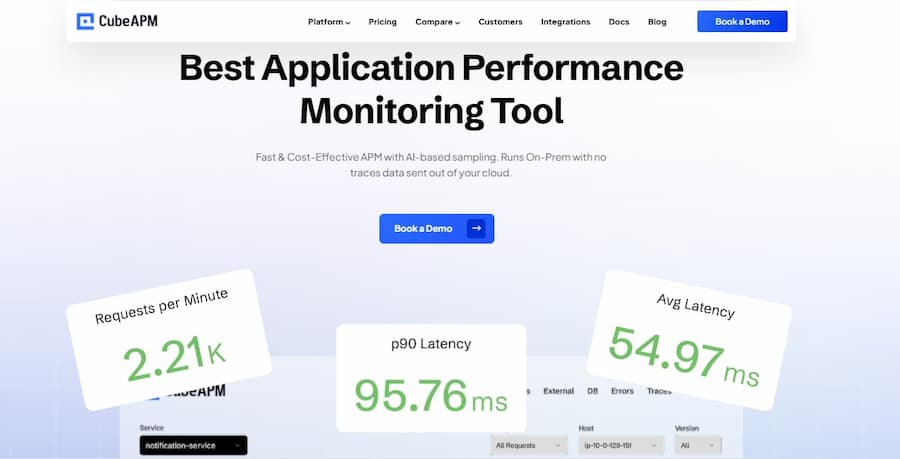
CubeAPM: CubeAPM is a unified observability and application performance monitoring (APM) platform built on OpenTelemetry and designed to run inside your cloud or data center while being vendor-managed like SaaS. It combines metrics, logs, traces, real-user monitoring, synthetic monitoring, and error tracking in one place, with predictable ingestion-based pricing and full data control. This self-hosted architecture allows teams to avoid vendor lock-in and operate observability at scale without sending telemetry out of their environment.
Elastic Observability: Elastic Observability delivers unified observability across applications and infrastructure by combining logs, metrics, application traces, and user experience data on top of the Elastic Stack’s search and analytics engine. Its strength lies in leveraging powerful search capabilities to correlate diverse telemetry for root-cause analysis and rich visualizations. This makes it particularly effective for environments where search-driven investigation is key.
New Relic: New Relic positions itself as an intelligent full-stack observability platform that gives deep visibility into systems with built-in analytics, machine-assisted insights, and broad integration coverage. It emphasizes proactive diagnostics across MELT and beyond (with features like AIOps, profiling, and change tracking) from a cloud-hosted single platform. The product supports a wide range of telemetry and rapid time-to-value through automatic instrumentation and pre-built dashboards.
Multi-Agent Support
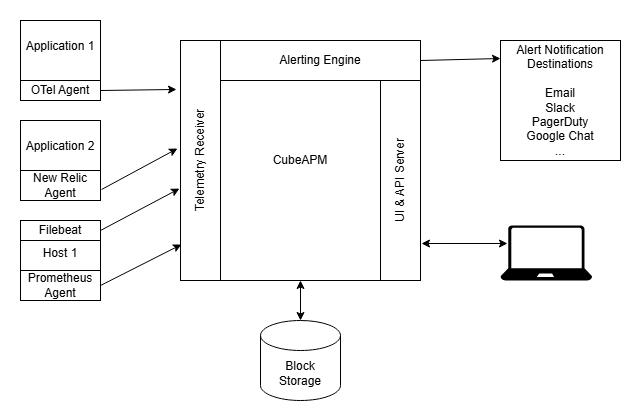
CubeAPM: CubeAPM is designed to accept telemetry from a wide range of agents and collectors, making it easy to integrate with existing instrumentation stacks. It natively supports OpenTelemetry Protocol (OTLP) collectors and can receive data from applications already instrumented with New Relic agents, Datadog agents, Elastic agents, Prometheus exporters, and more, allowing teams to reuse their existing instrumentation without rewriting it. This flexibility simplifies incremental migration and heterogeneous environments.
Elastic Observability: Elastic provides multi-agent support through Elastic Agent and legacy Beats shippers. Elastic Agent is a unified telemetry collector that can gather logs, metrics, traces, uptime data, and security signals from hosts in a single installation, and can be centrally managed via Fleet. Beats are lightweight, purpose-specific shippers (e.g., Filebeat for logs, Metricbeat for metrics) that can send data to Elasticsearch or through Logstash.
Elastic also supports OpenTelemetry ingestion and its own Elastic Distribution of OpenTelemetry (EDOT) to collect telemetry in standardized OTLP formats.
New Relic: New Relic supports multiple agent types, including its own proprietary language agents as well as OpenTelemetry instrumentation and collectors. Teams can mix and match instrumentation sources, using OpenTelemetry SDKs or the New Relic Distribution of the OpenTelemetry Collector, and have telemetry normalized into New Relic’s unified observability backend. This flexibility helps organizations transition from existing agents or adopt OTLP without losing context in dashboards and alerting.
MELT Support
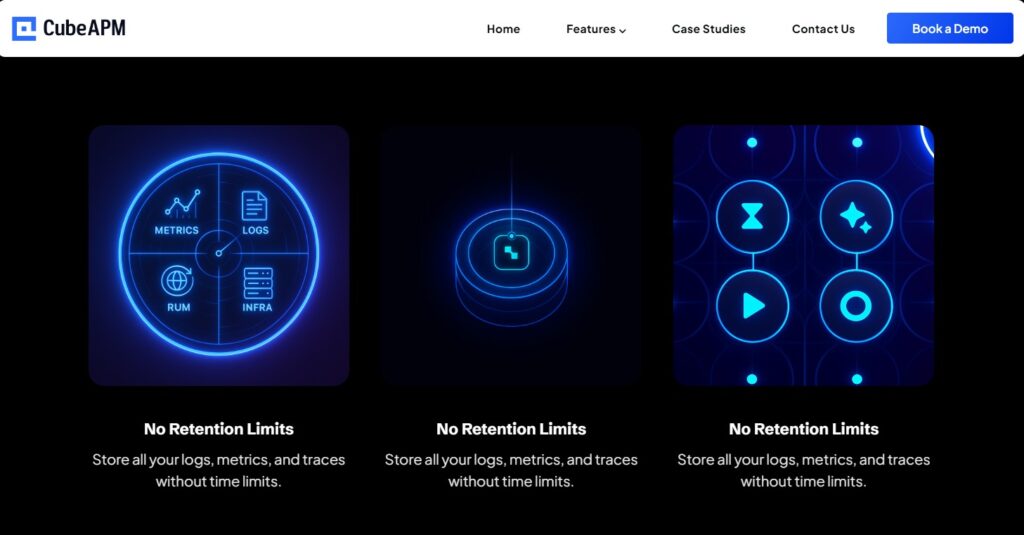
CubeAPM: CubeAPM provides full MELT coverage, meaning it collects and analyzes metrics, events, logs, and traces together in one unified platform. Because it is built around OpenTelemetry and purpose-designed to ingest all four telemetry types in a single backend, teams can correlate across signals without stitching data manually. This unified view supports deep diagnostics, service dependencies, and performance visibility across distributed systems.
Elastic Observability: Elastic Observability supports full MELT telemetry by ingesting logs, metrics, traces, and additional contextual data using the Elastic Stack. Its strength in search and analytics allows exploration of these signals in combination; logs can be correlated with traces and metrics for root-cause analysis and diagnostics. Elastic also supports OpenTelemetry ingestion, enabling standardized metric, log, and trace collection directly into the Elastic backend.
New Relic: New Relic’s platform is built around the four core telemetry types, metrics, events, logs, and traces (MELT), as foundational signals for observability. It stores and indexes all MELT data in its telemetry data platform (New Relic Database, NRDB), and users can query, visualize, and correlate these types together through dashboards and alerting. This unified approach enables deep contextual analysis across infrastructure and application performance.
Deployment
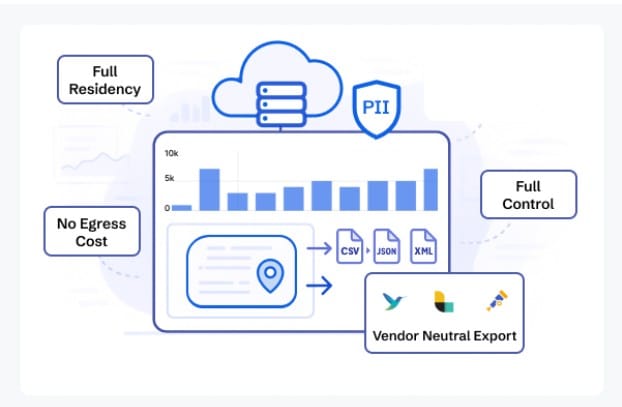
CubeAPM: CubeAPM is primarily self-hosted, meaning the observability backend runs inside your own infrastructure, whether your public cloud VPC, private cloud, or on-prem servers, while the vendor can assist with setup and management. This gives teams control over where their telemetry lives and satisfies strict data-residency or compliance requirements, without outsourcing data to a third-party managed service.
Elastic Observability: Elastic Observability offers multiple deployment options. You can run it on a fully self-managed Elastic Stack across your own servers or Kubernetes clusters, retain complete operational control, and customize every layer.
Alternatively, Elastic Cloud provides a hosted managed service, where Elastic handles scaling, upgrades, and infrastructure while you focus on telemetry and analysis. Elastic also supports hybrid deployment models like Elastic Cloud Enterprise and Elastic Cloud on Kubernetes (ECK) for flexible infrastructure choices.
New Relic: New Relic observability is delivered exclusively as a fully hosted SaaS platform, meaning all telemetry collection, storage, processing, and user interface are managed by New Relic’s cloud infrastructure. There is no self-hosted or on-prem deployment option in New Relic’s standard offering; customers ingest telemetry directly into New Relic’s platform with no deployment of backend components required.
Pricing for Small, Mid, and Large Teams
To summarize the pricing:
*All pricing comparisons are calculated using standardized Small/Medium/Large team profiles defined in our internal benchmarking sheet, based on fixed log, metrics, trace, and retention assumptions. Actual pricing may vary by usage, region, and plan structure. Please confirm current pricing with each vendor.
| Approx. cost for teams (size) | Small (~30) | Mid-Sized (~125) | Large (~250) |
| CubeAPM | $2,080 | $7,200 | $15,200 |
| New Relic | $7,896 | $25,990 | $57,970 |
| Elastic Observability | $4,550 | $17,435 | $35,370 |
CubeAPM Costs in Detail
CubeAPM: CubeAPM uses a transparent, usage-based pricing model where you pay based on the volume of data ingested. Pricing starts at about $0.15 per GB of telemetry ingested (metrics, logs, traces, etc.) with no per-host or per-user fees, and includes unified observability features like APM, logs, metrics, RUM, and synthetics.
- Small teams (~ 30): $2,080
- Mid-sized teams (~ 125): $7,200
- Large teams (~250): $15,200
New Relic Cost in Detail
New Relic: New Relic provides a free tier that includes 100 GB of data ingestion per month, after which data ingestion is priced at around $0.40 per GB under its usage-based model. Beyond the free tier, customers may also pay for user seats or compute pricing models depending on how they configure their plan, and higher tiers (Standard, Pro, Enterprise) come with features such as more quota, enhanced support SLAs, and Advanced Compute add-ons.
- Small teams: $7,896
- Mid-size teams: $25,990
- Large teams: $57,970
Elastic Observability Cost in Detail
Elastic Observability: Elastic Observability pricing depends on the deployment model you choose. For Elastic Cloud Serverless Observability, ingest pricing can be as low as ~$0.09 per GB of data ingested, with additional charges for features such as synthetic tests and managed AI. Elastic Cloud hosted offerings also have entry point pricing (for example, starting around $99 per month for basic hosted clusters), but total costs increase with data volume, storage, and compute usage. Self-managed deployments have custom pricing based on cluster size, resource allocation, and licensing.
- Small teams: $4,550
- Mid-size teams: $17,435
- Large teams: $35,370
As systems scale, observability costs often rise with higher request volume, deeper traces, and increased telemetry from microservices and OpenTelemetry instrumentation. What starts as a fixed tooling cost can quickly become a usage-driven expense shaped by ingestion rates, retention choices, and sampling behavior.
Sampling Strategy

CubeAPM: CubeAPM uses Smart Sampling that is automated and context-aware, meaning sampling decisions prioritize high-signal traces (for example, slow requests and errors) instead of relying only on fixed probabilities. CubeAPM positions this as a way to keep diagnostic value while controlling ingestion volume, especially when traffic spikes.
Elastic Observability: Elastic Observability supports both head-based and tail-based sampling in Elastic APM. Head-based sampling applies a probability-based sampling decision when a trace starts, while tail-based sampling makes the decision after the trace completes by evaluating traces against configured policies (sample rates and conditions). Elastic’s docs also note that tail-based sampling is implemented in APM Server and depends on the backend/output (for example, it is supported when writing to Elasticsearch).
New Relic: New Relic supports head-based sampling in standard distributed tracing, and tail-based sampling through its Infinite Tracing feature, where retention decisions are made after all spans in a trace arrive. New Relic also publishes guidance on using tail sampling with OpenTelemetry in New Relic workflows, which is typically used to retain traces based on outcome-driven criteria instead of purely random selection.
Data Retention
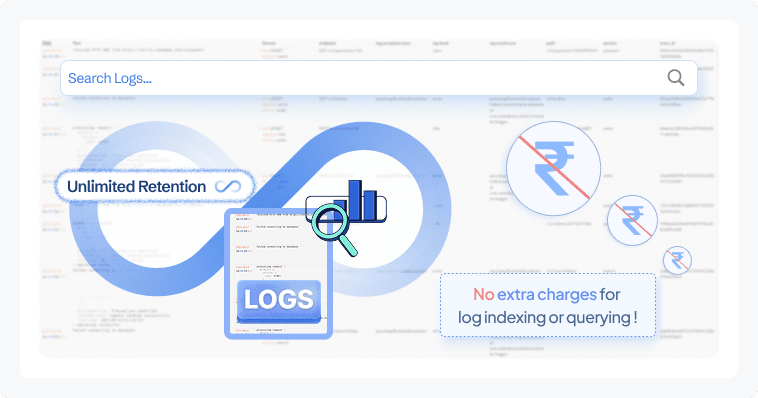
CubeAPM: CubeAPM supports unlimited data retention because all telemetry is stored in the customer’s own infrastructure (cloud VPC, private cloud, or on-prem). Retention is governed by the customer’s storage and lifecycle policies rather than platform-imposed limits, which allows long-term trend analysis, incident forensics, and compliance-driven retention without additional platform charges.
Elastic Observability: Elastic Observability applies default retention policies by data type, managed through Elasticsearch Index Lifecycle Management (ILM). Out of the box, Elastic documents the following defaults:
- Traces and APM logs: ~10 days
- Application and internal metrics: ~90 days
- RUM data: ~90 days
- Synthetic monitoring data: up to 1 year, with some assets (screenshots, network data) retained for shorter periods
These defaults can be extended or reduced by modifying ILM policies, but longer retention directly increases storage and infrastructure cost.
New Relic: New Relic enforces platform-defined retention windows that vary by data type and plan. By default, logs and events are retained for 30 days, while metrics and traces may have different limits depending on account configuration. Extended retention is available as a paid add-on or through higher-tier plans, increasing overall observability spend as data volume grows.
Support channel & TAT
CubeAPM: CubeAPM provides direct, real-time support channels that include Slack and WhatsApp, with responses typically handled by core engineers rather than a generic ticket queue. This model is designed for production troubleshooting where fast feedback during incidents matters, and response times are commonly measured in minutes rather than hours.
Elastic Observability: Elastic Observability support is tiered and ticket-driven, delivered through a web support portal and email, with phone support available on higher subscription tiers. According to Elastic’s official support matrix, initial response times range from about 30 minutes for critical issues on premium tiers to 1–2 business days on standard plans, depending on severity and subscription level.
New Relic: New Relic offers ticket-based support supplemented by extensive documentation and community forums. Official documentation states that standard plans typically see response times of up to 2 business days, while higher-tier or priority support plans can reduce response times to hours or around 1 hour for critical issues. Access to faster SLAs depends on the customer’s subscription and support add-ons.
How Teams Evaluate These Platforms at Scale
As observability usage matures, teams stop evaluating tools purely on features and start assessing how platforms behave under sustained load, organizational constraints, and real operational pressure. At scale, the evaluation process becomes cross-functional and outcome-driven rather than tool-driven.
Who is involved in the decision
Observability decisions at scale are rarely owned by a single team. Platform and application engineers evaluate instrumentation depth, signal quality, and impact on incident response. Finance teams look at how costs scale with ingestion, retention, and usage variability. Security and compliance teams assess data residency, access controls, auditability, and long-term governance. The final decision typically reflects a balance between technical visibility, cost predictability, and risk management.
What questions block decisions
Teams often get stuck on questions that only surface after initial adoption. How does pricing behave during traffic spikes or incidents. What data is dropped first when limits are reached. How difficult is it to retain high-cardinality or long-lived traces. Can telemetry be stored in-region or on-prem if compliance requirements change. These questions are harder to answer from marketing pages and usually require deeper architectural understanding.
Why comparisons alone aren’t enough
Feature comparison tables help narrow options, but they rarely capture how observability systems behave over time. Real differentiation appears in operational workflows such as incident analysis, cost control during outages, and long-term data retention for audits or trend analysis. As a result, teams increasingly evaluate platforms through proofs of concept, production pilots, and cost modeling exercises rather than static comparisons.
Elastic Observability vs New Relic vs CubeAPM: Use Cases
The following use cases reflect how teams typically choose between these platforms in real environments, based on deployment constraints, scale, and operational goals rather than feature checklists.
Choose CubeAPM if:
CubeAPM is a strong fit for teams that want full-stack observability with ownership, predictable costs, and minimal operational friction at scale.
- You need a self-hosted observability platform for strict data residency, compliance, or security requirements, where telemetry must stay inside your VPC, private cloud, or on-prem environment.
- You want predictable, ingestion-based pricing as telemetry volume grows, without per-user or per-host licenses (based on demo data and sales data).
- You are adopting OpenTelemetry and want a native backend that supports high-cardinality data and end-to-end tracing across microservices without re-instrumentation.
- You operate Java-heavy systems (Spring Boot, JVM microservices, distributed backends) and need deep transaction tracing, JVM performance visibility, and fast root-cause analysis across services.
- You want to reduce MTTR during incidents by retaining high-signal traces (errors, latency spikes) using automated, context-aware sampling rather than fixed sample rates.
- You need unlimited or long-term data retention for audits, trend analysis, or forensic debugging, without platform-imposed retention limits.
- You are a startup or growing SaaS team that wants lightweight, easy-to-deploy APM early, but does not want to replatform observability later as scale and costs increase.
Choose Elastic Observability if:
Elastic Observability works best for teams that prioritize search-driven investigation and already operate or plan to operate the Elastic Stack.
- You rely heavily on log analytics and search as the primary entry point for debugging and root-cause analysis.
- You already use Elasticsearch for logs, security, or analytics and want observability tightly integrated into the same stack.
- You are comfortable managing Elastic infrastructure yourself or using Elastic Cloud, and can tune storage, ILM policies, and cluster performance over time.
- You need flexibility in how telemetry is indexed, queried, and retained, even if it requires more operational overhead.
- You want the option to run observability in both SaaS and self-managed modes depending on workload or environment (based on Elastic’s deployment options).
Choose New Relic if:
New Relic is a good fit for teams that want fast time-to-value with minimal infrastructure ownership.
- You prefer a fully managed SaaS observability platform with no backend infrastructure to operate.
- You want quick onboarding with automatic instrumentation, prebuilt dashboards, and service maps across applications and infrastructure.
- You operate moderate telemetry volumes and are comfortable with usage-based pricing and platform-defined retention limits.
- You value advanced analytics, UI polish, and out-of-the-box integrations over deployment flexibility.
- You are an engineering-led organization without strong requirements around self-hosting, data residency, or long-term raw data retention.
Conclusion
Elastic Observability and New Relic both deliver strong observability capabilities, but teams often encounter trade-offs as systems scale. Elastic can introduce operational overhead and tuning complexity, while New Relic’s SaaS-only model can surface cost, retention, and data residency constraints over time.
CubeAPM offers a self-hosted, OpenTelemetry-native platform that delivers unified MELT observability, predictable ingestion-based pricing, smart sampling, and unlimited data retention. It is designed to reduce MTTR while giving teams control over data and long-term costs.
For teams evaluating observability at scale, CubeAPM offers a balanced alternative worth exploring. Try a demo to see how it fits your environment.
Disclaimer: The information in this article reflects the latest details available at the time of publication and may change as technologies and products evolve.
FAQs
1. Can Elastic Observability, New Relic, and CubeAPM be used together during a migration?
Yes. Teams often run tools side by side during phased migrations. OpenTelemetry support across all three platforms allows parallel instrumentation while traffic or services are gradually moved, reducing migration risk.
2. How do these platforms handle high-cardinality data differently?
Elastic Observability can ingest high-cardinality data but requires careful index and storage tuning. New Relic supports high-cardinality attributes within platform limits. CubeAPM is designed to handle high-cardinality OpenTelemetry data with predictable ingestion costs and smart sampling to control volume.
3. Which platform is better suited for long-term performance trend analysis?
Long-term analysis depends on retention. Elastic and New Relic typically require paid extensions or storage tuning for longer retention, while CubeAPM supports long-term analysis more easily since retention is governed by customer-controlled storage and policies.
4. How much operational effort is required after initial setup?
Elastic Observability usually requires ongoing operational effort for cluster management and ILM tuning. New Relic minimizes operational work due to its SaaS model. CubeAPM sits between the two, offering self-hosted control with vendor-managed setup and lower day-to-day overhead.
5. How do these tools impact observability costs during incidents?
During incidents, Elastic and New Relic costs can rise with increased ingestion unless limits or sampling are adjusted. CubeAPM is designed to keep costs more predictable by using context-aware sampling and simple, usage-based pricing that prioritizes high-signal data.