






The main difference between Dynatrace, Grafana, and CubeAPM is that Dynatrace is an AI-driven full-stack observability platform built around automatic instrumentation and topology intelligence, Grafana is a modular observability ecosystem centered on open-source components and flexible dashboards, and CubeAPM is an OpenTelemetry-native observability backend designed for unified signal control and predictable ingestion-based pricing.
Teams notice the real differences between observability tools as systems scale. Kubernetes growth, autoscaling, and deeper tracing expose how pricing models, sampling strategies, and retention policies behave under sustained load. At that stage, evaluation shifts from feature comparison to cost behavior. Observability becomes a structural budget line, and predictability at scale becomes the deciding factor.
In this guide, we compare Dynatrace vs Grafana vs CubeAPM across architecture, OpenTelemetry alignment, and cost behavior at scale to help you choose the platform that fits your infrastructure and long-term growth.
Dynatrace vs Grafana vs CubeAPM: Comparison Table
The comparisons below reflect behavior observed from public documentation and common production usage patterns. Pricing, sampling, and retention characteristics can change depending on workload size, data shape, and operational configuration.
| Features | CubeAPM | Dynatrace | Grafana |
| Known for | Unified, OpenTelemetry-native observability with predictable cost and full data control | AI-driven full-stack observability with automatic discovery and Smartscape topology | Modular observability ecosystem with powerful dashboards |
| Multi-Agent Support | Yes (OTel, New Relic, Datadog, Elastic) | Limited (OpenTelemetry,OneAgent SDK) | Yes (Prometheus, OTEL collectors, Loki, Tempo, and multiple third-party data sources) |
| MELT Support | Full MELT | Full MELT | Full MELT |
| Setup | Self-hosted but vendor-managed | SaaS & Self-hosted | SaaS & Self-hosted |
| Pricing | Ingestion-based pricing of $0.15/GB | Infra: $29 /mo per host* Full-Stack: $58/mo/ 8 GiB host* | Pro: $19/month + usage Logs: $0.50/GB Traces:$0.50/GB Metrics: $6.50/1k series |
| Sampling Strategy | Smart sampling (95% compression) | Head + Tail + adaptive traffic management | Tail + Head-based + probabilistic sampling |
| Log Retention | Infinite Retention | 35 days | Free: 14 days Pro: 30 days Enterprise: Custom |
| Support TAT | < 10 minutes | 30 minutes to 4 days | 30 minutes to 6 hours |
Dynatrace vs Grafana vs CubeAPM: Feature-by-Feature Breakdown
Known For
CubeAPM: known for its OpenTelemetry-native architecture and centralized signal control. Instead of relying on proprietary agents, it ingests standardized telemetry across metrics, logs, and traces into a unified backend built on OpenTelemetry semantics. The platform emphasizes predictable ingestion-based pricing, centralized smart sampling, and consistent cross-signal correlation, particularly in Kubernetes-heavy and multi-cloud environments where cost governance becomes critical.
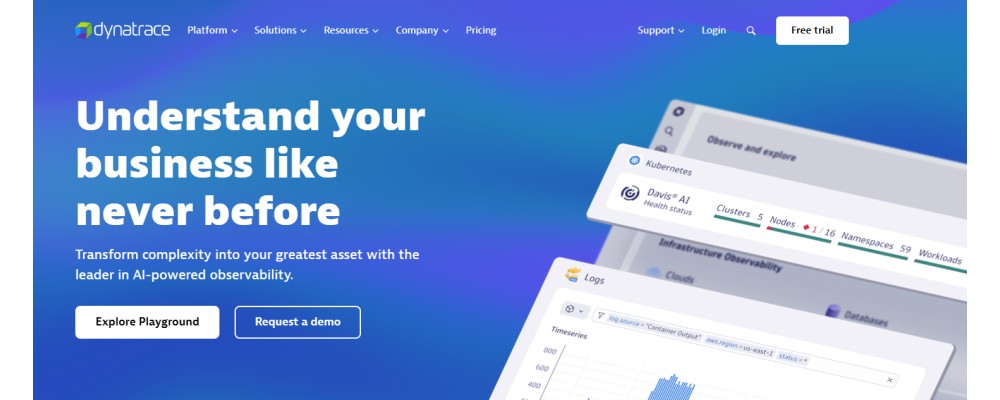
Dynatrace: Known for AI-driven full-stack observability and automatic topology discovery. Its OneAgent automatically instructs applications, containers, infrastructure, and services, building a continuously updated dependency map. The platform’s strength lies in automated root cause analysis, anomaly detection, and enterprise-scale visibility with minimal manual configuration.
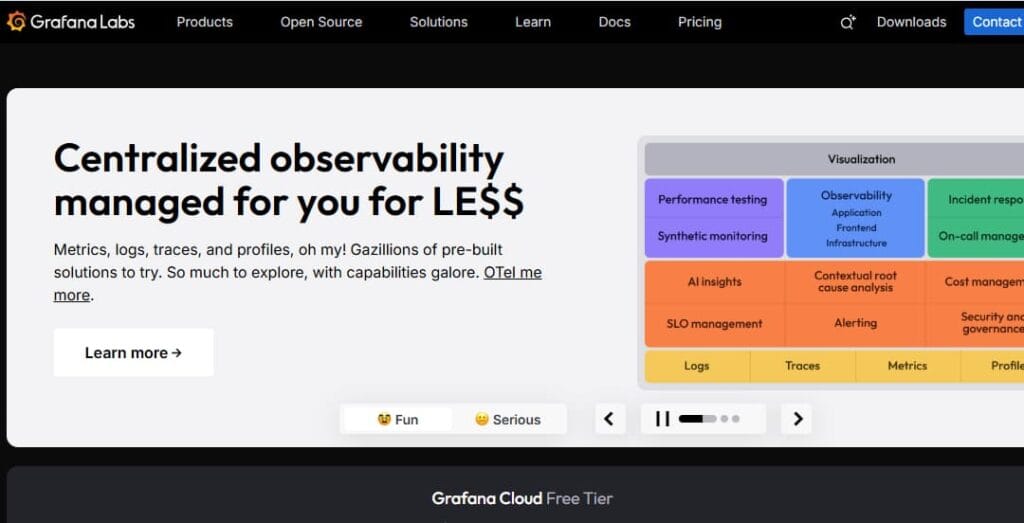
Grafana: Known for its modular observability ecosystem and powerful dashboarding capabilities. Rather than a single monolithic backend, it provides a composable stack built around Prometheus for metrics, Loki for logs, Tempo for traces, and Mimir for scalable metrics storage. This flexibility appeals to teams that prefer architectural control and open standards over tightly coupled platforms.
Multi-Agent Support
CubeAPM: Supports OpenTelemetry collectors and SDKs natively and can ingest telemetry from Prometheus as well as existing vendor agents such as Datadog, New Relic, and Elastic. This allows teams to migrate incrementally without re-instrumenting services or running parallel observability stacks during transition. It supports mixed environments where multiple telemetry standards and agents coexist across teams or business units.
Dynatrace: Uses OneAgent as its primary instrumentation mechanism for automatic discovery and full-stack monitoring. In addition, Dynatrace supports OpenTelemetry-based ingestion via OTLP endpoints and OpenTelemetry Collectors. It also supports Prometheus metric ingestion through remote write and scraping integrations, allowing metrics generated outside OneAgent to be ingested into the Dynatrace platform.
Grafana: Ingests telemetry through Prometheus exporters, OpenTelemetry collectors, and Grafana Agent depending on deployment model. Grafana Cloud and self-managed stacks support OpenTelemetry-native ingestion for metrics, logs, and traces. Multi-agent setups are common, particularly in environments combining Prometheus exporters, OTel collectors, and custom instrumentation pipelines.
MELT Coverage & Signal Correlation
CubeAPM: Provides unified support for metrics, events, logs, and traces within a single OpenTelemetry-native backend. All signals share consistent resource attributes and trace context, enabling direct navigation from a metric anomaly to correlated logs and distributed traces. Because telemetry is processed under a consistent data model, cross-signal investigation does not require stitching across separate storage systems or indexing layers.
Dynatrace: Delivers full MELT coverage through its unified observability platform. Metrics, logs, traces, and events are automatically correlated through its topology model, which continuously maps service dependencies and infrastructure relationships. Signal correlation is enriched by automatic discovery, allowing navigation between infrastructure, services, and distributed traces without manual context propagation.
Grafana: Supports full MELT through its ecosystem components, typically Prometheus or Mimir for metrics, Loki for logs, and Tempo for traces, all explored through Grafana dashboards. Signal correlation is enabled through shared metadata and context such as labels and trace IDs, and teams can standardize this via OpenTelemetry collectors and consistent instrumentation conventions.
Deployment Model

CubeAPM: Runs self-hosted within the customer’s environment while remaining vendor-managed. Infrastructure, storage, and data residency stay under customer control. Platform updates, maintenance, and operational management are handled by the vendor, reducing backend operational burden while preserving ownership of telemetry data.
Dynatrace: Available as both SaaS and self-hosted (Dynatrace Managed). In the SaaS model, Dynatrace operates and maintains the observability backend in its own cloud environment. With Dynatrace Managed, the platform is deployed within customer-controlled infrastructure, allowing organizations to manage data residency and meet regulatory or compliance requirements while running the Dynatrace cluster themselves.
Grafana: Offers both SaaS and self-hosted deployment options. Grafana Cloud provides a fully managed service where ingestion, storage, scaling, and backend operations are handled by Grafana Labs. In self-hosted deployments using open-source or enterprise editions, teams operate and maintain components such as Prometheus, Loki, Tempo, and storage backends. This provides full architectural control, but operational responsibilities such as scaling, upgrades, storage tuning, and reliability remain with the user.
Pricing: Approximate Cost for Small, Mid-Sized & Large Teams
*All pricing comparisons are calculated using standardized Small/Medium/Large team profiles defined in our internal benchmarking sheet, based on fixed log, metrics, trace, and retention assumptions. Actual pricing may vary by usage, region, and plan structure. Please confirm current pricing with each vendor.
*An APM host is a host that is actively generating trace data, and an Infra host is any physical or virtual OS instance that you monitor with any observability tool.
Below is a cost comparison for small, mid-sized, and large teams.
| Approx. Cost for Teams | Small (~30 APM Hosts) | Mid-sized (~125 APM Hosts) | Large (~250 APM Hosts) |
| CubeAPM | $2,080 | $7,200 | $15,200 |
| Dynatrace | $7,740 | $21,850 | $46,000 |
| Grafana | $3,870 | $11,875 | $26,750 |
What This Comparison Reveals at Scale
At small scale, differences between platforms may not immediately influence decision-making. Infrastructure footprints are limited, telemetry volume is manageable, and observability is often focused on core services. At this stage, feature depth and ecosystem familiarity tend to carry more weight than pricing architecture.
As environments grow, pricing models begin to shape long-term sustainability. Increased service count, broader log retention, deeper trace coverage, and Kubernetes expansion introduce compounding effects. The way a platform measures consumption, whether by host capacity or telemetry ingestion, becomes more important than individual features.
At large scale, cost behavior becomes a defining factor. Autoscaling, multi-cluster deployments, and distributed tracing depth can amplify how licensing models respond to growth. Observability shifts from a tooling decision to a financial strategy, where predictability, cost control, and alignment with infrastructure growth determine long-term viability.
CubeAPM: Cost for Small, Medium, and Large Teams
CubeAPM uses an ingestion-based pricing model, meaning observability spend scales with the volume of telemetry processed rather than the number of hosts, users, or feature tiers enabled. This structure becomes especially relevant in Kubernetes and autoscaling environments where host counts fluctuate.
Pricing model:
- $0.15 per GB of telemetry ingested
Based on standardized workload assumptions across comparable production environments, estimated monthly costs typically align with the following profiles:
- Small teams (~30 APM hosts): ~ $2,080
- Mid-sized teams (~125 APM hosts): ~ $7,200
- Large teams (~250 APM hosts): ~ $15,200
As environments expand, spend is primarily influenced by telemetry design choices such as log verbosity, trace sampling configuration, and retention policies. Because cost is tied to ingestion rather than host multiplication, forecasting remains more stable as clusters scale horizontally and traffic increases.
Dynatrace: Cost for Small, Medium, and Large Teams
Dynatrace primarily follows a host-based licensing model, where cost scales with monitored infrastructure capacity. Pricing is tied to host size and monitoring depth, with separate charges for logs and additional capabilities.
Pricing:
- Infrastructure Monitoring: $29 per host per month
- Full-Stack Monitoring: $58 per 8 GiB host per month
Using standardized workload assumptions across comparable production environments, estimated monthly costs typically align with the following profiles:
- Small teams (~30 APM hosts): ~ $7,740
- Mid-sized teams (~125 APM hosts): ~ $21,850
- Large teams (~250 APM hosts): ~ $46,000
As environments scale, spend increases with both infrastructure expansion and telemetry depth. Kubernetes growth, autoscaling, and multi-environment duplication directly influence costs due to host-based measurement.
For a live breakdown of how Dynatrace pricing scales based on your infrastructure, telemetry volume, and log usage, explore our detailed Dynatrace pricing calculator to model real-world costs.
Grafana: Cost for Small, Medium, and Large Teams
Grafana pricing depends on deployment model. In Grafana Cloud, pricing is ingestion-based and usage-based across different telemetry types, including metrics, logs, and traces. Costs scale with ingestion volume, metric series count, and storage requirements.
Pricing:
- Pro Plan: $19 per month + usage
- Logs: $0.50 per GB
- Traces: $0.50 per GB
- Metrics: $6.50 per 1k series
Using standardized workload assumptions across comparable production environments, estimated monthly costs typically align with the following profiles:
- Small teams (~30 APM hosts): ~ $3,870
- Mid-sized teams (~125 APM hosts): ~ $11,875
- Large teams (~250 APM hosts): ~ $26,750
As telemetry cardinality and trace depth increase, ingestion-based and usage-based components become the primary cost drivers. Metric series growth, log verbosity, and trace volume significantly influence total spend, particularly in Kubernetes and microservices environments.
Sampling Strategy
CubeAPM: Uses smart sampling, a real-time, context-aware approach that prioritizes high-value traces instead of collecting everything indiscriminately. Sampling decisions can consider latency spikes, rising error rates, anomalies, and service context to retain the traces that matter most during incidents. This reduces noise and controls ingestion volume while preserving visibility into critical transactions.
Dynatrace: Supports both head-based and tail-based sampling through OpenTelemetry Collector configurations. It also provides Adaptive Traffic Management, which dynamically adjusts trace capture rates based on traffic conditions and system load. This helps balance trace coverage and ingestion volume in high-throughput environments while maintaining representative visibility across services.
Grafana: Sampling in Grafana tracing setups is typically configured via OpenTelemetry Collectors and Tempo. It supports tail-based sampling through Tempo pipelines and probabilistic head-based sampling using OpenTelemetry processors. Sampling rules are defined within the collector configuration, allowing teams to tailor trace retention based on latency, error attributes, or percentage-based strategies.
Data Retention

CubeAPM: Offers unlimited retention for metrics, logs, and traces, with centrally configurable policies. Organizations can retain telemetry for as long as operational, investigative, or compliance requirements demand, without being constrained by signal-specific expiration tiers. This is significant for teams that rely on long-term trend analysis, forensic investigations, seasonal traffic comparisons, or regulatory audits. Because retention is not tied to predefined time windows, data governance decisions can be aligned with business and compliance needs rather than platform-imposed limits.
Dynatrace: Provides defined retention windows that vary by signal type and licensing tier. Trace data is typically retained for up to 10 days under standard configurations, logs are commonly retained for around 35 days, and metrics retention can extend up to 15 months depending on aggregation level and plan. Retention behavior depends on deployment model and subscription level, and extended retention may require higher-tier configurations. This tiered model allows flexibility but operates within predefined signal limits.
Grafana: Retention in Grafana Cloud depends on plan level. In the Free tier, metrics, logs, traces, profiles, and k6 test data are retained for 14 days. In the Pro tier, metrics retention extends to 13 months, while logs and traces are retained for 30 days. Enterprise plans provide custom retention options. In self-managed deployments, retention is entirely determined by storage configuration and infrastructure capacity, meaning teams control how long data is stored but must manage storage scaling, performance, and cost implications accordingly.
Support & Response Time
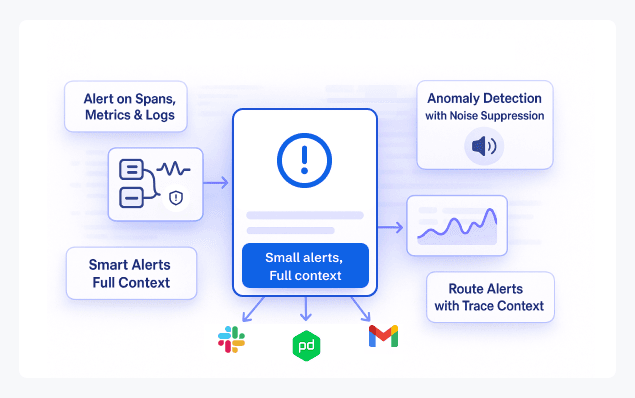
CubeAPM: Support is delivered through Slack and email with engineering-led assistance, and response times are consistently under 10 minutes. During production incidents, fast access to technical expertise reduces time spent escalating tickets and accelerates investigation. Rapid response is particularly important when latency spikes, outages, or data ingestion issues require immediate attention, helping engineers move from detection to resolution without waiting on tiered escalation processes.
Dynatrace: Support response times depend on support tier and incident severity. Under Standard Support, a critical issue has an initial response target of 4 business hours, while lower-severity cases range from next business day to up to 4 business days. Under Enterprise Support, critical incidents are targeted at 30 minutes, with high, medium, and low severity cases ranging from 4 hours to 2 business days. SLA-backed response structures provide defined expectations, which can be important for enterprise environments managing contractual uptime commitments.
Grafana: Support levels vary by plan. The Free tier relies on community support without SLA-backed response times, and this is the same case for Pro Plan. SLA-based initial response times are defined by priority. Under Advanced Plan, P1 (application down) issues have an initial response target of 2 business hours, P2 (serious degradation) 4 business hours, and P3 (moderate impact) 6 business hours. Premium plan may offer faster response targets, such as 30 minutes for P1, 1 hour for P2, and 4 business hours for P3, with custom SLAs available in certain cases. Technical support coverage varies by plan, with higher tiers offering 24/7 support availability.
How Teams Evaluate These Platforms at Scale
As observability programs mature, the evaluation shifts from feature depth to financial impact. What works well for a small team can behave very differently when clusters expand, telemetry volume increases, and retention windows extend. At scale, the question is no longer “Does it have the feature?” but “How does this behave when our bill triples?”
Kubernetes growth, autoscaling, and distributed tracing depth introduce compounding cost effects. Host-based models expand with infrastructure count. Usage-based models expand with ingestion volume and metric cardinality. Long retention windows increase storage pressure. High-cardinality metrics and verbose logging can quietly inflate spend. Bills become less predictable if pricing is tied to infrastructure churn rather than controlled telemetry design.
Support responsiveness also becomes operationally significant. During production-impacting incidents, response time from the vendor can directly influence mean time to resolution. Similarly, retention policies, sampling models, and ingestion controls determine whether engineers have the right data available when investigating complex failures.
For leadership teams, observability becomes a structural budget line. The focus turns to cost predictability, ingestion control, sampling efficiency, and how tightly pricing aligns with actual system activity. At scale, cost architecture matters as much as technical capability.
Dynatrace vs Grafana vs CubeAPM: Use Cases
Choose CubeAPM if:
- You want ingestion-based pricing that scales with telemetry volume rather than host count
- You are standardizing on OpenTelemetry across services
- You need centralized Smart Sampling to control trace volume
- You require unlimited data retention for compliance or long-term analysis
- You operate Kubernetes-heavy or autoscaling environments where infrastructure churn is high
- You prefer self-hosted control with vendor-managed operations
Choose Dynatrace if:
- You want automatic full-stack instrumentation via OneAgent
- You value AI-driven root cause analysis and topology mapping
- You manage large enterprise environments with complex dependencies
- You want deep Kubernetes visibility with automatic service discovery
Choose Grafana if:
- You prefer a modular ecosystem built around Prometheus, Loki, and Tempo
- You want flexible dashboards and visualization control
- You want usage-based and ingestion-based pricing across metrics, logs, and traces
- You need customizable retention and storage configuration based on plan or infrastructure
Conclusion
Dynatrace, Grafana, and CubeAPM represent three distinct approaches to modern observability.
Dynatrace emphasizes automated discovery, AI-driven analysis, and enterprise-scale visibility through its integrated platform. Grafana offers a modular ecosystem built around Prometheus, Loki, and Tempo, giving teams architectural flexibility and strong visualization capabilities. CubeAPM centers on OpenTelemetry-native ingestion, centralized sampling control, and predictable ingestion-based pricing aligned with Kubernetes and autoscaling environments.
At small scale, feature differences may appear incremental. At production scale, pricing behavior, retention limits, sampling efficiency, and operational overhead become decisive. The right choice depends not just on capability, but on how predictably the platform scales alongside your infrastructure, telemetry volume, and long-term budget.
Disclaimer: The information in this article reflects the latest details available at the time of publication and may change as technologies and products evolve.
FAQs
1. What is the main difference between Dynatrace, Grafana, and CubeAPM?
The primary difference lies in architecture and pricing model. Dynatrace is an AI-driven full-stack platform centered around automatic instrumentation and topology mapping. Grafana is a modular observability ecosystem built around Prometheus, Loki, and Tempo. CubeAPM is an OpenTelemetry-native backend designed for unified signal control and ingestion-based pricing.
2. Which platform is more cost-effective at scale?
Cost effectiveness depends on how pricing scales with infrastructure and telemetry growth. Dynatrace generally follows a host-based licensing model, which increases as infrastructure expands. Grafana Cloud pricing scales with usage across metrics, logs, and traces. CubeAPM uses ingestion-based pricing tied directly to telemetry volume, which can provide more predictable cost behavior in Kubernetes and autoscaling environments where host counts fluctuate frequently.
3. Do Dynatrace, Grafana, and CubeAPM all support OpenTelemetry?
Yes. Dynatrace supports OpenTelemetry ingestion alongside its OneAgent. Grafana integrates with OpenTelemetry through collectors and Tempo. CubeAPM is built around OpenTelemetry semantics as its native ingestion model across metrics, logs, and traces.
4. Which tool is better for Kubernetes environments?
All three support Kubernetes, but their approaches differ. Dynatrace provides automatic discovery and dependency mapping. Grafana relies on Prometheus and related components for cluster visibility. CubeAPM ingests Kubernetes telemetry through OpenTelemetry collectors and maintains consistent cross-signal correlation, particularly in autoscaling environments.
5. How do retention limits differ between Dynatrace, Grafana, and CubeAPM?
Dynatrace and Grafana apply retention limits based on signal type and plan tier. For example, traces and logs may have shorter default retention windows compared to metrics. CubeAPM offers unlimited retention with configurable policies, allowing organizations to retain telemetry data based on compliance or operational needs rather than predefined limits.