






The main difference between Datadog, Sumo Logic, and CubeAPM is that CubeAPM delivers full-stack OpenTelemetry-native observability with predictable pricing and unlimited retention, while Datadog and Sumo Logic follow costly, usage-based SaaS models with multiple feature add-ons.
According to the CNCF Ecosystem Gaps Survey 2024, cost management and observability rank among the top pain points for cloud-native teams. To solve this, CubeAPM offers an affordable and modern observability solution built for businesses, saving up to 50% of costs.
In this detailed Datadog vs Sumo Logic vs CubeAPM comparison, we’ll break down key differences to help you choose the best observability platform for your stack.
Datadog vs Sumo Logic vs CubeAPM Comparison
| Feature | CubeAPM | Datadog | Sumo Logic |
| Known for | Unified MELT, self-hosting, OpenTelemetry-native, cost predictability | Large enterprise SaaS ecosystem with 900+ integrations | Cloud-native log and security analytics, strong correlation, and threat insights |
| Multi-Agent Support | Yes (OTel, New Relic, Datadog, Elastic, etc.) | Yes (proprietary Datadog Agent, third-party agents) | Yes (native collectors; OTEL) |
| MELT Support (Metrics, Events, Logs, Traces) | Full MELT coverage | Full MELT coverage | Full MELT |
| Deployment (Self-Host / Setup) | Self-hosted with vendor-managed | SaaS-only; no self-hosting | SaaS-only |
| Pricing | Ingestion-based pricing of $0.15/GB | APM: $31/host/ month; Infra: $15 /host/month; Logs: $0.10/GB | Starts $3.14–$3.77 per TB scanned (based on location) |
| Sampling Strategy | Smart sampling – fully automated, context-aware | Head-based, tail-based, and adaptive sampling | Tail-based, probabilistic, and pattern-based sampling |
| Data Retention | Unlimited Retention (no extra cost) | 15-30 days based on the plan | 7 days (free plan); 365 days (Enterprise) |
| Support Channel & TAT & Pricing | Slack, WhatsApp; response in minutes | Community-based; email & chat (paid plan) with TAT: <2 hrs. To 48 hrs; premium support costs extra | Standard (8×5) support for Essentials; (P1 24×7) support for Enterprise; Premium support at extra cost |
Datadog vs Sumo Logic vs CubeAPM: Feature-by-Feature Breakdown
Known For
CubeAPM: Known for its OpenTelemetry-native design, predictable ingestion-based pricing ($0.15/GB), and self-hosting flexibility. It delivers unified MELT observability across metrics, logs, events, and traces with unlimited retention, making it a preferred choice for teams prioritizing data control, compliance, and cost transparency.
Datadog: Known for its comprehensive SaaS ecosystem with over 900+ integrations and a wide range of monitoring modules. Datadog provides strong cloud and container visibility. It remains popular among large enterprises seeking a centralized, managed observability suite.
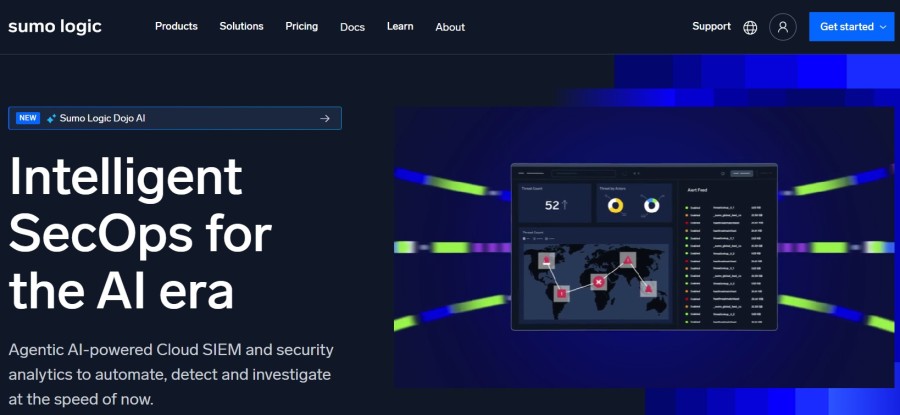
Sumo Logic: Known for its cloud-native log analytics and SIEM platform, offering strong log correlation, machine-data insights, and advanced security monitoring. It integrates seamlessly with cloud providers and OpenTelemetry pipelines, making it suitable for organizations focused on centralized log intelligence and compliance-driven observability.
Multi-Agent Support
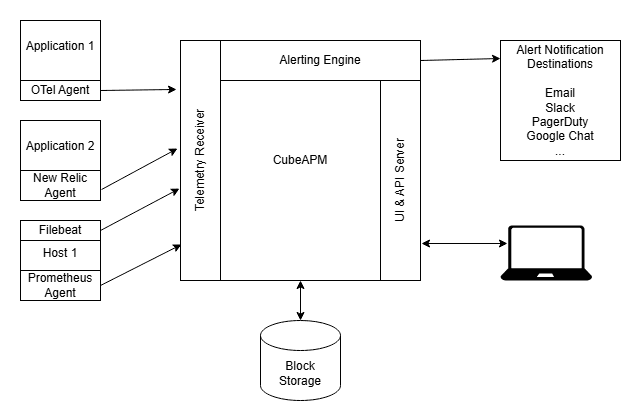
CubeAPM: CubeAPM is designed for multi-agent interoperability from the ground up, allowing teams to ingest data from OpenTelemetry, Prometheus, Elastic, Datadog, New Relic, and other exporters without rewriting pipelines. Its ingestion layer automatically normalizes telemetry into a unified schema, ensuring full correlation across logs, traces, and metrics from different agents. This architecture enables mixed-agent environments, where one team uses OTel, and another uses Prometheus to stream seamlessly into a single backend.
Datadog: Datadog’s observability stack is built around its own Datadog Agent, which handles log, metric, and trace collection through deeply integrated plugins. It also supports third-party agents and OpenTelemetry collectors.
Sumo Logic: Sumo Logic offers a collector-based architecture rather than a single universal agent. It ships with three primary options: the Sumo Logic Distribution for OpenTelemetry Collector (fully OTLP-compatible for logs, metrics, and traces), the Installed Collector for on-prem and container data, and Hosted Collectors for ingesting from AWS, GCP, and Azure services. Together, they provide broad collection coverage.
MELT Support
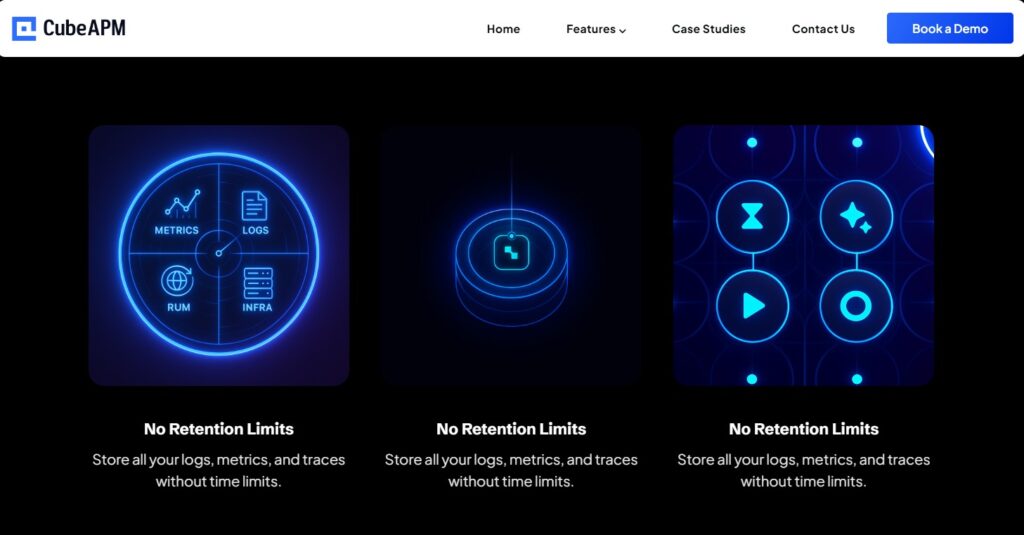
CubeAPM: CubeAPM offers complete MELT observability, covering Metrics, Events, Logs, and Traces within a unified ingestion pipeline. It provides real-time correlation across all four telemetry types, enabling users to jump from metrics to traces or logs in a single click. Events are captured automatically from alert rules, deployments, and infrastructure changes, giving full context during incident analysis.
Datadog: Datadog delivers full MELT coverage through separate modules for APM, Infrastructure Monitoring, Logs, and Events. Each telemetry signal is collected via the Datadog Agent and correlated through the platform’s unified observability workspace. While this ensures deep visibility across services, each module is priced independently.
Sumo Logic: Sumo Logic provides full MELT coverage through its native support for metrics, logs, traces, and events using the Sumo Logic Distribution for OpenTelemetry Collector. Metrics and traces are ingested via OTLP, while logs and events are handled through collectors and cloud integrations. The platform automatically correlates telemetry signals, allowing users to visualize logs, metrics, and trace data together for unified troubleshooting.
Deployment (Setup & Hosting Model)

CubeAPM: CubeAPM offers self-hosting via Bring-Your-Own-Cloud (BYOC) or on-premise deployment for customers. Teams can deploy CubeAPM inside their own infrastructure for data residency and compliance needs or opt for a vendor-managed cloud setup for faster onboarding. The platform’s lightweight architecture enables full installation and configuration within minutes, giving DevOps teams control over data flow, retention, and cost management.
Datadog: Datadog follows a SaaS-only deployment model, where all telemetry is collected through the Datadog Agent and processed within Datadog’s managed backend. Users access observability features entirely through the Datadog Cloud interface. But it doesn’t offer on-prem or self-managed deployments.
Sumo Logic: Sumo Logic operates on a SaaS-only architecture with deployment through hosted and installed collectors. The Hosted Collector ingests data directly from cloud services (AWS, Azure, GCP), while the Installed Collector is deployed on servers, containers, or Kubernetes clusters to send local telemetry to Sumo’s cloud. But it doesn’t support self-hosting.
Pricing for Small, Medium, & Large Teams
To summarize:
*All pricing comparisons are calculated using standardized Small/Medium/Large team profiles defined in our internal benchmarking sheet, based on fixed log, metrics, trace, and retention assumptions. Actual pricing may vary by usage, region, and plan structure. Please confirm current pricing with each vendor.
| Approx. Cost for Teams | Small (~30) | Mid-Sized (~125) | Large (~250) |
| CubeAPM | $2,080 | $7,200 | $15,200 |
| Datadog | $8,185 | $27,475 | $59,050 |
| Sumo Logic | $4,641 | $16,065 | $33,915 |
CubeAPM Costs: Detailed Calculation
CubeAPM: It follows a simple ingestion-based pricing model of $0.15/GB, covering metrics, logs, traces, and events without extra fees for hosts, users, or feature add-ons. This predictable structure eliminates the complexity of multi-module billing. Whether self-hosted or managed, the cost scales linearly with data volume, giving teams full control over usage and spend. Its smart sampling further reduces total telemetry costs by retaining only high-value data, helping companies cut overall observability expenses by up to 50% compared to host-based models.
- Small teams (~ 30): $2,080
- Mid-sized teams (~ 125): $7,200
- Large teams (~250): $15,200
Datadog Costs: Detailed Calculation
Datadog: Datadog’s pricing is modular and host-based, with APM at $31/host/month, infrastructure monitoring at $15/host/month, and logs at $0.10/GB for indexed data. Additional features, such as RUM, synthetic monitoring, and error tracking, add to the total cost, making Datadog better suited for enterprises with large budgets and static infrastructure footprints.
- Small teams: $8,185
- Mid-size teams: $27,475
- Large teams: $59,050
Sumo Logic Costs: Detailed Calculation
Sumo Logic: Sumo Logic uses a scan-based pricing model: $3.14-$3.77 per TB scanned, depending on data center location. Instead of paying for ingestion, customers are billed based on the data scanned during analytics queries. This model offers flexibility for teams that query logs occasionally, but it may confuse users.
- Small teams: $4,641
- Mid-size teams: $16,065
- Large teams: $33,915
Sampling Strategy

CubeAPM: CubeAPM uses a smart, context-aware sampling strategy that dynamically prioritizes traces based on latency, error rate, and transaction type. It retains critical spans while compressing redundant data, achieving up to 95% data compression without losing diagnostic accuracy. This approach drastically reduces observability costs while maintaining end-to-end trace integrity.
Datadog: Datadog supports head-based, tail-based, and probabilistic sampling. It also offers adaptive controls such as rate limits, error sampling, and rare-trace sampling.
Sumo Logic: Sumo Logic supports probabilistic and tail-based sampling. The probabilistic model randomly samples complete traces to manage ingestion volume, while tail-based filtering retains slow or error-heavy traces for deeper investigation. This gives users a flexible balance between cost efficiency and visibility without requiring complex manual setup. It also supports pattern-based filtering.
Data Retention

CubeAPM: CubeAPM provides unlimited log retention at no additional cost. Since it follows an ingestion-based pricing model, users are not charged extra for retaining or re-indexing older data. Organizations can store logs for as long as required, which is particularly useful for industries with strict compliance or audit requirements. Retention policies are fully configurable, even in self-hosted or BYOC deployments, ensuring data governance remains within the organization’s control.
Datadog: Datadog retains different data types for different durations based on the product. Metrics are stored for 15 months, while indexed APM traces are typically retained for about 15 days (up to ~30 days depending on plan and filters). Logs retention is configurable per log index and depends on the customer’s plan and settings. RUM data is kept for 30 days for sessions and 15 days for resource and long-task events, as documented in Datadog’s official docs.
Sumo Logic: Sumo Logic lets you configure log retention per partition, with the default partition kept for 30 days and retention adjustable between 1 and 5,000 days. Raw metrics data points are retained for 30 days, after which you can access only hourly rollups. In Cloud SIEM, normalized records not attached to signals are viewable for 90 days, and signals can be viewable up to 1 year or indefinitely if attached to insights. Free Sumo Logic accounts have 7-day log retention, while trial accounts retain all data for 30 days.
Support Channel, TAT & Pricing
CubeAPM: CubeAPM provides direct human support through Slack and WhatsApp, connecting users instantly with core engineers. Average response times are typically within minutes, ensuring faster resolution compared to ticket-based systems. All users, whether on self-hosted or managed plans, receive real-time assistance without additional support fees, making it ideal for teams needing hands-on technical guidance during setup or incident management.
Datadog: Datadog offers email and chat-based support, with response times ranging from under 2 hours for critical tickets to up to 48 hours for standard issues. Priority support and dedicated Technical Account Managers are available under enterprise plans at additional cost.
Sumo Logic: Sumo Logic provides Standard (8×5) support in its Essentials plan and Enterprise (P1 24×7) coverage in its Enterprise Suite, as stated on the official pricing page. Customers can also purchase Premium Support for enhanced SLAs and faster response times. Support is delivered through web-based tickets and email channels, ensuring consistent coverage across time zones for enterprise clients.
Which tool is best for you? Why brands choose CubeAPM
Datadog suits enterprises dependent on a broad cloud ecosystem with hundreds of integrations and a fully managed SaaS offering, but at a higher cost. Sumo Logic appeals to organizations prioritising log analytics and SIEM capabilities in a cloud-native context, though its deployment remains SaaS-only.
CubeAPM is best for teams and organisations seeking predictable ingestion-based pricing, self-hosted (BYOC/on-prem) flexibility, and a unified OpenTelemetry-native observability solution that supports full MELT coverage with minimal complexity.
Benefits of CubeAPM
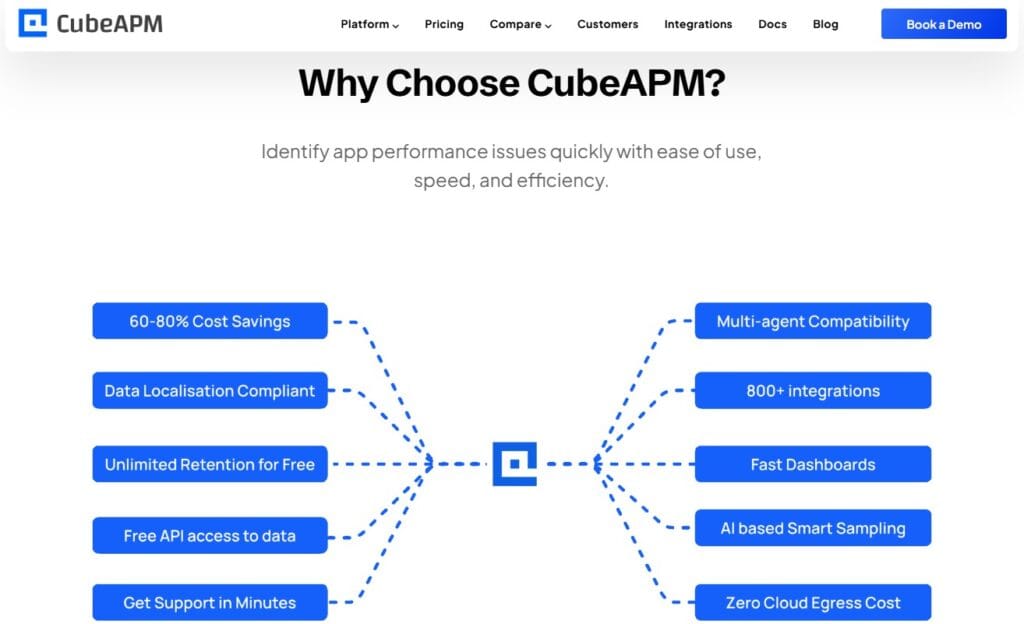
- Predictable pricing: Unlike host-based or credit-based models, CubeAPM’s ingestion-based pricing gives cost transparency and is easy to budget.
- Deployment flexibility: Self-host via bring-your-own-cloud, or deploy it on-premises, which is ideal for compliance, data residency, and hybrid environments.
- OpenTelemetry-native design: Built from the ground up for OTel, it integrates seamlessly with modern telemetry pipelines and standardises event collection across agents.
- Unlimited retention: Enables long-term data storage without hidden fees, critical for compliance, trend-analysis, and post-incident forensics.
- Smart sampling: Retains high-value traces based on latency and errors, compressing irrelevant data (up to 95%) and lowering cost without losing insight.
Datadog vs Sumo Logic vs CubeAPM: Use Cases
Each platform serves a distinct audience depending on observability goals, budget flexibility, and deployment needs. Here’s when to choose CubeAPM, Datadog, or Sumo Logic based on real-world scenarios and research insights.
Choose CubeAPM if:
You’re looking for a predictable, OpenTelemetry-native observability platform that balances deep visibility with cost efficiency.
- For cost-sensitive observability: With unlimited retention and adaptive sampling, CubeAPM enables up to 50% lower cost of ownership compared to host-based models.
- For startups and scale-ups: Ideal for teams that want full-stack observability without unpredictable SaaS bills. CubeAPM’s ingestion-based pricing of $0.15/GB ensures predictable monthly costs as telemetry scales.
- For strict compliance and data residency needs: Choose CubeAPM for self-hosted or BYOC deployment, keeping all telemetry within your cloud or on-prem environment; crucial for industries like BFSI and government tech.
- For teams focused on MTTR reduction: Smart, context-aware sampling helps detect anomalies quickly, capturing only high-value traces tied to errors or latency spikes.
- For engineering-heavy environments: Supports multiple agents (OpenTelemetry, Prometheus, Datadog, New Relic, Elastic), making migration painless for organizations consolidating monitoring stacks.
Choose Datadog if:
You want a feature-rich, SaaS-based monitoring ecosystem with extensive integrations and managed infrastructure.
- For large cloud-native enterprises: Best suited for organizations deeply invested in AWS, Azure, or GCP ecosystems, Datadog offers 900+ integrations and native support for modern DevOps workflows.
- For teams prioritizing plug-and-play setup: Datadog’s cloud-based model simplifies onboarding and configuration without the need for infrastructure management.
- For centralized observability at scale: Combines metrics, traces, and logs through a single dashboard, though costs increase with host count and log ingestion (based on their pricing structure of $15–$31 per host/month and $0.10/GB for logs).
Choose Sumo Logic if:
You need a cloud-native log analytics and SIEM platform with strong correlation and security monitoring capabilities.
- For security-driven organizations: Sumo Logic excels in log correlation and threat detection, making it ideal for SOC and compliance teams.
- For cloud-only setups: It offers SaaS-based deployment with hosted and installed collectorsintegrates seamlessly with AWS, GCP, and Azure sources.
- For teams prioritizing analytics over retention: With 30-day default log retention (charges extra for longer retention), it fits organizations needing short-term operational visibility and frequent log scanning (pricing between $3.14–$3.77 per TB scanned, based on their website).
- For teams standardizing on OpenTelemetry: It Offers native OTel collector support to collect logs, metrics, and traces, providing interoperability across modern cloud pipelines.
Datadog vs Sumo Logic vs CubeAPM: Conclusion
Datadog and Sumo Logic offer strong observability capabilities with some trade-offs, such as SaaS-only deployment and cost. CubeAPM, on the other hand, eliminates this complexity with predictable ingestion-based pricing ($0.15/GB), self-hosting flexibility, and unlimited retention. It simplifies telemetry management while ensuring OpenTelemetry-native compatibility, smart sampling for cost efficiency, and faster MTTR across environments.
Get a free demo to explore CubeAPM.
Disclaimer: The information in this article reflects the latest details available at the time of publication and may change as technologies and products evolve.
FAQs
1. Which tool offers the most transparent and predictable pricing model?
CubeAPM provides predictable ingestion-based pricing ($0.15/GB) that covers all observability data (metrics, logs, and traces) without per-host or feature-based add-ons. Datadog and Sumo Logic use usage-based models that vary according to hosts, queries, or storage.
2. Can CubeAPM, Datadog, or Sumo Logic be self-hosted?
CubeAPM offers self-hosting deployment via BYOC (Bring Your Own Cloud) or on-premises. Datadog and Sumo Logic are cloud-only SaaS platforms, so companies with strict data residency or compliance needs must validate this carefully.
3. Which platform provides the best OpenTelemetry support?
CubeAPM, Datadog, and Sumo Logic all offer support for OpenTelemetry-native. CubeAPM supports multiple agents (OTel, Prometheus, Datadog, New Relic, Elastic) for hybrid setups.
4. Which observability tool is most cost-efficient for large-scale telemetry?
Based on our research, CubeAPM delivers up to 50% lower total ownership cost through smart sampling, unlimited retention, and ingestion-based pricing. Datadog’s per-host billing and Sumo Logic’s scan-based pricing may scale with larger data volumes.
5. How do support response times differ across the three tools?
CubeAPM provides real-time support via Slack and WhatsApp, connecting users directly with engineers within minutes. Datadog offers tiered email and chat support (2–48 hour TAT), while Sumo Logic provides Standard (8×5) support for Essentials and Enterprise (24×7) coverage for higher tiers.