










CrowdStrike Falcon LogScale, formerly Humio, positions itself as a next-generation SIEM and log management platform capable of ingesting petabyte-scale data with sub-second query latency. After CrowdStrike acquired Humio in March 2021 and integrated it into the Falcon platform by September 2022, the product gained access to endpoint telemetry from millions of CrowdStrike agents worldwide.
This guide examines CrowdStrike Falcon LogScale’s pricing model, real user experiences from Reddit and G2, feature depth, and how it compares to alternatives for teams evaluating log management and SIEM platforms.
What Is CrowdStrike Falcon LogScale?
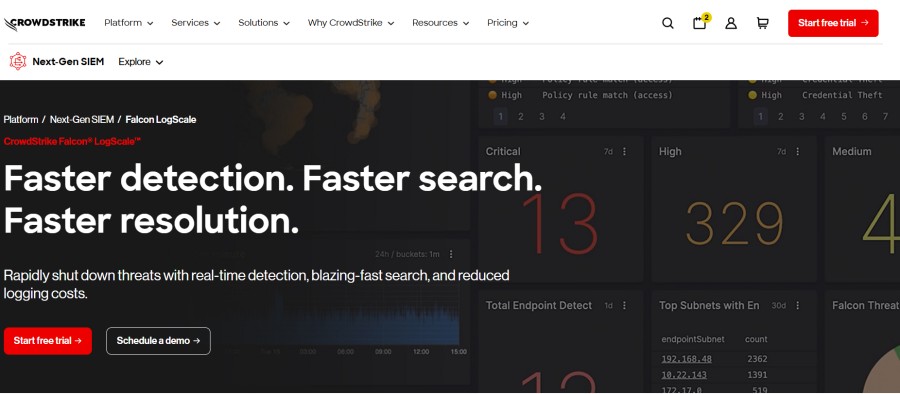
CrowdStrike Falcon LogScale is a cloud native log management and SIEM platform designed to handle massive data ingestion rates at petabyte scale. Originally developed as Humio, the platform operates on an index-free architecture that eliminates traditional indexing overhead, allowing teams to search unstructured log data in real time without the storage and compute costs typically required by index-heavy systems like Splunk.
The platform stores compressed log data at a 6x to 80x reduction ratio compared to traditional SIEM tools, meaning a terabyte of raw logs can shrink to as little as 12 GB on disk. This compression happens at write time without sacrificing query speed. LogScale’s query engine returns results in sub-second latency even across petabytes of retained data, using a streaming query model that scans only relevant data partitions instead of loading entire datasets into memory.
LogScale integrates deeply with the CrowdStrike Falcon ecosystem, particularly the endpoint detection and response (EDR) module. Security teams can correlate endpoint telemetry from Falcon agents with network logs, application logs, and cloud infrastructure events in a single interface. The platform supports log ingestion from syslog, HEC API endpoints, and OpenTelemetry, making it compatible with most existing log forwarding pipelines.
For deployment, LogScale offers three models: fully managed cloud hosted on CrowdStrike infrastructure, self-hosted in your own cloud VPC or data center, and hybrid where certain workloads remain on-premises while others run in the cloud. The self-hosted option addresses data residency requirements for regulated industries, though some users on Reddit note that on-premises support response times can vary significantly compared to cloud-hosted deployments.
LogScale’s query language is proprietary, similar to Splunk’s SPL or Datadog’s query syntax. While powerful for users who invest time learning it, this creates lock-in. Dashboards, alerts, and saved queries written in LogScale’s syntax cannot be exported to other platforms without rewriting, which becomes a migration barrier for teams considering alternatives.
How CrowdStrike LogScale Pricing Works
CrowdStrike Falcon LogScale pricing is not publicly listed on their website. Pricing is custom and negotiated based on data volume, deployment model, retention period, and feature set. This opacity makes it difficult for teams to estimate costs before engaging with sales, a common complaint across user reviews.
Based on user reports on Reddit and G2, LogScale pricing typically follows a site license model designed to remove per-user or per-gigabyte constraints. For teams ingesting large volumes, this can offer better predictability than tools that charge per host or per indexed gigabyte. However, the lack of transparent pricing means smaller teams or those in early evaluation stages cannot self-serve a cost estimate.
For context, one Reddit user managing a mid-sized deployment noted that Humio’s pricing before the CrowdStrike acquisition was competitive with Splunk for high-volume ingestion but became less transparent after integration into the Falcon platform. Another user in a security-focused subreddit mentioned that CrowdStrike offered different types of packages based on endpoint count, with Falcon going around $60 per device per year and Falcon Pro around $90 per device per year, though these figures apply to endpoint protection rather than log ingestion specifically.
The site license model removes logging constraints in theory, but in practice, costs still scale with infrastructure requirements for self-hosted deployments. Teams running LogScale on-premises must account for compute, storage, and network costs, which can add 20 to 40% to the total cost of ownership depending on data compression ratios and retention policies.
For cloud-hosted LogScale, CrowdStrike manages the infrastructure, but pricing is bundled and not broken out publicly. Teams should verify current rates directly at CrowdStrike’s pricing page or through a sales consultation.
Pricing is based on publicly available information as of early 2026. Enterprise discounts, custom contracts, and negotiated rates are not reflected here.
CrowdStrike LogScale Features
CrowdStrike Falcon LogScale delivers several capabilities that differentiate it from legacy SIEM platforms and commodity log management tools. These features matter most for security teams, SRE teams managing high-volume infrastructure, and organizations that need to retain large volumes of log data without hitting prohibitive storage costs.
Index-Free Architecture
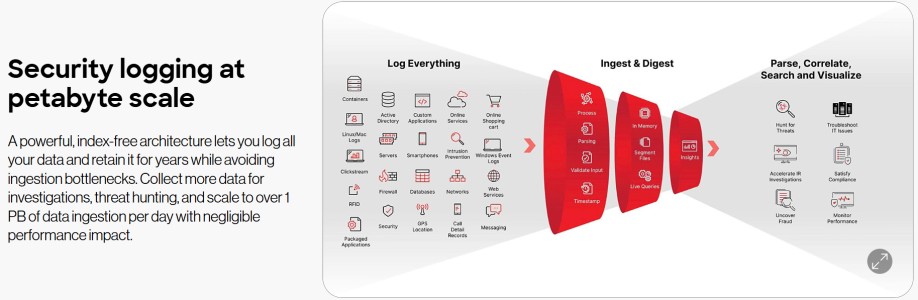
LogScale does not build traditional inverted indexes for every field in your log data. Instead, it uses a streaming query model that scans compressed data partitions directly. This eliminates the upfront compute and storage overhead required by indexed systems like Splunk or Elasticsearch.
For a team ingesting 10 TB per day, traditional indexed systems might require 30 to 50 TB of storage after indexing. LogScale’s compression reduces this to 500 GB to 1.5 TB depending on log structure and entropy. Query latency remains sub-second because the engine scans only relevant time ranges and applies filters during the scan rather than loading full datasets into memory.
This architecture works well for write-heavy workloads where log volume exceeds the ability to index everything economically. However, it introduces a trade-off: queries that need to scan large time ranges or low-cardinality fields can become slower than pre-indexed equivalents in other systems.
High Data Ingestion and Retention
LogScale is designed to ingest up to 1 petabyte per day. For context, a large e-commerce platform with 500 microservices, 2,000 hosts, and global traffic might generate 10 to 20 TB per day. LogScale handles this without requiring pre-filtering or aggressive sampling.
Retention is technically unlimited in the sense that the platform does not enforce hard cutoffs like Datadog’s 15-month trace retention limit. However, storage costs still apply for self-hosted deployments, and cloud-hosted pricing likely incorporates retention duration into the negotiated contract. Teams should verify retention pricing explicitly during procurement.
The platform supports cold storage tiering where older data moves to cheaper object storage like AWS S3 or Azure Blob. Queries against cold storage are slower (seconds to minutes instead of sub-second), but the data remains searchable without rehydration, which is better than archive-only systems that require restore operations before querying.
CrowdStream and Data Onboarding
CrowdStream, powered by Cribl observability pipelining technology, simplifies log ingestion by enabling data enrichment, normalization, and filtering before logs hit LogScale storage. This reduces noise and storage costs by dropping irrelevant events at the edge.
For example, a team might use CrowdStream to filter out health check requests from load balancer logs, redact personally identifiable information (PII) from application logs, and enrich Kubernetes logs with pod labels and namespace metadata. These transformations happen in the pipeline before data is written, reducing downstream query complexity and storage volume.
However, CrowdStream introduces another layer of configuration and operational complexity. Teams need to define pipeline rules, test transformations, and monitor pipeline performance to avoid dropping critical events or introducing processing latency. For smaller teams, this added complexity may outweigh the cost savings.
Role-Based Access Control and Security
LogScale supports SAML 2.0 for single sign-on with identity providers like Okta, Azure Active Directory, and Duo Security. Role-based access control (RBAC) allows administrators to grant granular permissions at the repository, query, and dashboard level.
For example, a security analyst might have read-only access to production logs but full access to sandbox environments. A compliance officer might access only specific log repositories containing audit trails without seeing application performance data.
LogScale also supports API tokens for programmatic access and integration with CI/CD pipelines, though some users note that the token management UI is less mature than enterprise platforms like Datadog or Splunk.
Real-Time Threat Detection
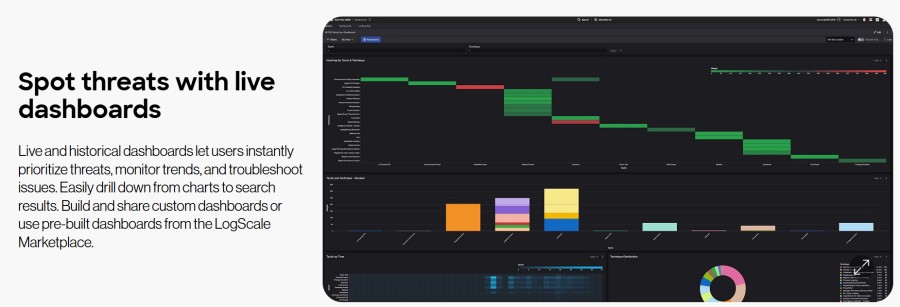
LogScale integrates with CrowdStrike’s threat intelligence feeds and endpoint telemetry from Falcon agents. Security teams can correlate endpoint behavior with network logs, cloud events, and application logs to detect lateral movement, privilege escalation, or data exfiltration patterns in real time.
The platform supports automated workflows and playbooks for incident response. For example, if LogScale detects a suspicious login pattern, it can trigger a Falcon response action to isolate the affected endpoint, create a ticket in PagerDuty, and notify the SOC team via Slack, all without manual intervention.
This tight integration with CrowdStrike’s endpoint platform makes LogScale particularly strong for organizations already using Falcon for EDR. For teams using other endpoint tools like SentinelOne or Microsoft Defender, the integration value diminishes unless they are willing to forward telemetry from those platforms into LogScale via API or syslog.
CrowdStrike LogScale User Experience: What Users Say
User feedback from Reddit, G2, and community forums reveals consistent patterns in how teams experience LogScale in production. These reports provide insight into what works well and where pain points emerge at scale.
Search Speed and Query Performance
Multiple users on Reddit confirm that LogScale delivers significantly faster search compared to Splunk. One user managing a deployment replacing Splunk noted that Humio searches faster and requires less maintenance than their previous Splunk infrastructure. The index-free architecture eliminates the reindexing delays that plague Splunk when schema changes or field extractions need updating.
However, query performance depends heavily on how queries are written. Users unfamiliar with LogScale’s query syntax can write inefficient queries that scan large time ranges or use wildcards on high-cardinality fields, leading to slow results. Unlike Datadog or New Relic, which optimize common query patterns automatically, LogScale requires users to understand query performance implications.
A security engineer on r/crowdstrike mentioned that they were able to replicate all alerting from Splunk by dumping logs into LogScale, though the learning curve for translating Splunk queries into LogScale syntax was steeper than expected.
Integration Ecosystem
LogScale’s integration library includes connectors for SIEM tools, incident management platforms like PagerDuty and OpsGenie, and collaboration tools like Slack. The CrowdStrike Marketplace offers additional packages for Splunk On-Call, Veeam, and Cloudflare Email Security.
However, some users note that the number of out-of-the-box integrations is smaller compared to Datadog’s 700+ integrations or Splunk’s extensive app ecosystem. For less common log sources or niche SaaS tools, teams may need to write custom ingestion scripts or rely on generic syslog forwarding, which requires more engineering effort than plug-and-play integrations.
On-Premises Support and Responsiveness
Several Reddit users report that on-premises support response times vary significantly. One user noted that while cloud-hosted LogScale receives quick responses from CrowdStrike support, their self-hosted deployment experienced slower turnaround times for configuration questions and troubleshooting.
For teams running LogScale on-premises, this means building internal expertise to handle day-to-day operations without relying on vendor support for every issue. This is common for self-hosted platforms but contrasts with managed SaaS tools where the vendor handles infrastructure and performance tuning.
Pricing Transparency Complaints
A recurring complaint across user reviews is the lack of public pricing. Teams evaluating LogScale cannot estimate costs without engaging a sales representative, which adds friction early in the evaluation process. One G2 reviewer mentioned that pricing negotiations felt opaque compared to competitors with published rate cards, making it harder to compare total cost of ownership across platforms.
For teams accustomed to self-serve pricing calculators like those offered by Datadog, New Relic, or CubeAPM’s pricing page, the absence of transparent pricing is a significant barrier.
CrowdStrike LogScale Limitations and Drawbacks
CrowdStrike Falcon LogScale delivers strong performance and scalability, but several limitations affect specific use cases and team types. These are sourced from user reports, documentation, and publicly disclosed vulnerabilities.
Proprietary Query Language and Lock-In
LogScale uses a proprietary query language similar to Splunk’s SPL. While powerful, this creates vendor lock-in. Dashboards, saved queries, and alert definitions written in LogScale syntax cannot be exported to other platforms without manual rewriting.
For teams evaluating multiple platforms or planning eventual migration, this lack of portability increases switching costs. Competitors like Grafana and CubeAPM support industry-standard query languages like PromQL and SQL, making queries more portable.
Limited Out-of-the-Box Integrations
Compared to Datadog’s 700+ integrations or New Relic’s extensive plugin library, LogScale’s integration ecosystem is smaller. While it covers major platforms, teams using niche SaaS tools or legacy systems may need to build custom ingestion pipelines.
This matters most for engineering teams with heterogeneous infrastructure where plug-and-play integrations reduce onboarding time from weeks to hours.
Security Vulnerabilities Disclosed
CrowdStrike maintains a security disclosure policy, and past vulnerabilities have been documented. For example, earlier versions of LogScale had an LDAP integration vulnerability and an issue where authenticated users could list all users via the GraphQL API. These have been patched, but they highlight the importance of keeping self-hosted deployments updated.
For cloud-hosted deployments, CrowdStrike manages patching, but self-hosted teams must monitor security advisories and apply updates promptly.
Cloud-Only Architecture for Managed Deployments
While LogScale offers self-hosted deployment, the fully managed cloud version runs only on CrowdStrike’s infrastructure. For teams with strict data residency requirements or regulatory constraints, this limits deployment flexibility unless they opt for the self-hosted model, which shifts operational burden to their team.
Competitors like CubeAPM and SigNoz offer managed deployments inside the customer’s own VPC, combining operational simplicity with data control.
CrowdStrike LogScale Alternatives
Several platforms compete with CrowdStrike Falcon LogScale across different dimensions: pricing transparency, deployment model, SIEM capabilities, and log management focus. This section compares LogScale to tools that address similar use cases, with sourced pricing and feature differences.
CubeAPM
CubeAPM is a self-hosted observability platform covering APM, logs, infrastructure monitoring, and Kubernetes visibility. It runs inside your own cloud VPC or data center, ensuring full data control and compliance by default. Unlike LogScale’s custom pricing, CubeAPM uses transparent ingestion-based pricing at $0.20/GB with unlimited retention and no per-user fees.
For a team ingesting 30 TB per month (20 TB logs, 7 TB traces, 3 TB metrics), CubeAPM costs approximately $6,000 per month compared to LogScale’s custom pricing model, which requires a sales quote. CubeAPM is OpenTelemetry native, supports direct Prometheus and Elastic agent compatibility, and provides direct engineering support via Slack and WhatsApp with response times measured in minutes during incidents.
CubeAPM is best for teams that need unified log, trace, and metric correlation without vendor lock-in or unpredictable SaaS pricing. It does not offer SIEM-specific features like threat intelligence feeds or automated incident response playbooks, making it less suitable for security-focused teams compared to LogScale.
Pricing: $0.20/GB for all telemetry (logs, traces, metrics) with unlimited retention. Self-hosted with vendor-managed updates.
Datadog
Datadog is a fully managed SaaS platform offering log management, APM, infrastructure monitoring, and security monitoring. Log ingestion costs $0.10/GB, but indexed logs cost an additional $1.70 per million events, creating a two-part pricing model that can surprise teams unfamiliar with the difference between ingestion and indexing.
For a 30 TB per month workload with 30% log indexing, Datadog’s log costs alone reach approximately $8,000 per month before APM, infrastructure monitoring, or RUM charges. This does not include AWS or GCP egress fees of approximately $0.10/GB when sending telemetry to Datadog’s SaaS infrastructure, adding another $3,000 per month for 30 TB.
Datadog offers 700+ integrations, strong dashboarding, and broad observability coverage, but its pricing complexity and lack of on-premises deployment make it less suitable for cost-sensitive or data-sovereign teams. Verify current pricing at Datadog’s pricing page.
Pricing: $0.10/GB ingestion + $1.70 per million indexed events + cloud egress fees.
Splunk
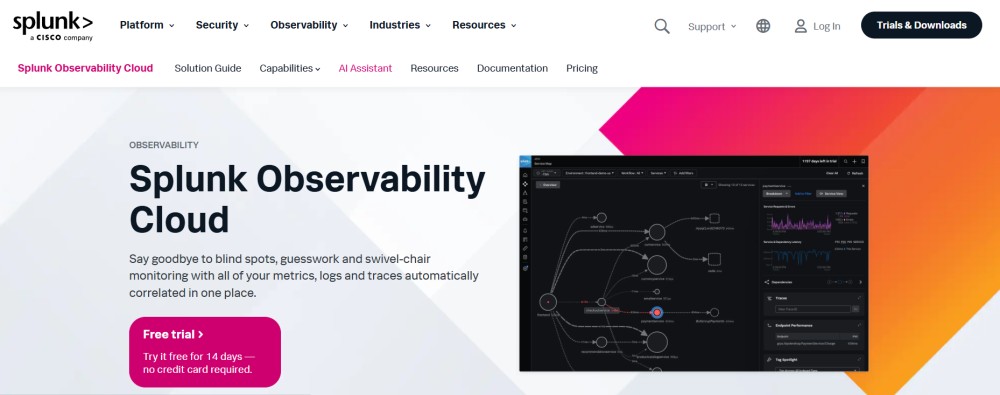
Splunk is the incumbent enterprise SIEM and log management platform with decades of market presence. Splunk Cloud starts at $15 per host per month for infrastructure monitoring, with additional costs for data ingestion, storage, and SIEM features. Splunk Enterprise pricing is custom and often negotiated at six-figure annual contracts for large deployments.
Splunk’s index-heavy architecture requires significant storage and compute resources, leading to total cost of ownership that can reach $50,000 to $100,000 per month for teams ingesting 50 TB per day. However, Splunk’s app ecosystem, SIEM maturity, and compliance certifications make it the default choice for regulated industries and large enterprises with dedicated security operations teams.
Splunk’s complexity and cost rule it out for smaller teams or those seeking faster query performance without indexing overhead. Verify current pricing at Splunk’s pricing page.
Pricing: Custom, typically starts at $15/host/month for infrastructure monitoring, with data ingestion priced separately.
SigNoz
SigNoz is an open-source observability platform built on OpenTelemetry and ClickHouse. It covers APM, logs, and infrastructure monitoring with unlimited retention and no per-user fees. SigNoz Cloud pricing starts at $0.30/GB for log ingestion, and self-hosted deployments are free but require operational expertise to manage ClickHouse clusters, Kafka queues, and query performance tuning.
SigNoz is best for engineering teams comfortable with self-hosting or teams that want to avoid vendor lock-in entirely. It does not offer SIEM-specific features, threat intelligence, or automated incident response, making it less suitable for security-focused use cases compared to LogScale.
Pricing: Free for self-hosted; SigNoz Cloud starts at $0.30/GB for logs with unlimited retention.
Elastic (ELK Stack)
Elastic offers log management through the ELK stack (Elasticsearch, Logstash, Kibana). The open-source version is free, but teams must manage their own Elasticsearch clusters, configure index lifecycle management, and tune query performance. Elastic Cloud starts at $99 per month for a standard plan, with pricing scaling based on data volume, retention, and deployment size.
Elastic’s search capabilities are powerful, but operational complexity is high for teams without dedicated Elasticsearch expertise. Index management, shard optimization, and cluster scaling require ongoing attention. For teams already running ELK, adding log management is straightforward. For teams evaluating new platforms, managed alternatives like CubeAPM or Datadog reduce operational burden.
Pricing: Free for self-hosted; Elastic Cloud starts at $99/month for the standard plan.
How to Evaluate CrowdStrike LogScale for Your Team
Choosing a log management and SIEM platform depends on data volume, deployment constraints, existing infrastructure, and whether security workflows or observability use cases drive the decision. This framework helps prioritize what matters for your specific context.
Data Volume and Retention Requirements
If your team ingests more than 10 TB per day and needs to retain data for compliance or forensic analysis, LogScale’s compression and index-free architecture deliver significant cost savings compared to indexed systems like Splunk or Elasticsearch. However, if your retention requirements are shorter (30 to 90 days), platforms with simpler pricing like CubeAPM or SigNoz may offer better total cost of ownership without requiring custom pricing negotiations.
Security vs. Observability Focus
If your primary use case is SIEM, threat detection, and incident response, LogScale’s integration with CrowdStrike Falcon EDR and built-in threat intelligence feeds provide strong value. For teams already using Falcon for endpoint protection, adding LogScale creates a unified security platform.
If your primary use case is application performance monitoring, infrastructure troubleshooting, or developer observability, tools like CubeAPM, Datadog, or SigNoz offer better correlation between logs, traces, and metrics without requiring SIEM-specific workflows.
Deployment Model and Data Residency
If data residency, GDPR compliance, or HIPAA requirements mandate that telemetry data never leaves your infrastructure, LogScale’s self-hosted deployment option meets this need. However, self-hosting requires operational expertise to manage storage, scaling, and performance tuning.
For teams that want data control without operational burden, platforms like CubeAPM run inside your VPC but are managed by the vendor, removing the DIY overhead while keeping data local.
Integration Ecosystem
If your infrastructure includes niche SaaS tools, legacy systems, or proprietary applications, verify that LogScale supports ingestion from those sources. For mainstream platforms (AWS, Azure, Kubernetes, Docker), LogScale’s integrations are sufficient. For less common sources, budget time for custom ingestion pipelines.
Pricing Transparency and Predictability
If your team needs to estimate costs before engaging with sales, LogScale’s lack of public pricing creates friction. Platforms like CubeAPM, Datadog, and SigNoz publish transparent rate cards, making cost modeling straightforward. Use CubeAPM’s pricing calculator or Datadog’s online estimator to compare total cost of ownership before committing to vendor demos.
This estimate models a production-ready setup with high availability. A smaller or simpler deployment may cost significantly less.
Frequently Asked Questions
How much did CrowdStrike pay for Humio?
CrowdStrike acquired Humio in March 2021. The acquisition price was not publicly disclosed. Humio was integrated into the CrowdStrike Falcon platform and rebranded as Falcon LogScale by September 2022.
What is Humio LogScale?
Humio LogScale, now called CrowdStrike Falcon LogScale, is a log management and SIEM platform that uses an index-free architecture to ingest and query petabyte-scale log data with sub-second latency. It was originally developed by Humio before CrowdStrike acquired the company.
Is LogScale free?
LogScale is not free. CrowdStrike offers custom pricing based on data volume, deployment model, and feature requirements. There is no publicly available free tier or community edition. Teams interested in LogScale must contact CrowdStrike sales for a pricing quote.
How does CrowdStrike LogScale pricing compare to Splunk?
CrowdStrike LogScale pricing is custom and not publicly listed, making direct comparison difficult without a sales quote. Splunk pricing typically starts at $15 per host per month for infrastructure monitoring, with additional costs for data ingestion and SIEM features. For high-volume deployments exceeding 10 TB per day, LogScale’s index-free architecture and compression may offer lower total cost of ownership than Splunk’s index-heavy model, but exact costs depend on negotiated contracts.
Can LogScale run on premises?
Yes, CrowdStrike Falcon LogScale supports self-hosted deployment in your own cloud VPC or data center. This addresses data residency and compliance requirements for regulated industries. However, self-hosted deployments require operational expertise to manage infrastructure, scaling, and performance tuning. Cloud-hosted LogScale is also available as a fully managed option on CrowdStrike infrastructure.
Does LogScale support OpenTelemetry?
Yes, CrowdStrike Falcon LogScale supports OpenTelemetry for log ingestion. It also supports ingestion via syslog, HEC API endpoints, and CrowdStream for data enrichment and normalization before logs are written to storage.
What is the LogScale community edition?
CrowdStrike does not offer a free community edition of Falcon LogScale. Pricing is custom and negotiated based on deployment size and requirements. Teams looking for free or open-source alternatives should evaluate platforms like SigNoz, Elastic (ELK stack), or Graylog.
Disclaimer: The information in this article reflects the latest details available at the time of publication and may change as technologies and products evolve. Features, pricing, and plan limits can change over time. Always verify the latest information directly with the vendor before making purchasing or deployment decisions.