









The main difference between Azure Monitor, New Relic, and CubeAPM is architectural control and pricing philosophy.
Azure Monitor is deeply integrated into the Microsoft Azure ecosystem and works best for Azure-native environments. New Relic is a SaaS-first observability platform with usage-based pricing and vendor-managed infrastructure. CubeAPM is a self-hosted, OpenTelemetry-native platform built for predictable ingestion-based pricing, unlimited retention, and full data residency control.
These differences become critical as telemetry volume scales, costs increase, and compliance requirements tighten. This article compares Azure Monitor vs New Relic vs CubeAPM across architecture, pricing, sampling strategy, retention, and real-world use cases.
Azure Monitor vs New Relic vs CubeAPM Comparison
This comparison is based on official documentation, published pricing pages, and commonly observed production deployments. Actual costs, retention limits, sampling behavior, and feature availability may vary by region, enterprise agreements, workload volume, and configuration choices. Teams should confirm final details directly with each vendor before making decisions.
| Feature | CubeAPM | Azure Monitor | New Relic |
| Known for | Unified MELT, native OTEL, self-hosting, cost predictability | Native Azure monitoring and diagnostics | Full-stack APM, service maps, advanced analytics |
| Multi-Agent Support | Yes (OTel, New Relic, Datadog, Elastic, etc.) | Limited (Azure Monitor Agent, OTel) | Yes (New Relic Agent, OTel, Prometheus) |
| MELT Support | Full MELT coverage | Full MELT coverage | Full MELT coverage |
| Deployment | Self-hosted with vendor-managed | SaaS (Fully managed AWS service) | SaaS-only |
| Pricing | Ingestion-based: $0.15/GB | Logs: $0.50/GBMetrics: $0.16/10 million samples ingested | Free 100 GB/month; beyond: $0.40/GB. Per-user license: $49-$349/month |
| Sampling Strategy | Smart sampling, automated, context-aware | Fixed-percentage, rate-limited sampling | Adaptive, head- based, & tail-based |
| Data Retention | Unlimited Retention | Basic Logs: 30dMetrics: 93d | 30d for logs/events; add-on retention |
| Support Channel & TAT | Slack, WhatsApp; response in minutes | Email, chat, phone; TAT: 8 hr to 15 min (plan-based) | Community, docs, ticket-based; TAT: 2d-2 hrs; 1hr priority |
Azure Monitor vs New Relic vs CubeAPM: Feature Breakdown
Known For
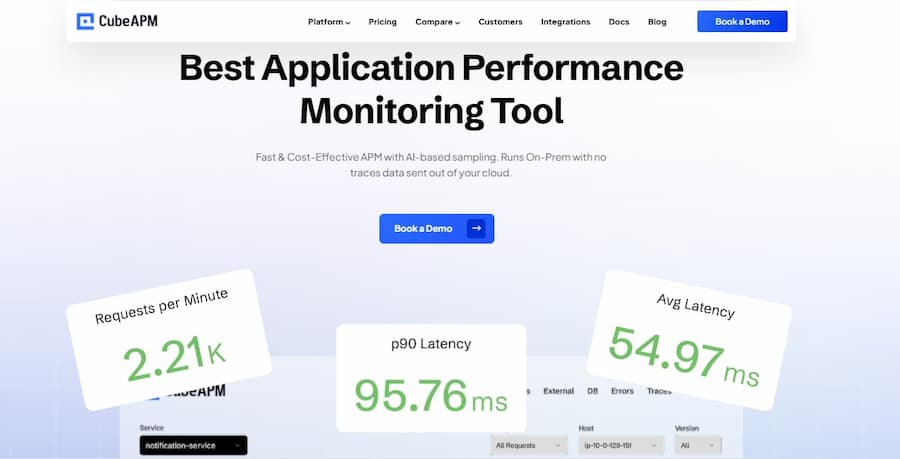
CubeAPM: Unified MELT observability with native OpenTelemetry and self-hosted control. CubeAPM is designed as a full-stack observability platform covering metrics, events, logs, traces, synthetic monitoring, real user monitoring, and error tracking. It emphasizes OpenTelemetry-native ingestion and deployment inside the customer’s cloud or on-prem environment for data control and predictable ingestion-based pricing.
Azure Monitor: Azure-native monitoring and diagnostics across cloud and hybrid environments. Azure Monitor is Microsoft’s platform for collecting, analyzing, and acting on telemetry from Azure resources, applications, and infrastructure. It integrates deeply with Azure services such as Azure VMs, AKS, Application Insights, and Log Analytics.
New Relic: SaaS-first full-stack observability with analytics-driven insights. New Relic provides a unified cloud-based observability platform that helps teams monitor applications, infrastructure, logs, and user experiences with advanced querying, dashboards, and AI-assisted insights through its New Relic One platform.
Multi-Agent Support
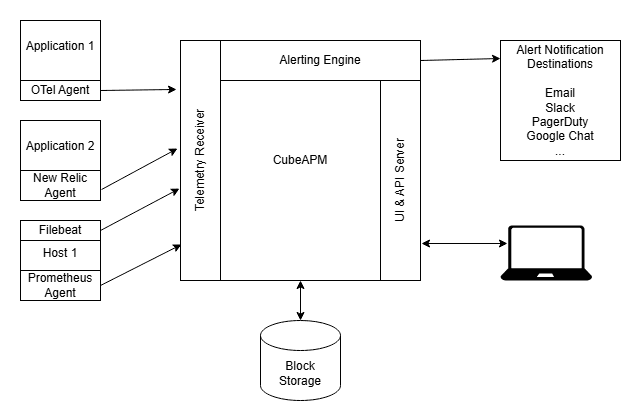
CubeAPM: Broad OpenTelemetry-first compatibility with support for multiple agent ecosystems. CubeAPM supports native OpenTelemetry ingestion and is compatible with Prometheus metrics as well as telemetry pipelines originating from other vendor agents, enabling migration without full re-instrumentation. This makes it suitable for hybrid environments where teams may already use mixed agent stacks.
Azure Monitor: Primarily Azure Monitor Agent with OpenTelemetry support for application telemetry. Azure Monitor uses the Azure Monitor Agent (AMA) for infrastructure data collection and supports OpenTelemetry-based instrumentation for applications through Azure Monitor OpenTelemetry exporters. While flexible for Azure workloads, the agent strategy is generally aligned with Microsoft’s ecosystem.
New Relic: Native New Relic agents with OpenTelemetry and Prometheus support. New Relic provides language-specific agents (Java, .NET, Node.js, Python, Go, etc.) and supports OpenTelemetry ingestion through OTLP endpoints. It also integrates with Prometheus and Kubernetes environments. Telemetry is ultimately routed to New Relic’s SaaS backend.
MELT Support
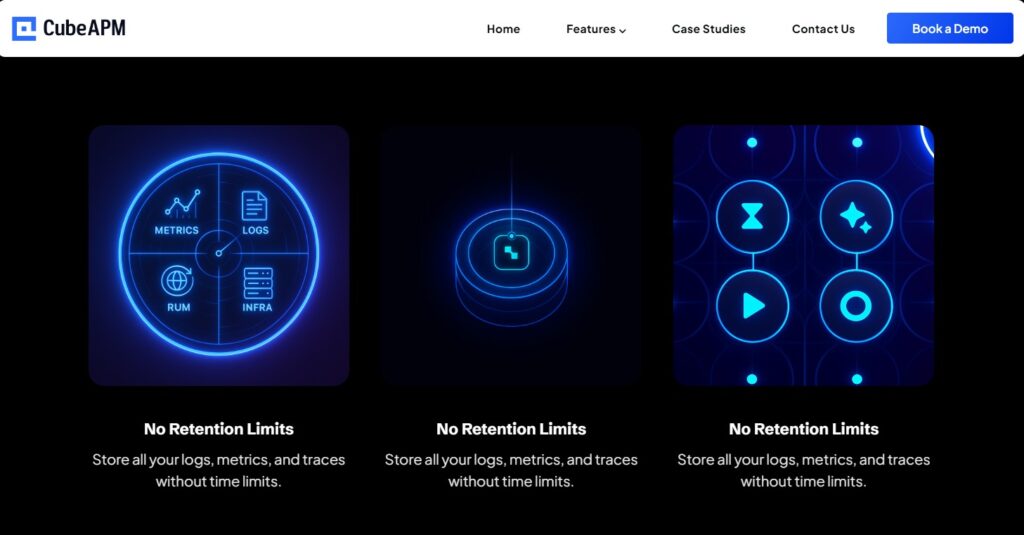
CubeAPM: Unified MELT coverage within a single observability stack. CubeAPM provides metrics, logs, traces, synthetic monitoring, real user monitoring, infrastructure monitoring, and error tracking within one platform. It is designed around OpenTelemetry-native ingestion, enabling correlation across telemetry types inside a self-hosted deployment model.
Azure Monitor: Full MELT support through Azure Monitor, Log Analytics, and Application Insights. Azure Monitor collects platform metrics, logs, and distributed traces, with Application Insights providing application-level telemetry and Log Analytics enabling query-based log analysis. Telemetry correlation is supported across services within the Azure ecosystem.
New Relic: Full-stack MELT observability delivered as a SaaS platform. New Relic supports metrics, events, logs, distributed tracing, real user monitoring, synthetic monitoring, and error tracking within the New Relic One platform. It emphasizes cross-entity correlation and advanced query capabilities through NRQL.
Deployment
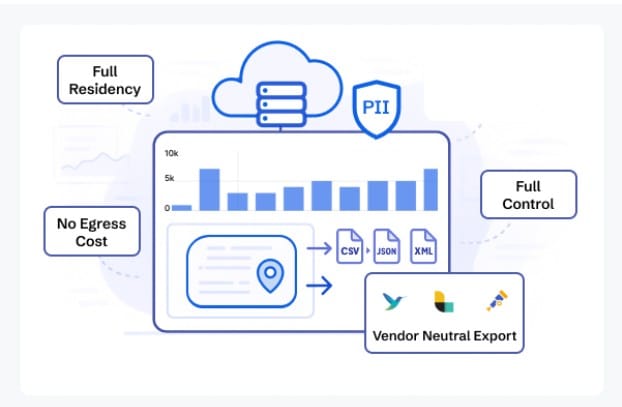
CubeAPM: Self-hosted deployment inside your cloud or on-prem environment. CubeAPM is deployed within the customer’s infrastructure, including AWS, Azure, GCP, or private data centers, with vendor-managed support. Telemetry data remains within the organization’s cloud account, supporting data residency control and compliance requirements while maintaining full-stack observability.
Azure Monitor: Microsoft-managed cloud service integrated into Azure. Azure Monitor operates as a fully managed Azure service, collecting telemetry from Azure resources and hybrid environments. Data is stored within Azure regions selected by the customer and managed through Azure subscriptions and Log Analytics workspaces.
New Relic: SaaS-only deployment hosted by New Relic. New Relic is delivered as a cloud-based SaaS platform. Agents send telemetry to New Relic-managed infrastructure, where data is processed, stored, and visualized through the New Relic One interface. Customers do not manage backend infrastructure.
Pricing for Small, Mid, and Large Teams
To summarize the pricing:
*All pricing comparisons are calculated using standardized Small/Medium/Large team profiles defined in our internal benchmarking sheet, based on fixed log, metrics, trace, and retention assumptions. Actual pricing may vary by usage, region, and plan structure. Please confirm current pricing with each vendor.
| Approx. cost for teams (size) | Small (~30) | Mid-Sized (~125) | Large (~250) |
| CubeAPM | $2,080 | $7,200 | $15,200 |
| New Relic | $7,896 | $25,990 | $57,970 |
| Azure Monitor | $2,064 | $5,232 | $13,228 |
CubeAPM Costs in Detail
CubeAPM: Ingestion-based pricing with no additional charges. CubeAPM charges $0.15 per GB of telemetry ingested, with no per-user license fees, no separate data transfer charges, and no additional retention fees. Costs scale directly with ingestion volume, making pricing predictable as usage grows.
- Small teams (~ 30): $2,080
- Mid-sized teams (~ 125): $7,200
- Large teams (~250): $15,200
New Relic Cost in Detail
New Relic: Usage-based pricing that bills for both data ingested and the number of users. Official pricing includes a 100 GB/month free telemetry ingestion allowance, after which data is charged at approximately $0.40 per GB for the standard “Original Data” plan. In addition to data costs, New Relic has user license tiers (e.g., Core and Full Platform), with common pricing such as $49/month for Core users and $349/month for Full Platform users (pricing can vary by edition and contract). Actual unit prices and plans may vary based on edition and enterprise agreements.
- Small teams: $7,896
- Mid-size teams: $25,990
- Large teams: $57,970
To get a better idea of how to calculate the pricing of New Relic, use our pricing calculator.
Azure Monitor Cost in Detail
Azure Monitor: Consumption-based pricing where you pay for what you use. Log data ingestion is charged per GB written to Log Analytics workspaces, with the first 31 days of retention included at no extra cost and additional retention beyond that optionally charged. Standard “Basic Logs” ingestion is roughly $0.50 per GB (varies by region and pricing tier), and custom metrics ingestion is about $0.16 per 10 million metric samples ingested. Retention and long-term storage can incur separate charges if extended beyond the default retention.
Pricing for different teams:
- Small teams: $2,064
- Mid-size teams: $5,232
- Large teams: $13,228
In practice, pricing differences become more visible as systems mature and telemetry volume scales. What initially feels like a manageable monitoring expense can evolve into a high operational cost once traffic stabilizes, microservices multiply, and log cardinality increases. At that point, observability shifts from a background tooling decision to an ongoing financial consideration that requires active cost tracking and forecasting alongside infrastructure growth.
Sampling Strategy
This section explains how each platform manages telemetry volume through trace sampling, based on official documentation and platform capabilities.
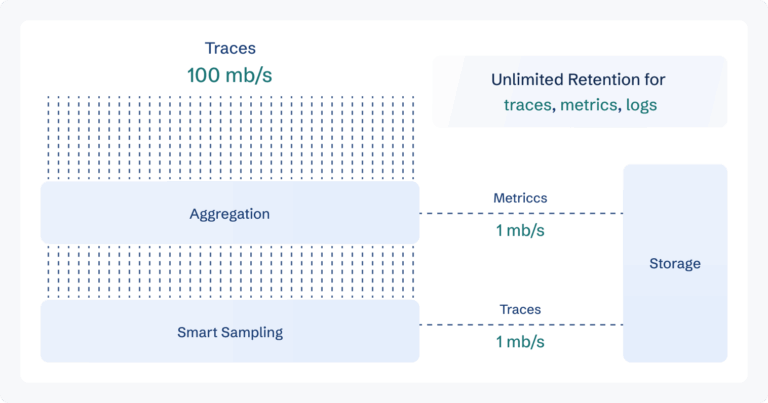
CubeAPM: Smart, context-aware sampling designed to preserve high-value traces. CubeAPM uses intelligent sampling mechanisms that consider factors such as latency and errors before deciding whether to retain or drop traces. This approach aims to maintain diagnostic signal quality while controlling ingestion volume in high-traffic environments.
Azure Monitor: Configurable sampling, commonly implemented as fixed-percentage or rate-limited sampling. Azure Monitor, through Application Insights, supports sampling to reduce telemetry volume and cost. It provides both ingestion sampling and adaptive sampling options that adjust based on traffic patterns, helping control data volume while attempting to retain representative telemetry.
New Relic: Head-based and tail-based sampling with adaptive controls. New Relic supports distributed tracing with configurable sampling, including head-based sampling at the agent level and tail-based sampling in Infinite Tracing. Adaptive sampling mechanisms help balance trace fidelity with data volume management in large-scale systems.
Data Retention

CubeAPM: Unlimited data retention included. CubeAPM provides unlimited retention for telemetry data under its ingestion-based pricing model, with no additional charges tied specifically to retention duration. Since deployment is self-hosted inside the customer’s cloud or infrastructure, data retention is governed by the organization’s own storage policies and capacity planning rather than vendor-enforced limits.
Azure Monitor: Default retention varies by data type and workspace configuration. For Log Analytics workspaces, the default retention is 30 days, which is included in the ingestion cost. Retention can be extended up to 730 days (2 years) for analytics logs, with additional charges applied beyond the included period. Basic Logs typically support 8 days of interactive retention and can be archived afterward. For metrics, Azure Monitor platform metrics are retained for 93 days by default.
New Relic: Standard 30-day retention with paid extensions available. Under New Relic’s standard data plan, most telemetry types, including logs and events are retained for 30 days by default. Extended retention options are available as add-ons or through enterprise agreements, allowing longer retention periods depending on the data type and plan. Exact limits vary by edition and contract terms.
Support Channel & TAT
CubeAPM: Direct real-time support via Slack and WhatsApp with rapid engagement. CubeAPM provides direct communication with engineering teams, with typical initial responses measured in minutes for urgent technical cases.
Azure Monitor: Microsoft Azure support plans provide severity-based response targets depending on the purchased plan (Developer, Standard, Professional Direct, Unified). Documented targets include:
- Severity A (Critical impact): 1 hour to 15 min.
- Severity B (High impact): 2-4 hours
- Severity C (Moderate impact): 4-8 hours
New Relic: Response times are defined by priority (P1-P4) and edition (Standard, Pro, Enterprise) as per New Relic’s Global Technical Support Offerings:
- P1 (Major outage): Standard: 2 business days, Pro: 2 hours, Enterprise: 1 hour
- P2 (Major component degraded): Standard: 2 business days, Pro: 6 business hours, Enterprise: 2 business hours
- P3 (All other monitored issues): Standard: 2 business days, Pro: 1 business day, Enterprise: 1 business day
- P4 (General questions/configuration): 2 business days across all editions
If you want to dive deeper into feature and pricing comparison, check out our CubeAPM vs New Relic page.
How Teams Evaluate These Platforms at Scale
Choosing between Azure Monitor, New Relic, and a self-hosted platform like CubeAPM rarely happens in isolation. As telemetry volume grows, the evaluation shifts from feature comparison to architectural and financial impact.
Who Is Involved
- Engineering: Focuses on instrumentation depth, trace correlation, sampling controls, and incident response speed. They evaluate how quickly the platform reduces MTTR across distributed systems.
- Finance/FinOps: Evaluates ingestion growth curves, retention costs, user licensing, and long-term budget predictability. At scale, observability becomes a recurring operational expense that must be forecasted.
- Security/Compliance: Reviews data residency, storage location, access controls, and regulatory alignment. Self-hosted versus SaaS deployment becomes a key factor here.
What Questions Block Decisions
- How will costs scale at 5× or 10× traffic?
- Where is telemetry physically stored?
- Do we pay per user or only per ingestion?
- How does retention affect total spend over 12–24 months?
- Can we migrate without re-instrumenting every service?
These questions often delay procurement more than feature gaps.
Why Comparisons Alone Aren’t Enough
Feature matrices show parity across MELT capabilities. The real difference emerges in cost structure, data control, sampling efficiency, and long-term retention economics.
A platform that looks equivalent at 100 GB per month may behave very differently at 10 TB per month. At scale, architecture and pricing philosophy matter more than dashboard features.
Azure Monitor vs New Relic vs CubeAPM: Use Cases
The right choice depends less on feature parity and more on architecture, pricing behavior, and operational priorities. Below are practical scenarios where each platform typically fits best.
Choose CubeAPM if:
CubeAPM is suited for teams prioritizing predictable pricing, OpenTelemetry-native architecture, and strict data control. Based on official documentation and demo data, its ingestion-only pricing model simplifies forecasting at scale.
- You want predictable observability costs at scale: With $0.15/GB ingestion and no per-user licensing (based on CubeAPM pricing page), budgeting remains linear as telemetry grows. This is particularly useful for mid-size SaaS companies scaling beyond early-stage traffic.
- You need unlimited data retention: For long-term trend analysis, compliance audits, or historical debugging, unlimited retention (as per CubeAPM documentation) avoids recurring archival add-ons.
- You operate in strict data residency environments: Since CubeAPM is deployed inside your own cloud or on-prem infrastructure, data never leaves your account. This is critical for regulated sectors such as fintech, healthcare, and public sector.
- You want OpenTelemetry-native observability: For teams standardizing on OTel instrumentation across microservices, CubeAPM provides direct compatibility without vendor lock-in.
- You are running large Java applications: Java-heavy environments (Spring Boot, Jakarta EE, microservices) benefit from deep trace visibility across JVM services. CubeAPM’s distributed tracing and context-aware sampling help reduce noise while preserving slow or error-prone transactions.
- You need end-to-end tracing across microservices: Especially in Kubernetes environments with multiple services, CubeAPM’s unified MELT model supports correlation across logs, metrics, and traces.
- You want to reduce MTTR without increasing ingestion cost: Smart sampling retains anomalous traces instead of blindly sampling traffic, improving incident diagnostics efficiency.
- You prefer vendor-managed self-hosting: Organizations that want support involvement without giving up infrastructure control often choose this model.
Choose Azure Monitor if:
Azure Monitor works best for organizations standardized on Microsoft Azure services and billing models.
- You are fully Azure-native: If workloads primarily run on Azure VMs, AKS, Azure SQL, App Services, and Azure Functions, Azure Monitor integrates directly into the control plane.
- You want centralized Azure billing: Observability costs are consolidated within Azure subscriptions, simplifying procurement for Microsoft-aligned enterprises.
- You rely heavily on Application Insights: For .NET and Azure-integrated application telemetry, Azure Monitor offers seamless instrumentation.
- You operate hybrid Azure/on-prem environments: Azure Arc integration enables telemetry collection across hybrid deployments.
- You prioritize Azure ecosystem alignment over deployment flexibility: For enterprises already committed to Microsoft licensing agreements, operational simplicity may outweigh architectural independence.
Choose New Relic if:
New Relic is positioned for SaaS-first teams that prefer fully managed infrastructure and strong analytics capabilities.
- You want SaaS simplicity with minimal infrastructure ownership: Telemetry is sent directly to New Relic’s cloud backend, eliminating operational overhead.
- You need advanced analytics and querying: NRQL and built-in dashboards support deep querying across telemetry types.
- You are an early-stage startup: The 100GB/month free tier (based on New Relic pricing page) can be attractive during initial growth phases.
- You need built-in service maps and distributed tracing: For multi-cloud or global teams, New Relic’s SaaS interface provides immediate centralized visibility.
- You prefer adaptive sampling options: Head-based and tail-based sampling configurations may suit high-throughput environments.
- You have distributed teams requiring structured ticket-based enterprise support: Enterprise plans include defined response SLAs (1-hour P1 on Enterprise, based on official documentation).
Conclusion
Azure Monitor, New Relic, and CubeAPM each address modern observability needs but differ in deployment model, pricing structure, and data control. Azure Monitor fits Azure-native environments, while New Relic offers SaaS-first simplicity with strong analytics and managed infrastructure.
CubeAPM provides unified MELT observability, OpenTelemetry-native support, predictable $0.15/GB pricing, and unlimited retention within a self-hosted model. These capabilities make it well-suited for teams prioritizing data residency, cost predictability, and long-term scalability.
The right platform depends on your architecture and growth plans. If you’re evaluating predictable, full-stack observability, explore CubeAPM’s demo to see how it fits your environment.
Disclaimer: The information in this article reflects the latest details available at the time of publication and may change as technologies and products evolve.
FAQs
1. Can Azure Monitor and New Relic be used together?
Yes. Many organizations use Azure Monitor for Azure-native infrastructure visibility while integrating New Relic for advanced application monitoring and cross-cloud observability. Azure Monitor can export logs and metrics to external tools, and New Relic supports Azure integrations via APIs and OpenTelemetry ingestion.
2. Which platform is easier to migrate to from an existing APM tool?
Migration complexity depends on current instrumentation. Platforms that support OpenTelemetry ingestion, such as CubeAPM and New Relic, allow gradual migration without fully rewriting instrumentation. Azure Monitor migrations are typically smoother when moving from other Microsoft tools like Application Insights.
3. How do these platforms handle multi-cloud environments?
New Relic and CubeAPM are well suited for multi-cloud architectures, supporting telemetry from AWS, Azure, GCP, and Kubernetes clusters. Azure Monitor can monitor non-Azure resources, but its strongest integrations and native capabilities are within the Azure ecosystem.
4. Which tool offers better visibility for Kubernetes workloads?
All three platforms support Kubernetes monitoring. Azure Monitor integrates tightly with AKS. New Relic provides Kubernetes observability through its SaaS platform and Prometheus integration. CubeAPM supports Kubernetes via OpenTelemetry and Prometheus ingestion, enabling unified correlation across microservices and infrastructure.
5. How do pricing models impact long-term observability strategy?
Usage-based SaaS platforms often combine ingestion costs with user-based licensing and retention tiers, which can increase total spend as teams scale. Azure Monitor pricing varies by ingestion type and retention configuration. CubeAPM follows a predictable ingestion-based pricing model at $0.15/GB, without per-user licensing or retention add-ons, simplifying long-term cost planning as telemetry volume grows.