








Axiom is a log and event intelligence platform built around usage-based pricing with automatic volume discounts. It charges for data loading (ingestion), query compute (measured in GB-hours), and storage (measured by compressed GB per month). According to Axiom’s transparency report, customers see 95% average compression on stored data, which reduces storage footprint significantly compared to raw log volume.
This review covers how Axiom’s pricing model works, what features it delivers at each plan tier, and where it fits compared to alternatives like Datadog, CubeAPM, and self-hosted platforms. If you are evaluating observability tools that handle logs at scale, this guide will help you model costs before you sign up.
What Is Axiom?
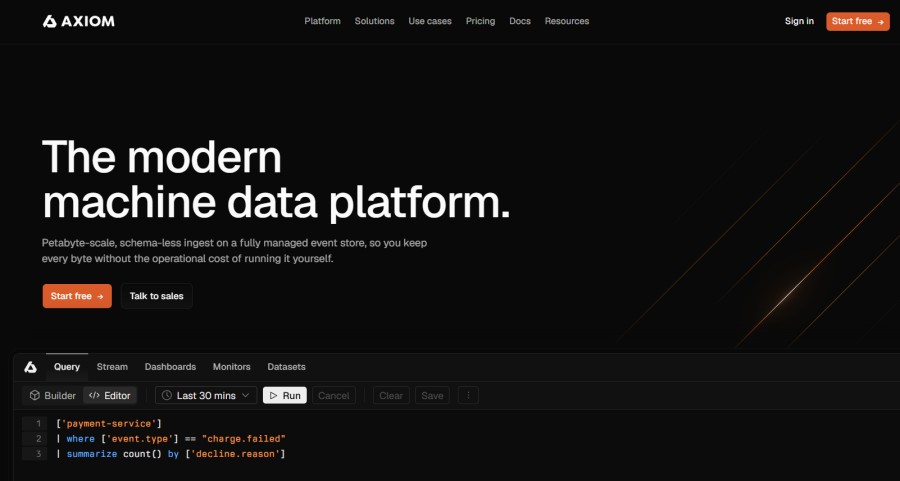
Axiom is a SaaS log management and event intelligence platform designed for teams that need to ingest large volumes of logs, metrics, traces, and events without hitting hard retention limits. It positions itself as a modern alternative to legacy log platforms that enforce strict retention caps or charge prohibitively for long-term storage.
The platform is fully managed, runs on cloud infrastructure, and focuses on three core capabilities: ingesting telemetry data from any source, running fast queries across billions of events, and storing data for as long as needed without separate cold storage tiers.
Axiom supports OpenTelemetry natively, which means it works with existing instrumentation from Prometheus, Elastic, Datadog, or New Relic agents. This makes migration incremental rather than a hard cutover.
Key use cases include centralized log management for microservices, real-time event analytics, compliance logging with long retention requirements, and debugging production issues with full context across all signals.
How Axiom Pricing Works
Axiom uses a three-part pricing model: data loading compute, query compute, and storage. Each dimension is billed separately, and costs scale with usage. Automatic volume discounts apply as usage grows.
Data Loading Compute
Every GB of data you send to Axiom is processed and optimized before it can be queried. This processing consumes compute resources, measured in credits. Axiom charges based on the volume of data loaded, and the rate decreases as your volume increases.
According to Axiom’s pricing page, data loading rates start higher for lower volumes and drop automatically at higher tiers. For example, the first 100 GB per month might cost more per GB than data loaded beyond 1 TB per month.
This automatic tiering means you do not need to negotiate or pre-commit to get volume discounts. The system applies them as your usage crosses each threshold.
Query Compute
Query compute is measured in GB-hours: the amount of memory allocated multiplied by the duration of the query. Axiom estimates that typical log management workloads consume about 20% of data loading volume in query compute, though your actual usage will vary based on query complexity and frequency.
If you ingest 10 TB per month, Axiom estimates you will use around 2,000 GB-hours of query compute. Query compute pricing also benefits from automatic volume discounts.
Storage
Storage is billed per GB of compressed data per month. Axiom reports 95% average compression, which means 1 TB of raw logs might only consume 50 GB of storage after compression.
Storage pricing varies by cloud provider and region. Axiom provides pricing breakdowns for AWS, Azure, and GCP deployments on their pricing page.
Retention is configurable. You pay for the actual storage consumed, so longer retention periods increase your storage costs proportionally. There are no separate cold storage tiers — all data remains queryable at full speed regardless of age.
Enterprise Add-Ons
Axiom offers enterprise features as optional add-ons, billed separately:
- SSO (Single Sign-On): authenticate users through your existing identity provider
- RBAC (Role-Based Access Control): define granular permissions for teams
- SCIM (System for Cross-domain Identity Management): automatically provision and manage users from your directory
- Audit Logs: track all actions taken within your Axiom organization for compliance and security investigations
These add-ons are priced separately and listed on the Axiom pricing page.
Axiom Plans and Tiers
Axiom offers three main plans: Personal (free), Team (pay-as-you-go), and Enterprise (custom pricing).
Personal Plan
The Personal plan is free and includes:
- 500 GB/month data loading
- 10 GB-hours/month query compute
- 25 GB storage
This plan is ideal for individual developers, small projects, or evaluation. It gives access to core capabilities without financial commitment.
Team Plan
The Team plan is Axiom’s pay-as-you-go tier. You pay for usage beyond the Personal allowance at the rates listed on Axiom’s pricing page.
Usage beyond the included allowances is billed based on the volume tiers described earlier. You can add SSO, RBAC, SCIM, and audit logs as paid add-ons.
This plan works for teams that want to start small and scale usage without negotiating contracts. All usage is billed monthly based on actual consumption.
Enterprise Plan
The Enterprise plan includes custom pricing, volume discounts beyond the standard automatic tiers, and access to optional services like dedicated support and professional training.
Enterprise pricing is available under NDA with a minimum annual spend. For details, contact Axiom directly via their pricing page.
Key Features of Axiom
Axiom delivers a set of capabilities focused on ingesting, querying, and retaining telemetry data at scale.
Fast Query Performance
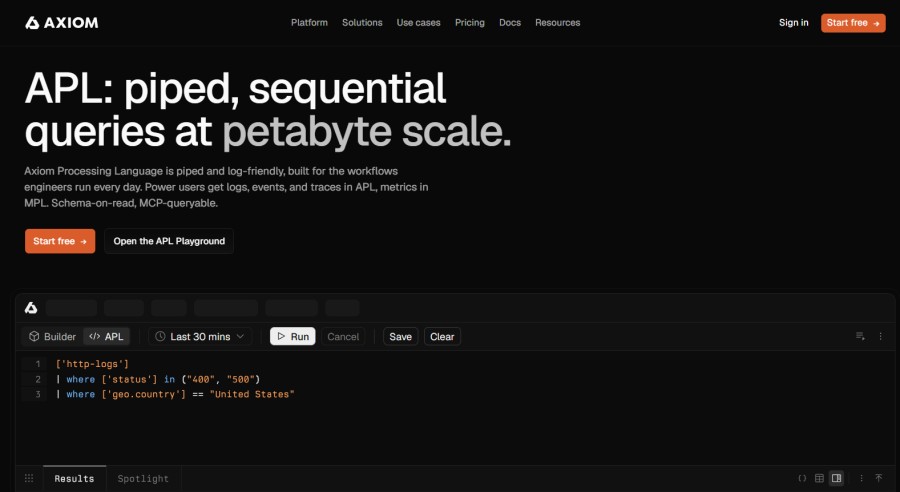
Axiom is built for fast queries across billions of events. The query engine is designed to handle high-cardinality data, which means you can filter by specific pod labels, user IDs, trace IDs, or custom fields without hitting performance degradation.
Query performance is consistent regardless of data age. A query across the last 30 days runs at the same speed as a query across the last 12 months.
Unlimited Data Retention
Axiom does not enforce retention limits. You can store data for as long as you need, and all stored data remains queryable. This is useful for compliance, long-term trend analysis, and post-incident forensics.
Because storage is billed per GB per month, longer retention increases your storage bill, but there are no separate archival or cold storage tiers. All data is indexed and searchable at full speed.
OpenTelemetry Native Support
Axiom supports OpenTelemetry natively, which means it works with existing instrumentation from tools like Prometheus, Elastic, Datadog, and New Relic. You can send logs, metrics, and traces using OpenTelemetry collectors without reworking your pipeline.
This makes migration incremental. You can start sending a subset of your telemetry to Axiom while keeping your existing stack in place, then shift more traffic over time.
Automatic Volume Discounts
Axiom applies volume discounts automatically as your usage grows. You do not need to negotiate or pre-commit. The system adjusts your rate per GB as you cross each tier threshold.
This transparency reduces surprise billing and makes cost modeling simpler.
Usage Dashboards and Alerts
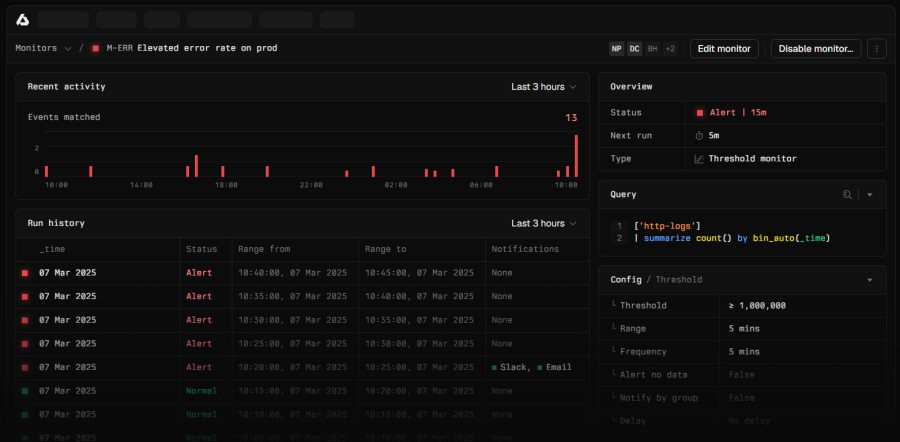
Axiom provides dashboards that show real-time usage across data loading, query compute, and storage. You can set alerts to notify you when usage crosses specific thresholds, which helps prevent unexpected bills.
You can also configure spending caps to limit usage if you want to enforce a budget ceiling.
What Axiom Is Good At
Axiom excels in scenarios where log volume is high, retention requirements are long, and teams need fast queries without managing infrastructure.
Compliance and regulatory logging: Teams in finance, healthcare, or government often need to retain logs for months or years. Axiom’s unlimited retention with no cold storage tiers makes this straightforward.
High-cardinality debugging: When you need to filter logs by specific trace IDs, user sessions, or Kubernetes pod labels, Axiom’s query engine handles it without slowdown.
OpenTelemetry adoption: If you are already using OpenTelemetry or planning to, Axiom integrates natively. You do not need to swap agents or rewrite pipelines.
Incremental migration: Axiom works alongside existing tools like Datadog, New Relic, or Elastic. You can route a subset of telemetry to Axiom while keeping your current stack in place.
What Axiom Is Not Good At (Sourced Drawbacks)
While Axiom delivers strong capabilities in log management and event analytics, there are trade-offs.
Cloud-Only Deployment
Axiom is SaaS only. There is no self-hosted option, no VPC-hosted deployment, and no on-premises version. All telemetry data is sent to Axiom’s cloud infrastructure.
For teams with strict data residency requirements, HIPAA constraints, or internal policies that prohibit external telemetry exports, this rules Axiom out. Tools like CubeAPM, Grafana, or self-hosted Elastic APM run inside your own infrastructure and keep data local.
Public Cloud Egress Costs
Because Axiom runs in the cloud, you pay public cloud egress fees to send data from your VPC to Axiom’s endpoints. AWS charges approximately $0.09/GB for data transfer out, which adds a hidden cost layer not included in Axiom’s advertised pricing.
For a team ingesting 10 TB per month, that is $900/month in AWS egress fees before any Axiom charges. This cost scales linearly with ingestion volume and is often overlooked during initial pricing estimates.
Self-hosted tools avoid this entirely because telemetry stays within your VPC.
Limited Full Stack Observability
Axiom focuses on logs, metrics, traces, and events. It does not provide native application performance monitoring (APM), real user monitoring (RUM), synthetic monitoring, or infrastructure monitoring dashboards.
If you want distributed tracing visualization, service maps, or end-to-end observability across application and infrastructure layers, you will need to integrate Axiom with other tools or use a full-stack platform like Datadog, Dynatrace, or CubeAPM.
No On-Call Alerting Features
Axiom provides usage alerts and billing thresholds, but it does not include on-call management, incident response workflows, or integrations with PagerDuty, Opsgenie, or Slack for alert routing.
Teams that need robust alerting workflows typically pair Axiom with dedicated alerting platforms or use observability tools that include native alerting.
Pricing based on publicly available information as of April 2026. Enterprise discounts, custom contracts, and negotiated rates are not reflected here.
Axiom vs. Alternatives: Where It Fits
Axiom competes with both legacy log platforms and modern observability tools. Here is where it fits relative to common alternatives.
Axiom vs. Datadog
Datadog offers full-stack observability: APM, logs, infrastructure, RUM, synthetics, and security monitoring all in one platform. It charges per host, per log ingestion, per indexed event, and per feature.
For a team with 50 hosts ingesting 10 TB of logs per month, Datadog costs approximately $8,185 per month, including APM, infrastructure monitoring, and log indexing. That figure excludes RUM, synthetics, and custom metrics. Detailed cost breakdowns are available on the Datadog pricing calculator.
Axiom costs less for pure log management because it does not charge per host or per feature. But Datadog delivers broader observability coverage, including APM and RUM, which Axiom does not provide natively.
If you need logs only and want to avoid per-host billing, Axiom is cheaper. If you need full-stack observability in one tool, Datadog delivers more out of the box.
Axiom vs. CubeAPM
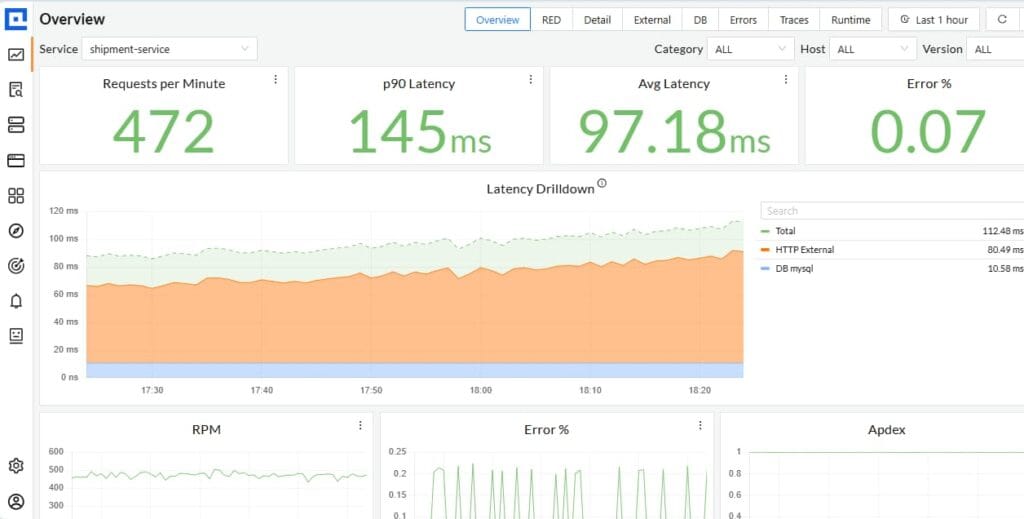
CubeAPM is a self-hosted, OpenTelemetry-native observability platform that includes APM, logs, infrastructure monitoring, Kubernetes monitoring, RUM, synthetics, and error tracking. It runs inside your VPC or on-premises, which eliminates public cloud egress fees and keeps telemetry data local.
CubeAPM charges $0.20/GB for data ingestion with unlimited retention, no per-host fees, and no separate charges for querying or indexing. For 10 TB per month, that is $2,000 total – no egress fees, no separate storage billing, no user seat costs.
Axiom charges separately for data loading, query compute, and storage. For the same 10 TB per month workload, Axiom’s estimated cost is approximately $2,080 per month (based on public rate cards and typical query patterns). That figure excludes AWS egress fees, which add another $900 per month.
CubeAPM is better for teams that need full-stack observability, data residency compliance, and predictable pricing. Axiom is better for teams that prefer SaaS, do not want to manage infrastructure, and primarily need log management without APM or RUM.
Axiom vs. Elastic (ELK Stack)
Elastic is a self-hosted or SaaS platform built around Elasticsearch, Logstash, and Kibana. It delivers log management, APM, infrastructure monitoring, and security analytics.
Self-hosted Elastic is free but requires significant operational overhead. You manage Elasticsearch clusters, tune indexing and retention, configure scaling, and handle backups. For teams with deep Elastic expertise, this works well. For teams without dedicated platform engineers, the operational burden is high.
Elastic Cloud (managed SaaS) starts at $99 per month for the Standard plan, but costs scale quickly with data volume and retention. Elastic Cloud pricing is based on deployment size, which makes cost modeling more complex than Axiom’s per-GB ingestion model.
Axiom is simpler to deploy and operate than self-hosted Elastic. Elastic Cloud and Axiom both charge for usage, but Elastic Cloud requires more tuning and configuration to optimize costs.
Axiom vs. Splunk
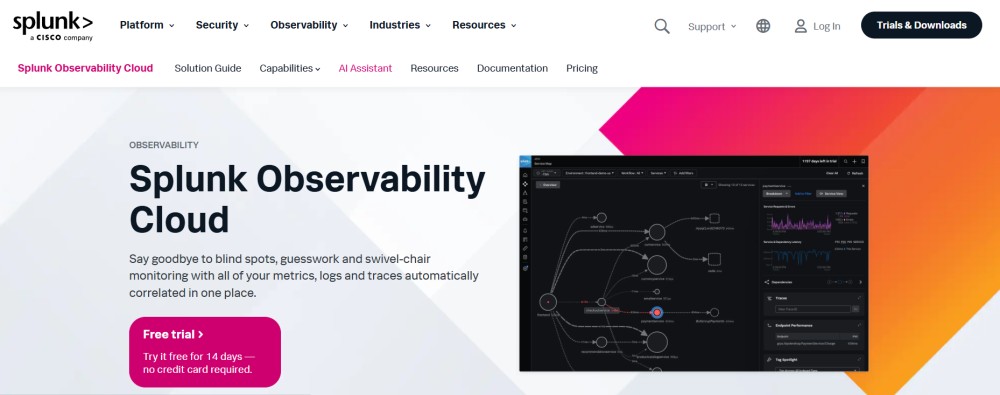
Splunk is an enterprise log management and SIEM platform with deep analytics capabilities and strong security tooling. It is widely used in regulated industries for compliance logging and threat detection.
Splunk pricing is based on daily ingestion volume and typically starts higher than Axiom. Splunk also enforces retention limits unless you pay for extended storage, which adds cost.
For teams that need SIEM, security analytics, or deep integration with enterprise IT workflows, Splunk delivers more. For teams that need high-volume log management with long retention and fast queries, Axiom is simpler and cheaper.
Feature availability may vary by plan tier. Verify current feature sets on each vendor’s official documentation.
How to Evaluate Axiom for Your Team
If you are considering Axiom, run through these five questions before committing.
1. What is your total monthly log volume?
Axiom’s pricing scales with ingestion volume. Estimate your average monthly volume across all services and environments. If you are currently using Datadog, New Relic, or Splunk, check your usage dashboards to find your current ingestion rate.
2. What retention period do you need?
Axiom charges per GB of storage per month. If you need 12 months of retention, multiply your monthly ingestion volume by 12, apply Axiom’s 95% compression estimate, and calculate storage cost.
For 10 TB per month with 12 months retention: 10,000 GB/month × 12 months × 0.05 (compression ratio) = 6,000 GB stored × storage rate per GB.
3. How complex are your queries?
Axiom estimates query compute at 20% of data loading volume for typical log workloads. If your team runs complex aggregations, high-frequency queries, or large-scale analytics, your query compute usage will be higher.
4. Do you need APM, RUM, or infrastructure monitoring?
Axiom focuses on logs, metrics, traces, and events. If you need distributed tracing visualization, service maps, real user monitoring, or infrastructure dashboards, you will need to integrate Axiom with other tools or use a platform that includes those features natively.
5. Do you have data residency or compliance requirements?
Axiom is cloud-only. If you need to keep telemetry data inside your own VPC, on-premises, or in a specific geographic region for regulatory reasons, Axiom will not work. Self-hosted tools like CubeAPM, Grafana, or Elastic are better fits.
Conclusion
Axiom delivers a transparent, usage-based pricing model with automatic volume discounts, unlimited retention, and fast query performance across high-cardinality log data. It works well for teams that need to ingest large volumes of telemetry without hitting retention limits or managing infrastructure.
The trade-offs are clear: Axiom is cloud-only, which means no data residency control and no ability to avoid public cloud egress fees. It does not include native APM, RUM, or infrastructure monitoring, so teams that need full-stack observability will need to integrate additional tools.
For teams that want a managed log platform with transparent pricing and strong OpenTelemetry support, Axiom is a solid choice. For teams that need self-hosted deployment, full-stack observability, or lower total cost of ownership at scale, platforms like CubeAPM or self-hosted Grafana stacks are better fits.
Disclaimer: The information in this article reflects the latest details available at the time of publication and may change as technologies and products evolve. Features, pricing, and plan limits can change over time. Always verify the latest information directly with the vendor before making purchasing or deployment decisions.
Frequently Asked Questions
Is Axiom free to use?
Yes, Axiom offers a free Personal plan with 500 GB/month data loading, 10 GB-hours/month query compute, and 25 GB storage. This is ideal for individual developers, small projects, or evaluation.
How much does Axiom cost at scale?
Axiom pricing depends on data loading volume, query compute usage, and storage. For 10 TB per month with typical query patterns and 30 days retention, estimated cost is around $2,080 per month based on public rate cards as of April 2026. Verify current rates on Axiom’s pricing page.
Does Axiom support self-hosted deployment?
No, Axiom is cloud only. There is no self-hosted or VPC-hosted option. All telemetry data is sent to Axiom’s cloud infrastructure.
Does Axiom support OpenTelemetry?
Yes, Axiom supports OpenTelemetry natively. You can send logs, metrics, and traces using OpenTelemetry collectors without reworking your pipeline.
What retention limits does Axiom enforce?
Axiom does not enforce retention limits. You can store data for as long as you need. All stored data remains queryable at full speed. Retention duration affects your storage bill, which is charged per GB per month.
Does Axiom include APM or RUM?
No, Axiom focuses on logs, metrics, traces, and events. It does not provide native application performance monitoring (APM) or real user monitoring (RUM). For full-stack observability, you will need to integrate other tools.
How does Axiom pricing compare to Datadog?
Axiom is cheaper than Datadog for pure log management because it does not charge per host or per feature. Datadog delivers broader observability coverage including APM and RUM, which Axiom does not provide natively. For detailed cost comparisons, see the Datadog pricing calculator.