










Atatus is a full-stack observability and APM platform for teams that need visibility across applications, infrastructure, logs, APIs, databases, network activity, security signals, and real user experience. Its main strengths are broad monitoring coverage, no user-based pricing, fast setup, responsive support, and an on-premises option for teams that need stronger data control.
Atatus pricing and reviews matter because its official pricing is quote-based. For buyers, the real question is not only the starting price but also how request volume, infrastructure size, RUM usage, logs, synthetics, and security modules affect the final bill.
In this guide, we verify Atatus pricing, billing units, features, user reviews, estimated costs, and key trade-offs. We also compare Atatus with alternatives, including CubeAPM, Datadog, Middleware, New Relic, and Dynatrace so you can decide which observability platform fits your stack, budget, and deployment needs.
What Is Atatus?
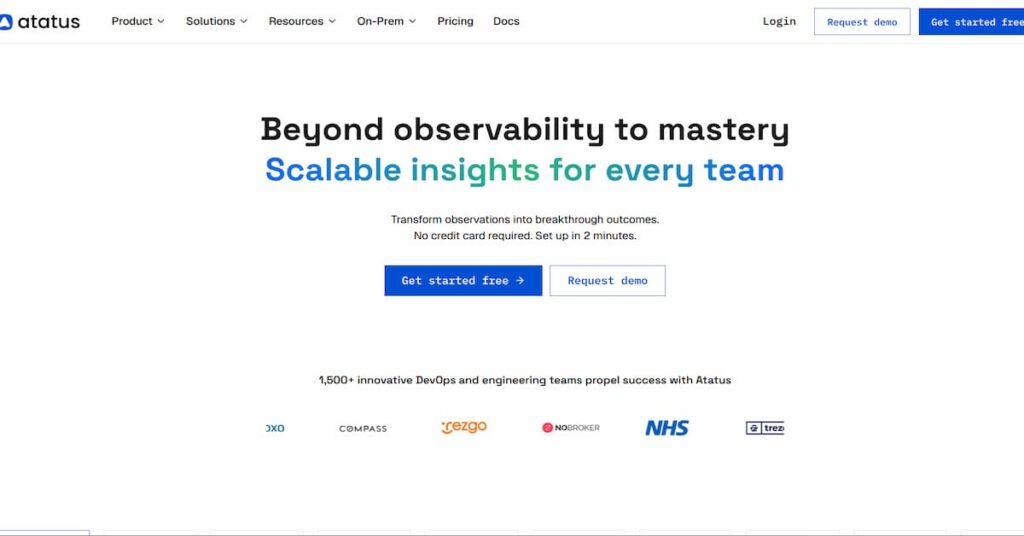
Atatus is a SaaS-delivered observability platform with an on-premises deployment option. It is designed to help teams monitor application performance, infrastructure health, logs, APIs, databases, network behavior, security events, and real user experience from one platform.
The platform helps teams detect anomalies, investigate performance problems, correlate signals, and reduce incident resolution time. Atatus’s G2 product description says it combines full-stack observability with API intelligence, database and network monitoring, security log analysis, and AI-driven signal correlation.
Atatus also promotes an on-premises deployment option for teams that need stronger data control, full customization, and compliance-driven data sovereignty.
Key Features of Atatus
Atatus APM provides transaction visibility, code-level tracing, database and external service monitoring, error tracking, infrastructure and runtime metrics, advanced diagnostics, real-time alerting, deployment tracking, built-in integrations, unlimited applications, and unlimited team members. These are listed directly on Atatus’s official pricing page.
Atatus says APM pricing is based on the number of requests processed. Multiple applications and multiple environments can be monitored under one plan as long as the combined request volume stays within the plan allowance.
Atatus RUM captures performance metrics, JavaScript errors, real user journeys, Web Vitals, sessions, browser/device/location context, AJAX calls, and frontend error data. Its RUM page positions the product around real user visibility, frontend performance, Core Web Vitals, JavaScript errors, and user-experience troubleshooting.
Atatus Infrastructure Monitoring covers servers, hosts, containers, and cloud infrastructure. G2’s Atatus media section describes the product as helping detect resource bottlenecks and infrastructure anomalies in real time.
Atatus lists Kubernetes Monitoring and Container Monitoring as product areas in its documentation and product navigation. This makes it relevant for teams running containerized and cloud-native environments.
Atatus offers log management and log monitoring, and G2’s product media summary describes it as supporting log search, analysis, and correlation with application traces for root-cause analysis.
Atatus lists database monitoring, network monitoring, network path monitoring, and network device monitoring as platform capabilities. G2 also describes Atatus as bringing together databases, network activity, logs, APIs, infrastructure, and user experience in one unified platform.
Atatus lists API Analytics and Serverless Monitoring as product areas in its documentation and navigation. These extend the platform beyond traditional APM into APIs and event-driven workloads.
Atatus announced Synthetic Monitoring as a platform capability in 2025. It supports API tests, multistep API tests, HTTP tests, SSL tests, TCP tests, DNS tests, ICMP tests, alerting, and checks from managed or private locations.
Atatus lists application security management, vulnerability management, sensitive data classification, SIEM, security logs, and file integrity monitoring under its security product category.
Atatus also lists SOC 2 Type II, GDPR, and ISO 27001 under Security & Compliance on its site.
Atatus Pricing in 2026
Atatus currently uses a custom pricing model on its official pricing page. The official page does not publish a fixed APM rate. Instead, it asks buyers to get a tailored pricing plan based on infrastructure size, data volume, and monitoring needs.
The official pricing page also says Atatus has no user-based pricing, no complex pricing tiers, no hidden fees, no surprise overages, and no credit card required to start.
Official Atatus Pricing
Atatus’s official APM pricing page confirms these points:
| Pricing detail | Verified status |
| Official fixed APM price | Not published |
| Pricing model | Custom pricing |
| Quote basis | Infrastructure size, data volume, and monitoring needs |
| APM billing logic | Based on requests processed |
| Multiple environments | No extra charge if request volume stays within allowance |
| Free trial | 14-day APM free trial |
| Support | Included in all subscription plans |
| Priority support | Available for enterprise plans |
| Team members | Unlimited team members listed for APM |
| Applications | Unlimited applications listed for APM |
What Counts Toward Atatus Billing?
Atatus officially confirms that APM pricing is based on the number of requests processed. It also confirms that multiple applications and environments can be monitored within one plan as long as the total request volume stays within the plan allowance. If the request limit is exceeded, Atatus says it notifies the customer and allows an upgrade.
Atatus does not publicly provide a complete official rate card for RUM sessions, log volume, synthetic checks, infrastructure host-hours, security logs, or database monitoring on the current pricing page. For those modules, buyers should treat pricing as quote-based unless Atatus provides a current rate in writing.
What Drives Atatus Costs?
- Request volume: Atatus officially says APM pricing is based on requests processed. Higher request volume can increase the plan requirement.
- Infrastructure size: Atatus official pricing says quotes are tailored based on infrastructure size. Its homepage also describes pricing as scaling with infrastructure rather than team size.
- Data volume: Atatus official pricing says data volume is one factor in tailored pricing.
- Module mix: Atatus offers APM, RUM, infrastructure, logs, synthetics, Kubernetes, database monitoring, API analytics, and security modules. Enabling more products can change the quote.
- Deployment model: Atatus offers SaaS and promotes an on-premises deployment option for teams needing control and data sovereignty.
- No per-user pricing: Atatus says it does not use user-based pricing, and its APM page lists unlimited team members.
Additional Costs Buyers Should Plan For
| Cost area | Why it matters |
| APM request growth | APM is request-based, so high-traffic applications need careful usage modeling. |
| Autoscaling | G2’s AI review summary says some users find pricing confusing, especially with autoscaled services. |
| RUM growth | Atatus supports RUM, but official public pricing does not show a full per-session rate card. |
| Synthetic checks | Atatus supports synthetic monitoring, but official public per-run pricing is not published. |
| Logs and security data | Log management and security modules are supported, but final cost should be confirmed by quote. |
| On-prem infrastructure | On-prem deployment may improve control but requires customer-side compute, storage, and operations planning. |
Atatus User Reviews
Atatus has strong review scores, but the review base is concentrated mostly on G2 and Capterra.
| Review source | Rating |
| G2 | 4.7/5 from 90 reviews |
| Capterra | 4.8/5 from 19 reviews |
| Gartner Peer Insights | 4.0/5 from 1 rating |
What Users Like
- Ease of setup and use: G2’s review summary says users consistently praise Atatus for ease of use, fast setup, and gaining application performance insights quickly.
- Customer support: G2 review excerpts mention excellent customer support, and the AI review summary lists customer support as one of the most repeated positive themes.
- Full-stack coverage: Reviewers value that Atatus can combine application tracing, infrastructure, container status, browser-based information, and logs in one tool.
- Time to value: G2 lists average time to implement as 1 month and average return on investment as 9 months, based on real user reviews.
- No per-user pricing: This is an official pricing advantage because Atatus states it does not use user-based pricing, and APM includes unlimited team members.
What Users Dislike
- Pricing can be confusing in autoscaled environments: G2’s AI-generated review summary says some users find the pricing model confusing, especially with autoscaled services.
- Interface depth has a learning curve: A Gartner Peer Insights reviewer said the interface is complicated and some menus are confusing. A G2 reviewer also described the UI as complicated in places.
- Framework coverage may need validation: A Gartner reviewer said their team had Laravel support but had to write custom code for Yii2. Atatus now has a Yii monitoring page, so teams using niche frameworks should validate support during trial rather than relying on old assumptions.
- Trace drill-down limitations: The same Gartner reviewer said it was not possible to see the exact file or row for a slow request in Transactions or Session Traces.
- Small enterprise review base: G2 shows 68 small-business reviews, 18 mid-market reviews, and only 2 enterprise reviews, so large enterprises should run a careful pilot.
Atatus Alternatives: How it Compares to Competitors
Atatus vs CubeAPM
CubeAPM is a self-hosted, OpenTelemetry-native observability platform with predictable ingestion pricing. CubeAPM lists pricing at $0.15/GB of data ingestion and says it deploys in the customer’s infrastructure while upgrades, patches, and support are handled by CubeAPM.
CubeAPM is a strong alternative for teams that want a predictable per-GB model, full data ownership, and OpenTelemetry-native ingestion. Atatus is stronger for teams that want a managed platform with broad modules and no per-user pricing, but buyers should confirm the full quote before committing.
| Category | Atatus | CubeAPM |
| Deployment | SaaS plus on-prem option | Self-hosted in customer infrastructure |
| Pricing model | Custom; APM request-based | $0.15/GB ingestion |
| Data ownership | SaaS-hosted or on-prem | Telemetry stays in customer environment |
| OpenTelemetry | Supported | OpenTelemetry-native |
| Per-user fees | No user-based pricing | No per-user fees listed on pricing positioning |
| Best for | Teams wanting managed observability with broad modules | Teams needing self-hosted observability, data control, and predictable per-GB costs |
Atatus vs Datadog
Datadog is a broad SaaS observability platform with product-based and host-based pricing. Atatus is positioned around custom pricing, no user-based pricing, and request-based APM. Datadog’s pricing page is modular, while third-party pricing analyses commonly cite infrastructure at $15/host/month and APM at $31/host/month on annual plans.
| Category | Atatus | Datadog |
| Pricing model | Custom; APM request-based | Modular, per product and per host |
| APM | Request-based | Commonly listed at $31/host/month |
| Infrastructure | Quote-based/current official rate not published | Commonly listed at $15/host/month for Pro |
| Per-user fees | No user-based pricing | Varies by product/plan |
| Best for | Teams wanting broad coverage without per-seat pricing | Teams wanting a mature SaaS platform with a large integration ecosystem |
Atatus vs New Relic
New Relic uses data-ingest pricing with 100 GB/month included on its free tier. Its pricing page lists Standard data ingest at $0.40/GB beyond the free 100 GB limit and Data Plus at $0.60/GB.
| Category | Atatus | New Relic |
| Pricing model | Custom; APM request-based | Per-GB data ingest plus user editions |
| Free tier | 14-day APM trial | 100 GB/month free ingest |
| Per-user fees | No user-based pricing | User pricing applies by edition |
| Best for | Teams avoiding per-seat pricing | Teams wanting ingest-based SaaS pricing and a generous free tier |
Atatus vs Dynatrace
Dynatrace is an enterprise-focused observability platform with consumption pricing. Its rate card lists Full-Stack Monitoring at $0.01 per memory-GiB-hour and Infrastructure Monitoring at $0.04 per hour for any-size host.
| Category | Atatus | Dynatrace |
| Pricing model | Custom; request/infrastructure/data factors | Consumption-based |
| Full-stack monitoring | Yes | Yes |
| AI/automation | AI-SRE driven positioning | Davis AI |
| Target market | Startups, SMBs, mid-market, and enterprises | Strong enterprise focus |
| Best for | Teams wanting broad observability with no per-user pricing | Large enterprises needing deep automation and AIOps |
Is Atatus the Right Choice?
When Atatus Works Best
Atatus is a good fit when:
- You want full-stack observability without per-user pricing.
- You want APM, RUM, infrastructure monitoring, logs, synthetics, databases, networks, APIs, and security signals in one platform.
- Your team values fast setup and responsive support, which are repeated positive themes in G2 reviews.
- You are evaluating a Datadog or New Relic alternative with a lower entry point.
- You use supported runtimes such as PHP, Node.js, Java, Python, Go, .NET, Ruby, Laravel, Symfony, Express, Django/Flask-style Python environments, React, Angular, or Vue.
- You need an on-premises option for stronger control and data sovereignty.
When Atatus May Not Be the Right Fit
Atatus may not be ideal when:
- You need strict budget predictability in autoscaled environments. G2’s review summary specifically says some users find pricing confusing, especially for autoscaled services.
- You require a public, complete rate card. Atatus’s official pricing page is custom, so buyers need a quote for the complete cost.
- You use niche frameworks. A Gartner reviewer mentioned needing custom work for Yii2, so teams on less common stacks should test support directly.
- You need very deep trace-level code granularity. A Gartner reviewer said they could not see the exact file or row for some slow requests.
- You are a very large enterprise and need extensive enterprise validation. G2 shows only 2 enterprise reviews, compared with 68 small-business and 18 mid-market reviews.
Conclusion
Atatus is a capable full-stack observability platform with strong user ratings, broad product coverage, and a clear advantage for teams that do not want per-user pricing. Its strongest verified positives are ease of setup, customer support, broad monitoring coverage, and fast time to value.
The main pricing takeaway is that Atatus’s current official pricing is custom. Third-party sites list indicative figures such as $0.07/hour for APM, $0.021/hour for infrastructure, and $49/month entry pricing, but those should not be treated as official current rates. Buyers should request a quote and confirm request limits, RUM volume, synthetic checks, infrastructure pricing, logs, retention, security modules, and deployment costs.
Atatus is worth shortlisting for startups, SMBs, and mid-market teams that want broad observability without per-seat pricing. Teams that need stricter pricing predictability, self-hosted data ownership, or a simple per-GB cost model should also compare CubeAPM, Datadog, New Relic, and Dynatrace before committing.
FAQs
1. What is Atatus’s starting price?
Atatus does not publish a fixed starting price on its current official pricing page. The official page says pricing is custom and based on infrastructure size, data volume, and monitoring needs. Third-party listings show indicative figures such as $0.07/hour for APM, $0.021/hour for infrastructure, and $49/month entry pricing, but buyers should confirm current pricing directly with Atatus.
2. Does Atatus have a free trial?
Yes. Atatus’s official pricing page says APM includes a 14-day free trial and does not require a credit card.
3. How does Atatus billing work?
Atatus says APM pricing is based on the number of requests processed. Multiple applications and environments can be monitored under one plan as long as total request volume stays within the plan allowance. If the limit is exceeded, Atatus notifies the customer and allows an upgrade.
4. What products does Atatus offer?
Atatus offers application performance monitoring, real user monitoring, infrastructure monitoring, log management, synthetic monitoring, error tracking, API analytics, Kubernetes monitoring, database monitoring, serverless monitoring, container monitoring, and application security features.
5. What are the best Atatus alternatives?
The best Atatus alternatives include Datadog, New Relic, Dynatrace, and CubeAPM. Datadog is strong for broad SaaS observability, New Relic is strong for ingest-based pricing and a free tier, Dynatrace is strong for large enterprises and AI-driven observability, and CubeAPM is strong for self-hosted OpenTelemetry-native observability with predictable per-GB pricing.