










Mezmo, formerly LogDNA, is a telemetry pipeline and log management platform for SRE, DevOps, platform engineering, and security teams. Its current positioning focuses on telemetry control, AI-ready context, and agentic root cause analysis across high-volume logs, metrics, and traces.
Mezmo pricing matters because it is not mainly priced by hosts, users, or vCPUs. Mezmo’s clearest public pricing announcement lists $0.20 per GB ingested and $0.20 per GB retained monthly for contract customers, which makes cost easier to model but still very sensitive to data volume and retention policy.
This review explains Mezmo pricing, what affects real-world cost, what users like and dislike, and how it compares with alternatives such as CubeAPM, Datadog, New Relic, Grafana Cloud, Elastic Observability, and Netdata.
What Is Mezmo?
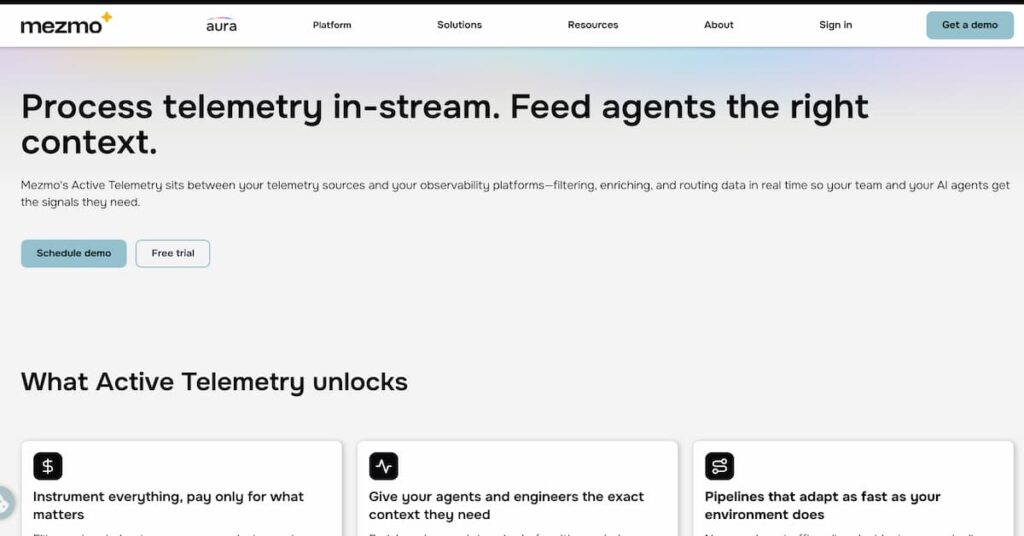
Mezmo is a telemetry data platform that helps teams collect, process, transform, route, and analyze observability data. It started as LogDNA, a log management product, and rebranded to Mezmo in 2022 to reflect a broader focus on observability and telemetry workflows.
Today, Mezmo is best understood as a telemetry pipeline and log-management-centered platform. Its product pages emphasize telemetry pipelines, Mezmo Edge, AI-ready context, agentic root cause analysis, and data control rather than positioning it as a traditional host-based APM suite.
That distinction matters. Mezmo can process logs, metrics, and traces, but teams looking for one full-stack observability platform with native APM, infrastructure monitoring, RUM, synthetics, and dashboards should compare it carefully against broader observability platforms.
Supported Data Sources, Integrations, and Collection Options
Mezmo supports modern telemetry collection and routing workflows. Its pricing page says teams can ingest and transform high-volume logs, metrics, and traces through Mezmo Edge, OpenTelemetry, or direct connection.
| Area | Mezmo support |
| Telemetry signals | Logs, metrics, and traces through telemetry pipelines |
| Collection options | Mezmo Edge, OpenTelemetry, and direct connection |
| Local processing | Mezmo Edge can run pipelines in the customer environment |
| Alerts | Slack, PagerDuty, Datadog, and other alert integrations |
| Log workflows | Views, boards, alerts, archive, restoration, parsing, exclusion rules |
Mezmo Edge is especially important for teams that want local processing. Mezmo’s documentation says Edge lets teams run telemetry pipelines locally when they do not want to egress data directly to Mezmo SaaS, while pipeline metrics and management remain handled by Mezmo’s SaaS infrastructure.
Mezmo also supports alert workflows. Its documentation lists Slack and PagerDuty alert integrations, and its log management documentation mentions alerts, spike protection, archive, restoration, parsing, and exclusion rules.
Key Features of Mezmo
Mezmo’s telemetry pipeline helps teams enrich, reduce, transform, and route telemetry before it reaches downstream destinations. Mezmo says pipelines can help eliminate noisy logs, redundant traces, and metric sprawl while preparing cleaner data for observability tools and AI systems.
Mezmo Log Management lets teams ingest log data, optimize it through a telemetry pipeline, and route it to the right teams for real-time analysis. Its documentation highlights ingestion options, parsing, exclusion rules, variable retention, alerts, spike protection, archive, and restoration.
Mezmo Edge lets teams deploy telemetry processing closer to the source. This can be useful for reducing egress, filtering sensitive data, preprocessing telemetry, or controlling what data gets sent to cloud platforms. Mezmo says Edge runs locally, while management remains connected to Mezmo SaaS.
Mezmo supports OpenTelemetry-based collection and migration workflows. Its telemetry pipeline page references migration to OpenTelemetry, while its pricing page says teams can ingest and transform telemetry through OpenTelemetry.
Mezmo’s current pricing page says the platform prepares telemetry so AI systems can find root causes from structured context rather than noisy data. This is part of Mezmo’s newer positioning around AI-driven SRE workflows.
Mezmo’s pricing page says AI root cause analysis is included in the platform license, with no AI surcharges and no pay-per-query surprises. Mezmo also announced an AI-powered SRE agent for root cause analysis as part of its subscription.
Mezmo’s 2025 pricing announcement highlights cold storage and rehydration as part of its cost-control approach. Teams can retain what matters, archive older data, and restore it later when needed for debugging or analysis.
Mezmo Pricing in 2026
Mezmo’s current pricing page does not publish a full self-serve rate card for every plan. It says pricing is built for AI-driven SRE, based on telemetry volume and retention needs, and includes no AI surcharges or pay-per-query charges.
The clearest official pricing figure comes from Mezmo’s May 2025 announcement. Mezmo said its contract-customer pricing uses two components: $0.20 per GB ingested and $0.20 per GB retained monthly. The same announcement says this replaced a prior $1.80 per GB retained rate.
| Pricing component | Public rate | Billing logic |
| Data ingestion | $0.20/GB | Charged on telemetry processed |
| Data retention | $0.20/GB/month | Charged on retained searchable data |
| AI RCA | Included | No AI surcharge stated |
| Free trial | Available | Confirmed on Mezmo pricing page |
| Enterprise terms | Not fully public | Confirm with Mezmo |
📌 Important Note
The $0.20/GB ingestion and $0.20/GB retained monthly figures come from Mezmo’s official 2025 announcement for contract customers. The current pricing page confirms the broad pricing model, but it does not publish a complete calculator, volume discount table, or enterprise rate card.
Is There a Free Tier in Mezmo?
Mezmo’s current pricing page confirms that a free trial is available. It does not clearly publish a permanent free-tier entitlement table on the main pricing page.
Third-party pages such as G2 and Capterra still show older or self-service-style entries, including a $10/month starting point and usage-based pricing. However, those listings may reflect older LogDNA-era packaging or lower-volume self-service plans, so they should not be treated as the main source for current contract pricing.
How Mezmo Measures Usage
Mezmo’s public pricing is mainly tied to data volume and retention. That means buyers should focus less on hosts or seats and more on how much telemetry they send, how much they keep searchable, and how much data they filter or archive before retention.
| Usage factor | Why it matters |
| GB ingested | Drives ingestion cost |
| GB retained | Drives monthly retention cost |
| Retention period | Longer searchable retention increases retained volume |
| Filtering | Reduces noisy or low-value telemetry |
| Rehydration | Lets teams restore archived data when needed |
This is different from host-based tools. A team with 50 hosts and a team with 200 hosts could pay very different or similar Mezmo bills depending on how much telemetry they generate and retain.
What Does Mezmo Really Cost?
⚠️ Disclaimer
The scenarios below are directional editorial estimates, not official Mezmo quotes. They use Mezmo’s public $0.20/GB ingestion and $0.20/GB retained monthly figures from its May 2025 announcement. Actual cost can change based on contract terms, retention rules, volume discounts, filtering, archive strategy, and how retained data is measured in the final agreement.
Mezmo is not priced like a host-based APM platform. A 50-host team does not automatically pay for 50 hosts. The main planning question is: how many GB are ingested, and how many GB remain searchable each month?
For simple planning, the estimates below assume active retained data is roughly equal to the monthly ingested volume. Teams with shorter retention, stronger filtering, or more archive usage may pay less. Teams with longer searchable retention may pay more.
Pricing Assumptions Used in These Scenarios
| Scenario | Mezmo pricing anchor | Mezmo estimate | CubeAPM estimate |
| Small team | 1.1 TB ingested + 1.1 TB retained | ~$440/month | ~$522/month |
| Growing team | 5.4 TB ingested + 5.4 TB retained | ~$2,160/month | ~$919/month |
| Mid-market team | 27 TB ingested + 27 TB retained | ~$10,800/month | ~$4,594/month |
These estimates use 1 TB as roughly 1,000 GB for editorial simplicity. They do not include enterprise discounts, custom retention rules, premium support, professional services, or special contract terms.
Workload Assumptions Used for Mezmo Estimates
| Team size | Infrastructure context | Telemetry context | Mezmo usage assumption | Estimated Mezmo cost |
| Small team | ~10 hosts | ~1.1 TB/month | Ingest + retain 1.1 TB | ~$440/month |
| Growing team | ~50 hosts | ~5.4 TB/month | Ingest + retain 5.4 TB | ~$2,160/month |
| Mid-market team | ~250 hosts | ~27 TB/month | Ingest + retain 27 TB | ~$10,800/month |
The host count is included only to make the scenarios easier to understand. Mezmo’s public pricing announcement is based on data ingestion and retention, not host count.
Scenario 1: Small Team, ~10 Hosts
Situation
A small production team runs around 10 hosts and produces roughly 1.1 TB of monthly telemetry. The team wants centralized log visibility, telemetry filtering, alerting, and enough retention to troubleshoot recent production issues.
For Mezmo, the 10 hosts do not directly drive the main bill. The stronger cost driver is the 1.1 TB of telemetry ingested and the amount retained for search.
Why Teams at This Stage Consider Mezmo
Small teams may consider Mezmo because they want easier log centralization, faster search, Slack or PagerDuty-style alerts, and pipeline controls without managing their own logging stack. Mezmo’s UI, log management workflows, and pipeline controls can be attractive when teams are outgrowing basic cloud logs.
Estimated Profile
| Configuration | Detail |
| Telemetry context | ~1.1 TB/month |
| Mezmo usage assumption | 1.1 TB ingested + 1.1 TB retained |
| Pricing basis | $0.20/GB ingestion + $0.20/GB retained |
| Main cost driver | Data volume and retention |
Estimated Monthly Cost
| Component | Assumption | Monthly cost |
| Ingestion | 1,100 GB × $0.20/GB | ~$220 |
| Retention | 1,100 GB × $0.20/GB/month | ~$220 |
| AI RCA | Included, based on public pricing page | $0 separately |
| Estimated total | Small log/pipeline setup | ~$440/month |
CubeAPM Cost Comparison
| Platform | Pricing basis | Estimated monthly cost |
| Mezmo | 1.1 TB ingested + 1.1 TB retained | ~$440/month |
| CubeAPM | ~1.1 TB/month ingestion estimate | ~$522/month |
| Difference | Mezmo lower in this narrow scenario | ~$82/month |
What This Scenario Shows
At small scale, Mezmo can be cost-effective if the team mainly needs log management and telemetry pipeline controls. CubeAPM is not cheaper in this narrow estimate, but it covers a broader full-stack observability scope, including APM, metrics, traces, infrastructure monitoring, RUM, synthetics, and error tracking.
Scenario 2: Growing Team, ~50 Hosts
Situation
A growing SaaS team runs around 50 hosts and produces roughly 5.4 TB of monthly telemetry. The environment has more services, more deployments, more Kubernetes activity, and more noisy logs.
For Mezmo, the main cost is still the volume of telemetry ingested and retained. If the team retains the same amount it ingests, the monthly bill scales directly with GB volume.
Why Teams at This Stage Consider Mezmo
Teams at this stage often need stronger control over telemetry volume. Mezmo can help reduce noise, filter low-value data, route high-value data to the right systems, and prepare cleaner context for incident response or AI-assisted analysis.
Estimated Profile
| Configuration | Detail |
| Infrastructure context | ~50 hosts |
| Telemetry context | ~5.4 TB/month |
| Mezmo usage assumption | 5.4 TB ingested + 5.4 TB retained |
| Pricing basis | $0.20/GB ingestion + $0.20/GB retained |
| Main cost driver | Telemetry volume and retention |
Estimated Monthly Cost
| Component | Assumption | Monthly cost |
| Ingestion | 5,400 GB × $0.20/GB | ~$1,080 |
| Retention | 5,400 GB × $0.20/GB/month | ~$1,080 |
| AI RCA | Included, based on public pricing page | $0 separately |
| Estimated total | Growing log/pipeline setup | ~$2,160/month |
CubeAPM Cost Comparison
| Platform | Pricing basis | Estimated monthly cost |
| Mezmo | 5.4 TB ingested + 5.4 TB retained | ~$2,160/month |
| CubeAPM | ~5.4 TB/month ingestion estimate | ~$919/month |
| Estimated savings with CubeAPM | Difference vs Mezmo | ~$1,241/month |
| Percentage savings | $1,241 ÷ $2,160 | ~57% lower |
What This Scenario Shows
At growing-team scale, retention becomes a bigger part of the Mezmo bill. Mezmo can still be useful for pipeline control, but teams should be careful about keeping everything searchable. CubeAPM becomes more cost-effective in this estimate because it is priced around ingestion and does not add a separate retained-GB charge in the same way.
Scenario 3: Mid-Market Team, ~250 Hosts
Situation
A mid-market engineering team runs around 250 hosts and produces roughly 27 TB of monthly telemetry. The environment may include multiple Kubernetes clusters, customer-facing applications, backend services, APIs, queues, and security-relevant log streams.
At this size, Mezmo’s value is less about simple log centralization and more about telemetry control. Teams need to decide what data to keep, what to reduce, what to route, and what to archive.
Why Teams at This Stage Consider Mezmo
Mid-market teams may consider Mezmo because telemetry sprawl can become expensive and hard to manage. Mezmo’s pipeline approach is relevant when teams want to reduce redundant logs, transform telemetry before storage, and route data to observability, security, or AI systems.
Estimated Profile
| Configuration | Detail |
| Infrastructure context | ~250 hosts |
| Telemetry context | ~27 TB/month |
| Mezmo usage assumption | 27 TB ingested + 27 TB retained |
| Pricing basis | $0.20/GB ingestion + $0.20/GB retained |
| Main cost driver | Retained searchable telemetry |
Estimated Monthly Cost
| Component | Assumption | Monthly cost |
| Ingestion | 27,000 GB × $0.20/GB | ~$5,400 |
| Retention | 27,000 GB × $0.20/GB/month | ~$5,400 |
| AI RCA | Included, based on public pricing page | $0 separately |
| Estimated total | Mid-market log/pipeline setup | ~$10,800/month |
CubeAPM Cost Comparison
| Platform | Pricing basis | Estimated monthly cost |
| Mezmo | 27 TB ingested + 27 TB retained | ~$10,800/month |
| CubeAPM | ~27 TB/month ingestion estimate | ~$4,594/month |
| Estimated savings with CubeAPM | Difference vs Mezmo | ~$6,206/month |
| Percentage savings | $6,206 ÷ $10,800 | ~57% lower |
What This Scenario Shows
At mid-market scale, Mezmo’s cost depends heavily on retention strategy. If the team retains everything actively, the retained-data charge can match the ingestion charge. Strong filtering, archive, and rehydration policies become important. CubeAPM may be more cost-effective for teams that want broader full-stack observability under a predictable ingestion-based model.
Summary: Mezmo vs CubeAPM Estimated Monthly Cost
⚠️ Disclaimer
These are directional planning estimates, not official quotes. Mezmo’s final pricing can change with discounts, retention terms, contract size, and data filtering. CubeAPM’s value is strongest for teams that want full-stack observability without per-host fees, per-user fees, or separate pricing for every signal.
| Team profile | Mezmo estimate | CubeAPM estimate | Monthly savings with CubeAPM | Percentage savings |
| Small team | ~$440/month | ~$522/month | Mezmo lower by ~$82 | Mezmo lower |
| Growing team | ~$2,160/month | ~$919/month | ~$1,241/month | ~57% |
| Mid-market team | ~$10,800/month | ~$4,594/month | ~$6,206/month | ~57% |
The key point is scope. Mezmo is mainly a telemetry pipeline and log-management platform. CubeAPM is a broader full-stack observability platform covering logs, metrics, traces, APM, infrastructure monitoring, RUM, synthetics, and error tracking.
What Drives Mezmo Costs?
Ingestion is the first major cost driver. Mezmo’s official 2025 announcement lists ingestion at $0.20 per GB for contract customers. Teams with noisy logs, verbose application traces, or high-cardinality telemetry should estimate ingestion volume before purchase.
Retention is the second major cost driver. Mezmo’s public contract pricing lists retained data at $0.20 per GB per month. Long searchable retention can materially increase the bill, especially for teams generating several TB per month.
Filtering can reduce cost by removing noisy, duplicate, or low-value telemetry before it reaches storage or downstream tools. Mezmo’s telemetry pipeline page specifically emphasizes reducing noisy logs, redundant traces, and expensive metric sprawl.
Mezmo Edge can help teams process telemetry locally before sending selected data onward. This can matter for privacy, egress, compliance, and cost control, although the management plane still uses Mezmo SaaS infrastructure.
Archive and rehydration can reduce active retention cost. Mezmo’s pricing announcement describes cold storage and rehydration as part of its cost-control model, allowing teams to restore older data when needed.
Mezmo’s public pricing page does not publish all enterprise contract terms. Buyers should confirm committed volume, retention rules, overage pricing, support terms, free trial limits, and whether any legacy or self-service pricing applies to their account.
Mezmo User Reviews
Mezmo has solid public review visibility across G2 and Gartner Digital Markets properties. G2 lists Mezmo at 4.6/5 based on 224 reviews. Capterra lists Mezmo at 4.7/5 based on 42 reviews. GetApp lists Mezmo at 4.7/5 based on 42 user reviews and also shows user review content for Mezmo/LogDNA and reflects similar review themes around ease of use, Kubernetes logging, support, and search.
| Review source | Rating shown publicly | Review count |
| G2 | 4.6/5 | 224 |
| Capterra | 4.7/5 | 42 |
| GetApp | 4.7/5 | 42 |
What Users Like
Users commonly praise Mezmo for ease of use. G2’s review summary says users like the intuitive interface and simplified log management experience, while Capterra shows a high ease-of-use score.
G2’s review summary says users praise Mezmo’s search functionality, log aggregation, and real-time insights. This fits Mezmo’s core use case as a centralized log and telemetry workflow platform.
GetApp review text mentions teams getting started with centralized logging from Kubernetes and using Mezmo to support early production visibility. This makes Mezmo relevant for cloud-native teams that need fast log access across distributed services.
Capterra lists Mezmo’s customer service score at 4.8/5, and Mezmo documentation confirms integrations with Slack, PagerDuty, and other alerting tools. This is useful for teams that want log alerts to flow into incident workflows.
What Users Criticize
⚠️ Disclaimer
The following points reflect public user-review themes from review platforms. They are user claims, not universal limitations of Mezmo, and may not apply to every deployment.
G2’s review summary says some users note that costs can escalate as log volume increases. This is common with volume-based pricing and makes ingestion filtering important before scaling Mezmo broadly.
Software Advice review text mentions search friction, including the need to escape special characters and difficulty toggling between search styles. This does not mean Mezmo search is weak overall, but teams should test their real incident queries during trial.
Software Advice review text mentions indexing lag in some cases, where alerts could arrive before logs were easy to inspect. GetApp review text also includes user concerns around rough spots in the older LogDNA experience.
This is more of a buying consideration than a review complaint. Mezmo is strongest for telemetry pipelines and log workflows. Teams that want native APM, RUM, synthetics, infrastructure monitoring, and error tracking in one platform should compare it with broader observability tools.
Mezmo Alternatives: How It Compares to Competitors
Mezmo vs CubeAPM
Mezmo is a SaaS telemetry pipeline and log management platform with pricing based on data ingestion and retention. CubeAPM is a self-hosted, vendor-managed observability platform with $0.15/GB ingestion pricing and broader coverage across logs, metrics, traces, APM, infrastructure monitoring, RUM, synthetics, and error tracking.
| Category | Mezmo | CubeAPM |
| Primary focus | Telemetry pipelines and logs | Full-stack observability |
| Deployment | SaaS with Edge option | Self-hosted, vendor-managed |
| Pricing model | $0.20/GB ingest + $0.20/GB retained | $0.15/GB ingestion |
| Retention | Billed separately by retained GB | Flexible retention model |
| Best for | Pipeline control and log workflows | Full-stack observability with data control |
CubeAPM is the stronger fit when teams want self-hosted, OpenTelemetry-native observability with native logs, metrics, traces, APM, RUM, synthetics, and infrastructure monitoring in one platform. Mezmo is stronger when the priority is telemetry pipeline control, log routing, and AI-ready context.
Mezmo vs Datadog
Datadog is a broader SaaS observability platform covering infrastructure monitoring, APM, logs, RUM, synthetics, security, and many integrations. Datadog’s pricing is modular; its public list page shows Infrastructure Pro at $15 per host/month, with separate pricing across other products.
| Category | Mezmo | Datadog |
| Primary focus | Telemetry pipeline and logs | Full-stack SaaS observability |
| Pricing model | Ingest + retained GB | Per host, per GB, per feature |
| Logs | Core strength | Native log management |
| APM/RUM/Synthetics | Not the main platform focus | Native modules |
| Best for | Telemetry control | Broad SaaS observability |
Datadog is a better fit for teams that want one broad SaaS platform for infrastructure, APM, logs, RUM, synthetics, and security. Mezmo is more focused for teams that want to control telemetry before it reaches downstream systems.
Mezmo vs New Relic
New Relic uses usage-based pricing built around data ingestion and users. Its pricing page says every account includes 100 GB of free data ingest per month, then $0.40/GB beyond that.
| Category | Mezmo | New Relic |
| Pricing model | Ingest + retained GB | Data ingest + users |
| Free allowance | Free trial stated | 100 GB/month free ingest |
| Scope | Pipeline and log workflows | Full-stack observability |
| AI pricing | No AI surcharge stated | Depends on New Relic plan/features |
| Best for | Telemetry routing and retention control | Full-stack observability with ingest pricing |
New Relic is broader than Mezmo for application and infrastructure observability. Mezmo is more specialized for teams that want to reduce telemetry noise, route data, and prepare cleaner context for humans or AI systems.
Mezmo vs Grafana Cloud
Grafana Cloud is a managed observability platform built around Grafana dashboards, metrics, logs, traces, profiles, k6 testing, and the open-source Grafana ecosystem. Grafana’s pricing page lists Free and Pro options, and its billing documentation shows pricing units for metrics, logs, traces, profiles, k6, IRM, and database observability.
| Category | Mezmo | Grafana Cloud |
| Primary focus | Telemetry pipeline and logs | Dashboards and managed observability |
| Pricing model | Ingest + retained GB | Usage by signal and service |
| Dashboards | Log and telemetry workflows | Core strength |
| Open-source ecosystem | OpenTelemetry support | Strong Grafana ecosystem |
| Best for | Telemetry control | Visualization and managed OSS observability |
Grafana Cloud is stronger for teams that want managed Grafana, Prometheus/Mimir, Loki, Tempo, and dashboards. Mezmo is stronger for teams that need telemetry pipeline processing and routing before data reaches observability tools.
Mezmo vs Elastic Observability
Elastic Observability is part of Elastic Cloud and supports logs, metrics, APM, synthetics, and search-driven observability workflows. Elastic’s pricing page covers hosted, serverless, and self-managed options, while Elastic Observability Serverless lists usage-based components such as synthetic browser tests and other add-ons.
| Category | Mezmo | Elastic Observability |
| Primary focus | Telemetry pipeline and logs | Search-based observability |
| Deployment | SaaS with Edge option | Hosted, serverless, self-managed |
| Pricing model | Ingest + retention | Elastic Cloud consumption |
| Search | Log search workflows | Core Elasticsearch strength |
| Best for | Telemetry routing and reduction | Search-heavy observability and SIEM-adjacent workflows |
Elastic is stronger when teams want search, logs, APM, security analytics, and observability in the Elastic ecosystem. Mezmo is more focused on controlling telemetry before storage and routing.
Mezmo vs Netdata
Netdata is a real-time infrastructure monitoring platform with per-node pricing. Its pricing page says Netdata is free for up to 5 nodes and Business starts at $4.50/node/month when billed annually.
| Category | Mezmo | Netdata |
| Primary focus | Telemetry pipelines and logs | Real-time infrastructure monitoring |
| Pricing model | Ingest + retained GB | Per node/month |
| Metrics | Pipeline support | Core strength |
| Logs | Core workflow | Included in Netdata Business |
| Best for | Telemetry control | Infrastructure visibility |
Netdata is a better fit for teams that want lightweight, real-time infrastructure monitoring with simple per-node pricing. Mezmo is a better fit when the main problem is high-volume log and telemetry routing.
Is Mezmo the Right Choice?
Mezmo Works Best For
Mezmo is strongest when teams want to collect, filter, transform, enrich, and route telemetry across systems. Its telemetry pipeline page specifically emphasizes reducing noisy logs, redundant traces, and metric sprawl.
Mezmo is relevant for SRE teams that want AI-assisted incident investigation without separate AI query charges. Its pricing page says there are no AI surcharges and no pay-per-query surprises.
Mezmo can fit teams that generate large volumes of logs and need better routing, retention control, and cost management. The platform’s pricing announcement specifically frames the model around ingest, retention, local preprocessing, and cold storage.
Mezmo Edge is useful when teams want to process telemetry locally before sending selected data onward. This can matter for compliance, egress control, sensitive data handling, and reducing downstream volume.
Mezmo can work well when teams already use other observability, SIEM, or data tools and need a pipeline layer to clean and route telemetry before it reaches those destinations.
When Mezmo Might Not Be the Right Fit
⚠️ Disclaimer
The points below are based on public user-review themes from platforms such as G2, Capterra, GetApp, and Software Advice. They should be treated as user feedback and buying considerations, not universal limitations of Mezmo.
Mezmo’s pricing is tied to data ingestion and retained data, so teams with fast-growing log volumes should model costs carefully before committing. Some G2 review themes mention pricing and cost as concerns, especially as usage scales. This does not mean Mezmo is expensive for every team, but buyers should estimate monthly ingest, searchable retention, filtering rules, and archive strategy early in the evaluation.
Some review-platform feedback mentions friction with live logs and real-time views, including clunky live views, delays, or cases where logs are not immediately easy to inspect. Teams that depend on live tail during incident response should test Mezmo with their own production-style log volume before rollout.
Users generally praise Mezmo’s search and log aggregation, but some Software Advice and Capterra review text mentions search syntax friction, including query tuning and special-character handling. Teams with complex troubleshooting workflows should test common incident queries, regex patterns, service filters, and historical searches during the trial.
Some reviewers mention wanting better ways to organize views and separate logs across larger environments. This may matter for teams running many Kubernetes clusters, microservices, environments, or customer-specific log streams inside one workspace. Buyers should test how easily their teams can structure views, boards, alerts, and saved searches.
A small number of review comments mention agent or resource overhead, including memory usage concerns on smaller cloud instances. This appears to be individual user feedback rather than a broad platform-wide issue, but teams running small VMs, edge workloads, or constrained infrastructure should test agent behavior before a wide rollout.
Conclusion
Mezmo is a focused telemetry pipeline and log management platform for teams that need better control over high-volume observability data. Its strengths are log workflows, telemetry filtering, routing, OpenTelemetry support, Mezmo Edge, AI-ready context, and agentic root cause analysis.
The pricing model is relatively transparent compared with many enterprise observability tools. Mezmo’s official 2025 announcement lists $0.20 per GB ingested and $0.20 per GB retained monthly for contract customers, while the current pricing page confirms volume- and retention-based pricing with no AI surcharge.
The main trade-offs are scope and retention cost. Mezmo is strong for telemetry control, but it is not a direct replacement for every full-stack observability platform. Teams that need native APM, infrastructure monitoring, RUM, synthetics, error tracking, and self-hosted data control should compare it with broader alternatives such as CubeAPM, Datadog, New Relic, Grafana Cloud, Elastic Observability, and Netdata.
Disclaimer: Pricing, packaging, included entitlements, retention terms, support terms, and product limits can change. The cost examples in this article are editorial estimates based on publicly available information as of June 2026. Always confirm final pricing, usage limits, discounts, and contract terms directly with Mezmo before purchase.
FAQs
1. How much does Mezmo cost?
Mezmo’s official 2025 pricing announcement lists $0.20 per GB ingested and $0.20 per GB retained monthly for contract customers. The current pricing page does not publish a complete plan-by-plan enterprise rate card, so buyers should confirm final pricing with Mezmo.
2. Does Mezmo have a free trial?
Yes. Mezmo’s pricing page says a free trial is available.
3. Does Mezmo charge extra for AI features?
Mezmo’s pricing page says there are no AI surcharges and no pay-per-query surprises. Mezmo also says AI root cause analysis is included in the platform license.
4. Was Mezmo previously called LogDNA?
Yes. LogDNA rebranded to Mezmo in 2022. Mezmo’s own announcement says the new name reflected a broader vision for observability data.
5. What drives Mezmo pricing?
The main cost drivers are data ingestion, retained searchable data, filtering strategy, retention period, archive and rehydration usage, and enterprise contract terms. Mezmo’s public contract pricing is based on GB ingested and GB retained, not hosts or vCPUs.
6. Is Mezmo a full-stack observability platform?
Mezmo can process logs, metrics, and traces through telemetry pipelines, but it is best described as a telemetry pipeline and log-management-centered platform. Teams needing full-stack APM, infrastructure monitoring, RUM, synthetics, and error tracking should compare it with broader observability tools.
7. What are the best Mezmo alternatives?
Strong Mezmo alternatives include CubeAPM, Datadog, New Relic, Grafana Cloud, Elastic Observability, and Netdata. CubeAPM is best for teams that want self-hosted, vendor-managed, OpenTelemetry-native full-stack observability with predictable per-GB pricing.