










Next.js presents a monitoring challenge that most generic JavaScript RUM tools are not designed for. Unlike a traditional single-page application, a Next.js app can mix App Router Server Components rendered on the server, Client Components hydrated in the browser, API routes processed in Node.js, static pages served from a CDN, and dynamic routes rendered on demand. Monitoring it well means tracking performance across all of these boundaries simultaneously.
The frontend piece alone requires tracking Core Web Vitals from real user browsers, detecting App Router and Pages Router navigation events as distinct page views, correlating slow browser-side performance with the server-side API route or data fetcher that caused it, and capturing JavaScript errors in the context of the Next.js component tree.
This guide covers the best frontend performance monitoring tools for Next.js in 2026, with features and pricing verified from each tool’s own documentation and website.
Key Takeaways
- Core Web Vitals (LCP, INP, CLS) are the foundation of frontend performance monitoring. INP replaced FID as a Core Web Vital in March 2024.
- Next.js-specific monitoring requires tracking both App Router and Pages Router navigation events as separate page views, and correlating browser-side performance with server-side API route and data fetcher traces.
- CubeAPM is a self-hosted, OpenTelemetry-native platform supporting Next.js RUM, Core Web Vitals, session replay, error tracking, and full-stack APM trace correlation at $0.15/GB ingested.
- Sentry’s @sentry/nextjs SDK auto-instruments page loads (LCP, CLS, TTFB), client-side navigations, HTTP requests, user interactions (INP), long tasks, and Next.js API routes and data fetchers server-side, with no additional configuration needed.
- PostHog supports Next.js 15.3+ via instrumentation-client.ts, the App Router via a client-side PostHogProvider, and the Pages Router via _app.tsx. Free tier includes 5,000 session recordings and 100,000 error exceptions per month.
- Datadog’s rum-next-plugin provides automatic route change detection and dynamic segment normalization for both the App Router and Pages Router. Both routers require Next.js v15.3+. Billed per 1,000 sessions.
What Next.js-specific features should your monitoring tool support?
- Core Web Vitals from real users: LCP, INP, CLS, FCP, and TTFB collected from actual visitor browsers across devices, networks, and geographies.
- App Router and Pages Router navigation tracking: Next.js applications using the App Router do not trigger full page reloads on navigation. Your monitoring tool needs to detect both App Router and Pages Router navigation events and record each route as a distinct page view with its own performance timeline and Web Vitals measurement.
- Dynamic route normalization: Next.js generates URLs like /orders/12345 from dynamic route segments. A monitoring tool should normalize these to /orders/[id] so performance is tracked per route pattern, not per individual URL.
- Server-side trace correlation: Next.js API routes, Server Actions, and data fetchers run in Node.js. Frontend-to-backend trace correlation connects a slow browser navigation event to the server-side span that handled the underlying API request, making it possible to identify whether a slow page is a frontend rendering problem or a backend data fetching problem.
- Error tracking with Next.js context: JavaScript errors thrown in Client Components, unhandled rejections in API routes, and hydration mismatches all require different capture strategies. The right tool handles all three.
1. CubeAPM
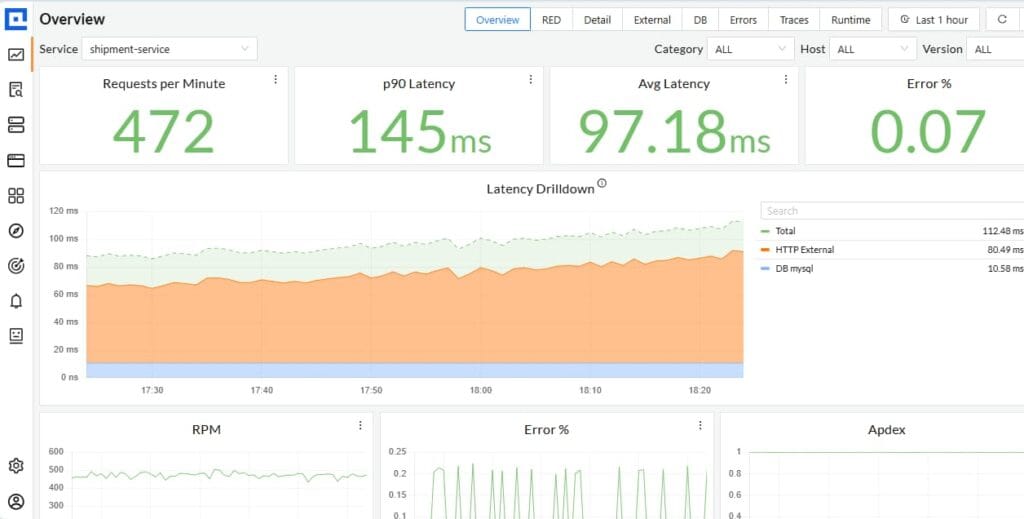
CubeAPM is a self-hosted, OpenTelemetry-native APM and observability platform supporting Next.js frontend monitoring alongside full-stack application observability.
Features
- Core Web Vitals (LCP, INP, CLS) from real user sessions on Next.js applications, correlated with backend spans
- App Router and Pages Router navigation tracking as distinct page views with their own performance timelines
- Session replay for debugging UI issues in real user sessions
- Error tracking: automatically logs runtime and API errors from Next.js with complete trace context
- Full-stack trace correlation: link a slow Next.js page load or API call to the backend Node.js span, database query, or infrastructure component that caused it
- SSR and API route tracing: instrumentation for Next.js server-side handlers and API routes linked to frontend RUM sessions
- Synthetic monitoring: scripted uptime and API checks running alongside RUM for combined proactive and reactive coverage
- OpenTelemetry-native: uses the OTel browser and Node.js SDKs for standardized browser-to-backend trace continuity
- Self-hosted inside your VPC; telemetry data never leaves your infrastructure
- Smart sampling to reduce storage costs without losing critical error and latency signals
Pricing: $0.15/GB of data ingested. No per-user, per-session, or per-host fees.
Limitations: Requires self-hosting and infrastructure management. Not open-source.
Best for: Next.js teams that want frontend RUM, Core Web Vitals, session replay, and full-stack APM trace correlation in a single self-hosted platform with predictable ingestion-based pricing that does not scale with user session volume.
2. Sentry
Sentry has a dedicated Next.js SDK (@sentry/nextjs) with Next.js-specific features documented at Sentry’s Next.js automatic instrumentation docs. It is one of the most complete Next.js monitoring integrations available, covering both the browser and the Node.js server side in a single SDK.
Features
- Automatic browser instrumentation via BrowserTracing, enabled by default once tracing is set up. Captures the following without additional code:
| Signal | Description | Metrics |
| Page loads | Full page load performance | LCP, CLS, TTFB |
| Navigations | Client-side route changes | Duration, Web Vitals |
| HTTP requests | All XHR/fetch calls | Duration, status, URL |
| User interactions | Clicks and inputs | INP (responsiveness) |
| Long tasks | Main thread blocking >50ms | Duration, attribution |
- Server-side auto-instrumentation: The SDK automatically enables error collection and tracing in Next.js API routes and Next.js data fetchers (getServerSideProps, getStaticProps), creating server-side spans that link back to the browser transaction that triggered them
- Distributed tracing: Frontend-to-backend trace correlation via tracePropagationTargets; Sentry attaches sentry-trace and baggage headers to outgoing XHR and fetch requests
- Web Vitals dashboard: LCP, INP, CLS, TTFB surfaced in the Next.js Overview dashboard in Sentry Dashboards, with a Performance Score per route
- Session replay: Video-like reproduction of user sessions with traces in the replay timeline; all DOM text, images, and user input masked by default
- Error monitoring: JavaScript errors, uncaught exceptions, and unhandled rejections with full stack traces; source maps applied automatically
Pricing
- Developer (free): 1 member, 1 project, limited monthly volume
- Team: $29/month. Includes 50,000 errors, 5M spans, 50 replays, 5GB logs, 5GB application metrics per month
- Business: $89/month. Same base volumes with higher overage rates and additional enterprise features
Limitations: Event-based pricing across errors, spans, and replays can become unpredictable at scale. The free Developer plan supports only 1 member and 1 project.
Best for: Next.js engineers who want the deepest out-of-the-box Next.js instrumentation covering both client and server, with error tracking, session replay, and distributed tracing in a single SDK.
3. PostHog
PostHog has dedicated Next.js documentation at PostHog’s Next.js session replay installation guide covering Next.js 15.3+, the App Router, and the Pages Router with framework-specific initialization patterns for each.
Features
- Next.js version-aware integration:
- Next.js 15.3+: Initialize via instrumentation-client.ts for a lightweight, fast integration
- App Router: Create a providers.tsx file with a ‘use client’ directive wrapping PostHogProvider from @posthog/react
- Pages Router: Initialize directly in _app.tsx
- Session replay: Records browser sessions, including console logs, network requests with timing, DOM state, rage clicks, and user interactions. Linked directly to associated error events and feature flag variants. Data retention: 1 month free, 3 months on paid plans.
- Web vitals: FCP, LCP, INP, and CLS captured automatically as $web_vitals events from real user sessions
- Error tracking: Exception autocapture for unhandled errors and rejections. 100,000 exceptions per month free. Each error links to the associated session replay.
- Product analytics: Autocapture of clicks, page views, and form submissions alongside RUM data
- Feature flags: Toggle features per user, with replays and analytics scoped to flag variants for A/B test impact analysis
- Network performance: Network requests captured in session replays with timing breakdown, status codes, and response sizes
Pricing:
- Free tier (no credit card required): 1M analytics events, 5,000 session recordings, 100,000 error exceptions, 1M feature flag requests per month
- Session replay: $0.005/recording (5k–15k), $0.0035/recording (15k–50k), reducing to $0.0015/recording at 500k+
- Error tracking: $0.000370/exception (100k–325k), reducing at higher volumes
Limitations: PostHog does not provide server-side Next.js API route tracing or frontend-to-backend distributed trace correlation (listed as alpha). No Next.js server component render span tracking.
Best for: Next.js product and engineering teams that want session replay, web vitals, error tracking, and product analytics in one platform with a generous free tier and no credit card required.
4. Datadog RUM

Datadog has a dedicated Next.js RUM plugin documented at Datadog’s RUM Next.js integration docs. The plugin requires Next.js v15.3+ for both App Router and Pages Router, as it relies on the instrumentation-client file convention introduced in that version.
Features
- Automatic route change detection for both the App Router and Pages Router via the nextjsPlugin() initialized in instrumentation-client.js
- Dynamic route segment normalization: converts URLs like /users/123 to /users/[id] automatically
- App Router setup: Uses the DatadogAppRouter component in app/layout.tsx alongside the onRouterTransitionStart export for client-side navigation tracking. For the Pages Router, onRouterTransitionStart is not needed.
- Error boundaries: App Router errors are reported using addNextjsError inside error.tsx files. Server Component errors pass a digest hash that links the client-side error to server-side logs; Client Component errors include the original error.message.
- Core Web Vitals: LCP, INP, CLS, FCP, and TTFB from real user traffic. The RUM Optimization page provides Core Web Vitals breakdowns by browser, device, region, and app version.
- Session replay: DOM snapshot-based session recording linked to RUM sessions and APM traces
- APM trace correlation: XHR and fetch requests automatically linked to backend APM traces; navigate from a RUM session to the backend trace that served a slow API route
- Source map upload: Build plugins automate source map uploads for deobfuscated stack traces
Pricing: Billed per 1,000 sessions ingested. The specific per-1,000-session rate is not published on Datadog’s public documentation; see Datadog’s pricing page or contact Datadog sales for current rates.
Limitations: Both App Router and Pages Router require Next.js v15.3+. Per-session billing can be unpredictable at high traffic volumes. No self-hosted option.
Best for: Enterprise Next.js teams already using Datadog for infrastructure and backend APM who want frontend RUM integrated with their existing setup.
Comparison table
| Tool | App Router support | Pages Router support | Core Web Vitals | Session replay | Server-side trace correlation | Self-hosted | Free tier |
| CubeAPM | Yes | Yes | Yes (LCP, INP, CLS) | Yes | Yes | Yes | No |
| Sentry | Yes | Yes | Yes (LCP, INP, CLS, TTFB) | Yes | Yes (API routes + data fetchers) | No | Yes (limited) |
| PostHog | Yes (providers.tsx) | Yes (_app.tsx) | Yes (FCP, LCP, INP, CLS) | Yes | Alpha | No | Yes (5K replays, 100K exceptions/mo) |
| Datadog RUM | Yes (Next.js 15.3+) | Yes (Next.js 15.3+) | Yes (LCP, INP, CLS, FCP, TTFB) | Yes | Yes | No | No |
Which Next.js frontend monitoring tool should you choose?
- Choose CubeAPM if you want Next.js frontend RUM, Core Web Vitals, session replay, and full-stack APM trace correlation in a single self-hosted platform, with ingestion-based pricing that does not scale with session volume.
- Choose Sentry if you want the deepest out-of-the-box Next.js instrumentation: automatic coverage of page loads, navigations, API routes, and data fetchers in a single SDK with no manual configuration, plus error tracking, session replay, and distributed tracing.
- Choose PostHog if you want Next.js session replay, web vitals, and error tracking in one platform with a generous free tier and no credit card required. Best for product and engineering teams that also use feature flags and A/B experiments.
- Choose Datadog RUM if your team already uses Datadog for infrastructure and backend APM and needs Next.js frontend RUM with App Router and Pages Router support integrated with your existing setup. Requires Next.js v15.3+.
Summary
Frontend performance monitoring for Next.js requires Core Web Vitals from real users, App Router and Pages Router navigation tracking, dynamic route normalization, server-side API route trace correlation, and error tracking that understands the Next.js component model.
CubeAPM provides the most cost-predictable full-stack option with self-hosted deployment, session replay, and no per-session fees. Sentry provides the deepest automatic Next.js instrumentation covering both client and server. PostHog provides the most generous free tier. Datadog provides the most mature enterprise managed RUM for teams already on the Datadog platform.
| Tool | Best for | Free tier | Self-hosted |
| CubeAPM | Full-stack APM + RUM + session replay, ingestion-based pricing | No | Yes |
| Sentry | Deepest Next.js auto-instrumentation, client + server coverage | Yes (limited) | No |
| PostHog | Session replay + product analytics, generous free tier | Yes (5K replays, 100K exceptions/mo) | No |
| Datadog RUM | Enterprise managed RUM, App + Pages Router, existing Datadog users | No | No |
Disclaimer: Features and pricing are verified from official vendor documentation as of June 2026: Sentry’s Next.js automatic instrumentation docs, Sentry’s Stripe Projects blog for plan pricing, PostHog’s Next.js session replay docs and PostHog’s pricing page, Datadog’s RUM Next.js integration docs and Datadog’s RUM billing docs, and CubeAPM’s Next.js monitoring blog and CubeAPM’s pricing page. Always verify current pricing and feature availability directly with each vendor before making purchasing decisions.
Also read:
What Are the Best Frontend Performance Monitoring Tools for Vue.js in 2026?
Best Cloud Security Monitoring Tools for Cloud Environments in 2026
Best Security Monitoring Tools for Kubernetes Clusters in 2026