







Groundcover is a cloud-native observability platform for Kubernetes and microservices. It uses eBPF to collect logs, metrics, traces, and Kubernetes events with minimal code changes. This makes it useful for teams that want fast visibility without heavy manual instrumentation.
Pricing matters because Groundcover uses host-based pricing, not direct ingest-based pricing. Buyers still need to plan for BYOC hosting, storage, retention, and backend infrastructure. So the real cost is not only the public license price.
This Groundcover Pricing and Review covers pricing, real cost scenarios, features, user feedback, and alternatives like CubeAPM, Datadog, New Relic, and Grafana Cloud. The goal is to help buyers compare Groundcover fairly before starting a proof of concept.
What Is Groundcover?
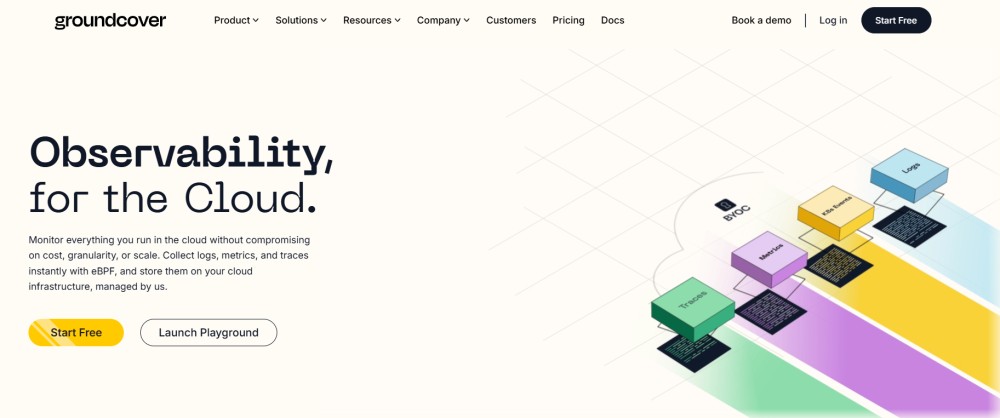
Groundcover is a cloud-native observability platform designed mainly for Kubernetes and modern cloud environments. It uses eBPF sensors to collect telemetry from infrastructure and application behavior, helping teams monitor services with fewer code changes.
The platform collects logs, infrastructure metrics, custom metrics, traces, and Kubernetes events. Groundcover’s architecture documentation says its BYOC model allows observability data to remain inside the customer’s infrastructure.
In simple terms, Groundcover is built for teams that want the following:
- Kubernetes observability
- eBPF-based telemetry collection
- Logs, metrics, traces and Kubernetes events in one place
- Data stored inside their own cloud or infrastructure
- Host-based pricing instead of ingest-based pricing
- A managed experience without fully handing data to a SaaS vendor
Supported Environments and Integrations
Groundcover is strongest in Kubernetes and cloud-native environments. Its pricing page defines a billable host as a Kubernetes host or any Linux host that is actively monitored by Groundcover. It also says pricing is calculated using the average number of monitored hosts over the past month, not short-lived peaks.
Groundcover supports common observability data sources. Its docs say logs can come from sources such as Fluentd, Fluent Bit, Logstash, or CloudWatch Logs; metrics can be ingested through Prometheus remote write or agents such as StatsD and Telegraf; and traces can be ingested from OpenTelemetry-instrumented applications or Datadog SDKs.
Groundcover is relevant for teams running the following:
- Kubernetes clusters
- EKS workloads
- Linux hosts
- Cloud-native microservices
- Containerized applications
- OpenTelemetry workloads
- Prometheus metrics workflows
- Grafana dashboards
- Fluentd, Fluent Bit or Logstash pipelines
What Does Groundcover Monitor?
| Monitoring Area | Examples | Why It Matters |
| Logs | Application logs, Kubernetes logs, container logs | Helps developers investigate errors and production behavior |
| Metrics | CPU, memory, latency, throughput, error rates | Shows system health and performance trends |
| Traces | Service requests, spans, dependencies | Helps teams follow requests across microservices |
| Kubernetes events | Pod restarts, deployment changes, crashes | Connects platform activity to incidents |
| Infrastructure | Nodes, containers, Linux hosts, services | Links application issues to resource pressure |
| OpenTelemetry data | OTEL traces and telemetry | Helps teams reduce vendor lock-in |
Key Features of Groundcover
Groundcover’s main feature is eBPF-based data collection. Its AWS Marketplace page says the eBPF sensor captures logs, metrics, and traces without code changes. This is useful for Kubernetes teams that want fast coverage without adding language agents to every service.
Groundcover can monitor Kubernetes workloads without manual code instrumentation. This can reduce onboarding effort for teams with many services, especially when compared with tools that require separate agents, SDKs, or manual instrumentation work.
Groundcover combines core observability signals in one platform. Its AWS Marketplace listing says it captures application logs, metrics, traces, and Kubernetes events for cloud-native observability from infrastructure to application.
Groundcover’s BYOC model is one of its strongest selling points. Its docs say observability data remains inside the customer’s infrastructure, while the backend runs in the customer’s cloud environment.
Groundcover supports OpenTelemetry ingestion and Prometheus remote write. Its architecture docs also mention ingestion endpoints for Prometheus, OpenTelemetry, and cloud integrations inside the Groundcover backend.
Groundcover prices by monitored host or node, not by raw data volume. Its pricing page says the model is based on the average number of monitored hosts over the past month.
Groundcover’s AWS Marketplace listing says the product is SOC 2 Type II and ISO 27001 compliant. Buyers should still request current compliance reports during procurement.
Groundcover Pricing: How Does It Work?
Groundcover uses host-based pricing. Instead of charging separately for logs, metrics, traces, and events by GB, Groundcover charges based on monitored hosts or Kubernetes nodes.
The official pricing page lists four main pricing options: Free, Pro, Enterprise, and On Premise.
| Pricing Path | Public Price | Deployment Mode | Best For |
| Free | $0 | BYOC | Testing and early exploration |
| Pro | $30 per host/month | BYOC | Teams that want integrations, SSO and standard retention |
| Enterprise | $35 per host/month | BYOC | Larger teams needing RBAC, unlimited retention and premium support |
| On Premise | $50 per host/month | Full On-Prem | Regulated teams needing self-hosted data plane and UI |
Groundcover Free Plan
Groundcover Free costs $0 and is designed for teams that want to start exploring the product. The pricing page lists BYOC deployment, 12-hour data retention, Slack community support, and no credit card requirement.
This plan is useful for:
- Product testing
- Small proof of concepts
- Early Kubernetes observability evaluation
- Teams that want to understand Groundcover before buying
Groundcover Pro Pricing
Groundcover Pro is listed at $30 per host per month. The pricing page says it includes BYOC deployment, all available integrations and data sources, SSO support, standard retention, and standard support.
Pro is best for teams that want:
- Full integrations
- Standard support
- SSO
- Predictable host-based pricing
- A managed BYOC observability setup
Groundcover Enterprise Pricing
Groundcover Enterprise is listed at $35 per host per month on the pricing page. It includes everything in Pro, plus RBAC support, unlimited data retention, and premium support.
Enterprise is best for organizations that need:
- RBAC
- Higher support expectations
- Longer retention requirements
- More mature access control
- Larger Kubernetes environments
Groundcover On Premise Pricing
Groundcover On Premise is listed at $50 per host per month. The pricing page says it includes everything in Enterprise, plus a self-hosted data plane, a self-hosted UI, and isolated authentication.
This plan is best for:
- Regulated environments
- High-compliance teams
- Companies that need full on-prem control
- Buyers with strict data isolation requirements
Important Billing Notes Buyers Should Not Miss
Groundcover pricing is based on monitored hosts or Kubernetes nodes, not direct telemetry volume. Its pricing page defines a host as a Kubernetes host or Linux host of any size that is actively monitored. It also says monthly billing is based on the average number of monitored hosts over the month.
However, host-based pricing does not mean total cost is only the license fee. Groundcover’s FAQ says total cost depends on two factors: the number of monitored nodes or hosts and the cost of hosting Groundcover’s backend in the customer environment.
Buyers should model:
- Groundcover license cost
- BYOC backend hosting
- Storage
- Retention
- Cloud provider fees
- Operational planning
- Support requirements
- Marketplace procurement terms
What Does Groundcover Really Cost?
Disclaimer
The scenarios below are directional editorial estimates, not official Groundcover quotes. Groundcover publishes host-based pricing, but the real total cost can also include BYOC backend hosting, storage, retention, cloud provider fees, support needs, and contract terms. Buyers should confirm final pricing directly with Groundcover.
Groundcover is not priced like a pure ingest-based observability platform. A team producing 5 TB or 27 TB of monthly telemetry does not automatically pay based on GB volume. Groundcover’s public pricing is mainly tied to monitored hosts or Kubernetes nodes.
That said, telemetry volume still matters. Logs, traces, metrics, and retention can affect the cloud infrastructure needed to run Groundcover’s backend in the customer environment. Groundcover says the total cost depends on monitored nodes/hosts and the cost of hosting Groundcover’s backend in your environment.
Pricing Assumptions Used in These Scenarios
These scenarios use the workload profiles from the CubeAPM calculator but map Groundcover estimates to Groundcover’s host-based pricing model.
| Scenario | Groundcover pricing anchor | Groundcover estimate | CubeAPM estimate |
| Small team | 10 hosts on Pro | ~$300/month before BYOC backend cost | ~$522/month |
| Growing team | 50 hosts on Enterprise | ~$1,750/month before BYOC backend cost | ~$919/month |
| Mid-market team | 250 hosts on Enterprise | ~$8,750/month before BYOC backend cost | ~$4,594/month |
These estimates do not include BYOC backend hosting, cloud storage, object storage, premium support, professional services, enterprise discounts or contract-specific terms.
Workload Assumptions Used for Groundcover Estimates
| Team size | Infrastructure context | Telemetry context | Groundcover usage assumption | Estimated Groundcover license |
| Small team | 10 hosts | ~1.1 TB/month | Pro plan | ~$300/month |
| Growing team | 50 hosts | ~5.4 TB/month | Enterprise plan | ~$1,750/month |
| Mid-market team | 250 hosts | ~27 TB/month | Enterprise plan | ~$8,750/month |
The telemetry volume is included for planning because it can affect BYOC backend sizing, storage, and retention. For Groundcover’s public pricing, the main license calculation still depends on monitored hosts or nodes.
Scenario 1: Small Team, ~10 Hosts
Situation
A small production team runs around 10 hosts and produces about 1.1 TB of monthly telemetry across logs, traces, and metrics. The team needs Kubernetes observability, APM-style troubleshooting, infrastructure visibility, and basic production monitoring.
For Groundcover, the 1.1 TB/month telemetry estimate does not directly drive the license price. The stronger pricing factor is the 10 monitored hosts.
Why teams at this stage consider Groundcover
Teams at this stage may consider Groundcover because it gives Kubernetes visibility without heavy manual instrumentation. The Pro plan is the most relevant public plan when a team wants full integrations, SSO, standard retention, and standard support.
Estimated profile
| Configuration | Detail |
| Infrastructure context | 10 hosts |
| Telemetry context | ~1.1 TB/month |
| Logs | 720 GB/month |
| Traces/APM | 360 GB/month |
| Metrics | 1 GB/month |
| Base Groundcover package | Pro |
| Pricing basis | Host-based license + BYOC backend planning |
Estimated monthly cost
Disclaimer: This estimate uses Groundcover’s public Pro price as a planning anchor. It does not include BYOC backend hosting, storage, cloud provider fees, or retention-related infrastructure costs.
| Component | Assumption | Monthly cost |
| Groundcover Pro license | 10 hosts × $30/host | ~$300 |
| BYOC backend hosting | Depends on workload and cloud setup | Estimate separately |
| Storage and retention | Depends on logs, traces, metrics and retention | Estimate separately |
| Estimated total license | Groundcover license only | ~$300/month |
CubeAPM cost comparison
| Platform | Pricing basis | Estimated monthly cost |
| Groundcover | 10 hosts on Pro | ~$300/month before BYOC backend cost |
| CubeAPM | ~1.1 TB/month ingestion estimate | ~$522/month |
| Estimated difference | Calculation | Result |
| Groundcover license-only advantage | $522 – $300 | ~$222/month lower |
| Percentage difference | $222 ÷ $522 | ~43% lower license-only |
What this scenario shows
For a small 10-host team, Groundcover’s license-only estimate looks lower than CubeAPM. The main caveat is that Groundcover’s BYOC backend hosting, storage, and retention costs still need to be estimated separately. Buyers should not compare only the license line without checking the full BYOC cost.
Scenario 2: Growing Team, ~50 Hosts
Situation
A growing SaaS team runs around 50 hosts and produces about 5.4 TB of monthly telemetry. The team has more services, more Kubernetes workloads, and more production incidents to investigate.
For Groundcover, the 5.4 TB/month telemetry volume is useful for backend sizing, but it does not directly drive the public license price. The main license cost comes from the 50 monitored hosts.
Why teams at this stage consider Groundcover
At this stage, teams usually need stronger Kubernetes visibility, better service correlation, and more control over observability data. Groundcover becomes attractive because it keeps data in the customer environment while using a host-based pricing model.
Estimated profile
| Configuration | Detail |
| Infrastructure context | 50 hosts |
| Telemetry context | ~5.4 TB/month |
| Logs | 3,600 GB/month |
| Traces/APM | 1,800 GB/month |
| Metrics | 5 GB/month |
| Base Groundcover package | Enterprise |
| Pricing basis | Host-based license + BYOC backend planning |
Estimated monthly cost
Disclaimer: This estimate uses Groundcover’s public Enterprise price as a planning anchor. Buyers should confirm final plan price, backend sizing, retention cost, and support terms directly with Groundcover.
| Component | Assumption | Monthly cost |
| Groundcover Enterprise license | 50 hosts × $35/host | ~$1,750 |
| BYOC backend hosting | Depends on cloud resources and query load | Estimate separately |
| Storage and retention | Depends on telemetry volume and retention | Estimate separately |
| Estimated total license | Groundcover license only | ~$1,750/month |
CubeAPM cost comparison
| Platform | Pricing basis | Estimated monthly cost |
| Groundcover | 50 hosts on Enterprise | ~$1,750/month before BYOC backend cost |
| CubeAPM | ~5.4 TB/month ingestion estimate | ~$919/month |
| Estimated savings with CubeAPM | Calculation | Result |
| Difference vs Groundcover | $1,750 – $919 | ~$831/month |
| Percentage savings | $831 ÷ $1,750 | ~47% lower |
What this scenario shows
For a growing 50-host team, CubeAPM becomes cheaper in this estimate. Groundcover’s license rises with host count, while CubeAPM follows telemetry volume. Groundcover can still be attractive for teams that value BYOC architecture and eBPF-based Kubernetes visibility, but buyers should include backend hosting and storage before making the final comparison.
Scenario 3: Mid-Market Team, ~250 Hosts
Situation
A mid-market team runs around 250 hosts and produces about 27 TB of monthly telemetry. The environment may include multiple Kubernetes clusters, customer-facing services, backend APIs, queues, databases, and internal platforms.
At this stage, the team needs more than basic monitoring. It likely needs strong Kubernetes observability, application troubleshooting, service correlation, alerting, dashboards, and longer retention planning.
Why teams at this stage consider Groundcover
At mid-market scale, Groundcover can be appealing because it does not price directly by logs, traces, or metrics volume. Teams with high telemetry volume may prefer a host-based license because the software bill is easier to forecast from infrastructure size.
Estimated profile
| Configuration | Detail |
| Infrastructure context | 250 hosts |
| Telemetry context | ~27 TB/month |
| Logs | 18,000 GB/month |
| Traces/APM | 9,000 GB/month |
| Metrics | 25 GB/month |
| Base Groundcover package | Enterprise |
| Pricing basis | Host-based license + BYOC backend planning |
Estimated monthly cost
Disclaimer: This estimate uses Groundcover’s public Enterprise list price. It does not include BYOC backend hosting, object storage, block storage, cloud networking, premium support, enterprise discounts, or professional services.
| Component | Assumption | Monthly cost |
| Groundcover Enterprise license | 250 hosts × $35/host | ~$8,750 |
| BYOC backend hosting | It depends on workload, retention and cloud provider | Estimate separately |
| Storage and retention | Important at this telemetry volume | Estimate separately |
| Estimated total license | Groundcover license only | ~$8,750/month |
CubeAPM cost comparison
| Platform | Pricing basis | Estimated monthly cost |
| Groundcover | 250 hosts on Enterprise | ~$8,750/month before BYOC backend cost |
| CubeAPM | ~27 TB/month ingestion estimate | ~$4,594/month |
| Estimated savings with CubeAPM | Calculation | Result |
| Difference vs Groundcover | $8,750 – $4,594 | ~$4,156/month |
| Percentage savings | $4,156 ÷ $8,750 | ~47% lower |
What this scenario shows
At mid-market scale, CubeAPM is much cheaper, in this estimate. Groundcover’s license cost grows with the number of monitored hosts, while CubeAPM remains tied to ingested telemetry volume. Groundcover may still be a strong fit for Kubernetes-heavy teams that want eBPF collection and BYOC control, but buyers should calculate the full cost with backend hosting and retention included.
Summary: Groundcover vs CubeAPM Estimated Monthly Cost
Disclaimer: These are directional planning estimates, not official quotes. Groundcover’s final cost can change based on monitored hosts, selected plan, BYOC backend hosting, storage, retention, support level, contract terms and enterprise discounts. CubeAPM’s estimate is based on the provided usage profiles and public ingestion-based pricing.
| Team profile | Groundcover license estimate | CubeAPM estimate | Monthly difference | Lower-cost option in this scenario |
| Small team | ~$300/month before BYOC backend cost | ~$522/month | Groundcover license is ~$222 lower | Groundcover license-only |
| Growing team | ~$1,750/month before BYOC backend cost | ~$919/month | CubeAPM is ~$831 lower | CubeAPM |
| Mid-market team | ~$8,750/month before BYOC backend cost | ~$4,594/month | CubeAPM is ~$4,156 lower | CubeAPM |
Groundcover looks very attractive when host count is low and telemetry volume is moderate to high. However, its license-only price should not be treated as the full bill because BYOC backend hosting, storage and retention still need to be modeled.
CubeAPM becomes more cost-effective in the growing and mid-market examples because it does not charge per host, user or separate observability module. Its $0.15/GB ingestion model can be easier to forecast for teams that want full-stack observability across logs, metrics, traces, dashboards, APM, RUM, synthetics and error tracking.
Groundcover Cost Drivers
| Cost Driver | How It Affects Cost | How to Control It |
| Number of hosts or nodes | Main license driver | Remove stale environments |
| Deployment model | BYOC and On Premise require infrastructure planning | Match deployment to security needs |
| Logs volume | Does not change license directly, but affects storage | Filter noisy logs |
| Metrics cardinality | Can affect backend pressure | Govern labels and dimensions |
| Retention | Longer retention increases storage needs | Separate hot and cold retention |
| Support level | Premium support is tied to Enterprise and On Premise | Match support to incident risk |
Additional Costs and Operational Overhead Buyers Should Plan For
Groundcover’s BYOC model keeps data in the customer environment, but it also means buyers must budget for cloud resources used by the backend. Groundcover’s FAQ says total cost includes backend hosting in the customer environment.
Groundcover’s BYOC docs say object storage can be used with ClickHouse for longer-term storage, including Amazon S3, Google Cloud Storage or Azure Blob Storage. This is useful for cold storage, but it still needs cost planning.
Groundcover is strongest for Kubernetes. Teams with limited Kubernetes maturity may need more setup planning around access, cluster coverage, permissions, dashboards and alert design.
Observability data can include sensitive fields. Groundcover’s FAQ says users can control what is left out of automatic collection using data obfuscation.
Teams moving from Datadog, New Relic, Elastic, Grafana Cloud or custom Prometheus stacks should budget time for dashboards, alerts, notification routes, access control and team training.
Groundcover User Reviews in 2026
Groundcover has positive public review signals, though its review footprint is smaller than long-established observability vendors.
G2 lists Groundcover at 4.8/5 from 26 reviews. G2’s AI-generated review summary says users praise the intuitive interface, ease of use, quick setup and local data storage, while some users mention that UI navigation and usability could improve.
GetApp lists Groundcover at 4.7/5 from 32 reviews, with 94% positive reviews in its page data.
Gartner Peer Insights shows Groundcover with 4.0/5 from 1 rating in the alternatives page. Because the Gartner review volume is very small, buyers should not rely on Gartner alone for evaluation.
| Review Platform | Rating or Signal | Notes |
| G2 | 4.8/5 from 26 reviews | Strong sentiment around ease of use and setup |
| GetApp | 4.7/5 from 32 reviews | Positive SMB and software buyer signal |
| Gartner Peer Insights | 4.0/5 from 1 rating | Too limited to treat as broad market proof |
What Users Praise
Users often praise Groundcover’s quick setup. G2 highlights quick setup as a recurring review theme, and Groundcover’s AWS Marketplace listing says teams can cover the Kubernetes stack with no code changes.
Groundcover is built around Kubernetes and cloud-native environments. This makes it useful for teams that need to connect logs, traces, metrics and Kubernetes events around pods, nodes and services.
Groundcover’s BYOC model is a major strength. The official docs say observability data remains within the customer’s infrastructure, and G2 review summaries mention local data storage as a praised theme.
G2 and GetApp review summaries highlight ease of use, simple monitoring and clear visualization as common positive themes.
What Users Criticize
Disclaimer
These points reflect public review themes and buyer considerations. They should not be treated as universal product limitations.
G2’s review summary says some users want better navigation and usability. One reviewer also mentioned that scrolling and filtering workloads on the left side of the dashboard can be difficult.
Some users mention documentation gaps. One reviewer said some parts were missing or unclear, while another mentioned minor glitches and documentation gaps during setup.
One reviewer said Groundcover’s built-in eBPF plugins are still limited. However, they also noted that Groundcover supports OpenTelemetry and Prometheus, which helps reduce this limitation.
A few users mention dashboard issues. One reviewer said the dashboard can look messy when many logs are monitored, while another mentioned problems with Grafana dashboard sharing and page reloads.
G2 shows “Poor Customer Support” as a negative theme, but visible comments are more balanced. Several users praise the support team, so buyers should validate response times and escalation paths during the proof of concept.
Groundcover Alternatives: How it Compares to Competitors
Groundcover is strongest for Kubernetes-first teams that want eBPF-based observability, host-based pricing and data control through BYOC or On Premise deployment. The alternatives below are better fits when teams need broader SaaS observability, stronger OpenTelemetry-native workflows, open-source-style dashboards, enterprise automation or search-heavy log analytics.
Groundcover vs CubeAPM
Groundcover and CubeAPM both focus on cost control and data ownership, but they use different pricing models. Groundcover is better suited for Kubernetes-heavy teams that want eBPF-based collection and host-based pricing. CubeAPM is better for teams that want OpenTelemetry-native full-stack observability with simple ingestion-based pricing.
| Category | Groundcover | CubeAPM |
| Main strength | eBPF Kubernetes observability | OpenTelemetry-native full-stack observability |
| Pricing model | Host-based pricing | $0.15/GB ingestion pricing |
| Deployment | BYOC and On Premise | Customer-controlled deployment |
| Best fit | Kubernetes-heavy teams | Teams needing MELT, RUM, synthetics and error tracking |
| Main tradeoff | BYOC backend cost must be planned | Cost rises with telemetry volume |
Groundcover vs Datadog
Datadog is a broad SaaS observability platform with infrastructure monitoring, APM, logs, RUM, synthetics, security and many integrations. Groundcover is more focused on Kubernetes, eBPF collection and customer-controlled data. Datadog is stronger for teams that want a mature SaaS platform, while Groundcover is stronger when BYOC and predictable host-based pricing matter more.
| Category | Groundcover | Datadog |
| Main strength | Kubernetes observability with eBPF | Broad SaaS observability platform |
| Pricing model | Per monitored host | Modular pricing by product and usage |
| Deployment | BYOC and On Premise | SaaS |
| Best fit | Kubernetes teams needing data control | Teams wanting many integrations and modules |
| Main tradeoff | Requires BYOC planning | Costs can stack across modules |
Groundcover vs New Relic
New Relic is a SaaS observability platform built around data ingest and user-based pricing. It is strong for APM, telemetry exploration, dashboards and developer workflows. Groundcover is stronger for Kubernetes-first teams that want eBPF-based visibility and data stored in their own environment.
| Category | Groundcover | New Relic |
| Main strength | Kubernetes and eBPF visibility | Developer-friendly SaaS observability |
| Pricing model | Per monitored host | Data ingest plus user pricing |
| Deployment | BYOC and On Premise | SaaS |
| Best fit | Teams wanting data inside their cloud | Teams wanting broad SaaS observability |
| Main tradeoff | Backend hosting must be planned | User and ingest costs need forecasting |
Groundcover vs Grafana Cloud
Grafana Cloud is best for teams already using Grafana, Prometheus, Loki, Tempo and other open observability tools. It gives strong dashboarding and familiar workflows for open-source observability teams. Groundcover is a better fit when teams want automatic Kubernetes telemetry collection through eBPF and a BYOC model.
| Category | Groundcover | Grafana Cloud |
| Main strength | eBPF-based Kubernetes observability | Grafana dashboards and open observability stack |
| Pricing model | Per monitored host | Usage-based cloud pricing |
| Deployment | BYOC and On Premise | SaaS |
| Best fit | Kubernetes teams wanting automatic collection | Teams already using Grafana and Prometheus |
| Main tradeoff | Less focused on open dashboard ecosystem | Costs depend on telemetry usage |
Groundcover vs Dynatrace
Dynatrace is an enterprise observability platform known for automation, dependency mapping, AI-assisted analysis and full-stack monitoring. It is usually a stronger fit for large enterprises with complex hybrid environments. Groundcover is more focused on Kubernetes-native observability, eBPF collection and data control.
| Category | Groundcover | Dynatrace |
| Main strength | Kubernetes observability with eBPF | Enterprise full-stack observability |
| Pricing model | Per monitored host | Usage-based rate card |
| Deployment | BYOC and On Premise | SaaS and Managed options |
| Best fit | Kubernetes-first teams | Large enterprises needing automation |
| Main tradeoff | Narrower enterprise scope | Pricing can be complex to model |
Groundcover vs Elastic Observability
Elastic Observability is strong for logs, search, metrics, traces, APM and Kibana-based workflows. It is a good fit for teams already using Elasticsearch or needing search-heavy log analytics. Groundcover is stronger when the main need is Kubernetes observability, eBPF-based collection and host-based pricing.
| Category | Groundcover | Elastic Observability |
| Main strength | Kubernetes telemetry through eBPF | Search-driven logs and observability |
| Pricing model | Per monitored host | Usage-based pricing by ingest, retention and usage |
| Deployment | BYOC and On Premise | Cloud and self-managed options |
| Best fit | Kubernetes-heavy teams | Teams centered on Elasticsearch and Kibana |
| Main tradeoff | Less search-focused than Elastic | Cost depends on data and retention |
Is Groundcover the Right Choice?
When Groundcover Works Best
Groundcover is a strong fit when:
- Your production environment is Kubernetes-heavy.
- You want eBPF-based telemetry collection.
- You want logs, metrics, traces and Kubernetes events together.
- You want zero-code instrumentation.
- You prefer host-based pricing over ingest-based pricing.
- You want observability data stored in your own cloud.
- You need BYOC or On Premise deployment.
- Your team can plan backend hosting and retention.
- You want to reduce telemetry cost unpredictability.
When Groundcover May Not Be the Right Fit
Groundcover may not be the best fit when:
- Most of your observability needs sit outside Kubernetes. Teams with large VM fleets, serverless-heavy systems or mixed legacy environments should confirm coverage first.
- You want a fully SaaS observability tool with no backend planning. Groundcover’s BYOC model keeps data in your environment, but buyers still need to plan hosting, storage and retention.
- You have only a few services and very small telemetry volume. A simpler monitoring setup may be enough until your environment grows.
- You need a very broad enterprise SaaS suite. Buyers needing RUM, synthetics, security monitoring, business analytics or many packaged integrations should compare carefully.
- Your team does not want to plan BYOC storage or backend sizing. Groundcover’s license is host-based, but total cost can still include cloud infrastructure, storage and retention.
Conclusion
Groundcover is a strong observability option for Kubernetes-heavy teams that want eBPF-based data collection, zero-code instrumentation, BYOC deployment and predictable host-based pricing. Its main appeal is that license pricing is tied to monitored hosts rather than raw telemetry volume.
The main buying challenge is total cost modeling. Groundcover’s public pricing is clear on its pricing page, with Free, Pro, Enterprise and On Premise options. But real cost also includes BYOC backend hosting, storage, retention, cloud provider fees, support needs and implementation effort.
For teams that want automatic Kubernetes visibility and data control inside their own cloud, Groundcover is worth serious evaluation. For teams that want broader OpenTelemetry-native observability with transparent GB-based pricing, CubeAPM should also be compared using the same node count, telemetry volume and retention assumptions.
Disclaimer: This is an independent editorial review based on publicly available Groundcover pricing pages, documentation, review-platform data, marketplace listings and competitor information available at the time of writing. Pricing, packaging and feature availability can change. Buyers should verify current terms directly with Groundcover before making purchasing decisions.
FAQs
1. What is Groundcover?
Groundcover is a cloud-native observability platform built mainly for Kubernetes and modern production environments. It uses eBPF to collect logs, metrics, traces and Kubernetes events with minimal code changes.
2. How much does Groundcover cost?
Groundcover’s pricing page lists Free at $0, Pro at $30 per host per month, Enterprise at $35 per host per month and On Premise at $50 per host per month. Buyers should verify final pricing directly because Groundcover’s FAQ currently shows a conflicting Enterprise price.
3. What is Groundcover’s pricing model?
Groundcover uses host-based pricing. Buyers pay based on monitored Kubernetes nodes or Linux hosts rather than direct data ingest volume.
4. Does Groundcover charge for data ingestion?
Groundcover’s public pricing is based on hosts, not data ingestion. However, telemetry volume can still affect backend hosting, storage and retention costs in the customer environment.
5. What is a billable host in Groundcover?
Groundcover defines a billable host as a Kubernetes host or Linux host of any size that is actively monitored by the Groundcover platform.