



Choosing a monitoring tool is one of the most consequential decisions a DevOps or SRE team makes. Prometheus and Datadog are two of the most widely used options in the industry, but they take fundamentally different approaches to observability. One is free and open-source. The other is a commercial SaaS platform with an extensive feature set. Getting this decision wrong means either overpaying for capabilities you do not use, or spending weeks stitching together open-source tools to patch gaps in your stack.
This guide compares Prometheus vs Datadog across the dimensions that matter most: how they collect data, what they can monitor, how they handle alerting and dashboards, how they scale, and what they actually cost. If you are evaluating both tools, this comparison will help you make the right call for your team.
🔑 Key Takeaways
- ✔ Prometheus is a free, open-source monitoring tool focused on time-series metrics collection, while Datadog is a commercial, full-stack observability platform.
- ✔ Prometheus uses a pull-based model to scrape metrics; Datadog uses a push model via its agent, which enables closer to real-time data collection.
- ✔ Datadog offers built-in dashboards, ML-based alerting, distributed tracing, and log management out of the box. Prometheus requires Grafana and Alertmanager for comparable capabilities.
- ✔ Prometheus can be deployed anywhere (on-premises, cloud, hybrid). Datadog is SaaS-only, meaning it manages your monitoring infrastructure for you.
- ✔ Datadog pricing starts at $15/host/month for infrastructure monitoring; APM with infrastructure costs $31/host/month. Prometheus is free but carries infrastructure and operational overhead.
- ✔ For teams prioritizing cost control, flexibility, and Kubernetes-native monitoring, Prometheus is a strong fit. For teams that need an all-in-one platform with minimal setup, Datadog delivers faster time-to-value.
Prometheus vs Datadog at a Glance
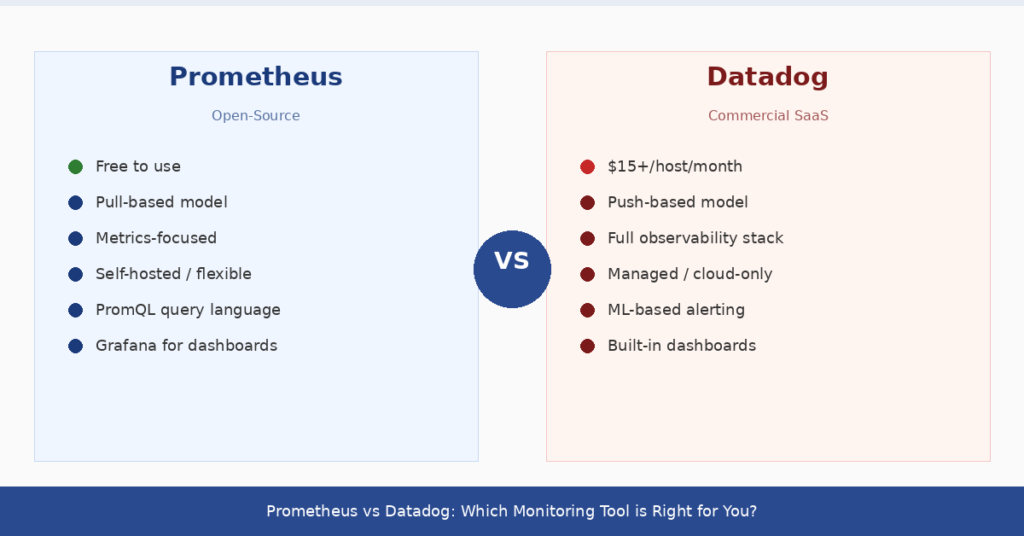
Figure: Side-by-side overview of Prometheus and Datadog key characteristics.
What Is Prometheus?
Prometheus is an open-source monitoring and alerting toolkit originally developed at SoundCloud in 2012. It joined the Cloud Native Computing Foundation (CNCF) in 2016 as a graduated project, making it a recognized standard in cloud-native observability. Prometheus is designed to collect and store time-series metrics, and it excels in dynamic, containerized environments.
Prometheus works on a pull-based model: it periodically scrapes metrics from configured targets (applications, exporters, and services) over HTTP. The data is stored in a built-in time-series database (TSDB) on disk. Teams query this data using PromQL (Prometheus Query Language), a powerful and expressive query language that lets you slice and aggregate metrics with precision.
Key characteristics of Prometheus:
- Free and open-source under the Apache 2.0 license.
- Stores all data locally in a time-series database.
- Uses a pull model to scrape metrics from exporters and instrumented applications.
- Supports over 600 exporters for databases, message queues, hardware, cloud services, and more.
- Pairs with Grafana for visualization and Alertmanager for alert routing.
- Widely adopted for Kubernetes monitoring, often deployed via the kube-prometheus-stack Helm chart.
What Is Datadog?
Datadog is a cloud-based, commercial observability and security platform founded in 2010. It was built from the ground up to monitor cloud-native and hybrid infrastructure, and it has grown into a full-stack platform covering metrics, logs, distributed tracing, security monitoring, synthetic monitoring, real user monitoring (RUM), and more.
Unlike Prometheus, Datadog uses an agent-based, push model. You install the Datadog Agent on your infrastructure or containers, and the agent collects and ships data to Datadog’s cloud platform for storage, analysis, and visualization. Everything lives in Datadog’s managed environment, which eliminates infrastructure overhead but introduces ongoing subscription costs.
Key characteristics of Datadog:
- Commercial SaaS platform with a subscription pricing model.
- Unified observability covering metrics, logs, traces, and security in one platform.
- Agent-based data collection with push to Datadog’s cloud.
- Over 600 built-in integrations with auto-configured dashboards.
- Includes ML-powered anomaly detection (Watchdog) and AI-based alerting.
- Offers distributed tracing, APM, RUM, synthetic monitoring, and CSPM out of the box.
Prometheus vs Datadog: Side-by-Side Comparison
| Feature | Prometheus | Datadog |
| Type | Open-source | Commercial SaaS |
| Cost | Free (infra costs apply) | $15+/host/month |
| Data collection | Pull-based (scraping) | Push-based (agent) |
| Scope | Metrics only | Metrics, logs, traces, security |
| Dashboards | Via Grafana (third-party) | Built-in, 450+ templates |
| Alerting | Alertmanager (third-party) | Native + ML-based (Watchdog) |
| Deployment | On-prem, cloud, hybrid | SaaS only |
| Kubernetes support | Native, widely used | Full, with auto-discovery |
| Query language | PromQL | Proprietary + Metrics Explorer |
| Machine learning | Not built-in | Built-in anomaly detection |
| Integrations | 600+ via exporters | 600+ built-in |
| Vendor lock-in | None (open standard) | Moderate (proprietary format) |
| Support | Community | 24/7 paid support |
Key Differences Between Prometheus and Datadog
1. Data Collection: Pull vs Push
The most important architectural difference between Prometheus and Datadog is how they collect data. Prometheus pulls metrics by scraping HTTP endpoints at defined intervals. Datadog’s agent pushes data to Datadog’s cloud platform continuously.
Pull-based collection gives Prometheus more control: you define what gets scraped, at what interval, and from where, all from a central configuration file. It is easier to audit and adjust. Push-based collection, as in Datadog, means data can arrive in closer to real time whenever the agent detects a change, which can be an advantage for latency-sensitive alerting.
2. Scope of Observability
Prometheus is a metrics-only tool. It does not handle logs or distributed traces natively. To build a full observability stack with Prometheus, you need additional tools: Grafana for dashboards, Loki for log aggregation, and Jaeger or Tempo for distributed tracing.
Datadog is a full-stack observability platform. Metrics, logs, distributed traces, RUM, security events, and synthetics all live in one unified interface. If you need correlated observability across your entire stack with a single pane of glass, Datadog delivers that out of the box without requiring you to manage multiple tools.
3. Dashboards and Visualization
Prometheus includes a built-in Expression Browser, which is useful for running ad hoc PromQL queries, but it is not a production-grade dashboarding tool. Most teams pair Prometheus with Grafana, which provides rich, customizable dashboards and supports dozens of data sources.
Datadog includes its own native dashboards with over 450 pre-built integration dashboards, a powerful drag-and-drop UI, and advanced widgets including heatmaps, topology maps, and SLO tracking. Setup is faster and requires no third-party tooling.
4. Alerting
Prometheus relies on Alertmanager for alert routing, grouping, and silencing. Alerting rules are written in YAML and evaluated against PromQL expressions. It is flexible and powerful, but requires manual configuration and has no anomaly detection out of the box.
Datadog offers native alerting with multiple alert types including threshold, change, anomaly, forecast, and outlier detection. Watchdog, Datadog’s ML-powered engine, proactively surfaces anomalies without requiring you to write explicit alert rules. This significantly reduces mean time to detect (MTTD) for novel issues.
5. Kubernetes Monitoring
Prometheus is deeply integrated with the Kubernetes ecosystem. The kube-prometheus-stack Helm chart (which bundles Prometheus, Grafana, and a set of curated dashboards and alert rules) is the de facto standard for Kubernetes observability. Prometheus uses Kubernetes service discovery natively and can dynamically scrape newly deployed pods and services without manual configuration.
Datadog also has strong Kubernetes support, including automatic discovery and tagging of Kubernetes resources such as pods, deployments, and namespaces. It provides pre-built Kubernetes dashboards and alerting out of the box. Both tools are well-suited for Kubernetes monitoring; the choice here often comes down to whether you want a managed solution (Datadog) or a self-hosted stack (Prometheus).
6. Scalability
Prometheus is designed to scale horizontally, but managing high-cardinality metrics and long-term retention at scale requires additional tooling. Teams running large Prometheus deployments often use Thanos or Cortex for highly available, globally scalable setups with long-term storage backed by object storage like Amazon S3.
Datadog scales automatically as a managed SaaS service. There is no infrastructure to provision or maintain. This is a significant operational advantage for teams that do not want to manage the observability platform itself. Datadog’s platform can handle tens of billions of metrics per day without additional configuration on the user side.
7. Pricing
Prometheus is free to use, but hosting and operating it is not. The real costs are infrastructure (compute and storage for the TSDB), engineer time for setup and maintenance, and additional tools like Grafana, Alertmanager, Thanos, or Loki.
Datadog pricing is subscription-based and varies by product. Infrastructure monitoring starts at $15 per host per month (billed annually). APM with infrastructure monitoring costs $31 per host per month (billed annually). Log management is priced separately, at $0.10 per ingested or scanned GB per month. Costs scale quickly with the number of hosts and ingested data. For large deployments, Datadog can become one of the most significant line items in an infrastructure budget.
8. Deployment Flexibility
Prometheus can be deployed on-premises, in a self-managed Kubernetes cluster, in a cloud VM, or as a managed service through providers like Grafana Cloud, AWS Managed Service for Prometheus, or similar offerings.
Datadog is SaaS-only. All monitoring data is sent to and stored in Datadog’s cloud environment. This is a non-starter for some organizations with data residency requirements, air-gapped environments, or strict data sovereignty policies. If keeping monitoring data within your own infrastructure is a requirement, Prometheus is the only choice of the two.
9. Vendor Lock-in
Prometheus uses open standards. Its data format is compatible with OpenMetrics, and its exporters are widely used across the industry. Migrating away from Prometheus is relatively straightforward because your instrumentation libraries and exporter configurations are portable.
Datadog, despite supporting OpenTelemetry ingestion, stores data in a proprietary format. Dashboards, alert configurations, and integrations are all specific to the Datadog platform. Migrating away from Datadog means rebuilding much of your observability configuration from scratch.
Prometheus + Grafana vs Datadog
In practice, most Prometheus deployments include Grafana for visualization. This combination is often compared directly to Datadog as an alternative observability stack.
The Prometheus + Grafana stack is highly customizable, entirely open-source, and avoids vendor lock-in. It requires more engineering time to set up, maintain, and extend, but gives teams complete control over data retention, query performance, and cost. Grafana also supports dozens of data sources, making it a versatile tool beyond just Prometheus.
Datadog provides everything in one platform. The onboarding experience is faster, the integrations are pre-built, and there is no additional tooling to manage. The trade-off is cost and lock-in. At scale, the Prometheus + Grafana stack can be significantly cheaper to operate, provided your team has the expertise to manage it.
When to Use Prometheus
- You are running Kubernetes or other cloud-native infrastructure and want a monitoring tool that integrates natively with the ecosystem.
- Cost control is a priority and you have the engineering capacity to build and maintain the observability stack.
- You need full control over data retention, query performance, and where monitoring data is stored.
- Your team is already familiar with PromQL, Grafana, or the kube-prometheus-stack.
- You are in a regulated industry or air-gapped environment where sending data to an external SaaS platform is not feasible.
- You want to avoid long-term vendor lock-in.
When to Use Datadog
- You want a unified observability platform covering metrics, logs, distributed traces, and security monitoring without managing multiple tools.
- Fast time-to-value matters more than cost optimization. Datadog’s pre-built dashboards and integrations significantly reduce setup time.
- Your team needs professional support with guaranteed SLAs.
- You require ML-powered anomaly detection and proactive alerting without manual threshold configuration.
- You are monitoring a complex, distributed architecture and need correlated insights across services.
- You want a managed platform that scales automatically with your infrastructure growth.
📌 Monitoring Costs Getting Out of Hand?
If you are evaluating Prometheus and Datadog, you are likely searching for observability that is powerful, flexible, and cost-effective. CubeAPM is a self-hosted APM and observability platform that gives you the depth of Datadog at a fraction of the cost, with the deployment flexibility of Prometheus.
It supports OpenTelemetry natively, integrates with Grafana, and is built for teams that want full control over their monitoring stack without the unpredictable billing.
→ Explore CubeAPM Today
Conclusion
Prometheus and Datadog are both excellent monitoring tools, but they serve different needs. Prometheus is the right choice for teams that prioritize cost control, deployment flexibility, and Kubernetes-native observability. It is free, open-source, and deeply integrated with the cloud-native ecosystem, but it requires meaningful engineering investment to set up and operate at scale.
Datadog is built for teams that want a fully managed, all-in-one observability platform and are willing to pay a premium for it. Its strength is breadth: metrics, logs, traces, security, and ML-powered insights, all in a single unified platform. For organizations where speed of setup, comprehensive coverage, and professional support justify the cost, Datadog delivers strong value. The right answer depends on your team’s size, budget, and how much of the observability infrastructure you want to own and operate yourself.
Disclaimer: Pricing information in this article is sourced from official vendor pricing pages and is accurate as of the publication date. Pricing may change; always verify the latest figures on the respective vendor’s website before making purchasing decisions. CubeAPM is not affiliated with Prometheus or Datadog.
FAQs
1. Is Prometheus better than Datadog?
Neither is universally better. Prometheus is better for teams that need a free, self-hosted, metrics-focused solution with full control over their stack. Datadog is better for teams that want a managed, all-in-one platform with built-in logging, tracing, and ML-based alerting, and are willing to pay for it.
2. Can Prometheus replace Datadog?
Prometheus can replace Datadog for metrics monitoring, but not for the full observability stack. To match Datadog’s capabilities, you would need to combine Prometheus with Grafana, Loki, Jaeger or Tempo, and Alertmanager. This is a viable approach for teams with the operational maturity to manage these tools.
3. What is the cost difference between Prometheus and Datadog?
Prometheus is free to use, though you will incur infrastructure costs for hosting. Datadog starts at $15 per host per month for infrastructure monitoring and $31 per host per month for APM with infrastructure, billed annually. At scale, the total cost of ownership for Datadog can be significantly higher than a self-managed Prometheus deployment.
4. Does Prometheus work with Kubernetes?
Yes. Prometheus is one of the most widely used monitoring tools for Kubernetes. The kube-prometheus-stack Helm chart provides a ready-to-use setup with Prometheus, Grafana, and a comprehensive set of Kubernetes dashboards and alerting rules.
5. What is PromQL?
PromQL (Prometheus Query Language) is the query language used to select, filter, and aggregate time-series metrics stored in Prometheus. It is a powerful, functional language that supports operations like rate calculations, histogram quantiles, and multi-dimensional aggregations. PromQL is used both for ad hoc exploration and for defining alerting rules.