









Sentry is still one of the most popular error tracking tools for Python teams. Its Python SDK supports common Python stacks, and Sentry now covers more than exceptions, including error monitoring, tracing, logs, replays, cron monitoring, and uptime monitoring. The trade-off is pricing: Sentry’s self-serve plans are usage-based across errors, logs, spans, replays, and other event categories, so high-volume incidents can push teams beyond included quotas.
That is why many Python teams compare Sentry alternatives before committing. Some want a drop-in replacement that accepts events from the existing sentry-sdk. Others want a simpler hosted error tracker, a self-hosted tool for data control, or a full OpenTelemetry-native APM platform that connects errors with traces, logs, metrics, and infrastructure context.
This guide compares the best Sentry alternatives for Python apps in 2026, with verified pricing, Python integration notes, and user-review-based pros and cons where enough public review data is available.
🔑 Key Takeaways
- Sentry is powerful, but event-based pricing can become harder to forecast when errors, logs, traces, and replays grow during incidents.
- GlitchTip and Bugsink are the easiest drop-in options because they support Sentry-compatible SDK workflows.
- Rollbar is a mature hosted error monitoring tool with a free tier and strong Python framework support.
- Honeybadger bundles error tracking, uptime monitoring, check-ins, APM-style dashboards, and logging in one subscription.
- CubeAPM is better for Python teams that want full observability, not just error tracking, using OpenTelemetry and self-hosted/VPC deployment.
- PostHog is a strong fit when error tracking needs to sit next to product analytics, session replay, and user behavior data.
Why Python Teams Look for Sentry Alternatives
Sentry’s pricing docs say paid plans include preset monthly volumes, such as 50K errors, 5GB logs, 5M spans, 50 replays, uptime monitoring, cron monitoring, attachments, and other categories. Additional usage can be handled through PAYG or reserved volume. That model is flexible, but it can become difficult to predict when an incident creates a sudden burst of errors, spans, or logs.
Some users report challenges with error handling, including budget overruns and difficulty pinpointing the right error logs. This matters for Python teams because high-volume exceptions from Django, Flask, FastAPI, or Celery workers can quickly create noise during production incidents.
Some users also describe Sentry pricing as expensive, especially when usage grows. Since error tracking volume can spike during incidents, teams may want alternatives with flatter pricing, self-hosted deployment, or more predictable ingestion-based models.
Some users find Sentry’s configuration complex, especially during initial setup and integration. This can slow down smaller engineering teams that want fast Python SDK setup, simple alerts, and fewer moving parts.
Users also mention that the UI can feel complex or disorganized for first-time users. Teams that only need error grouping, stack traces, and simple alerting may prefer a lighter tool with a narrower workflow.
Sentry Alternatives for Python: Quick Comparison
| Tool | Self-Hosted | Python Support | Best For |
| CubeAPM | Yes | OpenTelemetry Python | Full APM + error correlation |
| GlitchTip | Yes | Sentry-compatible SDK | Drop-in Sentry replacement |
| Bugsink | Yes | Sentry-compatible SDK | Lightweight self-hosted error tracking |
| Rollbar | No | Rollbar Python SDK | Mature SaaS error monitoring |
| Honeybadger | No | Honeybadger Python SDK | Errors + uptime + check-ins |
| PostHog | Yes | PostHog Python SDK | Analytics + error tracking |
Best Sentry Alternatives for Python Apps
1. CubeAPM
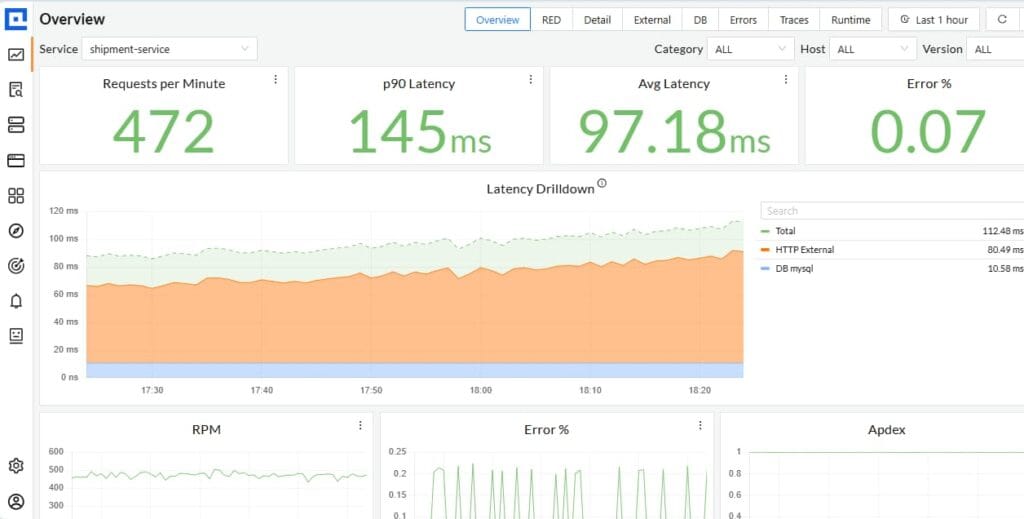
CubeAPM is a self-hosted, OpenTelemetry-native observability and APM platform. It is better for Python teams that want error visibility connected to traces, logs, metrics, infrastructure, and service-level debugging.
CubeAPM supports OTLP natively, so Python applications can send telemetry through OpenTelemetry instrumentation. CubeAPM also documents Python instrumentation paths for frameworks such as Flask, Django, FastAPI, and other Python deployment patterns.
Best for: Python teams running Django, Flask, FastAPI, Celery, APIs, workers, or microservices that need full-stack observability, not just exception inboxes.
Python integration: CubeAPM uses OpenTelemetry Python instrumentation. Teams can instrument Python services with OpenTelemetry SDK/exporters and send OTLP data to CubeAPM. This is more involved than changing a Sentry DSN, but it gives broader observability coverage.
Error-tracking approach: CubeAPM correlates exceptions with traces, logs, metrics, and infrastructure context. Instead of only seeing the stack trace, teams can inspect the request path, service calls, database spans, latency, and related logs around the error.
Pricing: CubeAPM lists predictable pricing at $0.15/GB of data ingestion, with no hidden fees or surprise overages. It is deployed in the customer’s infrastructure while the CubeAPM team handles operational work such as upgrades and support.
Pros and Cons
| Pros from user reviews / review profiles | Cons to state carefully |
| Users describe it as cost-effective compared with tools where bills are harder to explain. | Not suited for teams looking for off-prem solution |
| Capterra review text highlights self-hosting and data control as positives. | Strictly an observability platform and does not support cloud security management |
| Users mention quick support through a dedicated Slack channel. | |
| Strong fit for full-stack observability: APM, logs, metrics, traces, and infra. |
2. GlitchTip
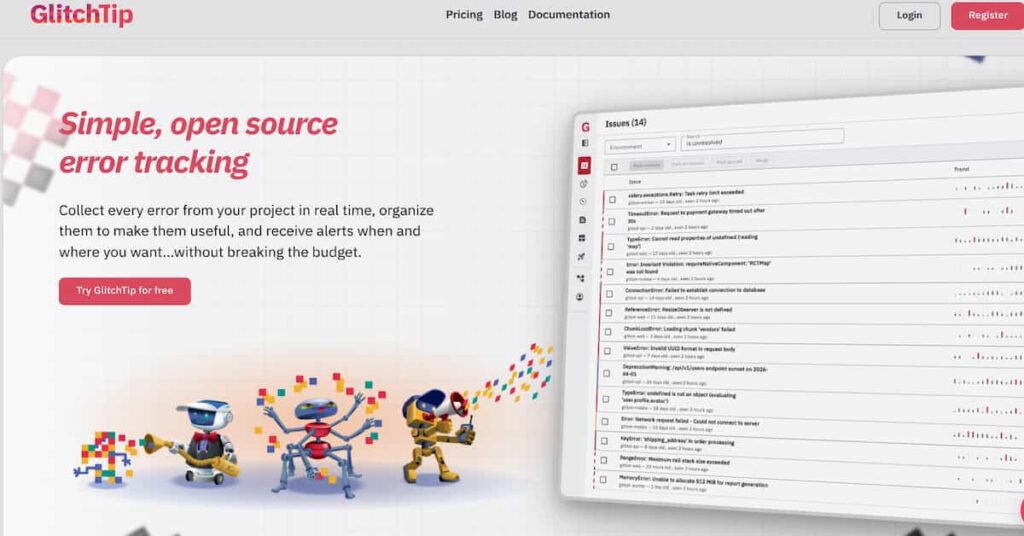
GlitchTip is an open source error tracking platform compatible with Sentry client SDKs. It can be self-hosted or used as a hosted service, making it one of the closest practical replacements for teams already using Sentry-style instrumentation.
GlitchTip’s official site says it tracks errors, monitors performance, checks uptime, and is compatible with Sentry client SDKs. Its pricing page defines “events” across issues, uptime checks, performance transactions, and release file storage.
Best for: Python teams that want a lower-cost, open source, Sentry-compatible replacement with minimal migration work.
Python integration: Use the existing sentry-sdk pattern and point the DSN to GlitchTip. This makes it a strong option for Django, Flask, FastAPI, Celery, and other Python apps already using Sentry-compatible SDKs.
Error-tracking approach: GlitchTip receives Sentry-compatible events, groups errors into issues, supports uptime monitoring, and includes basic performance monitoring.
Pricing: GlitchTip’s hosted pricing includes a free tier and paid hosted plans. Its pricing page confirms the Large plan at $250/month for up to 3 million events/month, and it also confirms that events are counted across issues, uptime, performance, and releases. It also offers US and EU hosting, with Germany-based EU hosting available across plans.
Pros and Cons
| Strengths | Trade-offs |
| Sentry-compatible client SDK support. | Complex initial setup |
| Open source and self-hostable. | Self-hosted adds operational overhead |
| Hosted plans and EU hosting available. | Steep learning curve |
| Easier to run than self-hosted Sentry for many teams. |
3. Rollbar
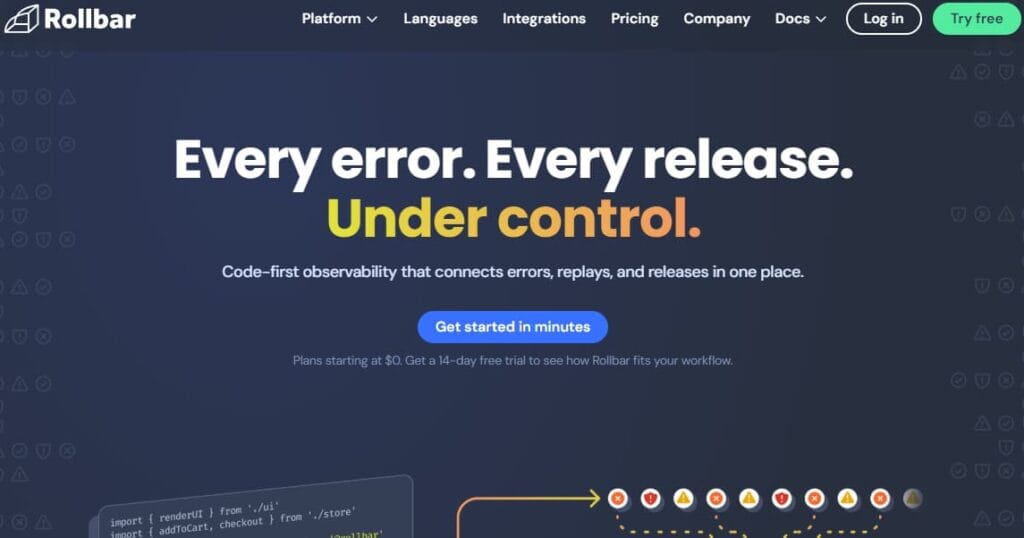
Rollbar is a mature SaaS error monitoring platform used for real-time error detection, grouping, alerting, and debugging. It is a strong Sentry alternative for teams that want a hosted tool rather than self-hosting.
Rollbar’s pricing page confirms a free tier with 5K occurrences and 1K replays per month, a 14-day full-access trial, and billing controls such as plan limits, on-demand events, and overage budgets.
Best for: Mid-size Python teams that want a mature hosted error monitoring tool with alerting, grouping, integrations, and predictable event limits.
Python integration: Rollbar provides Python framework documentation, including FastAPI support. Its FastAPI docs describe supported setup options using async or sync handlers.
Error-tracking approach: Rollbar groups occurrences into items, provides monitoring and alerting, supports grouping customization, and helps teams reduce notification noise. Its docs describe grouping, notification, and customization features for reducing error noise.
Pricing: Free plan includes 5K occurrences + 1K replays/month.
Pros and Cons
| Pros | Cons |
| Users praise ease of use and simple setup. | Some users say error grouping can be inconsistent. |
| Review summaries highlight strong integrations. | Some users find grouping rules unclear. |
| Helpful for aggregating and presenting error data quickly. | Some users have reported the mobile UI can feel overwhelming |
| Seen as reliable for error tracking workflows. | High error volume can still require tuning to reduce noise. |
4. Honeybadger
Honeybadger is an application monitoring platform that bundles error tracking with uptime monitoring, cron/check-in monitoring, performance visibility, dashboards, and logging. It is popular with smaller engineering teams that want a simple developer-focused monitoring tool.
Honeybadger’s Python docs describe it as a tool for monitoring Python applications for errors and performance bottlenecks.
Best for: Small and mid-size Python teams that want errors, uptime, check-ins, and lightweight performance visibility in one subscription.
Python integration: Honeybadger’s Python documentation covers Python error tracking, performance monitoring, and observability. Its GitHub docs also show Django middleware setup for Python applications.
Error-tracking approach: Honeybadger captures application errors, sends alerts, supports uptime monitoring and check-ins, and provides dashboards/APM-style performance views.
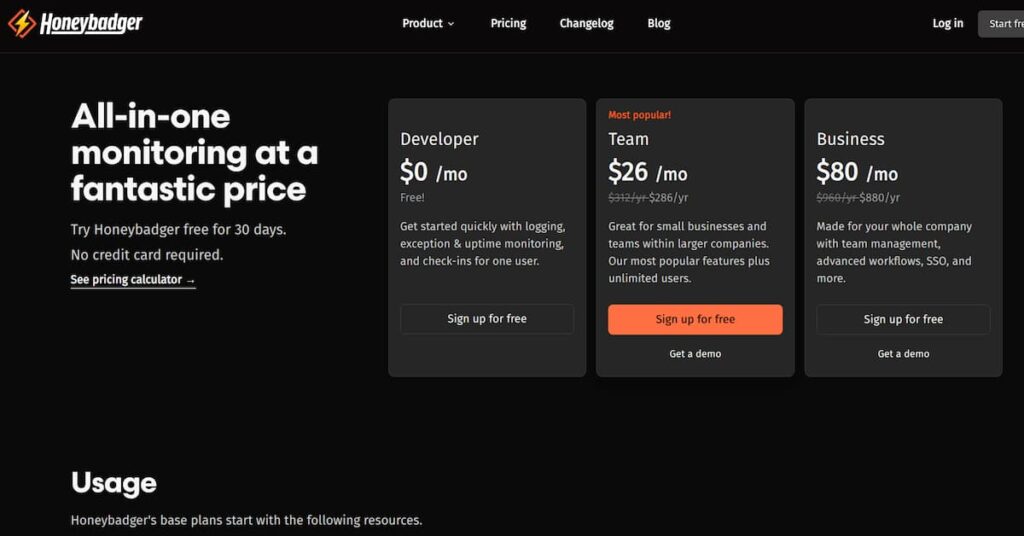
Pricing: Honeybadger has a Developer plan at $0/month, Team at $26/month, and Business at $80/month. The Team plan includes unlimited users, and the pricing page says the base plan includes 50K errors/month for Team and Business.
Pros and Cons
| Pros | Cons |
| Users praise simplicity and ease of use. | Some users say it can be costly for small projects. |
| Users mention strong support and customer service. | Some users want more tools or integrations. |
| Useful for tracking application errors and uptime. | Some users mention language/API limitations. |
| Good fit for teams that want a clean monitoring workflow. |
5. PostHog
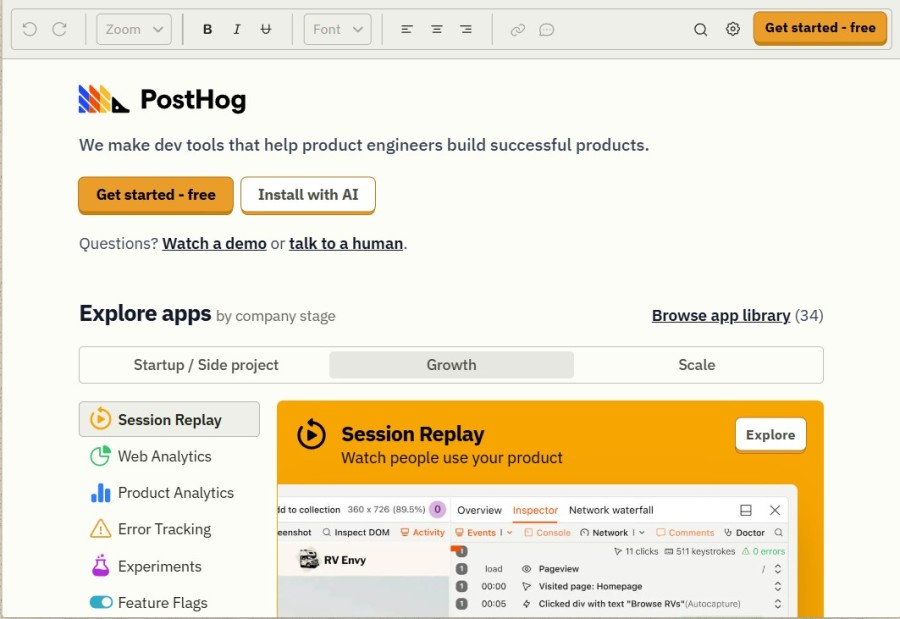
PostHog is primarily a product analytics platform, but it also includes error tracking. It is strongest when Python teams want error data connected to product analytics, user sessions, feature flags, experiments, and session replay.
PostHog’s error tracking pricing docs say error tracking is billed by $exception events, with 100,000 exceptions/month at $0, and billing limits can be set to avoid surprise charges. Its pricing page lists error tracking from $0.00037/exception after the free tier.
Best for: Python teams already using PostHog for analytics, session replay, experiments, or feature flags.
Python integration: PostHog’s Python error tracking docs show installation with pip install posthog, initialization with a project key and host, exception autocapture, manual exception capture, and framework-specific handling for Django, Flask, and FastAPI.
Error-tracking approach: PostHog captures exception events and can connect them with user/product context. This is helpful when product teams need to know which users were affected, what they did before the error, and whether the issue connects to a feature rollout or experiment.
Pricing: Error tracking includes the first 100K exceptions/month free. After that, PostHog lists tiered exception pricing, starting at $0.000370/exception for 100K–325K exceptions, then lower rates at higher volumes.
Pros and Cons
| Pros from user reviews | Cons from user reviews |
| Users praise broad analytics and product insight features. | Users frequently mention a learning curve. |
| Strong fit for technical product teams. | Can feel complex for less technical users. |
| Easy to implement once event design is clear. | Setup requires careful event and dashboard planning. |
| Generous free tier across multiple products. |
How to Choose the Right Sentry Alternative for Python
Choose GlitchTip. Both support Sentry-compatible SDK workflows, which means Python teams can usually keep existing instrumentation and update the DSN. GlitchTip is broader, with hosted plans, uptime checks, and basic performance monitoring. Bugsink is more focused and lightweight.
Choose Rollbar or Honeybadger. Rollbar is stronger for event-volume-based error monitoring, grouping, alerting, and integrations. Honeybadger is stronger when you want errors, uptime, check-ins, and lightweight application monitoring in one simple product.
Choose CubeAPM. It is the best fit when Python errors need to be debugged alongside traces, logs, metrics, database calls, infrastructure, and service dependencies. It is especially relevant for Django, Flask, FastAPI, and microservice environments using OpenTelemetry.
Choose PostHog. It is not a dedicated APM tool, but it is strong when error tracking should connect with product analytics, session replay, feature flags, and user behavior.
Final Comparison Table
| Tool | Best For | Pricing Model | Python Setup |
| CubeAPM | Full-stack APM + errors | $0.15/GB ingestion | OpenTelemetry Python |
| GlitchTip | Drop-in Sentry alternative | Hosted event tiers + self-hosted | Sentry-compatible DSN |
| Rollbar | SaaS error monitoring | Event-volume plans | Rollbar Python SDK |
| Honeybadger | Errors + uptime + check-ins | Monthly plans | Honeybadger Python SDK |
| PostHog | Analytics + error tracking | Usage-based exceptions | PostHog Python SDK |
📌 Try CubeAPM: Self-Hosted APM for Python Teams
If your Python stack needs more than exception capture, CubeAPM gives you distributed tracing, logs, metrics, infrastructure monitoring, and error correlation in one self-hosted observability platform.
It is built for OpenTelemetry, priced at $0.15/GB, and deployed inside your infrastructure so telemetry data stays under your control. For Django, Flask, FastAPI, Celery, and Python microservices, that means you can debug errors with the full request path, related logs, database spans, and infrastructure signals in one place.
Conclusion
The best Sentry alternative for Python depends on what problem you are solving. If you want the lowest-friction migration from Sentry, GlitchTip and Bugsink are the closest options because they support Sentry-compatible SDK workflows. If you want a hosted SaaS error monitoring platform, Rollbar and Honeybadger are more mature choices with stronger public review data.
If you need deeper observability for Django, Flask, FastAPI, or Python microservices, CubeAPM is the stronger option. It goes beyond error tracking by connecting exceptions with traces, logs, metrics, infrastructure data, and service dependencies through OpenTelemetry.
For product-led teams, PostHog is also worth considering because it connects errors with analytics, sessions, and user behavior. The trade-off is that it is not a dedicated APM platform.
Disclaimer: Pricing and features change often, so always confirm current limits, included usage, retention, and overage rules on each vendor’s official pricing page before buying.
FAQs
1. What is the best Sentry alternative for Python?
For a drop-in replacement, GlitchTip and Bugsink are the closest because they support Sentry-compatible SDK workflows. For full observability, CubeAPM is stronger because it connects Python errors with traces, logs, metrics, and infrastructure context.
2. Can I use the Sentry Python SDK with alternatives?
Yes, with some tools. GlitchTip and Bugsink are designed around Sentry SDK compatibility, so Python teams can usually keep Sentry-style instrumentation and update the DSN.
3. Which Sentry alternative is best for Django and Flask?
Rollbar, Honeybadger, PostHog, CubeAPM, GlitchTip, and Bugsink can all work with Python apps, but the best fit depends on the setup. For Sentry-compatible migration, use GlitchTip or Bugsink. For OpenTelemetry-based observability, use CubeAPM. For hosted error monitoring, use Rollbar or Honeybadger.
4. Which Sentry alternative has the best free tier?
PostHog has one of the strongest free tiers for error tracking, with 100K exceptions/month free. Rollbar also has a free plan with 5K occurrences and 1K replays/month.
5. Is CubeAPM a direct Sentry replacement?
Not exactly. CubeAPM is better described as a full-stack observability and APM alternative for teams that need more than an error inbox. It is useful when Python errors need to be debugged alongside distributed traces, logs, metrics, infrastructure, and service dependencies.