










Sentry is a popular error tracking platform for capturing exceptions, grouping issues, and helping developers debug production errors faster. But it is not the only option for teams that want more control over how error and performance data is collected, stored, and monitored.
Many teams look for Sentry alternatives because they want self-hosting, predictable costs, open-source licensing, stronger data residency, or deeper observability beyond exception tracking. This is especially important for engineering teams that need to connect errors with logs, traces, metrics, uptime checks, incidents, and real user behavior.
The tools below include open-source Sentry alternatives as well as one cost-effective self-hosted option for teams that want managed operations without giving up data control. Each option is reviewed based on deployment model, error tracking depth, observability coverage, pricing, and best-fit use case.
🔑 Key Takeaways
- CubeAPM is the best fit when you want self-hosted, vendor-managed observability with error tracking, APM, logs, metrics, traces, RUM, synthetics, and predictable $0.15/GB pricing.
- GlitchTip is the closest open-source drop-in Sentry replacement because it supports Sentry client SDKs and can be self-hosted.
- SigNoz is a strong OpenTelemetry-native option for teams that want exceptions, traces, logs, metrics, dashboards, and alerts in one open-source platform.
- Uptrace fits teams that want OpenTelemetry-based tracing and observability with Sentry SDK compatibility.
- Grafana OSS is not a direct Sentry clone, but it is one of the biggest open-source observability ecosystems for teams that want dashboards, logs, traces, metrics, profiling, and frontend observability.
- OneUptime is useful when you want error tracking together with uptime monitoring, incident management, on-call scheduling, and status pages.
- Apache SkyWalking is a much bigger open-source APM and observability project than lightweight error trackers, but it is better for distributed tracing and service monitoring than pure Sentry-style issue workflows.
Best Sentry Open Source Alternatives
1. CubeAPM
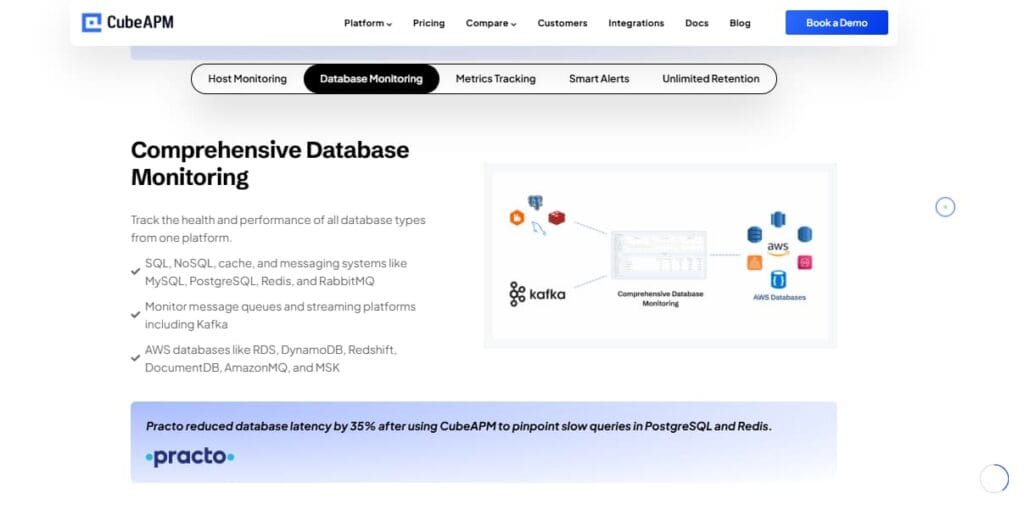
CubeAPM is the best choice for teams that want more than error tracking, but still need the control of a self-hosted deployment.
CubeAPM is a better fit than a narrow error tracker when teams need errors connected to traces, logs, infrastructure metrics, real user sessions, and synthetic checks. It includes intelligent error tracking, OpenTelemetry compatibility, APM, log management, infrastructure monitoring, RUM, synthetics, Kubernetes monitoring, smart sampling, and long-term retention.
Key Features
- Error tracking with intelligent grouping and context
- OpenTelemetry-native ingestion
- APM, distributed tracing, logs, metrics, and infrastructure monitoring
- Real User Monitoring and synthetic monitoring
- Self-hosted deployment inside your own cloud or on-prem
- Vendor-managed operations, upgrades, patches, and support
- Predictable $0.15/GB ingestion pricing
- No per-user or per-host pricing model
Pricing
CubeAPM uses flat ingestion-based pricing at $0.15/GB. The platform is designed to avoid per-host, per-user, and event-spike pricing surprises.
Best For
Teams that want full-stack observability and error tracking inside their own cloud, but do not want to manage a complex open-source stack themselves.
Open source: No
Self-hosted: Yes
Vendor-managed: Yes
Best fit: Cost-effective managed self-hosted observability with error tracking and full APM.
2. GlitchTip
GlitchTip is the closest open-source drop-in replacement for Sentry. It supports Sentry client SDKs, which means teams already sending errors to Sentry can usually migrate by changing the DSN instead of rewriting instrumentation. GlitchTip’s official site describes it as simple, open-source error tracking with support for error tracking, performance monitoring, uptime monitoring, and logs.
The biggest advantage of GlitchTip is focus. It is built for teams that want Sentry-style error tracking without adopting a large observability platform. It is also self-hostable, and the hosted version has a free plan and paid plans starting at $15/month for up to 100,000 events/month.
Key Features
- Sentry SDK compatibility
- Error tracking and issue grouping
- Performance monitoring
- Uptime monitoring
- Application logs
- Email and webhook alerts
- Self-hosted option
Pricing
GlitchTip offers a free self-hosted version. Its hosted free plan supports up to 1,000 events/month, and the hosted Small plan is listed at $15/month for up to 100,000 events/month.
Best For
Teams that want a simple open-source Sentry replacement with minimal migration effort.
Open source: Yes
Self-hosted: Yes
Best fit: Drop-in Sentry-style error tracking.
3. SigNoz
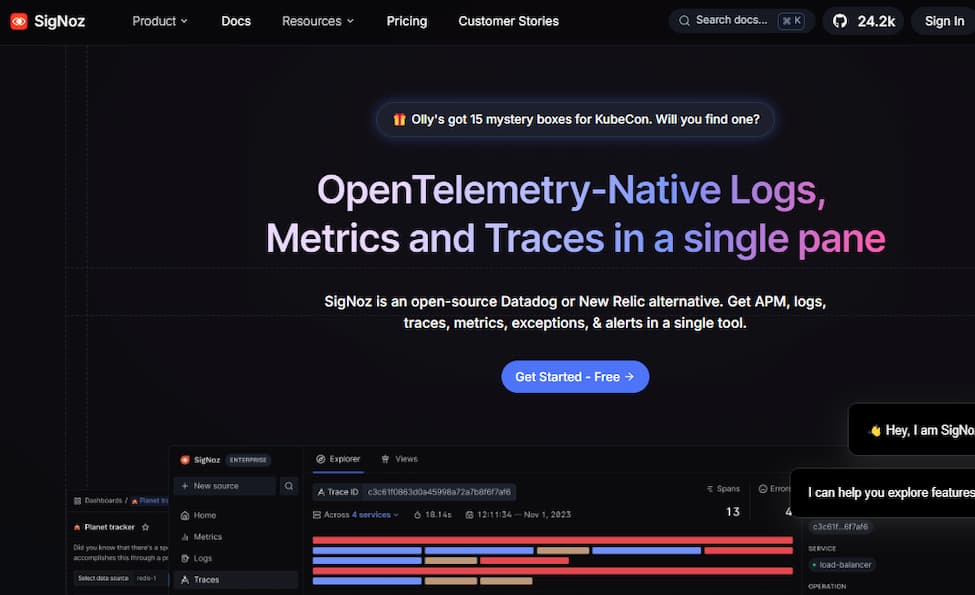
SigNoz is an OpenTelemetry-native observability platform that combines traces, logs, metrics, exceptions, dashboards, and alerts. It is broader than Sentry because it is built as a full observability platform, not just an error tracker. SigNoz says it can be self-hosted, used as cloud, or deployed as managed self-hosted for teams with data privacy and regulatory needs.
SigNoz is much stronger than lightweight error trackers when teams want to correlate exceptions with traces and logs. It is also a large open-source project, with SigNoz listing 10 million+ OSS downloads, 25k+ GitHub stars, and 140+ contributors on its site.
Key Features
- OpenTelemetry-native ingestion
- Exceptions, traces, logs, and metrics
- Distributed tracing
- Dashboards and alerts
- No user-based pricing on the hosted model
- Self-hosted and managed self-hosted options
- Useful for microservices and cloud-native systems
Pricing
SigNoz can be self-hosted. Its hosted pricing is usage-based, with no user-based or host-based pricing according to its pricing page language.
Best For
Engineering teams standardizing on OpenTelemetry who want error tracking plus logs, metrics, and traces in one platform.
Open source: Yes
Self-hosted: Yes
Best fit: OpenTelemetry-native APM and observability.
4. Uptrace
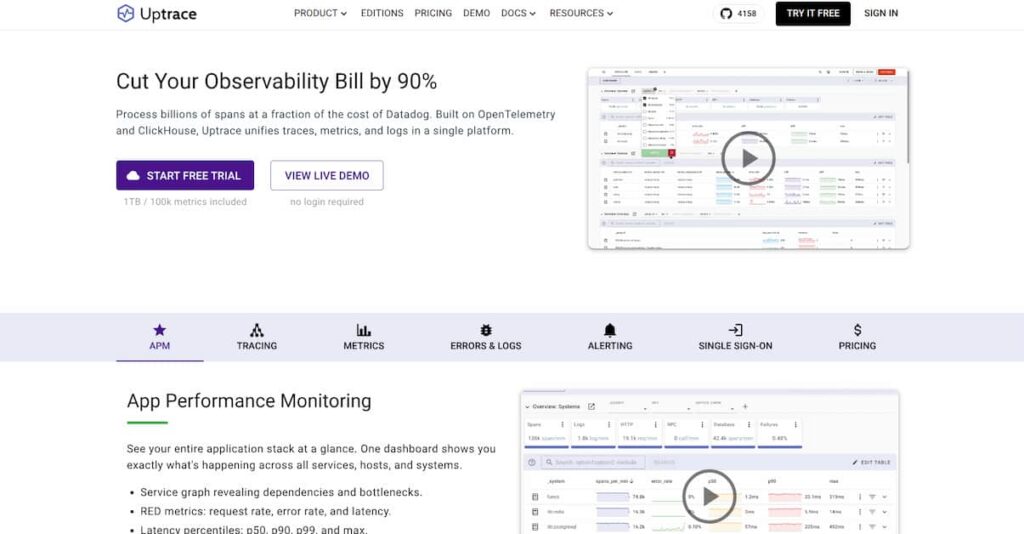
Uptrace is an OpenTelemetry-based observability platform for traces, metrics, and logs. It is not a pure Sentry clone, but it fits teams that want application debugging and distributed tracing with open standards. It can also be useful for teams moving away from proprietary instrumentation.
Uptrace is best positioned as an APM and tracing-oriented Sentry alternative rather than a dedicated issue-tracking product. It works well when the main goal is understanding request paths, latency, failed spans, and service-level behavior. It is less ideal if the team wants a polished Sentry-style issue workflow with release health, suspect commits, and deep frontend error workflows.
Key Features
- OpenTelemetry-based tracing
- Metrics and logs
- Application performance monitoring
- Service-level debugging
- ClickHouse-backed architecture
- Self-hosted deployment option
Pricing
Uptrace has a self-hosted option and commercial offerings. Teams should verify current pricing directly from Uptrace before buying because pricing and packaging can change.
Best For
Teams that want OpenTelemetry-based APM and tracing, especially when errors need to be investigated through distributed traces.
Open source: Yes
Self-hosted: Yes
Best fit: OpenTelemetry tracing and backend observability.
5. Grafana OSS
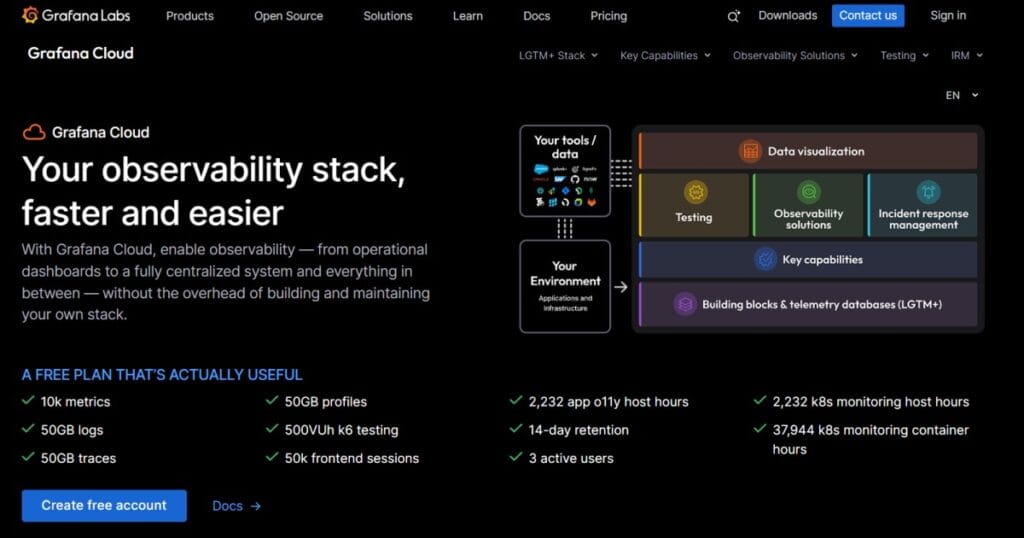
Grafana OSS is not a direct Sentry replacement, but it is one of the strongest open-source ecosystems for teams that want to build a complete observability stack. Grafana itself is the dashboarding layer, while the broader Grafana OSS ecosystem includes Loki for logs, Tempo for traces, Mimir or Prometheus for metrics, Alloy for telemetry collection, Pyroscope for profiling, and Faro for frontend observability. Grafana describes Grafana as the leading open-source visualization and dashboarding platform, Loki as log aggregation, Tempo as distributed tracing, and Alloy as an OpenTelemetry collector with support for metrics, logs, traces, and profiles.
The accuracy caveat is important: Grafana OSS does not give you Sentry-style issue grouping out of the box. You can monitor errors through logs, traces, alerts, frontend telemetry, and dashboards, but you will need to assemble the workflow yourself. That makes Grafana OSS better for platform teams and SREs than for developers looking for a simple error inbox.
Key Features
- Grafana dashboards and alerting
- Loki for log aggregation
- Tempo for distributed tracing
- Prometheus/Mimir for metrics
- Alloy for OpenTelemetry and Prometheus pipelines
- Faro for frontend observability and frontend errors
- Pyroscope for continuous profiling
Pricing
Grafana OSS components are open source and self-hostable. Costs mainly come from infrastructure, storage, operations, and optional managed Grafana Cloud services.
Best For
Teams that want a flexible open-source observability stack and have the engineering capacity to assemble and operate it.
Open source: Yes
Self-hosted: Yes
Best fit: Custom observability stack, dashboards, logs, traces, metrics, and alerts.
6. OneUptime
OneUptime is an open-source platform that combines monitoring, incident management, on-call scheduling, status pages, and error tracking workflows. It is a good option for teams that want more than exception capture and want operational response built into the same platform.
OneUptime is not as specialized as Sentry for developer-first error workflows, but it is useful when teams want to connect errors with incidents, uptime checks, alert routing, and status communication. This makes it stronger for small teams that want to consolidate several operational tools.
Key Features
- Error tracking
- Uptime monitoring
- Status pages
- Incident management
- On-call scheduling
- Alerts and notifications
- Log and observability workflows
Pricing
OneUptime has an open-source self-hosted option and paid cloud/enterprise options. Teams should verify current cloud pricing directly before purchase.
Best For
Teams that want error tracking, uptime monitoring, incidents, on-call, and status pages in one open-source platform.
Open source: Yes
Self-hosted: Yes
Best fit: Error tracking plus incident response and status pages.
7. Apache SkyWalking
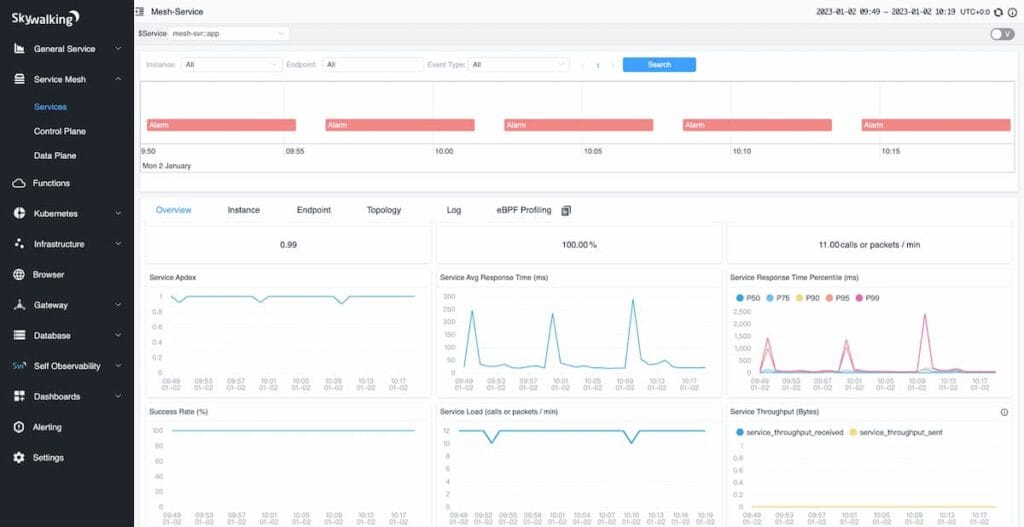
Apache SkyWalking is the better replacement for Errbit if you want a much bigger open-source project with real APM depth. It is not a simple Sentry clone. It is an Apache open-source observability platform for cloud-native systems, with distributed tracing, metrics, logs, profiling, alarms, service topology, language agents, and eBPF support for Kubernetes.
SkyWalking works best when errors are part of a broader performance and service diagnosis workflow. Teams can use it to analyze traces, service dependencies, logs, and metrics, but it does not provide the same developer-first issue inbox experience that Sentry or GlitchTip provides. That makes it a better fit for platform engineering and backend observability than lightweight exception tracking.
Key Features
- Distributed tracing
- Metrics and dashboards
- Logs with trace correlation
- Profiling
- Alarms and alerting rules
- Service topology
- Language agents
- eBPF support for Kubernetes
Pricing
Apache SkyWalking is open source and self-hosted. The main costs are infrastructure, storage, deployment, and ongoing operations.
Best For
Teams that want a large open-source APM and observability platform for distributed systems, especially microservices and Kubernetes environments.
Open source: Yes
Self-hosted: Yes
Best fit: Open-source APM, tracing, service topology, logs, metrics, and profiling.
Quick Comparison: Best Sentry Alternatives
| Tool | Open source? | Self-hosted? | Best for |
| CubeAPM | No | Yes, vendor-managed | Cost-effective full-stack observability with error tracking |
| GlitchTip | Yes | Yes | Closest Sentry-style OSS replacement |
| SigNoz | Yes | Yes | OTel-native APM, logs, metrics, traces, exceptions |
| Uptrace | Yes | Yes | OpenTelemetry tracing and APM |
| Grafana OSS | Yes | Yes | Custom OSS observability stack |
| OneUptime | Yes | Yes | Error tracking plus incidents, on-call, status pages |
| Apache SkyWalking | Yes | Yes | Large OSS APM for distributed systems |
How to Choose the Right Sentry Alternative
Choose CubeAPM if you want control without self-hosting pain
CubeAPM is the strongest fit when you want telemetry to stay inside your own cloud, but you do not want your team managing upgrades, scaling, storage, and platform reliability. It is not open source, but it is self-hosted, vendor-managed, and priced predictably at $0.15/GB.
Choose GlitchTip if you want the closest open-source Sentry replacement
GlitchTip is the cleanest choice when you want Sentry SDK compatibility and a lightweight self-hosted error tracker. It is the best option for teams that mostly care about errors, uptime, simple performance monitoring, and logs.
Choose SigNoz if you want OpenTelemetry-native observability
SigNoz is stronger when the team wants exceptions connected to traces, logs, metrics, dashboards, and alerts. It is a better fit for microservices than a narrow crash reporter.
Choose Grafana OSS if you already have platform engineering capacity
Grafana OSS is powerful, but it is a stack rather than a single Sentry alternative. It works best when your team can operate Loki, Tempo, Prometheus or Mimir, Alloy, Grafana dashboards, alerts, and storage.
Choose Apache SkyWalking if you want a large OSS APM platform
SkyWalking is a strong open-source APM option for distributed systems. It is better for traces, metrics, logs, topology, and service diagnosis than for Sentry-style issue management.
Conclusion
The best Sentry alternative depends on what you are really trying to replace. If you only need Sentry-style error tracking, GlitchTip is the most direct open-source option. If you want OpenTelemetry-native observability, SigNoz and Uptrace are stronger. If you want a large open-source observability ecosystem, Grafana OSS and Apache SkyWalking are better fits than small legacy error trackers.
CubeAPM belongs at the top of the list for teams that want full-stack observability, cost predictability, and self-hosted data control without running the platform themselves. It is not open source, so the article should be honest about that. But for teams moving away from Sentry because of pricing, data control, or limited observability depth, CubeAPM is the strongest practical option.
DisclaimerThis article is provided for informational purposes only. Pricing, features, and licensing details for all third-party tools are subject to change. Always verify current information directly on official product websites before making purchasing or deployment decisions. CubeAPM is the product of the publisher and is included as a recommended option alongside third-party tools.
FAQs
1. Is Sentry itself open source?
Sentry publishes its server-side code under the BSL (Business Source License), which restricts commercial use of the self-hosted version. Its client SDKs are open source under the MIT license. GlitchTip and other tools on this list are licensed under fully open source licenses such as MIT and Apache 2.0, with no commercial use restrictions.
2. Can I migrate from Sentry to GlitchTip without changing my application code?
Yes. GlitchTip is compatible with Sentry’s SDK protocol. You change the DSN (Data Source Name) in your application configuration to point to your GlitchTip instance. No changes to instrumentation code are required. The same approach works for Bugsink and Uptrace.
3. What is the easiest open source error tracker to self-host?
Bugsink runs as a single Docker container with about five minutes of setup time. GlitchTip requires four components (Django backend, Celery worker, Redis, PostgreSQL) and can be deployed with a single Docker Compose file. Both are significantly simpler than self-hosted Sentry, which requires a dozen or more services.
4. Does SigNoz replace both Sentry and a distributed tracing tool?
Yes. SigNoz ingests OpenTelemetry data and surfaces traces, metrics, logs, and exceptions in one interface. If you currently use Sentry for errors and a separate tool such as Jaeger for tracing, SigNoz can replace both. The trade-off is that SigNoz’s issue grouping and error workflow features are less specialized than Sentry’s.
5. How does CubeAPM complement these open source tools?
CubeAPM is an OpenTelemetry-native APM platform that runs inside your own cloud environment and covers the full MELT stack: metrics, events, logs, and traces, alongside real user monitoring, synthetics, and error tracking. Open source trackers like GlitchTip excel at error grouping and workflow but do not provide deep APM, infrastructure monitoring, or RUM. CubeAPM fills that gap.