





Datadog does not have a fully self-hosted option. All core services – metrics, traces, APM, RUM, synthetics, dashboards, and the Datadog UI – run on Datadog’s SaaS infrastructure. The only exception is CloudPrem (also called BYOC Logs), which lets you store and search logs inside your own cloud account while keeping everything else in Datadog’s SaaS platform. As of May 2026, CloudPrem is still in Preview and requires requesting access from Datadog.
If your team needs telemetry to stay inside your own VPC, cloud account, or on-premises environment – for compliance, data residency, cost control, or all three – you need a Datadog alternative platform entirely, not a configuration option within Datadog.
Key Takeaways
- Datadog has no fully self-hosted version. CloudPrem handles logs only and requires the Datadog SaaS control plane to function. Traces, metrics, and the UI remain on Datadog’s infrastructure.
- Self-hosted alternatives fall into two categories: fully open-source tools your team manages, and vendor-managed self-hosted platforms that run in your infrastructure, but the vendor operates.
- The hardest part of fully open-source self-hosting is not the initial setup – it is long-term storage management, upgrades, scaling, and alerting maintenance.
- OpenTelemetry-native platforms reduce lock-in because instrumentation stays portable across backends.
- Teams with strict compliance requirements (HIPAA, GDPR, PCI DSS, FedRAMP) often cannot use SaaS observability at all – vendor-managed self-hosted is frequently the only viable path.
Why Teams Look for Datadog Self-Hosted Alternatives
Pricing that compounds across multiple billing dimensions
Datadog bills separately for infrastructure hosts, APM hosts, log ingestion, log indexing, custom metrics, RUM sessions, synthetic test runs, and span retention. Each product has its own unit, included limit, and overage rule. As teams add services, enable more integrations, or increase telemetry volume, costs stack across dimensions rather than scaling through one predictable meter. For Kubernetes environments and microservices architectures, this effect is amplified because one user request can generate spans across many services simultaneously.
Custom metrics growing quietly beyond included limits
Kubernetes labels, high-cardinality tags, dynamic dimensions, and application-level metrics can push custom metric counts beyond the included allotments per host without any obvious trigger. Teams often discover the overage on the bill rather than in a dashboard.
Log indexing as the dominant cost driver at scale
Datadog charges separately for log ingest and log indexing across different retention tiers. Log-heavy environments – security teams retaining logs for compliance, or high-throughput microservices architectures – can find that indexed log costs become a significant share of the total bill, especially when longer retention is required.
For more details on Datadog’s cost, check out this Datadog pricing calculator.
No fully self-hosted option for teams with data residency requirements
Datadog launched CloudPrem (also called BYOC Logs) in October 2025. It is a hybrid log management solution that runs in your own infrastructure and stores logs in your object storage – S3, Azure Blob, or MinIO. However, the Datadog platform remains the control plane; the Datadog UI and all non-log telemetry, including traces, metrics, and APM data stay on Datadog’s SaaS infrastructure. As of May 2026, CloudPrem is still in Preview and requires requesting access from Datadog. For teams that need all telemetry – not just logs – inside their own environment, CloudPrem does not address the full requirement.
Vendor lock-in from proprietary instrumentation
Datadog supports OpenTelemetry through the Collector and OTLP ingest, but many existing Datadog deployments are built around Datadog’s own agents, SDKs, and query workflows. Migrating away later involves rebuilding instrumentation, dashboards, monitors, and alert rules – not just pointing to a new endpoint.
Span ingestion and indexed span costs at scale
APM includes default span allotments per host, but high-throughput distributed systems can exceed these quickly. Extra span ingestion is billed beyond the included amount, and indexed span retention adds additional costs by retention tier. Hourly metering for on-demand APM means a short traffic spike or release event can push usage above the hourly allotment even if the monthly average usage looks normal.
OpenTelemetry-first strategy creating friction
Teams standardizing on OTel pipelines and OTLP as their long-term telemetry standard sometimes prefer backends where OpenTelemetry is the primary architecture rather than one supported ingest path alongside proprietary options.
The Two Categories of Self-Hosted Alternatives
Category 1: Fully Open-Source Tools You Manage
You deploy, configure, scale, upgrade, back up, and maintain the stack. Maximum control, maximum operational burden. Best for teams with dedicated DevOps or SRE capacity who want full control and minimal vendor dependency.
Category 2: Vendor-Managed Self-Hosted Platforms
The vendor ships and manages the software, but it runs inside your own infrastructure – your VPC, cloud account, or data center. You keep data sovereignty without taking on a second ops burden. Best for teams that need compliance and control without the engineering overhead of running a full observability backend themselves.
The Best Datadog Self-Hosted Alternatives
1. CubeAPM – Vendor-Managed Self-Hosted, OTel-Native
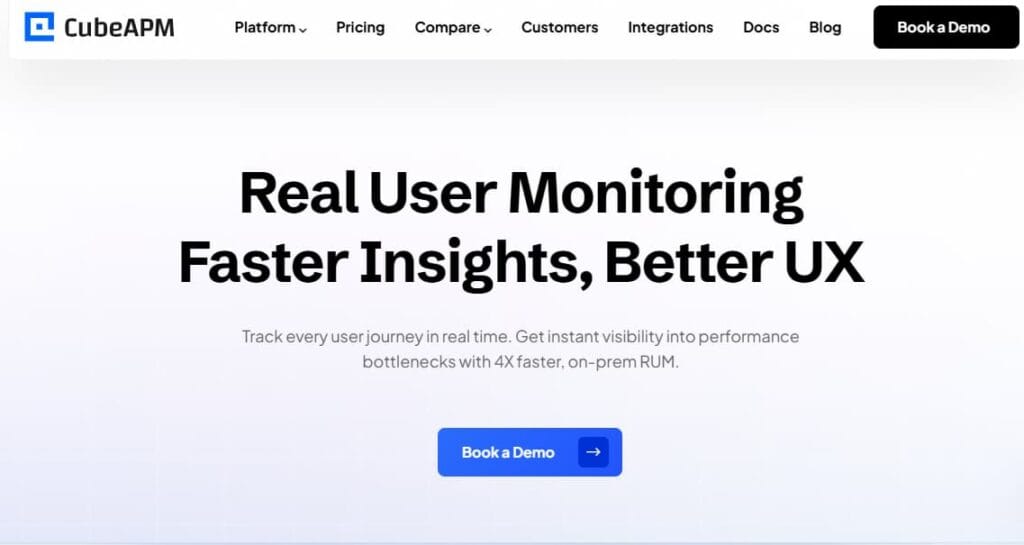
Best for: Teams that need full-stack observability – traces, metrics, logs, Kubernetes, synthetics, RUM, error tracking – running inside their own cloud account, without managing the platform themselves.
CubeAPM is a managed self-hosted observability platform built natively on OpenTelemetry. You deploy it into your own cloud account via Helm on Kubernetes. Your telemetry data stays in your infrastructure. CubeAPM manages upgrades, storage, scaling, and operational complexity.
What makes it different from fully open-source alternatives:
- Runs inside your cloud account (AWS, GCP, or Azure)
- Vendor-managed – no ops burden on your team
- No per-user pricing, no per-host charges
- Flat $0.15/GB ingested with unlimited retention
- OTel-native – uses OpenTelemetry SDKs, not proprietary agents
- Ranked 4th in ease of use in the G2 Spring 2026 APM category
Compared to Datadog:
| Parameter | Datadog | CubeAPM |
| Fully self-hosted | Mostly SaaS | Yes – runs in your VPC |
| Pricing | Host + feature-based, multiple billing units | $0.15/GB flat |
| Per-user fees | Yes | No |
| OTel support | Partial – also promotes proprietary agents | Native |
| Traces in your environment | No | Yes |
Who it is not for: Teams that want a pure off-prem SaaS experience with no infrastructure to provision.
2. SigNoz – Open-Source, Self-Hosted or Cloud
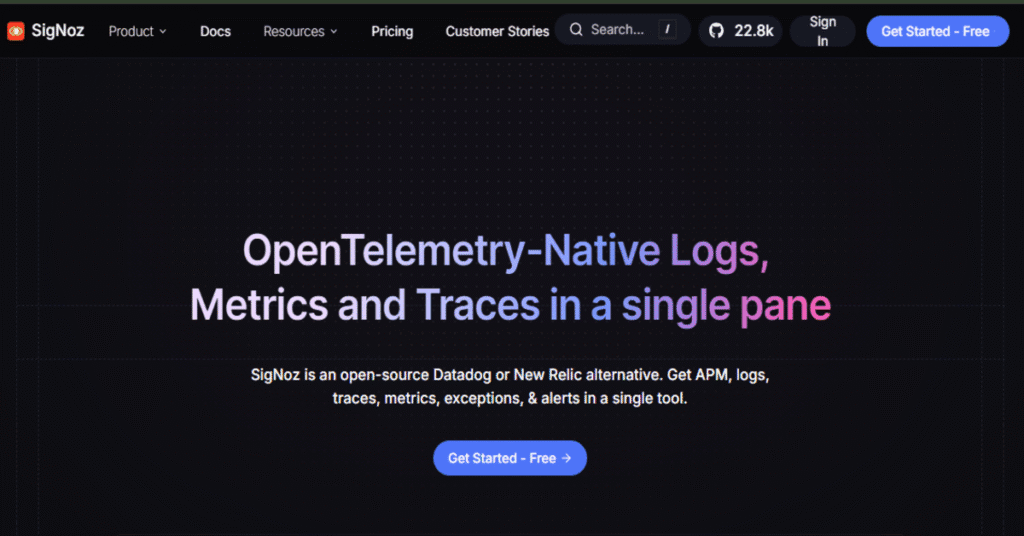
Best for: Engineering teams that want an open-source, OpenTelemetry-native platform and have DevOps capacity to operate it.
SigNoz is built around OpenTelemetry and provides traces, metrics, and logs in a unified interface. Self-hosted Community Edition is free. Enterprise options include BYOC managed by SigNoz, dedicated cloud, and self-hosted with support.
Deployment: Docker Compose for smaller setups, Helm chart for Kubernetes production.
Honest trade-off: With self-hosting, your team owns ClickHouse scaling, storage management, upgrades, and reliability. Enterprise BYOC removes that burden but starts at $4,000/month. Strong fit for funded startups or scale-ups with dedicated SRE capacity.
3. Grafana OSS Stack (LGTM)
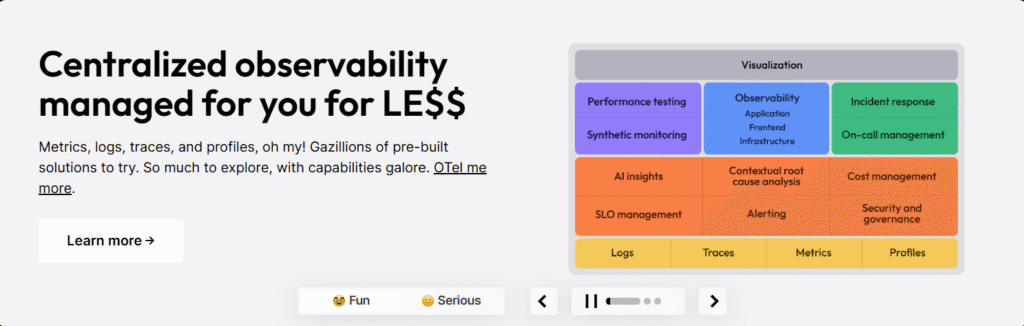
Best for: Teams already invested in Prometheus and Kubernetes who want to extend into distributed tracing and log correlation without replacing their existing metrics setup.
The Grafana stack – Loki for logs, Grafana for visualization, Tempo for traces, Mimir or Prometheus for metrics – is the most widely deployed open-source observability stack. Grafana Cloud Pro starts from $19/month plus usage for teams that want managed infrastructure.
Honest trade-off: Self-hosting the full Grafana LGTM stack creates real operational overhead across four separate components. It is not a drop-in Datadog replacement – teams coming from Datadog should expect meaningful configuration work before workflows feel equivalent. At scale, self-hosted Grafana can exhibit performance degradation and increased query latency as data volume and user count grow.
Best fit: Kubernetes-native teams with existing Prometheus investment and strong DevOps capacity.
4. Elastic APM – Self-Hosted if You Already Run ELK
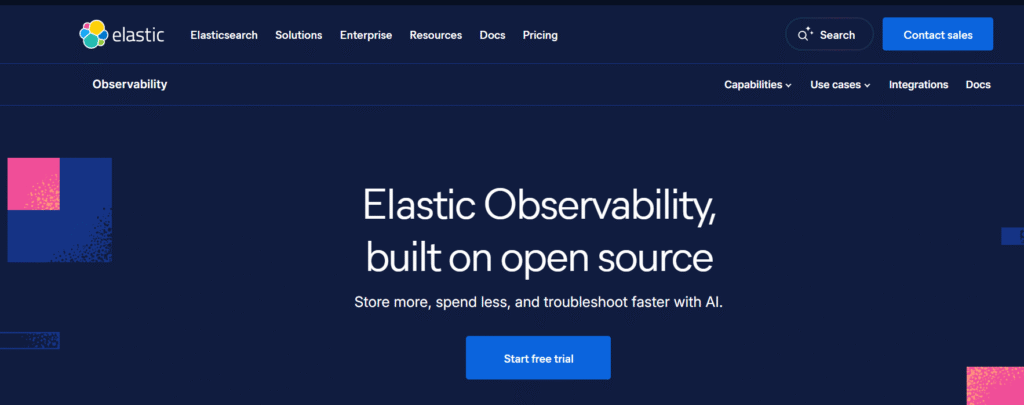
Best for: Teams already running Elasticsearch for log management who want to extend it to APM without adopting a second platform.
Elastic APM extends the same Elastic Stack into application performance monitoring. Self-managed Elastic can be run on your own infrastructure.
Honest trade-off: Self-hosting Elastic requires Elasticsearch expertise. Storage tuning, index lifecycle management, and query performance become complex at high volumes. Infrastructure and operations costs still apply even when the software is free. APM experience can feel less automated than dedicated APM platforms.
Best fit: Teams with existing ELK infrastructure who want to add APM without deploying a second stack.
5. Uptrace – OTel-Native, Flexible Deployment
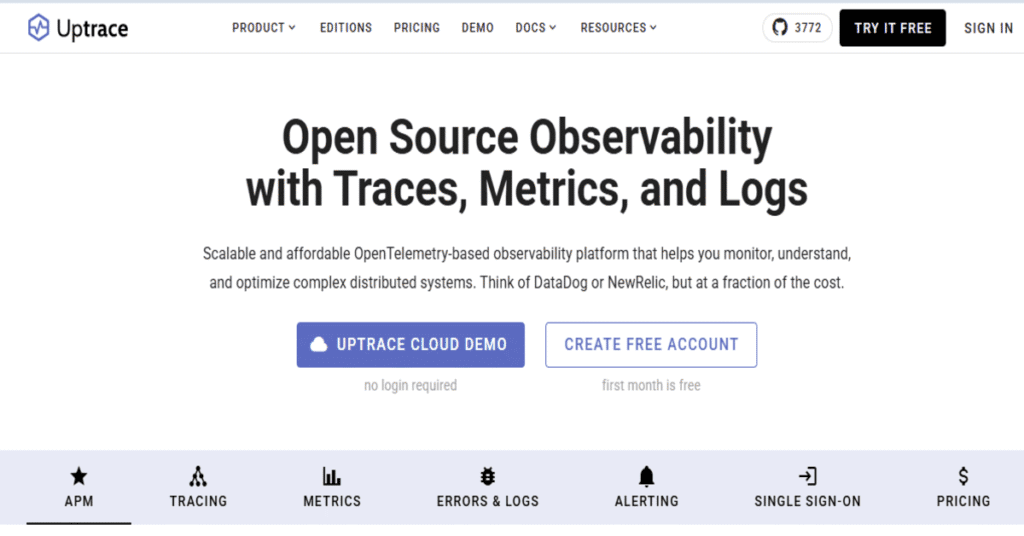
Best for: Teams that want a lightweight OpenTelemetry-native platform focused on distributed tracing and APM, with options for cloud, self-hosted, managed, and on-prem.
Uptrace is built on OpenTelemetry and ClickHouse, supports OTLP for traces, metrics, and logs, and offers a monthly budget cap so bills do not exceed your chosen limit. The self-hosted Community Edition is free, and the Premium Edition is $200/month.
Honest trade-off: Strongest for OTel tracing and APM workflows. May feel lighter than Datadog for teams that need broad infrastructure monitoring, digital experience monitoring, synthetics, and enterprise workflows at scale.
Side-by-Side Comparison
| Tool | Self-Hosted? | OTel Support | Manages Itself | Per-User Cost | Full APM Coverage |
| CubeAPM | Yes – your VPC | Native | Yes | No | Yes |
| SigNoz | Yes | Native | No (Community) / Yes (BYOC) | No | Yes |
| Grafana Stack | Yes | Yes, via Collector | No | No | Yes, composable |
| Elastic APM | Yes | Supported | No | Depends on deployment | Yes |
| Uptrace | Yes | Native | No (Community) / Yes (Managed) | No | Strong for tracing/APM |
| Datadog | No – SaaS only | Partial | Yes (SaaS) | Yes | Yes |
The Operational Cost Nobody Talks About
Every fully open-source self-hosted tool carries the same hidden cost: your engineers’ time. Initial setup is the easy part. Long-term production operations – storage growth, retention management, version upgrades, alert delivery, query performance, backups, and scaling – is where the real overhead lives. For teams of 3 to 5 engineers, that overhead is material.
This is why vendor-managed self-hosted platforms have grown as a category. CubeAPM runs in your infrastructure but manages itself, so teams get data sovereignty and compliance coverage without creating a second ops burden.
How to choose a platform:
- “We need telemetry inside our cloud account, but do not want to manage the stack” – CubeAPM
- “We have a dedicated DevOps or SRE function and want open source” – SigNoz or Grafana Stack
- “We already have ELK and need to add APM” – Elastic APM
- “We mainly need OpenTelemetry tracing with minimal cost” – Uptrace
- “We need open-source but want vendor support available” – SigNoz Enterprise BYOC
What to Check Before Switching
- Deployment model: Confirm whether the tool is fully self-hosted, vendor-managed self-hosted, BYOC, or private cloud. These are meaningfully different operational commitments.
- Data location: Verify where logs, traces, metrics, and metadata are actually stored and processed – not just where the vendor says they are. For Datadog CloudPrem, the control plane and UI remain on Datadog’s infrastructure.
- Feature parity on self-hosted: Ask whether the self-hosted version has the same features as the SaaS version, especially for alerting, dashboards, and AI-assisted workflows.
- Upgrade path: For fully open-source tools, your team handles upgrades. For vendor-managed tools, the vendor handles most of that work. Clarify this before committing.
- Compliance fit: Check whether the deployment model supports HIPAA, GDPR, PCI DSS, SOC 2, FedRAMP, or other requirements your procurement or legal team requires. A cheaper open-source tool may still fail your compliance review.
- OpenTelemetry instrumentation: Prefer platforms where OTel is the primary instrumentation path. This keeps telemetry portable if you switch backends again later.
Summary
Datadog has no fully self-hosted version. If your team needs telemetry inside your own infrastructure, you need a different platform entirely.
The right choice comes down to one question: do you want to manage the monitoring stack yourself, or do you want someone else to manage it while you control where the data lives?
- Data control without ops burden: CubeAPM
- Open source, full control, team has SRE capacity: SigNoz or Grafana Stack
- Already running ELK and need APM: Elastic APM
- Lightweight OTel tracing, minimal cost: Uptrace
- Open source with vendor support available: SigNoz Enterprise BYOC
Most tools on this list support OpenTelemetry natively or through compatible ingest paths, which means instrumentation stays portable if your requirements change later.
Disclaimer : This article is produced by CubeAPM, one of the tools evaluated here. Datadog CloudPrem details are sourced directly from Datadog’s official documentation and blog as of May 2026. All other pricing and feature information is based on publicly available data at the time of writing and may change – verify directly with each vendor before deciding. Nothing here constitutes legal, compliance, or purchasing advice. Teams with regulatory requirements should conduct their own due to diligence.
Also read: