










Datadog RUM is a capable product when it sits alongside an existing Datadog APM and infrastructure deployment. For teams that want to correlate frontend sessions with backend traces inside one platform they already use, it works well. The problem is the pricing structure: meaningful Datadog RUM requires three separate purchases – RUM Measure, RUM Investigate, and Session Replay – billed separately per 1,000 sessions. At 2 million monthly sessions, RUM Measure alone costs $300 per month before Session Replay or any investigation capability is added.
Teams looking for Datadog RUM alternatives are typically solving one of three problems: cost at scale, a desire for a RUM-focused tool rather than a full observability platform, or a need for self-hosted session replay for data residency or compliance.
Key Takeaways
- Datadog RUM pricing has three tiers: RUM Measure at $0.15 per 1,000 sessions, RUM Investigate at $3 per 1,000 filtered sessions, and Session Replay at $2.50 per 1,000 sessions. You need all three for the full product
- Session Replay in Datadog is browser-only – mobile session replay is not available as of May 2026
- The best RUM alternative depends on your primary need: cost reduction, self-hosting, backend trace correlation, or product analytics alongside RUM
- OpenReplay is currently the only enterprise-grade session replay tool that supports full self-hosting with zero third-party data sharing
- Highlight.io shut down on February 28, 2026 after being acquired by LaunchDarkly in April 2025 – if you are evaluating RUM tools, remove it from your shortlist
- Grafana Faro is OTel-native and free, but it requires operating the Grafana stack for storage and visualization
Why Teams Look for Datadog RUM Alternatives
- The three-tier pricing structure adds up fast: RUM Measure gives you aggregated metrics but no ability to drill into individual sessions. To investigate a specific slow or broken session, you need RUM Investigate on top. To watch what the user actually did, you need Session Replay on top of that. For a high-traffic application with 5 million monthly sessions, the combined cost of all three tiers can reach $400 to $450 per month for RUM alone – before any APM, infrastructure, or log charges.
- Session Replay is browser-only: Datadog Session Replay does not support mobile applications as of May 2026. Teams with React Native, iOS, or Android applications who need session replay need a different tool regardless of how they feel about Datadog’s pricing.
- RUM is not a standalone Datadog product in practice: Datadog RUM’s strongest capability – correlating a frontend session with a backend trace – requires that you are also paying for Datadog APM. Teams that want RUM without an existing Datadog APM subscription get less value from the platform and are often better served by a purpose-built RUM or session replay tool.
- Data residency and compliance for frontend session data: Session replay captures user interactions by default, which can include sensitive inputs, form data, and personal identifiers. Teams in healthcare, financial services, or regulated industries often cannot send this data to a third-party SaaS. Self-hosted RUM tools address this requirement in a way that Datadog’s SaaS-only architecture cannot.
- Cost unpredictability at traffic spikes: Datadog RUM is billed per session. Traffic spikes – product launches, marketing campaigns, seasonal peaks – directly translate into immediate billing increases with no cap unless explicitly configured.
The Best Datadog RUM Alternatives
1. CubeAPM – RUM as Part of Full-Stack Self-Hosted Observability
Best for: Teams that want RUM, distributed tracing, logs, metrics, and Kubernetes monitoring in one platform running inside their own cloud account – without sending frontend session data to a third-party SaaS.
CubeAPM includes RUM and error tracking as part of its full-stack observability platform, alongside distributed traces, logs, metrics, infrastructure monitoring, and synthetic uptime monitoring. It runs self-hosted inside your own cloud account via Helm on Kubernetes, so frontend session data stays in your environment.
What it covers for RUM:
- Real user monitoring and error tracking
- Frontend-to-backend trace correlation via OpenTelemetry
- Session data stays inside your own cloud account
- No per-user pricing, no per-session charges
- Flat $0.15/GB ingested across all signals including RUM data
Compared to Datadog RUM:
Datadog RUM is stronger as a standalone RUM product today – deeper session replay features, more mature UI for product teams. CubeAPM’s RUM is most valuable when you need RUM correlated with backend traces, logs, and infrastructure metrics in one platform that stays inside your VPC. The pricing model is fundamentally different: Datadog charges per session, CubeAPM charges per GB ingested across all signals.
Who it is not for: Teams that want a pure RUM or session replay tool without broader observability needs.
2. OpenReplay – Open-Source, Self-Hosted, Full Session Replay
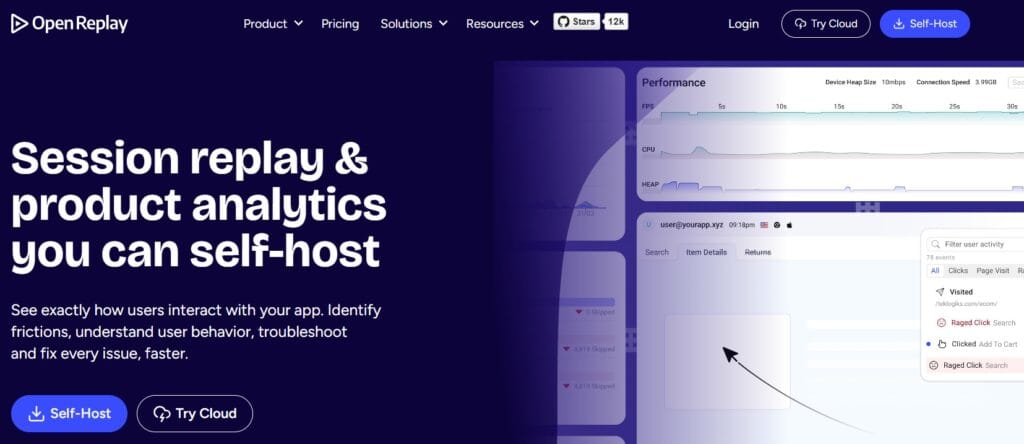
Best for: Teams that need session replay with zero third-party data sharing, or compliance-driven teams that cannot send frontend session data to any external SaaS.
OpenReplay is the only enterprise-grade session replay tool with a fully open-source codebase and production-ready self-hosting support on all major cloud providers. Your session data never leaves your infrastructure.
What it covers for RUM:
- Session replay with DevTools-style access to network activity, JavaScript errors, and console logs
- Heatmaps, funnels, and user journey analysis
- kAI for AI-powered session summarization and automatic issue identification
- Cobrowse for live co-browsing support sessions
- Backend log sync integrations with Sentry, Datadog, Rollbar, Elastic, and CloudWatch
- Fine-grained privacy controls and automatic PII masking
Compared to Datadog RUM:
Datadog RUM correlates sessions with backend traces natively because it is part of the same platform. OpenReplay connects to your backend observability tool via integrations rather than natively – the correlation exists but requires configuration. For teams not already on Datadog, this is rarely a meaningful difference.
Pricing: Cloud option available. Self-hosted Community Edition is free. Dedicated cloud and enterprise plans for teams that want SLAs.
Honest trade-off: Self-hosting adds operational overhead – you deploy and maintain the backend. For teams that specifically need zero external data sharing, this overhead is the price of that control. OpenReplay Cloud removes the ops burden at the cost of data leaving your infrastructure.
Who it is not for: Teams that want a drop-in SaaS replacement with zero setup.
3. Sentry – Developer-First, Error-Centric RUM
Best for: Engineering teams that want error tracking, session replay, and performance monitoring tightly connected to code-level context – without paying for infrastructure monitoring they do not need.
Sentry’s Session Replay captures video-like reproductions of user sessions, and uniquely, it connects replay directly to the error that triggered it. When a JavaScript exception fires, you can watch exactly what the user was doing in the 30 seconds before it happened. This is the most developer-useful framing of session replay in the market.
What it covers for RUM:
- Session replay linked directly to errors and performance issues
- Core Web Vitals (LCP, INP, CLS) tracking
- Distributed tracing across frontend and backend
- Profiling for slow code paths
- Web and mobile SDK coverage including React Native
Compared to Datadog RUM:
Sentry’s pricing is event-based rather than session-based, which can be cheaper or more expensive depending on your traffic profile. Sentry does not have Datadog’s infrastructure monitoring depth, but for teams that want RUM specifically – not full-stack observability – Sentry covers the RUM use case well with a cleaner pricing model.
Pricing: Team plan from $26/month. Business from $80/month. Session replay billed separately per session above plan limits.
Honest trade-off: Sentry is developer-first and error-first. If your primary RUM need is product analytics, user journey analysis, or heatmaps rather than error debugging, Sentry is not the best fit.
4. PostHog – RUM + Product Analytics in One Tool
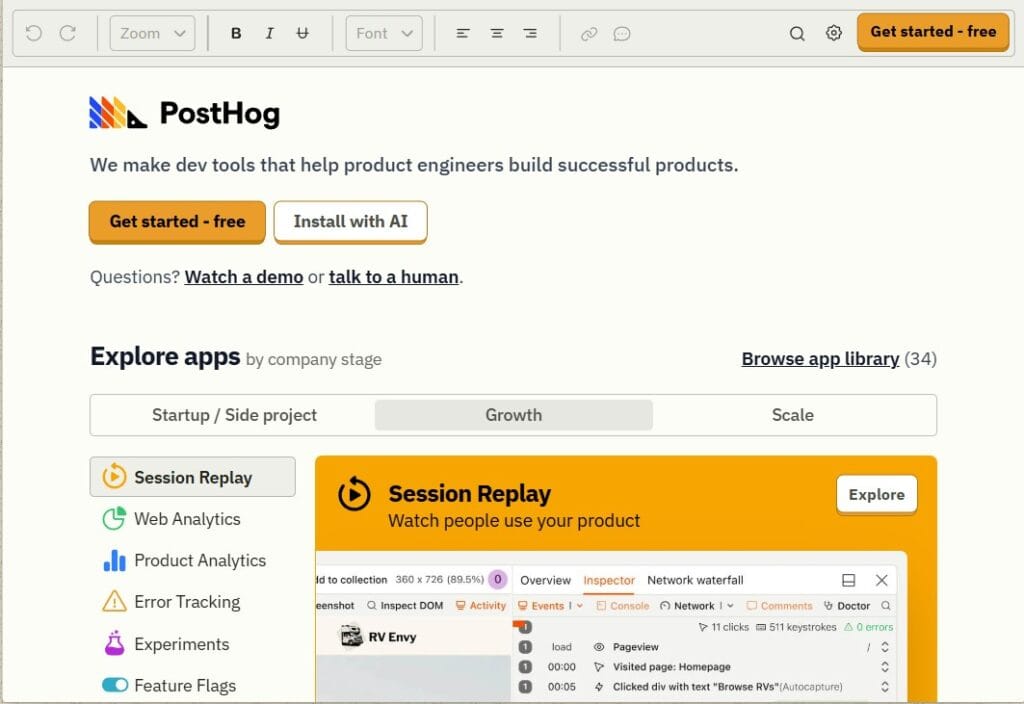
Best for: Product engineering teams that want session replay and real user monitoring combined with product analytics, feature flags, and A/B testing in a single platform.
PostHog combines session replay, web analytics, Core Web Vitals, error tracking, feature flags, and product analytics in one tool. It is the strongest choice for teams that currently use separate tools for analytics and RUM and want to consolidate.
What it covers for RUM:
- Session replay with automatic masking controls
- Core Web Vitals and custom performance events
- Error tracking linked to sessions
- User journey and funnel analysis
- Feature flags with session data correlation
- Web analytics with marketing attribution
Compared to Datadog RUM:
PostHog is not a backend observability tool. It does not replace Datadog APM or infrastructure monitoring. It replaces Datadog RUM specifically, and adds product analytics capabilities that Datadog RUM does not provide. Teams typically use PostHog alongside a separate backend observability tool.
Pricing: Generous free tier at 1 million events per month. Usage-based pricing above that. Open-source self-hosted option available.
Honest trade-off: PostHog’s session replay is strong for product and UX investigation. It is less focused on the developer debugging use case – connecting a session to a backend trace requires integration work rather than being native.
5. Grafana Faro – OTel-Native, Free, Grafana-Integrated
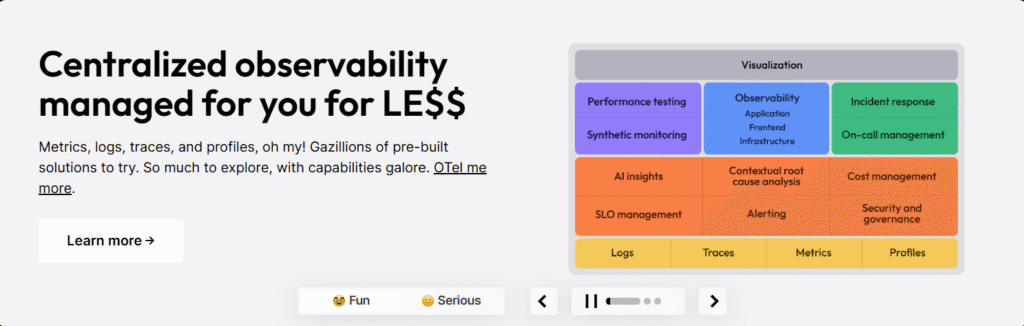
Best for: Teams already running Grafana Cloud or a self-hosted Grafana stack who want RUM data natively correlated with their existing metrics, logs, and traces without adding another vendor.
Grafana Faro is Grafana’s open-source Web SDK for real user monitoring. It is built on OpenTelemetry conventions and feeds natively into the Grafana ecosystem – Loki for logs, Tempo for traces, Mimir for metrics. If your team already uses Grafana, Faro is the lowest-friction RUM addition available.
What it covers for RUM:
- Core Web Vitals, JavaScript errors, network performance
- User sessions and page loads
- Custom events and measurements
- OTel-based trace propagation connecting frontend spans to backend traces in Tempo
Compared to Datadog RUM:
Faro does not include session replay. It covers the performance metrics and error tracking dimensions of RUM, not the visual replay dimension. For teams that specifically need session replay, Faro needs to be paired with a separate tool. For teams that want performance metrics and error context correlated with backend observability, Faro inside Grafana is a capable and cost-effective option.
Pricing: Free and open-source. Grafana Cloud has a free tier; usage-based pricing for larger deployments.
Honest trade-off: Faro requires setting up and operating the Grafana collection and storage backend if self-hosting. On Grafana Cloud, setup is easier but costs apply at scale. No session replay is the significant capability gap relative to Datadog RUM.
6. LogRocket – Session Replay Focused, Strong for Product and Dev Teams
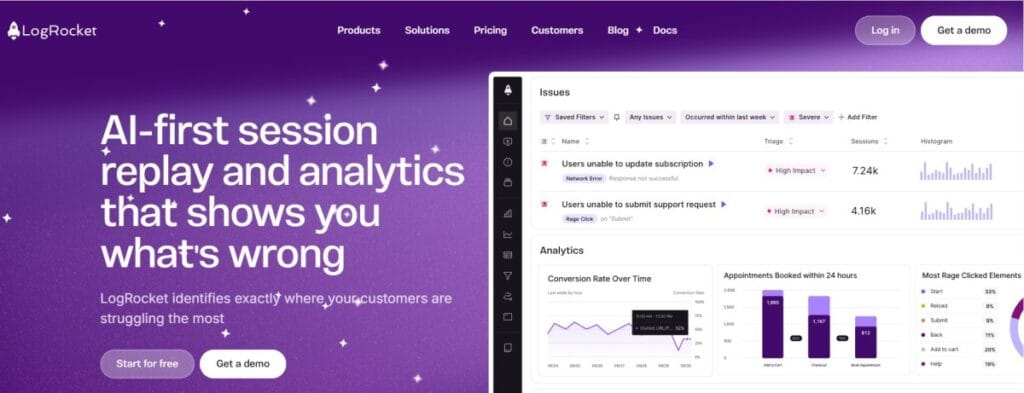
Best for: Teams that want the most feature-complete session replay experience – including mobile – and are willing to pay for a purpose-built tool rather than RUM as part of a broader observability platform.
LogRocket is one of the longest-established session replay tools and provides pixel-perfect replay for both web and native mobile applications. Its Galileo Highlights feature automatically watches and summarizes sessions so teams can diagnose what happened to a user without watching the full recording.
What it covers for RUM:
- Pixel-perfect session replay for web and native mobile (iOS, Android)
- Automatic capture of every user event, network request, and JavaScript error
- AI-powered session summarization via Galileo Highlights
- Performance monitoring and Core Web Vitals
- Product analytics, funnels, and user journey analysis
- Integrations with Jira, Intercom, Datadog, and Optimizely
Compared to Datadog RUM:
LogRocket covers mobile session replay – a gap Datadog RUM has as of May 2026. LogRocket is a standalone session replay and product analytics tool; it does not replace backend observability. Teams typically use LogRocket alongside a backend APM tool.
Pricing: Starts at $99/month. Enterprise plans for larger session volumes.
Honest trade-off: LogRocket is priced as a premium, purpose-built tool. For teams that only need basic RUM metrics without deep session replay, it may be more capabilities than needed.
Side-by-Side Comparison
| Tool | Session Replay | Mobile RUM | Self-Hosted | OTel Native | Best for |
| Datadog RUM | Yes (browser only) | Yes (no replay) | No | Partial | Teams already on Datadog APM |
| OpenReplay | Yes | Partial | Yes – fully | No | Data residency, compliance |
| Sentry | Yes | Yes | Yes | Partial | Developer error debugging |
| PostHog | Yes | No | Yes | No | Product analytics + RUM |
| Grafana Faro | No | No | Yes | Yes | Teams on Grafana already |
| LogRocket | Yes | Yes | No | No | Full-featured replay, mobile |
| CubeAPM | Yes | Yes | Yes – in VPC | Yes | Full-stack + RUM, data control |
How to Choose
- You need session replay with full data control: OpenReplay self-hosted
- You want error tracking and replay tightly linked to code: Sentry
- You want product analytics and RUM from one tool: PostHog
- You are already on Grafana and want OTel-native RUM metrics: Grafana Faro
- You need mobile session replay specifically: LogRocket or CubeAPM
- You need RUM as part of full-stack observability inside your own VPC: CubeAPM
You are already heavily invested in Datadog APM and value the native correlation: Stay with Datadog RUM and optimize session filtering in RUM Investigate to control cost
Summary
Datadog RUM works best when it is already part of a broader Datadog deployment. As a standalone RUM purchase, the three-tier pricing structure and the browser-only session replay limitation push many teams to evaluate purpose-built alternatives.
For session replay with zero external data sharing, OpenReplay self-hosted is the only enterprise-grade option. For developer-first error-linked replay, Sentry. For product analytics combined with RUM, PostHog. For OTel-native RUM inside Grafana, Faro. For full-stack observability with RUM inside your own cloud account, CubeAPM.
Disclaimer: This article is produced by CubeAPM, one of the tools evaluated here. Datadog RUM pricing details are sourced from publicly available Datadog documentation and third-party pricing analyses as of May 2026 – verify current pricing directly with Datadog before making decisions. All other tool details are based on publicly available information at the time of writing. Nothing here constitutes professional, legal, or compliance advice. Teams with regulatory requirements should conduct their own due diligence. Highlight.io shut down February 28, 2026 – any guides referencing it as an active alternative are outdated.
Also read: