





New Relic self-hosted alternatives are useful for teams that need observability data to stay inside their own VPC, cloud account, or on-prem environment.
Most “New Relic alternatives” lists recommend Datadog or Dynatrace. Both are strong enterprise observability platforms, but they are not always the right fit for teams that specifically need a self-hosted or VPC-based New Relic alternative. This page is specifically for teams who need a self-hosted alternative, either for data residency, compliance, cost control, or a combination of all three.
The tools covered here range from fully open-source stacks you manage yourself to managed self-hosted platforms like CubeAPM, which runs inside your own cloud account but handles its own operations so you get data control without taking on a second ops burden.
Key Takeaways
- Self-hosted New Relic alternatives fall into two groups: fully open-source tools you manage and managed self-hosted platforms where the vendor manages the software.
- The main reasons teams switch are New Relic’s per-user pricing ($49-$99+/user/month for Full Platform seats), unpredictable data ingest bills at $0.40/GB beyond 100GB free.
- The hardest part of self-hosting is not setup. It is long-term storage, upgrades, scaling, and alerting.
- OpenTelemetry-friendly tools reduce lock-in because teams can instrument once and switch backends more easily.
- Managed self-hosted platforms like CubeAPM are useful when teams need data control without managing the full stack.
- Prometheus + Grafana is powerful, but it is not a drop-in New Relic replacement.
Why Teams Leave New Relic for Self-Hosted Alternatives
Per-user and ingest pricing that can scale with team size. New Relic pricing combines data ingestion-based with user-based pricing. The free tier includes 100 GB/month. After that, Original Data is $0.40/GB and Data Plus is $0.60/GB. User pricing varies by role and edition, so costs can grow as more engineers need full platform access.
Data ingest costs that compound at scale. Teams with high log, trace, or Kubernetes telemetry volumes can face significant bills as usage grows. Microservices architectures and Kubernetes environments generate more telemetry data than monoliths, which is exactly when ingest-based pricing becomes harder to predict.
Not sure what you are actually paying New Relic?
Per-user fees, ingest costs, and Data Plus charges add up fast. Use our free calculator to see exactly what your bill looks like at your current usage, and what you could save by switching.
Calculate your New Relic cost →Data residency and compliance requirements. Financial services, healthcare, and government teams often cannot send application telemetry to a third-party SaaS. The data may need to stay inside a specific region, VPC, cloud account, or on-prem environment.
Vendor lock-in from proprietary agents and workflows. New Relic supports OpenTelemetry, but many existing deployments still depend on New Relic agents, platform workflows, and NRQL. OpenTelemetry-native self-hosted alternatives reduce this risk because instrumentation stays more portable.
Evaluating your options?
We reviewed the top New Relic alternatives on features, pricing, and deployment flexibility — including self-hosted and OpenTelemetry-native options. See how they stack up before you decide.
Read the full alternatives review →The Two Categories of Self-Hosted New Relic Alternatives
Category 1: Fully Open-Source Tools You Manage
You download, deploy, configure, scale, back up, and upgrade the stack yourself. This gives maximum control, but it also creates more operational burden.
Best for teams with dedicated DevOps or SRE capacity who want full control and minimal vendor dependency.
Category 2: Managed Self-Hosted Platforms
The vendor ships and manages the software, but it runs inside your own infrastructure, such as your VPC, cloud account, or data center.
You get a SaaS-like experience with stronger data control. This category is useful because it solves the operational burden problem without giving up data ownership.
The New Relic Self-Hosted Alternatives Worth Considering
1. CubeAPM — Managed Self-Hosted, OTel-Native
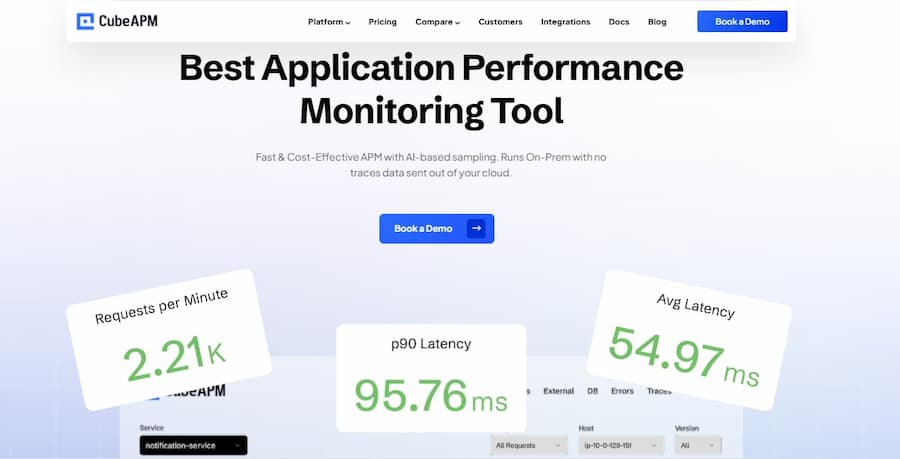
Best for: Teams that want a New Relic-quality APM experience running inside their own AWS, GCP, or Azure account without managing the software themselves.
CubeAPM is a managed self-hosted observability platform built natively on OpenTelemetry. You deploy it into your own cloud account, and it runs inside your VPC. Your data stays in your infrastructure, while CubeAPM manages the software, upgrades, and operational complexity. It covers distributed traces, metrics, logs, infrastructure monitoring, and synthetic uptime monitoring in a single platform.
What makes it different from other self-hosted options:
- Runs inside your cloud account
- Keeps telemetry data within your infrastructure
- Deployed via Helm on Kubernetes
- No per-user pricing or per-host charges
- Flat $0.15/GB ingested
- Uses OpenTelemetry SDKs instead of proprietary agents
- Manages its own storage, retention, and upgrades
Compared to New Relic:
- New Relic charges by ingest and user access; CubeAPM uses flat ingest-based pricing
- New Relic is primarily SaaS; CubeAPM runs inside your cloud
- New Relic deployments often depend on New Relic agents and workflows; CubeAPM is built around OpenTelemetry
Who it’s not for: Teams that want a fully off-prem solution. It does not offer an off-prem solution.
2. SigNoz — Open-Source, Self-Hosted or Cloud
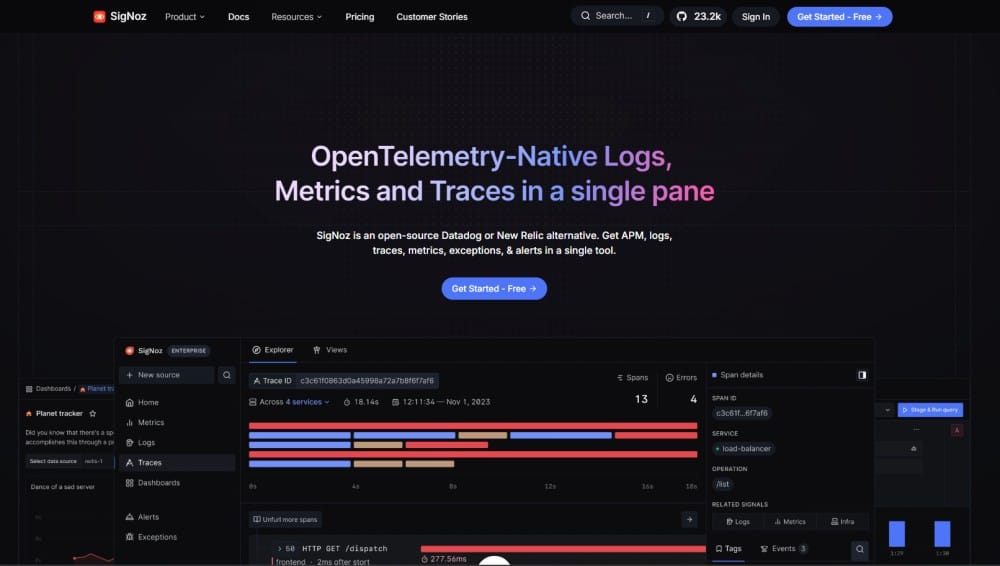
Best for: Engineering teams that want an open-source, OpenTelemetry-native alternative with a clean UI, and have the in-house DevOps capacity to operate it.
SigNoz is an open-source observability platform built around OpenTelemetry. It provides traces, metrics, and logs in a unified interface and can be self-hosted through Docker or Kubernetes.
Deployment: Docker Compose for smaller setups, Helm chart for Kubernetes production environments.
Pricing: Open-source self-hosted is free to use. SigNoz Cloud pricing is usage-based.
What you get: Distributed tracing, metrics dashboards, log management, alerting, and service maps.
The honest trade-off: SigNoz has strong core features, but it may not match New Relic’s depth across mature enterprise workflows. With self-hosting, your team owns upgrades, ClickHouse scaling, storage management, and reliability.
Best fit: Funded startups or scale-ups with a dedicated DevOps or SRE function who want data control and are comfortable managing a ClickHouse-backed stack.
3. Grafana OSS Stack
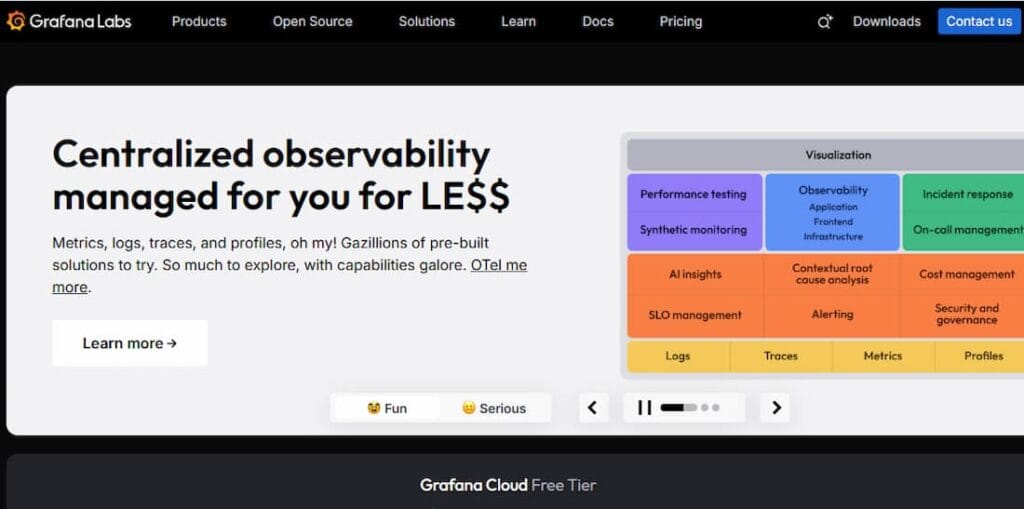
Best for: Teams already invested in Prometheus and Kubernetes who want to add tracing and log correlation without changing their existing metrics setup.
The Grafana “LGTM” stack includes Loki for logs, Grafana for visualization, Tempo for traces, and Mimir or Prometheus for metrics. It is one of the most widely used open-source observability stacks.
Deployment: Helm charts for each component. kube-prometheus-stack is a common Kubernetes entry point.
Pricing: Free and open-source if you run it yourself. Grafana Cloud has a free tier, and Grafana Cloud Pro starts from $19/month plus usage.
What you get: Grafana dashboards, Prometheus metrics, Loki logs, and Tempo distributed tracing.
The honest trade-off: Self-hosting the full Grafana stack creates real operational overhead. Your team must deploy, scale, connect, and maintain each component. Alerting can also become complex in larger environments.
Critical point: Prometheus + Grafana is not a drop-in New Relic replacement. It does not give you New Relic-style APM, distributed tracing, and correlated logs-metrics-traces out of the box. If you are migrating from New Relic, expect configuration work before workflows feel comparable.
Best fit: Teams with Kubernetes-native infrastructure, existing Prometheus investment, strong DevOps skills, and the patience to build and maintain a composable stack.
4. Elastic APM
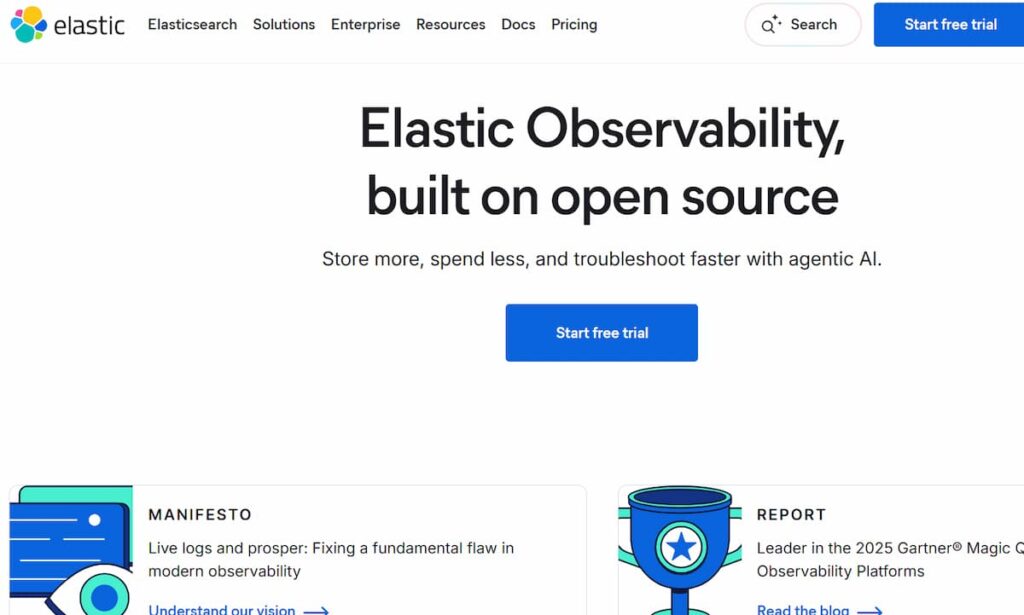
Best for: Teams already running Elasticsearch for log management who want to extend it to APM without adopting a separate platform.
Elastic APM is suited for users who already use Elasticsearch or the Elastic Stack. If Elasticsearch is already your log backend, Elastic APM lets you extend the same stack into application performance monitoring.
Deployment: Self-managed Elastic cluster or Elastic Cloud.
Pricing: Self-managed Elastic can be run on your own infrastructure, but infrastructure and operations costs still apply. Elastic Cloud pricing depends on deployment size, region, storage, and selected tier.
What you get: Log search and analytics, APM traces, metrics, and infrastructure monitoring inside Kibana.
The honest trade-off: Self-hosting Elastic Observability requires Elasticsearch expertise. Storage tuning, index lifecycle management, scaling, and query performance can become complex at high volumes. Its APM experience can also feel less automated than dedicated APM tools.
Best fit: Teams with existing Elasticsearch or ELK infrastructure who want to add APM without deploying a second observability stack.
5. Uptrace — OTel-Native, Self-Hosted
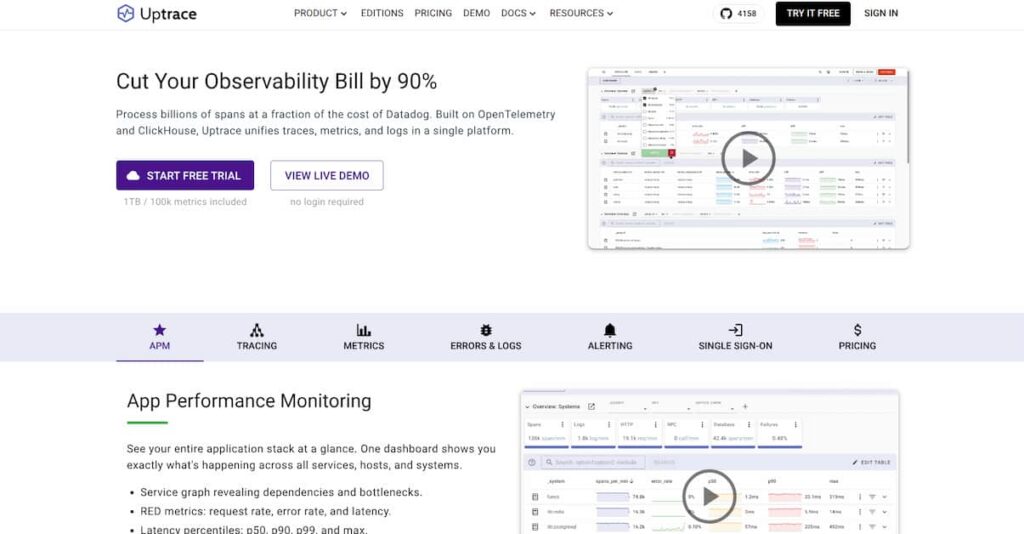
Best for: Teams that want a lightweight OpenTelemetry-native observability platform focused on distributed tracing and APM.
Uptrace is an OpenTelemetry-native observability platform built for traces, metrics, and logs. It is commonly used by teams that want a lighter backend around open standards rather than a large enterprise observability suite.
Deployment: Docker Compose or Kubernetes Helm chart.
Pricing: Self-hosted option is available. Cloud pricing depends on usage and plan.
The honest trade-off: Uptrace supports traces, metrics, and logs, but it is strongest for OpenTelemetry tracing and APM workflows. It may feel lighter than New Relic for teams that need broad infrastructure monitoring, digital experience monitoring, synthetics, and enterprise workflows.
Best fit: Teams replacing New Relic’s distributed tracing or APM workflows, especially if they already use separate tools for metrics and logs.
6. Apache SkyWalking — Open-Source APM
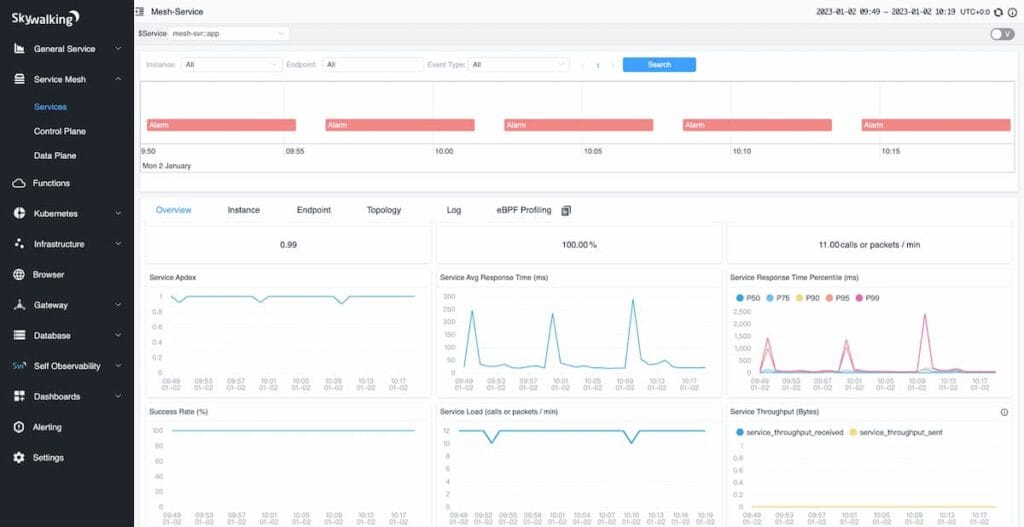
Best for: Java-heavy enterprise environments, particularly those running microservices on JVM-based stacks.
SkyWalking is an open-source APM and observability platform for distributed systems. It is used for service monitoring, distributed tracing, service mesh observability, and Kubernetes environments.
Deployment: Self-hosted. It can use supported backends such as BanyanDB or Elasticsearch.
Pricing: Free and open source under Apache License 2.0.
The honest trade-off: SkyWalking has its own agent ecosystem and also supports OpenTelemetry ingestion, so it is better described as OpenTelemetry-compatible rather than purely OpenTelemetry-native. Its ecosystem is especially strong for Java-heavy environments.
Best fit: Large enterprise Java/JVM environments, especially if the team is already familiar with SkyWalking.
Side-by-Side Comparison
| Tool | Self-Hosted? | OTel Support | Manages Itself | No Per-User Cost | Full APM Coverage |
| CubeAPM | Yes — your VPC/cloud account | Yes, OTel-native | Yes, managed self-hosted | Yes | Yes |
| SigNoz | Yes | Yes, OTel-native | No, you manage | Yes | Yes |
| Grafana Stack | Yes | Yes, usually through OTel Collector | No, you manage | Yes | Yes, but composable |
| Elastic APM | Yes | Supports OpenTelemetry | No, you manage | Depends on deployment | Yes |
| Uptrace | Yes | Yes, OTel-native | No, you manage | Yes | Strong for tracing/APM |
| SkyWalking | Yes | OTel-compatible | No, you manage | Yes | Yes, strongest for Java-heavy teams |
| New Relic | No, primarily SaaS | Supports OpenTelemetry | Yes | No, user pricing applies | Yes |
Note
Datadog and Dynatrace are not listed as primary self-hosted New Relic alternatives here because they are not usually evaluated as lightweight self-hosted or open-source replacements. Datadog now offers CloudPrem/BYOC Logs in preview for self-hosted log management, but that is focused on logs and is not the same as running a complete Datadog observability platform inside your VPC. Dynatrace also has Dynatrace Managed documentation, so it should not be described as purely SaaS-only.
The Self-Hosting Trade-Off Nobody Talks About Enough
Every fully open-source self-hosted tool has the same hidden cost: your engineers’ time.
Initial setup can be quick. Keeping it running in production is the harder part. Teams need to manage storage growth, version upgrades, alert delivery, query performance, backups, retention, and scaling.
For a team of 3–5 engineers, that overhead is material.
This is why the managed self-hosted category has grown. Tools like CubeAPM run in your infrastructure but manage themselves, so teams get data sovereignty without creating a second ops burden.
The honest framework for choosing:
- “We need data to stay in our cloud account but don’t want to manage the monitoring stack” → CubeAPM
- “We have a dedicated DevOps/SRE function and want open source” → SigNoz or Grafana Stack
- “We already have ELK and just need to add APM” → Elastic APM
- “We mainly need OpenTelemetry tracing” → Uptrace
- “We run a Java-heavy microservices environment” → Apache SkyWalking
What to Look for When Evaluating Self-Hosted Alternatives
1. OpenTelemetry instrumentation support
If the tool requires only proprietary agents, you may be trading one form of lock-in for another. OpenTelemetry-friendly tools let you keep instrumentation more portable.
2. Storage backend and retention management
Check what powers the backend. ClickHouse, Elasticsearch, Loki, Prometheus, and other storage systems behave differently at scale. Retention, compression, indexing, and query performance can affect long-term cost.
3. Upgrade path
Ask who handles version upgrades. For fully self-hosted tools, your team does. For managed self-hosted tools, the vendor handles most of that work.
4. Correlated logs, traces, and metrics in one UI
This is one of New Relic’s strengths. A good replacement should let teams move from a latency spike to the related trace and logs without too much manual stitching.
5. Alerting quality
Alerting is often where self-hosted stacks become painful. Evaluate routing, deduplication, notification channels, silences, and how easy alerts are to maintain over time.
Summary
The best New Relic self-hosted alternative depends on one question: do you want to manage the monitoring infrastructure, or do you want someone else to manage it while you control the data?
You want data sovereignty without operational burden: CubeAPM.
You want full control and can manage it yourself: SigNoz, Grafana Stack, or Elastic APM.
You specifically need distributed tracing: CubeAPM or Uptrace.
You run a Java-heavy enterprise stack: Apache SkyWalking.
Most tools on this list support OpenTelemetry directly or through compatible ingestion paths.
FAQs
1. What is the best self-hosted alternative to New Relic?
The best option depends on how much operational work your team wants to manage. CubeAPM is a strong fit if you want a managed self-hosted platform that runs inside your own cloud account. SigNoz, Grafana Stack, Elastic APM, Uptrace, and SkyWalking are better fits if your team wants to manage the stack directly.
2. Is New Relic self-hosted?
No. New Relic is primarily a SaaS observability platform. It supports OpenTelemetry and many deployment environments, but teams that need telemetry data to stay fully inside their own VPC, cloud account, or on-prem environment usually look for self-hosted or managed self-hosted alternatives.
3. Why do teams choose self-hosted observability tools?
Teams usually choose self-hosted observability tools for data residency, compliance, cost control, or infrastructure control. Self-hosting can keep telemetry inside the company’s own environment, but it also adds work around storage, upgrades, scaling, and alerting.
4. Is Prometheus and Grafana a full New Relic replacement?
Not by itself. Prometheus and Grafana are powerful, but they are not a drop-in New Relic replacement. Teams usually need Loki for logs, Tempo for traces, Alertmanager or Grafana Alerting for alerts, and extra setup to connect metrics, logs, and traces into one workflow.
5. Which New Relic alternative is best for OpenTelemetry?
CubeAPM, SigNoz, and Uptrace are strong OpenTelemetry-native options. Grafana and Elastic also support OpenTelemetry through compatible ingestion paths. OpenTelemetry support is useful because it helps teams avoid deep agent lock-in and makes backend migration easier later.