










The main difference between Grafana, Uptrace, and CubeAPM is how they approach observability. Grafana focuses on visualization with separate backends for MELT data, while Uptrace provides an OpenTelemetry-native backend built on ClickHouse. CubeAPM offers a unified OpenTelemetry-native platform for MELT with predictable pricing.
As teams scale, managing and operating multiple observability backends(Loki, Tempo) in the case of Grafana becomes more challenging. Uptrace’s self-hosted ClickHouse storage model places more data management responsibility on the user.
CubeAPM removes this operational complexity by providing a single OpenTelemetry-native platform that handles metrics, logs, traces, and events in one system. Teams don’t need to deploy or operate multiple backends, making observability simpler to run and easier to scale.
Grafana vs Uptrace vs CubeAPM — Comparison
| Features | CubeAPM | Grafana | Uptrace |
| Known for | Unified OpenTelemetry stack, multi-agent ingest, predictable pricing, BYOC deployment. | Visualization powerhouse with extensive dashboards and plugins. | Lightweight tracing with ClickHouse speed and open-source control. |
| Multi-Agent Support | Yes (OTel, New Relic, Datadog, Elastic) | Yes (Full OTel, Prometheus, StatsD, Influx, and more) | Partial (OTel-centric — with Jaeger, Zipkin, Prometheus). |
| MELT Support | Full MELT coverage | Full MELT coverage | Full MELT coverage |
| Setup | Self-hosted but vendor-managed | SaaS & Self-hosted | SaaS & Self-hosted |
| Pricing | Ingestion-based pricing of $0.15/GB | Pro Plan: $19/month Logs: $0.50/GB Traces: $0.50/GB APM: $0.04/host/hour | Free trial with 1TB of storage Logs: $0.08 / GB (budget ≥ >= $99) Metrics: $0.50/1k series |
| Sampling Strategy | Smart sampling – fully automated, context-aware | Head + Tail sampling | Head + Tail + Rule-based sampling |
| Log Retention | Infinite Retention (no extra cost) | Pro Plan: 30 days retention for logs; 13 months for metrics | 14-day free data retentionPaid: Custom retention |
| Support Channel & TAT & Pricing | Slack, WhatsApp; response in minutes | Community + Email + Paid enterprise; | TAT: 2hrs to 6hrs | Telegram, Slack, GitHub, Email | TAT: Not details |
Grafana vs Uptrace vs CubeAPM: Feature-by-Feature Breakdown
Multi-Agent Support
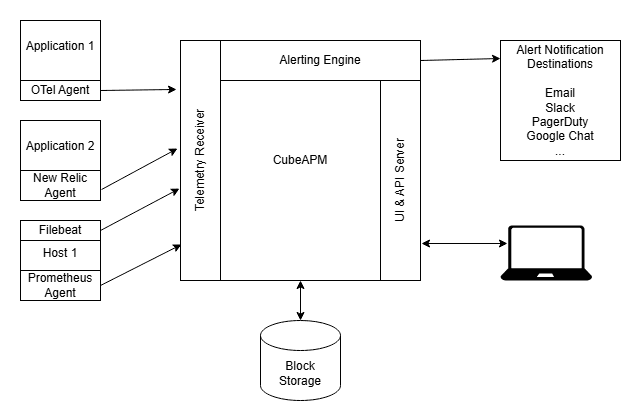
CubeAPM: Supports Datadog, Elastic, New Relic, Prometheus, and OpenTelemetry agents, giving teams flexibility to migrate without re-instrumenting code. It’s truly multi-agent, not just OTel-compatible.
Grafana: Yes, has multi-agent support. Grafana Alloy accepts OTLP, Jaeger, Zipkin, OpenCensus, Prometheus, and Kafka receivers. It’s versatile but requires configuring each protocol within Alloy.
Uptrace: Partial multi-agent support. OTel-centric; uses the OpenTelemetry Collector to receive data from Jaeger, Zipkin, Prometheus, and Fluent Bit rather than native agents.
MELT Coverage (Metrics, Events, Logs, Traces)
CubeAPM: CubeAPM delivers complete MELT observability across APM, infrastructure, logs, real user monitoring (RUM), synthetics, and error tracking in a single, unified platform. All signals are priced under one predictable $0.15/GB ingestion model, eliminating per-feature add-ons and making costs easier to control as usage scales.
Grafana: Grafana achieves MELT coverage through its LGTM stack (Grafana, Loki, Tempo, and Mimir), with each signal handled by a separate backend that is deployed, managed, and priced independently based on usage.
Uptrace: Uptrace provides native support for metrics and traces, with logs ingested via OpenTelemetry pipelines and all telemetry stored in ClickHouse. This OpenTelemetry-first design appeals to teams looking for a lightweight, standards-based observability backend.
Deployment & Setup
CubeAPM: CubeAPM supports self-hosted and BYOC deployments, with unlimited retention. The BYOC model gives teams full control over their data, infrastructure, and compliance requirements without sacrificing observability depth.
Grafana: It can be deployed on-premises or used via Grafana Cloud, but self-hosted deployments require setting up and operating multiple services (Grafana and its associated backends), rather than a single unified system.
Uptrace: Uptrace supports both self-hosted and cloud deployments. In self-hosted environments, it runs on Docker or Kubernetes, with ClickHouse and Redis components managed and scaled by the user.
Pricing: Approximate Cost for Small, Medium & Large Teams
*Disclaimer: Pricing comparisons are based on standardized Small/Medium/Large team profiles defined in our internal benchmarking sheet. Actual costs may vary by usage, region, and plan. Please verify current pricing with each vendor.
An APM host is a host that is actively generating traces data and an Infra host is any physical or virtual OS instance that you monitor with any observability tool.
Cost for Small Teams (~30):
CubeAPM: $2,080
Grafana: $3,870
Uptrace: $1,695
Cost for Mid-Sized Teams (~125):
CubeAPM: $7,200
Grafana: $11,875
Uptrace: $5,600
Cost for Large Teams (~250):
CubeAPM: $15,200
Grafana: $26,750
Uptrace: $12,500
CubeAPM: Cost for Small, Medium, and Large Teams
Based on verified vendor pricing, CubeAPM runs on a simple, all-inclusive $0.15 per GB ingestion model — with no extra fees for infrastructure, user licenses, or retention. Whether monitoring logs, traces, or metrics, the pricing remains flat and predictable across all telemetry types.
Here’s a breakdown for different team sizes:
- Small teams (~30): $2,080
- Mid-sized teams (~125): $7,200
- Large teams (~250): $15,200
CubeAPM is ideal for startups, SaaS providers, and enterprises managing multi-terabyte ingestion every month. On average, teams experience lower cost of ownership compared to Grafana due to unified pricing and smart sampling.
Grafana Cloud: Cost for Small, Medium, and Large Teams
Grafana Cloud pricing combines a base platform fee with usage-based charges for different observability signals e.g., log and trace ingestion per GB.
- Pro plan: $19/month
- Logs: $0.50/GB ingested
- Traces: $0.50/GB ingested
- Metrics: billed per-series
- Retention: 30 days (extendable at extra cost)
Grana remains powerful for its enriched dashboards, but costs increase rapidly as ingestion grows due to separate usage-based billing for logs, traces, and metrics. Grafana remains popular for its visualization power, yet less predictable for full-stack observability.
Here’s a cost breakdown based on average team sizes:
- Small teams (~30): $3,870
- Mid-sized teams (~125): $11,875
- Large teams (~250): $26,750
Uptrace: Cost for Small, Medium, and Large Teams
Uptrace offers a hybrid pricing model: free for light usage, then approximately Cloud edition starts $0.08 / GB (≥ 50 GB) to $0.025 / GB (≥ 200 TB ) for hosted or ClickHouse-based deployments. Retention is limited to 14 days by default, with longer storage requiring custom management and added cost.
Here’s an estimated cost breakdown:
- Small teams (~30): $1,695
- Mid-sized teams (~125): $5,600
- Large teams (~250): $12,500
Sampling Strategy
CubeAPM: CubeAPM uses smart, context-aware sampling to reduce noise while preserving the signals that matter most. By prioritizing error paths, high-latency requests, and anomalous behavior, it significantly improves the signal-to-noise ratio and avoids storing low-value telemetry.
Grafana: Grafana supports both head-based and tail-based sampling through Grafana Alloy and the OpenTelemetry Collector. Sampling is configured at the collector level using probabilistic or policy-based rules before data is sent to Tempo.
Uptrace: Supports OpenTelemetry-standard sampling strategies, including head-based, tail-based, and rule-based sampling configured via OTel SDKs or collectors, with sampling decisions defined upstream before ingestion.
Retention & Storage Control
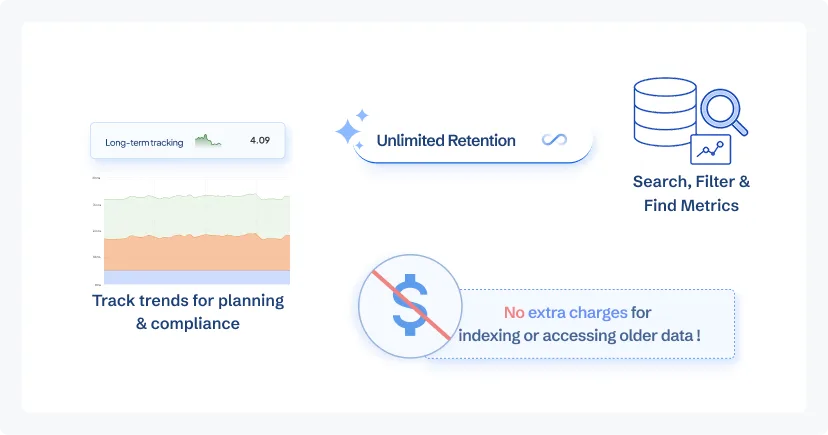
CubeAPM: CubeAPM offers unlimited data retention on enterprise plans, along with fine-grained, tenant-level retention controls. Teams can define how long different types of telemetry are stored, balancing long-term observability needs with cost and compliance requirements, without managing separate storage backends.
Grafana: Grafana Cloud uses tier-based retention, with the Free tier offering 14 days, the Pro tier retaining metrics for up to 13 months and logs and traces for 30 days, and custom retention available on Enterprise plans. While flexible, retention varies by signal and tier. CubeAPM, by contrast, provides unlimited retention on enterprise plans with fine-grained
Uptrace: Community Edition with a default 14-day data retention for traces, metrics, and logs. Paid editions (Premium, Managed, and Cloud) support custom data retention, meaning you can configure how long data is kept based on your needs.
Support Channel & TAT
CubeAPM: CubeAPM offers direct support via Slack, WhatsApp, and email, with response times typically under 10 minutes. Teams get fast, human support from engineers without ticket-only workflows, escalation hurdles, or tier-based delays, making issue resolution significantly faster.
Grafana: Grafana Cloud offers tiered support, ranging from community forums and documentation on the free plan to 24/7 technical support on paid plans. Enterprise customers can receive SLA-based initial response targets with response times ranging from 2 hours to 6 hours.
Uptrace: The Community Edition provides free open-source use with community support via GitHub issues, while paid and managed editions include dedicated email and messaging support (e.g., Slack or Telegram) with defined coverage for faster responses.
Known For
CubeAPM: CubeAPM is known for delivering unified, OpenTelemetry-native observability across metrics, events, logs, and traces. With smart sampling, predictable pricing, and low operational complexity, it’s designed for teams that want deep visibility without cost or management overhead.
Grafana: known for its powerful visualization and dashboarding capabilities, widely used to explore metrics, logs, and traces across diverse data sources. Its modular LGTM ecosystem gives teams flexibility in how they deploy and scale observability components.
Uptrace: known as an OpenTelemetry-native observability backend with a strong focus on distributed tracing and metrics. It appeals to teams looking for fast setup, open standards, and flexibility through OpenTelemetry-based ingestion and sampling.
Which Tool Is Best for You? Why Brands Choose CubeAPM
Benefits of Choosing CubeAPM
- Unified Observability Stack: End-to-end coverage for APM, infra, logs, RUM, synthetics, and errors — no separate tools to integrate.
- Predictable, All-Inclusive Pricing: Flat $0.15 / GB ingestion-based pricing with zero add-ons for users, retention, or infrastructure.
- Smart Sampling Engine: Dynamically prioritizes critical traces while filtering low-value data, optimizing cost and performance.
- Multi-Agent Ingestion: Works with Datadog, Elastic, New Relic, Prometheus, and OpenTelemetry agents to ease migration from legacy tools.
- Self-Hosted & BYOC Deployment: Deploy within your own VPC or cloud account for full data-residency, privacy, and compliance assurance.
- Enterprise-Grade API Access: Robust APIs for managing telemetry pipelines, user access, alerts, and integrations with DevOps systems.
- Real-Time Human Support: Direct Slack and WhatsApp channels with minute-level response times from core engineers.
CubeAPM empowers DevOps and SRE teams to achieve complete observability, predictable spending, and full ownership of their telemetry data — all while keeping control inside their own infrastructure.
Grafana vs Uptrace vs CubeAPM: Use Cases
Choose CubeAPM If
- You want a single, unified observability platform for metrics, events, logs, and traces without managing multiple backends.
- You need OpenTelemetry-native ingestion with true multi-agent support, making migrations from other tools easier.
- You care about predictable costs at scale, with smart sampling that reduces noise and controls ingestion.
- You value fast, human support via Slack or WhatsApp, with response times typically under 10 minutes.
Choose Grafana If
- You need best-in-class dashboards and visualization across many data sources.
- You already use Prometheus, Loki, Tempo, or other open-source tools and want a flexible UI on top.
- Your team is comfortable deploying and managing multiple observability components separately.
- You want strong community support and a rich plugin ecosystem.
Choose Uptrace If
- You want an OpenTelemetry-native observability backend focused on traces and metrics.
- Your team is already instrumented with OpenTelemetry SDKs or the OTel Collector and wants a clean backend to ingest and analyze that data.
- You prefer open-source-first tooling with the option to self-host or use a managed cloud offering.
Conclusion
Grafana excels at visualization and ecosystem flexibility, while Uptrace appeals to developers with its OpenTelemetry-native simplicity. However, both typically require managing multiple components or making trade-offs as systems grow. CubeAPM brings everything together with unified observability, self-hosted or BYOC deployment options, smart sampling, and fast human support—giving teams deeper visibility and greater control over their data.
Disclaimer: The information in this article reflects the latest details available at the time of publication and may change as technologies and products evolve.
FAQs
1. Which tool is easier to set up — Grafana, Uptrace, or CubeAPM?
Uptrace is lightweight but needs manual ClickHouse setup and tuning. Grafana requires configuring multiple components like Loki, Tempo, and Mimir. CubeAPM offers a vendor-managed, self-hosted setup inside your own cloud (BYOC), so deployment takes minutes without external dependencies.
2. Can I migrate data from Grafana or Uptrace to CubeAPM?
Yes. CubeAPM supports multiple agents, including Datadog, Elastic, New Relic, Prometheus, and OpenTelemetry, allowing easy migration from Grafana or Uptrace without code rewrites.
3. Which platform handles large-scale log and trace ingestion better?
CubeAPM scales natively within your VPC using smart sampling and ingestion-based architecture. Grafana’s pricing becomes expensive at scale, while Uptrace’s ClickHouse backend adds operational overhead.
4. Does Uptrace offer real-time alerting like Grafana or CubeAPM?
Uptrace supports alerts. Grafana and CubeAPM provide more mature alerting stacks. CubeAPM integrates directly with Slack and WhatsApp for real-time incident notifications and rapid MTTR.
5. Which tool is better for enterprise-grade observability and compliance?
CubeAPM fits enterprises best — fully self-hosted inside your cloud, vendor-managed, with API access, unlimited retention, and full control over data residency and compliance.