










OpenTelemetry and Zipkin are both used in distributed tracing, but they operate at different layers and their relationship changed significantly in 2025 and 2026. OpenTelemetry is an instrumentation and collection framework. Zipkin is a distributed tracing storage and visualization backend.
The relationship changed in two ways: Zipkin now supports OTLP ingestion natively via the zipkin-otel project, removing the need for format translation. And OpenTelemetry deprecated its Zipkin exporter specification in December 2025, with SDK support for existing exporters continuing until at least December 2026.
Key Takeaways
- OpenTelemetry handles instrumentation and transport. Zipkin handles trace storage, querying, and visualization. They are complementary, not competing
- Zipkin latest stable version is 3.6.0 (2026). Docker images are now based on JRE 25. Elasticsearch 7.x is no longer tested as it is EOL. Elasticsearch 8.x, 9.x, and OpenSearch 2.x are supported
- The OTel Zipkin exporter specification was deprecated in December 2025. Existing stable exporters receive security patches until at least December 2026. New language SDKs are not required to implement Zipkin exporters. The recommended migration path is OTLP
- Zipkin now accepts OTLP natively via the zipkin-otel project. The OTLP endpoint is bound to Zipkin’s default server port 9411, not a separate port. Set OTEL_EXPORTER_OTLP_ENDPOINT=http://zipkin:9411 with OTEL_EXPORTER_OTLP_PROTOCOL=http/protobuf
- The fundamental propagation difference: Zipkin uses B3 headers (X-B3-TraceId, X-B3-SpanId, X-B3-Sampled). OpenTelemetry defaults to W3C TraceContext (traceparent, tracestate). OTel supports B3 via configurable propagators for migration compatibility
- Zipkin only handles traces. It does not store metrics or logs. OpenTelemetry supports traces, metrics, logs, and profiling (beta)
What Each Tool Does
OpenTelemetry
OpenTelemetry is the instrumentation and collection layer. It provides language-specific SDKs for generating traces, metrics, and logs from application code, the OpenTelemetry Protocol (OTLP) for transporting that data, and the Collector for receiving, processing, and routing it to backends.
What OpenTelemetry does not do: it has no storage engine, no query interface, and no trace visualization UI. It is a pipeline that feeds backends.
Zipkin
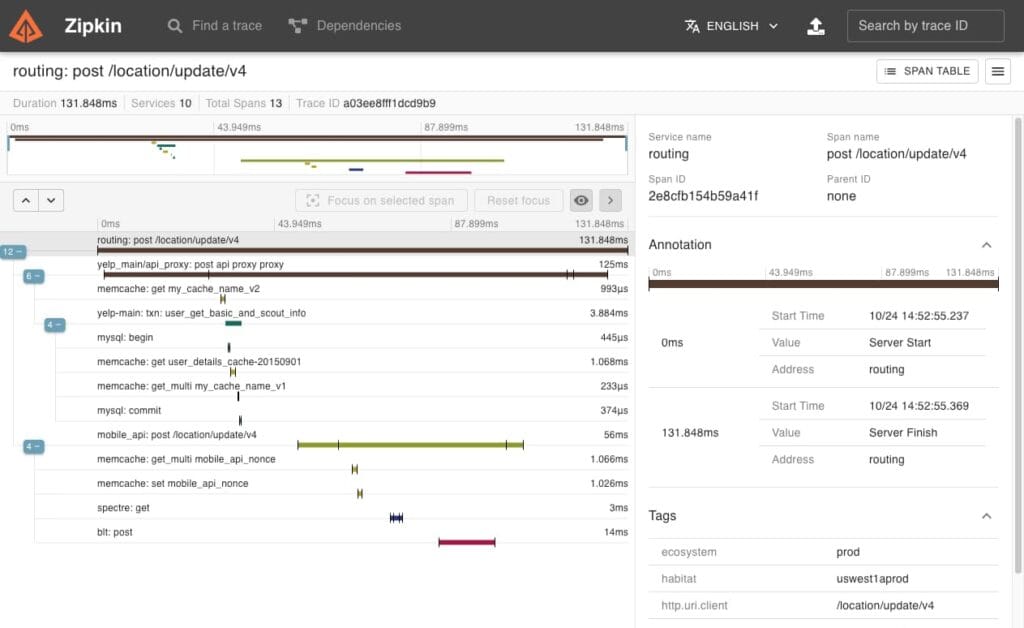
Zipkin is a distributed tracing backend originally developed at Twitter, inspired by Google’s Dapper paper, and open-sourced in 2012. It stores trace spans, provides a query API, and a UI at port 9411 for visualizing individual traces and service dependency graphs.
What Zipkin does not do: it has no instrumentation API targeting modern standards, no metrics storage, and no log storage. It handles traces only.
The Core Differences
| OpenTelemetry | Zipkin | |
| What it is | Instrumentation and collection framework | Distributed tracing storage and visualization backend |
| Signals supported | Traces, metrics, logs, profiling (beta) | Traces only |
| Instrumentation | Yes (APIs and SDKs for 11+ languages) | Via Brave (Java) or Zipkin-compatible libraries |
| Storage | None | In-memory, Cassandra, Elasticsearch 8.x/9.x, OpenSearch 2.x |
| Visualization UI | None | Yes (port 9411) |
| Default propagation format | W3C TraceContext (traceparent) | B3 (X-B3-TraceId, X-B3-SpanId, X-B3-Sampled) |
| Native wire protocol | OTLP (gRPC port 4317, HTTP port 4318) | Zipkin JSON v2 (HTTP port 9411), OTLP via zipkin-otel (also port 9411) |
| CNCF status | Graduated | Not a CNCF project |
| Latest version | SDK per language (all stable as of 2026) | 3.6.0 (2026) |
The Propagation Difference: B3 vs W3C TraceContext
This is the most practically significant difference when migrating from Zipkin to OpenTelemetry or running both in the same system.
B3 propagation (Zipkin's native format) uses separate HTTP headers:

X-B3-TraceId: 463ac35c9f6413ad48485a3953bb6124

X-B3-SpanId: 0020000000000001

X-B3-ParentSpanId: 0010000000000001

X-B3-Sampled: 1Or a single-header variant:
b3: 463ac35c9f6413ad48485a3953bb6124-0020000000000001-1-0010000000000001

W3C TraceContext (OpenTelemetry's default) uses a standardized format:

traceparent: 00-463ac35c9f6413ad48485a3953bb6124-0020000000000001-01

tracestate: vendor-specific-dataWhen a request crosses a boundary between a Zipkin-instrumented service and an OTel-instrumented service, the trace breaks into disconnected fragments unless one side is configured to understand both formats.
OTel supports B3 via configurable propagators. During migration, configure OTel services to propagate both formats simultaneously:
OTEL_PROPAGATORS=tracecontext,baggage,b3multiWith this setting, OTel injects both sets of headers on every outgoing request. A Zipkin service reads B3 headers. An OTel service reads traceparent. Both see the same trace ID and can participate in the same trace.
The OTel Zipkin Exporter Deprecation
The OpenTelemetry project published an official deprecation notice for the Zipkin exporter specification in December 2025, confirmed on the official OpenTelemetry blog and the OpenTelemetry specification page. The key points:
Why deprecated: Usage analysis across language ecosystems showed Zipkin exporters see limited adoption. In several languages, adoption was lower than the already-deprecated Jaeger exporter. Zipkin now supports OTLP ingestion natively, making the custom Zipkin exporter logic in OTel SDKs an unnecessary maintenance burden.
Timeline:
- Specification deprecation: effective December 2025
- Zipkin exporter support will be removed from the OTel specification: December 2026
- Existing stable SDK exporters: continue to receive security patches and critical bug fixes until at least December 2026
- New language SDKs: not required to implement Zipkin exporters
Migration paths:
- Option 1 (recommended): Switch to OTLP. Enable Zipkin’s native OTLP ingestion via the zipkin-otel project and point your OTel SDK at Zipkin’s server port.
- Option 2: Keep your existing Zipkin backend and route OTel data through the OTel Collector’s Zipkin exporter, which remains available in opentelemetry-collector-contrib.
How to Send OTel Traces to Zipkin
Option 1: Direct OTLP to Zipkin (Recommended)
Zipkin accepts OTLP natively via the zipkin-otel extension (openzipkin-contrib/zipkin-otel). The OTLP endpoint is bound to Zipkin’s default server port 9411, not a separate port. Configure your OTel SDK to point at port 9411 using HTTP/protobuf:
OTEL_EXPORTER_OTLP_ENDPOINT=http://zipkin:9411 \

OTEL_EXPORTER_OTLP_PROTOCOL=http/protobuf \

OTEL_SERVICE_NAME=order-service \

java -javaagent:opentelemetry-javaagent.jar -jar app.jarOption 2: Via the OTel Collector (Legacy Zipkin Format)
If you cannot enable OTLP ingestion on Zipkin, route through the OTel Collector using its Zipkin exporter from opentelemetry-collector-contrib:
# otel-collector-config.yaml

receivers:

  otlp:

    protocols:

      grpc:

        endpoint: 0.0.0.0:4317

      http:

        endpoint: 0.0.0.0:4318

processors:

  batch:

exporters:

  zipkin:

    endpoint: http://zipkin:9411/api/v2/spans

    format: proto

service:

  pipelines:

    traces:

      receivers: [otlp]

      processors: [batch]

exporters: [zipkin]Quick-start: Run Zipkin
docker run -d -p 9411:9411 openzipkin/zipkin:3.6.0

Open the Zipkin UI at http://localhost:9411.Migrating from Zipkin to OpenTelemetry
If you are running Zipkin instrumentation (Brave client libraries) and want to migrate to OTel SDKs, the migration has two distinct phases.
- Phase 1: Bridge propagation formats. Configure your OTel services to emit both W3C and B3 headers so they can participate in traces with existing Zipkin services:
OTEL_PROPAGATORS=tracecontext,baggage,b3multi- Phase 2: Migrate instrumentation service by service. Replace Brave instrumentation with OTel SDKs in each service. Because both formats are propagated in Phase 1, mixed deployments work correctly. Once all services are migrated, remove B3 from the propagator list.
Keep your Zipkin backend during migration. You do not need to migrate your storage backend at the same time as your instrumentation. The OTel Collector’s Zipkin exporter can continue sending data to your existing Zipkin backend while you migrate instrumentation.
Zipkin vs Other Trace Backends
| Backend | Signals | Storage | OTLP native | Best for |
| Zipkin 3.6.0 | Traces only | In-memory, Cassandra, Elasticsearch 8/9, OpenSearch 2.x | Yes (via zipkin-otel, port 9411) | Teams with existing Zipkin deployments; simple setup |
| Jaeger v2.18.0 | Traces only | Cassandra, Elasticsearch, OpenSearch (primary) | Yes (Jaeger v2 is OTel Collector distribution) | Teams wanting richer UI, service dependency graphs at scale |
| Grafana Tempo | Traces only | Object storage (S3, GCS, Azure Blob) | Yes | Teams already in Grafana stack; cost-effective at scale |
Common Setup Problems
| Problem | Likely cause | Fix |
| Traces appear broken into disconnected fragments | Propagation format mismatch between Zipkin (B3) and OTel (W3C) services | Add b3multi to OTEL_PROPAGATORS on OTel services: OTEL_PROPAGATORS=tracecontext,baggage,b3multi |
| OTLP to Zipkin connection refused | Pointing OTel SDK at port 4318 instead of 9411 | The zipkin-otel OTLP endpoint is on Zipkin’s server port 9411. Set OTEL_EXPORTER_OTLP_ENDPOINT=http://zipkin:9411 |
| OTel Zipkin exporter deprecation warning | Using the now-deprecated Zipkin exporter | Migrate to OTLP. Point your OTel SDK at Zipkin’s OTLP endpoint (port 9411) or route through the OTel Collector’s Zipkin exporter |
| No traces appearing in Zipkin UI | Wrong path for the legacy HTTP collector | Zipkin’s legacy HTTP collector is at port 9411, path /api/v2/spans |
| Elasticsearch 7.x no longer working with Zipkin 3.6.0 | Zipkin 3.6.0 dropped Elasticsearch 7.x testing as it is EOL | Upgrade to Elasticsearch 8.x or 9.x, or migrate to OpenSearch 2.x |
When You Need More Than Traces: Where CubeAPM Fits
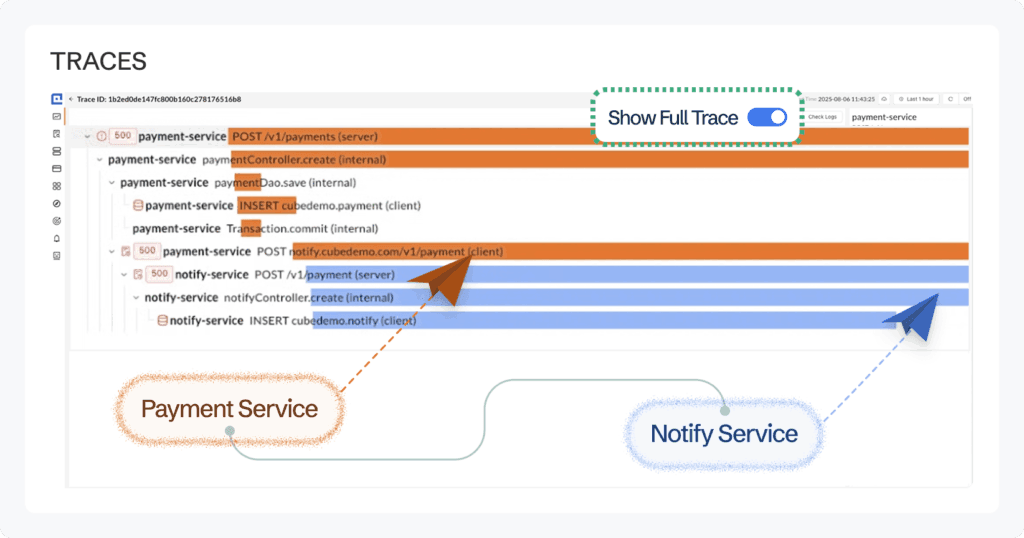
Both Zipkin and Jaeger solve the trace storage and visualization problem well. What neither provides is correlation between a slow trace and the infrastructure metric at that moment, or the logs from that exact request. Finding the root cause of a slow trace requires jumping between a trace UI, a metrics dashboard, and a log search tool, matching timestamps manually.
CubeAPM accepts OTLP directly from your existing OTel SDK or Collector, the same data you would send to Zipkin, and stores events, metrics, logs, and traces (MELT) together. When a slow trace appears, you move from the trace to the infrastructure metric on the affected host to the logs from that exact request without switching tools. It runs self-hosted inside your own infrastructure at $0.15/GB ingestion pricing with no per-user fees, so data never leaves your environment.
Summary
OpenTelemetry and Zipkin are complementary tools. OpenTelemetry handles instrumentation and collection across all signals. Zipkin handles trace storage, querying, and visualization. The relationship between them changed in 2025: OpenTelemetry deprecated its Zipkin exporter specification in December 2025 (existing exporters supported until December 2026), and Zipkin added native OTLP ingestion via zipkin-otel. The correct endpoint for OTLP ingestion is Zipkin’s standard server port 9411 using HTTP/protobuf, not a separate port. For migration from existing Zipkin instrumentation, configure composite B3 and W3C propagation to bridge the formats during the transition.
| OpenTelemetry | Zipkin | |
| Role | Instrumentation and collection | Trace storage and visualization |
| Signals | Traces, metrics, logs, profiling (beta) | Traces only |
| Instrumentation | Yes (11+ languages) | Via Brave (Java) or compatible libraries |
| Storage | None | In-memory, Cassandra, Elasticsearch 8.x/9.x, OpenSearch 2.x |
| Default propagation | W3C TraceContext | B3 |
| Native OTLP | Yes (primary protocol) | Yes (via zipkin-otel on port 9411) |
| Zipkin exporter in OTel | Spec deprecated December 2025; removed December 2026 | N/A |
| Latest version | Stable per language (2026) | 3.6.0 (2026) |
Disclaimer: Zipkin version (3.6.0), OTel Zipkin exporter deprecation timeline (spec deprecated December 2025, specification removal December 2026, SDK support until December 2026), zipkin-otel OTLP endpoint details (port 9411, HTTP/protobuf), and Zipkin storage backend support are verified against the official OTel deprecation blog post (opentelemetry.io/blog/2025/deprecating-zipkin-exporters), the OTel specification page for Zipkin exporters (opentelemetry.io/docs/specs/otel/trace/sdk_exporters/zipkin), the openzipkin-contrib/zipkin-otel GitHub repository README, and the Zipkin GitHub releases page (github.com/openzipkin/zipkin/releases) as of May 2026.
Also read:
What Is the Difference Between OpenTelemetry and Jaeger?