






If you are setting up observability for a distributed system, you have probably asked this question: should we use OpenTelemetry, Datadog, or both? The confusion is understandable because the two tools are often compared head-to-head, yet they are fundamentally different kinds of software.
OpenTelemetry is an open-source observability framework maintained by the Cloud Native Computing Foundation (CNCF). It gives you a vendor-neutral way to instrument your code and collect telemetry data including traces, metrics, and logs. It does not store data or provide dashboards on its own.
Datadog is a commercial SaaS platform. It provides its own agent, its own instrumentation libraries, built-in storage, dashboards, alerting, and machine learning features. It is an end-to-end observability product.
This guide breaks down exactly how these two tools differ across instrumentation, cost, architecture, and vendor lock-in, so you can make a clear decision for your team.
🔑 Key Takeaways
- OpenTelemetry is an instrumentation and data collection framework. Datadog is a full-stack commercial observability platform.
- OpenTelemetry is free and open source. Datadog APM and infrastructure monitoring costs approximately $31 per host per month (annual commitment).
- OpenTelemetry avoids vendor lock-in. You can route telemetry to any OTLP-compatible backend without changing your application code.
- Datadog accepts OpenTelemetry data via OTLP, so the two tools can be used together.
- For teams wanting to self-host observability and avoid SaaS costs, CubeAPM is a self-hosted alternative that ingests OTel data natively.
- Choose OpenTelemetry if portability and cost control matter. Choose Datadog if you need an all-in-one solution with minimal setup time.
OpenTelemetry vs Datadog at a Glance
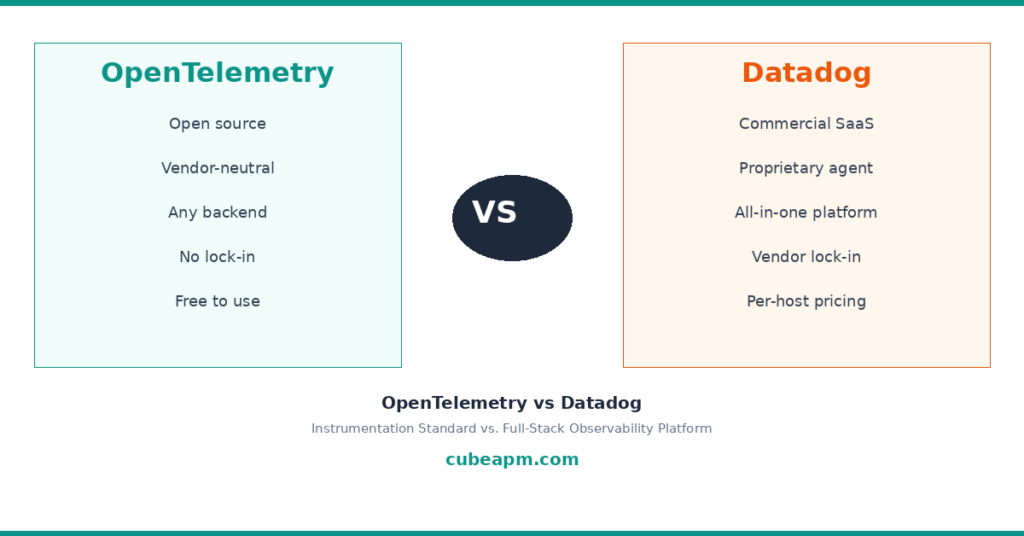
OpenTelemetry vs Datadog: instrumentation standard vs. full-stack SaaS platform.
What is OpenTelemetry?
OpenTelemetry (OTel) is a CNCF project that provides a unified set of APIs, SDKs, and a data collection agent called the OpenTelemetry Collector. It supports the three pillars of observability: traces, metrics, and logs.
Key components of OpenTelemetry:
- OTel SDKs: Language-specific libraries for Java, Python, Go, .NET, JavaScript, and more.
- OTel API: A stable interface for generating telemetry data, decoupled from the implementation.
- OpenTelemetry Collector: A vendor-agnostic proxy that receives, processes, and exports telemetry data to one or more backends.
- OTLP: OpenTelemetry Protocol, the wire protocol for transmitting telemetry data between components.
OpenTelemetry does not provide storage, dashboards, or alerting. You need a backend such as Jaeger, Prometheus, or an all-in-one platform like CubeAPM, Grafana, or Datadog to visualize and query your data.
What is Datadog?
Datadog is a commercial cloud-based observability and monitoring platform. It provides infrastructure monitoring, APM, log management, security monitoring, real user monitoring (RUM), and more, all within a single SaaS interface.
Key components of Datadog:
- Datadog Agent: A lightweight daemon installed on each host that collects metrics, logs, and traces and sends them to Datadog’s cloud.
- ddtrace libraries: Proprietary APM instrumentation libraries for Python, Java, Ruby, Go, and other languages.
- Datadog Platform: Cloud-hosted storage, dashboards, ML-powered anomaly detection (Watchdog), alerting, and integrations with 800+ technologies.
- OTLP ingestion: Datadog also accepts telemetry data sent via OTLP, so you can use OpenTelemetry SDKs and send data to Datadog.
Architecture: How They Differ
The fundamental difference is coupling. Datadog tightly couples data collection, storage, and visualization in one product. OpenTelemetry decouples instrumentation from the backend entirely.
With OpenTelemetry, your application code uses OTel SDKs. The OpenTelemetry Collector receives data and exports it to one or more backends of your choice. You could send traces to Jaeger, metrics to Prometheus, and both to CubeAPM simultaneously, all from the same instrumented application.
With Datadog, your application uses ddtrace libraries. The Datadog Agent forwards data to Datadog’s cloud. All storage, processing, and visualization happens inside the Datadog platform. Routing that data elsewhere requires re-instrumentation.
OpenTelemetry vs Datadog: Feature Comparison
| Feature | OpenTelemetry | Datadog |
|---|---|---|
| Type | Open-source framework | Commercial SaaS platform |
| Vendor lock-in | None – swap backends freely | High – proprietary agent & libs |
| Instrumentation | OTel SDKs (Java, Python, Go…) | ddtrace proprietary libraries |
| Data storage | Requires external backend | Built-in cloud storage |
| Visualization | Requires external tool | Built-in dashboards & alerts |
| Pricing | Free (backend costs vary) | ~$31/host/month (APM + infra) |
| Deployment | OTel Collector + backend | Datadog Agent + SaaS |
| Protocol | OTLP (open standard) | Proprietary (OTLP also accepted) |
| AI/ML features | None built-in | Watchdog AI, anomaly detection |
| Self-hosted | Yes – fully self-hosted | No – sends to Datadog cloud |
| Best for | Flexibility, no lock-in | All-in-one, fast deployment |
Instrumentation: OTel SDK vs ddtrace
With OpenTelemetry, you use the opentelemetry-sdk package and standard OTLP exporters. Your instrumentation code is portable: swap the exporter configuration to switch backends without touching application logic.
With Datadog, you use the ddtrace package. The patch_all() call automatically instruments common frameworks. This is convenient but binds your instrumentation to Datadog’s proprietary library. Removing Datadog later means rewriting your tracing code.
For teams that want portability, the OTel SDK is the better choice. For teams that value speed of initial deployment, ddtrace is faster to set up.
Cost Comparison
OpenTelemetry itself is free. Costs come from the backend you choose. If you self-host everything, the cost is infrastructure only.
Datadog pricing is based on hosts and data volume. As of 2025, the combined APM and Infrastructure monitoring plan costs approximately $31 per host per month on an annual commitment. Log ingest is billed separately at $0.10 per GB ingested plus $1.70 per million log events per month.
For a team running 50 hosts, Datadog APM and infrastructure monitoring alone costs roughly $1,550 per month before logs. That figure scales linearly as you grow. OpenTelemetry with a self-hosted backend keeps the backend cost fixed or near-fixed as host count grows.
This cost difference is one of the most common reasons engineering teams evaluate OpenTelemetry as a path away from Datadog, or combine OpenTelemetry instrumentation with a more cost-effective backend like CubeAPM.
Vendor Lock-in: The Core Tradeoff
With Datadog, your instrumentation code uses ddtrace. Your dashboards, alerts, and saved queries live inside the Datadog platform. Migrating to a different vendor requires re-instrumenting your services and recreating your dashboards.
With OpenTelemetry, instrumentation is backend-agnostic. You write your tracing and metrics code once using OTel SDKs. To change backends, you update the exporter configuration in your OpenTelemetry Collector, not your application code. This gives you negotiating leverage with vendors and the freedom to move to cheaper or better-fitting backends as your needs evolve.
OpenTelemetry also makes multi-backend scenarios practical. You can send the same telemetry stream to multiple backends simultaneously for evaluation, redundancy, or cost comparison.
Using OpenTelemetry with Datadog
Datadog officially supports OpenTelemetry ingestion. You can send traces, metrics, and logs to Datadog using OTLP without using ddtrace.
Two main integration approaches:
- OTLP directly to Datadog Agent: Configure your OTel SDK or Collector to export via OTLP to the Datadog Agent on localhost. The Agent accepts OTLP on port 4317 (gRPC) and 4318 (HTTP).
- OTel Collector with Datadog Exporter: Run the OpenTelemetry Collector with the Datadog Exporter configured. This approach gives you more flexibility in preprocessing and routing data before it reaches Datadog.
The advantage of this hybrid approach: your instrumentation code is already portable. If you later reduce Datadog usage, you update the Collector config to route to a different backend without touching application code.
Note that some Datadog features, such as its Continuous Profiler and dynamic instrumentation, work best with native ddtrace libraries. If you need those features, using ddtrace alongside OTel is a common pattern.
When to Use OpenTelemetry
- You want portability and the ability to switch backends without re-instrumenting.
- You operate in a multi-cloud or polyglot environment and want a single instrumentation standard.
- You are cost-sensitive and want to control backend costs as your infrastructure scales.
- You need to send telemetry data to multiple backends simultaneously.
- You are building a new service and want to avoid proprietary dependencies from the start.
When to Use Datadog
- You need an all-in-one platform that works out of the box with minimal infrastructure management.
- You need AI-powered alerting, anomaly detection, and root cause analysis built in.
- You require real user monitoring, synthetic monitoring, and APM correlation in one product.
- Your team has limited time for observability infrastructure setup and ongoing maintenance.
- Your cost analysis shows Datadog is within budget relative to the engineering time saved.
📌 Want a Self-Hosted Alternative to Datadog?
If you use OpenTelemetry for instrumentation and want a backend that avoids Datadog’s per-host pricing and vendor lock-in, CubeAPM is built for exactly that scenario.
CubeAPM is a self-hosted observability platform that ingests OpenTelemetry data natively. You get APM traces, metrics, and logs in a single dashboard, deployed on your own infrastructure. No SaaS markups, no data egress costs, and full control over your telemetry data.
→ Book a demo today
Conclusion
OpenTelemetry and Datadog are not direct competitors at the instrumentation layer. OpenTelemetry is a standard for collecting and transporting telemetry data. Datadog is a platform for storing, visualizing, and alerting on that data.
The choice becomes meaningful at the architectural level: do you want proprietary instrumentation tied to a specific vendor, or vendor-neutral instrumentation that keeps your options open? For most teams building modern distributed systems, starting with OpenTelemetry SDKs is the lower-risk, longer-term approach.
If budget is a concern and you want a self-hosted backend that natively speaks OpenTelemetry, CubeAPM is worth evaluating alongside Grafana and SigNoz.
Disclaimer: Pricing figures in this article are based on publicly available information as of June 2025. Vendor pricing changes frequently. Always verify current pricing on official vendor websites before making purchasing decisions. Product features and integration capabilities may change with new releases.
FAQs
1. Is OpenTelemetry a replacement for Datadog?
No. OpenTelemetry is an instrumentation and data collection framework. It does not provide storage, dashboards, or alerting. Datadog is a full-stack observability platform. You can use OpenTelemetry for instrumentation and Datadog as the backend, combining both tools.
2. Does Datadog support OpenTelemetry?
Yes. Datadog accepts telemetry data via OTLP. You can configure the OpenTelemetry Collector or OTel SDKs to export data to the Datadog Agent using OTLP on gRPC port 4317 or HTTP port 4318.
3. What is the main cost difference between OpenTelemetry and Datadog?
OpenTelemetry is free. Datadog charges approximately $31 per host per month for APM and infrastructure monitoring (annual commitment). For large deployments, this becomes a significant expense compared to self-hosted backends.
4. Can I migrate from Datadog to OpenTelemetry?
Yes, but it requires re-instrumentation of your services. You replace ddtrace libraries with OTel SDKs, set up an OpenTelemetry Collector, and configure a new backend. Starting new services with OTel SDKs while keeping existing services on ddtrace is a common incremental migration approach.
5. What backend should I use with OpenTelemetry?
Popular open-source options include Jaeger for traces, Prometheus for metrics, and Grafana for visualization. For an all-in-one self-hosted platform that natively ingests OpenTelemetry data, CubeAPM is a strong option for teams that want APM without SaaS pricing.