






Data pipelines are the invisible backbone of every analytics stack, ML platform, and data product. When they run well, dashboards refresh on time, AI models train on clean data, and decisions get made on accurate information. When they fail silently, the consequences range from stale reports to costly business decisions based on bad data.
Monitoring a data pipeline means more than knowing whether a job ran. You need to track: throughput (events per second, rows processed),
- Latency: How long does ingestion and transformation take?
- Data freshness: When was this table last updated?
- Data quality: Did the schema change? Are there unexpected nulls?
- Pipeline cost: How much compute did this dbt model consume in Snowflake? Different tools address different layers of this problem, and the right monitoring stack often combines more than one.
This guide covers the best data pipeline monitoring tools in 2026 across two categories: orchestration-native monitoring (tools that schedule, run, and monitor pipelines in one system) and data observability platforms (tools that monitor the health and quality of data flowing through pipelines, independent of the execution layer).
Key Takeaways
- Data pipeline monitoring spans two distinct layers: operational monitoring (did the pipeline run? did it fail? how long did it take?) and data quality observability (did the data arrive correctly? are schema, volume, and distribution within expected ranges?).
- Apache Airflow 3.2.2 is the current stable release of the most widely deployed open-source pipeline orchestrator. It emits metrics to StatsD or OpenTelemetry, supports OTel trace export, native Sentry error tracking integration, and a built-in health check endpoint. Free under the Apache 2.0 license.
- Dagster is an asset-centric orchestrator that embeds monitoring, data quality checks, and lineage directly into pipeline definitions. Dagster+ pay-as-you-go: Solo at $10/month plus $0.040/credit, Starter at $100/month plus $0.035/credit. Asset quality checks, freshness checks, and dbt test integration are available on all plans, including Solo and Starter.
- Prefect is a Python-native orchestrator with built-in flow-level observability and event-driven automations. Its Hobby tier is free with 2 users, 5 deployments, 5 automations, 500 serverless compute minutes per month, and 7-day run retention.
- Monte Carlo is a data observability platform that unifies data and AI agent observability with ML-powered anomaly detection across freshness, volume, schema, and distribution. It now offers four tiers: Start, Scale, Enterprise, and Business Critical. Pricing is credit-based and requires contacting sales.
- CubeAPM is a self-hosted, OpenTelemetry-native APM and infrastructure monitoring platform that monitors streaming pipeline components, including Kafka, RabbitMQ, and ActiveMQ, alongside full-stack application observability, at $0.15/GB ingested with no per-host or per-pipeline fees.
The two layers of data pipeline monitoring
Before comparing tools, it is worth being precise about what data pipeline monitoring covers.
Operational monitoring:
It answers:
- Did the job run?
- Did it fail?
- How long did it take?
- Was there a retry?
- How much compute did it consume?
This is the domain of orchestration tools like Airflow, Dagster, and Prefect. They schedule pipeline runs, track task and job execution state, emit job-level metrics, and alert on failures or SLA misses.
Data quality observability:
It answers:
- Did the right data arrive?
- Did the schema change unexpectedly?
- Are there volume anomalies that suggest an upstream source stopped sending?
- Are there distribution shifts that indicate silent data corruption?
This is the domain of dedicated data observability platforms like Monte Carlo. They sit outside the execution layer and monitor the data itself, usually by inspecting the warehouse or lake directly.
A complete data pipeline monitoring setup typically combines both layers: an orchestrator that tracks job execution, and a data observability platform that validates the quality of what the pipeline produced.
1. CubeAPM
CubeAPM is a self-hosted, OpenTelemetry-native full-stack observability platform that provides visibility into the infrastructure components that power data pipelines. It monitors streaming and messaging systems (Kafka, RabbitMQ, ActiveMQ), databases, Kubernetes, and application services, correlating all signals in a single platform.
Features
- Kafka monitoring: Broker uptime, topic throughput (messages/sec, bytes/sec), consumer group lag (records_lag_max and time delay), under-replicated partitions, ISR counts, rebalance events, producer throughput, and per-partition traffic. Metrics collected via OpenTelemetry Collector and JMX/Prometheus exporters.
- RabbitMQ and ActiveMQ monitoring: Queue depth, message rates, consumer counts, unacknowledged messages, dead-letter queue growth, and broker health metrics via OTel-native collection.
- Full-stack APM correlation: Link a Kafka consumer lag metric to the application trace of the service causing the delay. Navigate from a lag spike to the upstream producer or downstream consumer service in one click.
- Infrastructure layer: Monitor the Kubernetes pods, VMs, or bare-metal nodes running your pipeline components alongside application-layer signals.
- Log correlation: Pipeline error logs from Kafka, consumer services, and connector workers are ingested alongside metrics and traces.
- Alerting: Rich notifications via Slack, PagerDuty, email, and Google Chat with 30-minute alert charts. Configurable SLO tracking for pipeline SLAs.
- Smart sampling: Retains high-latency and error traces while reducing storage costs.
- Self-hosted inside your VPC: No pipeline data, logs, or trace data leaves your infrastructure. SOC 2 and ISO 27001 compliant.
Pricing: $0.15/GB of data ingested. No per-host, per-pipeline, per-topic, or per-user fees.
Limitations: CubeAPM does not provide orchestration-layer monitoring (DAG execution state, task retries, schedule health) for Airflow or Dagster. It does not provide data quality observability at the warehouse level (schema change detection, distribution anomaly detection). It is the infrastructure and application observability layer that sits underneath an orchestrator, not a replacement for one.
Best for: Data engineering and platform teams that want Kafka, RabbitMQ, and ActiveMQ pipeline infrastructure monitoring correlated with full-stack APM traces and application logs in a single self-hosted platform, with predictable ingestion-based pricing that does not scale with pipeline or topic count.
2. Apache Airflow
Apache Airflow is the de facto open-source standard for data pipeline orchestration. The current stable release is Airflow 3.2.2, as confirmed on Airflow’s logging and monitoring documentation. Airflow Summit 2026 is scheduled for August 31 to September 2 in Austin, TX.
Features
- Built-in UI monitoring: DAG-level views (run history, task states, execution timeline), task instance logs, Gantt charts showing task duration and parallelism, and a Grid view providing a historical matrix of task states per DAG run.
- Health check: Airflow exposes a built-in /health endpoint reporting the status of the scheduler and metadatabase, enabling external monitoring systems to detect scheduler failures.
- Metrics emission: Airflow emits metrics to StatsD or OpenTelemetry. Metrics cover DAG processing time, task duration, scheduler heartbeat, task failure counts, and queue depth. The Airflow docs recommend sending StatsD metrics to Prometheus for visualization in Grafana.
- Traces: Airflow 3.x includes a dedicated Traces Configuration section for exporting OTel traces of DAG and task execution to any compatible backend.
- Error tracking: Airflow supports real-time error notification via native Sentry integration, in addition to the standard health check.
- SLA misses: Airflow supports SLA definitions per task. When a task exceeds its SLA, Airflow logs a miss and triggers configurable email alerts.
- Task logs: Stored locally or in remote backends (S3, GCS, Azure Blob Storage). Supports multiple logging handlers simultaneously.
- Callbacks: Configurable callbacks on task success, failure, retry, and SLA miss for custom alerting logic.
- OpenTelemetry Provider: The Airflow OpenTelemetry Provider generates traces, metrics, and logs in OTel format for DAG runs, enabling integration with any OTel-compatible backend.
Pricing: Apache Airflow is free and open source under the Apache 2.0 license. Managed Airflow services (Amazon MWAA, Google Cloud Composer, Astronomer) are priced separately by each provider.
Limitations: Airflow’s built-in monitoring covers job execution state but not data quality. Self-hosting Airflow requires managing its multi-component architecture (scheduler, webserver, workers, metadata database, message broker). External tooling (Prometheus and Grafana) is needed for time-series metrics dashboards beyond the built-in UI.
Best for: Data engineering teams that want the most widely adopted open-source pipeline orchestrator with the largest ecosystem of providers, operators, and community support, and flexible deployment options from self-hosted to managed cloud.
3. Dagster
Dagster is an asset-centric data orchestration platform that embeds observability, data quality checks, and lineage directly into the pipeline definition layer. Rather than modeling pipelines as sequences of tasks, Dagster models them as the data assets they produce, making lineage and impact analysis automatic.
Features
- Asset-centric observability: Every data asset (table, model, ML feature, report) is tracked by health state, freshness, and execution history. When an asset fails, Dagster shows the full blast radius: which downstream assets depend on it and will be affected.
- Asset quality checks: Declarative data quality checks run as part of pipeline execution. Available on all plans, including Solo and Starter.
- Asset freshness checks: Monitor how current each asset is relative to its expected update schedule. Available on all plans.
- dbt test integration: dbt tests are surfaced as asset checks within Dagster’s UI and execution model. Available on all plans.
- Asset-level lineage: Automatic upstream and downstream dependency mapping across all assets in the platform, including dbt models, Fivetran syncs, and Snowflake tables. Available on all plans.
- Column-level lineage: Maps which source columns feed each destination column. Pro plan only.
- Catalog search: Search across all assets in the data catalog. Available on Starter and Pro plans.
- Cost Insights (Cost tracking for BigQuery and Snowflake): Surfaces compute and storage costs per asset correlated with pipeline execution. Pro plan only.
- Event-driven automations: Available on all plans. Alert on asset failures, freshness violations, and custom conditions.
- Hybrid deployment: Run compute in your own infrastructure while Dagster manages the control plane. No additional compute charge on hybrid.
- dbt, Fivetran, and Snowflake integrations: First-class native integrations across all plans.
- Branch deployments: Test pipeline changes in a production-like environment before deploying. Available on all plans.
Pricing:
Dagster+ offers two self-serve models and an enterprise Pro plan:
Pay-as-you-go (Dagster+ Cloud):
| Plan | Base price | Credit rate | Users | Deployments | Free trial |
| Solo | $10/month | $0.040/credit | 1 | 1 | 30 days |
| Starter | $100/month | $0.035/credit | Up to 3 | 1 | 30 days |
Committed credits (Dagster+ Serverless):
| Plan | Price | Credits included | Users | Deployments |
| Solo | $120/month | 7,500 credits/month | 1 | 1 |
| Starter | $1,200/month | 30,000 credits/month | Up to 3 | 1 |
Serverless compute is billed at $0.010/compute minute on pay-as-you-go plans; no compute charge on hybrid. Pro plan pricing requires contacting Dagster sales. A credit is defined as one asset materialization or one op execution. Dagster is also available as open-source self-hosted under the Apache 2.0 license with no managed control plane.
Limitations: Dagster’s asset-centric model requires structuring pipelines around Software-Defined Assets, which has a learning curve for teams migrating from task-centric orchestrators. Column-level lineage and Cost Insights (Snowflake/BigQuery cost tracking) are Pro plan only. The committed credits Serverless model can become expensive at high materialization volumes.
Best for: Data platform teams that want orchestration, lineage, data quality checks, and cost observability in a single system, and who are building a data platform around the concept of data assets rather than tasks.
4. Prefect
Prefect is a Python-native workflow orchestration platform that prioritizes developer experience and built-in observability. Pipelines are pure Python functions decorated with @flow and @task.
Features
- Flow-level monitoring: Every flow run is tracked with state (Pending, Running, Completed, Failed, Crashed), execution timeline, and task-level logs. The Prefect UI shows exactly where tasks failed alongside the relevant logs.
- Durable execution: Prefect persists task results to guarantee exactly-once execution. Failed flows resume from the last successful task rather than re-running everything.
- Event-driven automations: Prefect’s active event bus detects state changes, missing runs, or custom conditions in real time. Automations trigger alerts, retries, or downstream flows.
- SLA tracking: Monitor pipelines with automated recovery, clear audit trails, and SLA tracking.
- Hybrid execution model: Orchestration is separated from execution. Workflows run in your own infrastructure (Kubernetes, ECS, or any compute) while Prefect Cloud manages the control plane.
- Prefect MCP server: Read-only diagnostics and built-in docs access for AI-assisted troubleshooting via Claude Code, Cursor, Codex CLI, and Gemini CLI.
- Assets Catalog: Tracks cross-team assets and their materialization state.
- Logging and alerting: Available on all plans, including the free Hobby tier.
Pricing:
Prefect Cloud is priced by seats and workspaces, not by usage volume.
| Feature | Hobby (free) |
| Users | 2 |
| Workspaces | 1 |
| Deployments | 5 |
| Automations | 5 |
| Serverless compute | 500 minutes/month |
| Run retention | 7 days |
| API rate limit | 625 requests/minute |
| Logging and alerting | Included |
| Webhooks | Included |
| SSO / SCIM | Not included |
| Uptime SLA | None |
Serverless compute on paid plans: $0.010/compute minute. Pro, Growth, and Enterprise plan pricing requires contacting the Prefect sales. Prefect is open source and free under the Apache 2.0 license and can be self-hosted.
Limitations: Prefect is an orchestrator, not a data quality platform. It does not monitor the data flowing through pipelines (schema changes, volume anomalies, distribution shifts). The Hobby tier limits run retention to 7 days and caps users at 2 and deployments at 5.
Best for: Python-native data engineering teams that want modern workflow orchestration with built-in observability, durable execution, and event-driven automations without DAG-based framework complexity, including teams running ML and AI pipelines alongside traditional data pipelines.
5. Monte Carlo
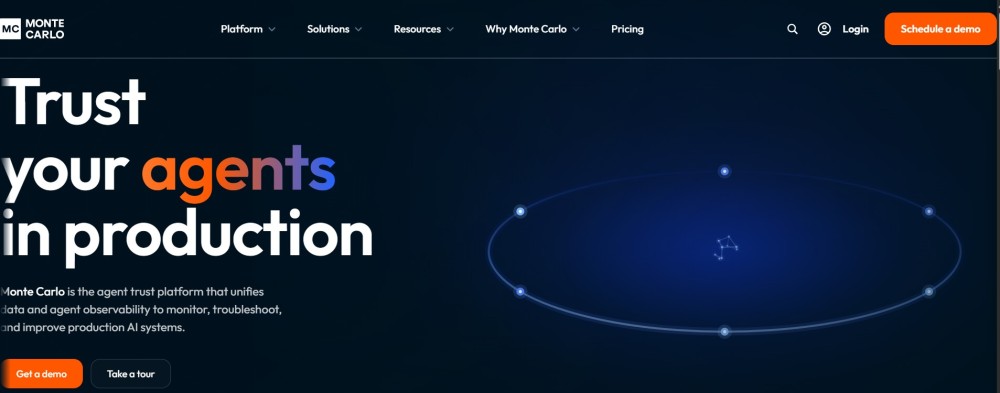
Monte Carlo is a data and AI observability platform that monitors the health and quality of data across the warehouse, BI layer, and ETL systems, as well as AI agent outputs. It now describes itself as “the agent trust platform that unifies data and agent observability.”
Features
- ML-powered anomaly detection: Automatically detects anomalies across five data health dimensions without requiring manual threshold configuration: freshness, volume, schema, distribution, and lineage.
- AI-powered data quality: Monitoring Agent, Troubleshooting Agent, and Operations Agent automate quality checks, root cause analysis, and incident response workflows.
- Automated lineage: Maps end-to-end data lineage across the stack from source systems through ETL/ELT transformations to BI dashboards. When an upstream table changes, Monte Carlo identifies every downstream asset affected.
- Root cause analysis: Links data incidents to upstream changes through automated lineage traversal.
- ETL and orchestration integration: Monitors data produced by Fivetran, dbt, Airflow, and other pipeline tools, as well as BI tools (Looker, Tableau, Mode).
- Agent observability: Monitors AI agent outputs alongside traditional data pipelines, covering agents built on LangChain, Snowflake Intelligence, Databricks Genie, and others.
- Incident management: Assign incident severity and owners, triage issues, and track resolution time.
- Monitors-as-code: Define monitors programmatically via the Monte Carlo SDK.
- Performance observability: Track query performance and data platform costs.
Pricing:
Monte Carlo uses credit-based, usage-based pricing across four tiers. Specific per-credit dollar rates are not published publicly and require contacting Monte Carlo sales.
| Tier | Users | API calls/day | Key additions |
| Start | Up to 10 | 10,000 | Data warehouse, BI, ETL monitoring; incident triage; lineage; self-guided onboarding |
| Scale | Unlimited | 50,000 | Everything in Start plus SSO, SCIM, self-hosted storage, PII filtering, audit logging, data lake integrations (Databricks, Hive, Glue, Azure Data Lake) |
| Enterprise | Unlimited | 100,000 | Everything in Scale plus multi-workspace support, advanced cost attribution, ServiceNow integration, Oracle/SAP Hana/Teradata/Microsoft Fabric EDW support |
| Business Critical | Unlimited | 100,000 | Everything in Enterprise plus dedicated instance and disaster recovery |
All tiers include access to Data Observability, Agent Observability, ML Observability, and a fleet of AI agents.
Limitations: Monte Carlo is a data quality observability platform, not a pipeline orchestrator. It does not schedule or execute pipelines. It is primarily built for cloud data warehouse environments; teams with on-premises or streaming-only architectures may find limited coverage.
Best for: Data platform and analytics engineering teams with Snowflake, BigQuery, or Databricks as their core data platform who need ML-powered data quality monitoring, automated lineage, and AI-assisted incident management without manually configuring every monitoring threshold.
Comparison table
| Tool | Type | Operational monitoring | Data quality monitoring | Data lineage | Self-hosted | Free tier | Pricing model |
| CubeAPM | Infra + streaming APM | Yes (Kafka, RabbitMQ, ActiveMQ) | No | No | Yes | No | $0.15/GB ingested |
| Apache Airflow | Orchestrator | Yes (DAG/task execution, SLAs, OTel traces) | No | Partial (built-in lineage) | Yes | Yes (open source) | Free (OSS); managed varies |
| Dagster | Asset-centric orchestrator | Yes (asset execution, freshness) | Yes (asset quality checks, dbt tests, all plans) | Yes (auto asset lineage, all plans) | Yes | Yes (open source + 30-day Dagster+ trial) | $10/mo + $0.040/credit (Solo PAYG) |
| Prefect | Workflow orchestrator | Yes (flow/task execution, SLA tracking) | No | No | Yes | Yes (Hobby: free, 2 users, 5 deployments) | Free (Hobby); Pro: contact sales |
| Monte Carlo | Data + AI observability | No | Yes (ML anomaly detection) | Yes (automated, end-to-end) | No (SaaS) | No | Credit-based; contact sales for rates |
Which data pipeline monitoring tool should you choose?
- Choose CubeAPM if you need monitoring for the infrastructure components of your data pipelines: consumer lag, Kafka brokers, RabbitMQ queues, ActiveMQ, and the application services that produce and consume streaming data, all correlated with APM traces in a single self-hosted platform at predictable ingestion-based pricing.
- Choose Apache Airflow if you need the most widely deployed open-source pipeline orchestrator with the largest ecosystem of providers, native OTel trace export, built-in Sentry error tracking integration, and flexible deployment from self-hosted to managed cloud. Pair it with CubeAPM for infrastructure monitoring and Monte Carlo for data quality observability.
- Choose Dagster if you want orchestration, automatic lineage, built-in data quality checks (including dbt test integration and freshness checks, available on all plans), and Snowflake/BigQuery cost observability in one system. Dagster’s asset-centric approach provides the most integrated monitoring experience of any orchestrator in this comparison.
- Choose Prefect if you want Python-native workflow orchestration with minimal friction, durable execution, built-in flow-level observability, and event-driven automations without restructuring your Python code into DAGs. Best for teams running ML and AI pipelines alongside traditional data pipelines.
- Choose Monte Carlo if you need ML-powered data quality monitoring across your cloud data warehouse with automated lineage, AI-assisted root cause analysis, and enterprise-grade incident management. Monte Carlo is the data quality layer that runs on top of whatever orchestrator you use.
Summary
Data pipeline monitoring is a multi-layer problem. A complete setup usually involves an orchestration tool that tracks job execution state and an observability platform that validates the quality of the data that pipelines produce.
For teams running streaming pipelines on Kafka, RabbitMQ, or ActiveMQ, CubeAPM provides infrastructure and application-layer monitoring with APM correlation at $0.15/GB ingested. For batch orchestration, Airflow and Dagster lead the market: Airflow for breadth of ecosystem and the largest community, Dagster for teams that want lineage and data quality embedded directly in the orchestrator at every plan tier. Prefect is the strongest choice for Python-native teams that also run ML and AI pipelines. Monte Carlo fills the data quality observability gap that all orchestrators leave: monitoring what the data looks like after the pipeline runs, with AI agents that now cover both data and AI agent outputs.
| Tool | Best for | Free tier | Self-hosted |
| CubeAPM | Kafka/RabbitMQ/ActiveMQ infra + APM monitoring, self-hosted | No | Yes |
| Apache Airflow | Open-source pipeline orchestration, OTel traces, Sentry integration | Yes (OSS) | Yes |
| Dagster | Asset-centric orchestration with lineage and quality checks on all plans | Yes (OSS + 30-day Dagster+ trial) | Yes |
| Prefect | Python-native orchestration, durable execution, ML/AI pipeline support | Yes (Hobby tier) | Yes |
| Monte Carlo | ML-powered warehouse data quality observability, AI agent observability | No | No (SaaS) |
Disclaimer: Features and pricing are verified from official Airflow’s logging and monitoring docs and Airflow’s ecosystem page, Dagster’s pricing page (Solo and Starter pricing updated May 1, 2026), Prefect’s pricing page and Prefect’s docs, Monte Carlo’s pricing page, and CubeAPM’s infrastructure monitoring docs and pricing page. Always verify current pricing and feature availability directly with each vendor before making purchasing decisions.
Also read:
Datadog LLM Observability: Examples, Pricing, and Alternatives in 2026
What Are the Best Frontend Performance Monitoring Tools for Angular in 2026?
What Are the Best Frontend Performance Monitoring Tools for Next.js in 2026?