









Uncontrolled log retention is one of the fastest ways to inflate infrastructure costs in Kubernetes environments.
Kubernetes changes how telemetry behaves. Pods are ephemeral, workloads autoscale, and log volume scales with application activity rather than server lifespan. In the past, VM-based systems would grow in a predictable way. Now, they can grow in bursts because of traffic spikes, misconfigured services, or noisy dependencies.
Without intentional retention design, indexed storage grows slowly, and compliance assumptions change. During an incident or audit, teams find out what happened when logs are either too expensive to keep searchable or no longer defensible.
Log retention in Kubernetes needs to be built into the collection, indexing, archiving, lifecycle enforcement, and governance processes. This guide shows you how to design retention that keeps the ability to investigate, keeps costs down, and passes compliance checks.
What Is Log Retention?
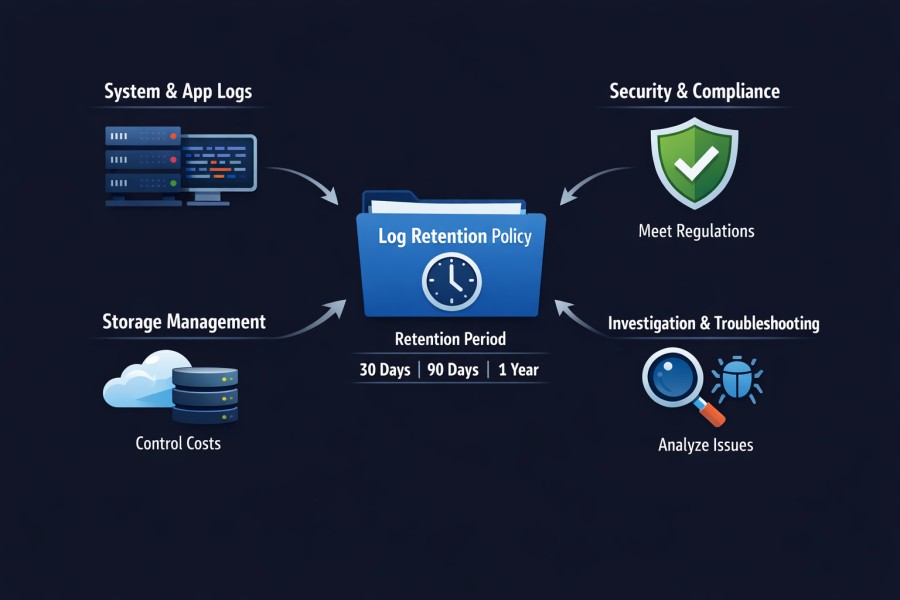
Log retention is the disciplined practice of keeping system and application logs for a set amount of time before deleting or archiving them. Teams set retention windows to keep the right data for security investigations, troubleshooting, and regulatory requirements while keeping storage costs from getting too high.
In real life, log retention has a cycle. Logs are made and taken in. They are indexed so that they can be searched quickly while the investigation is still going on. They go to lower-cost archive storage after a set time when they can be searched. Unless a legal hold or regulatory rule says otherwise, they are deleted at the end of the policy period.
Keeping things for an indefinite amount of time sounds safe, but it is risky. Costs for storage add up. Sensitive data stays open longer than it should. GDPR and other privacy laws require that data be stored for only as long as necessary and that it be kept to a minimum. Retention policies have to find a balance between what is useful for the business and what is legal and financially sound.
Log retention is not the same as log collection. The latter means collecting logs from systems, such as Kubernetes nodes or apps. Retention controls how long those logs can be accessed, searched, and used legally.
Why Log Retention Is Necessary
Finding and fixing problems with operations and incidents
When production goes wrong, teams use historical logs to put together timelines and find the root causes. Most investigations into incidents only look back a few days or weeks, not years. Retention policies make sure that searchable logs are kept for as long as it takes to meet your incident response goals.
Security Forensics and Investigating Breaches
Log history is needed by security teams to find unauthorized access, lateral movement, or data theft. Frameworks like PCI DSS Requirement 10 require that audit trails be kept. Forensic analysis is incomplete and legally weak without structured retention.
Requirements for Audits and Regulations
Companies have rules that make it clear that they need to keep logs and make sure they are accurate:
- SOC 2 says that you need to keep an eye on and record system activity.
- PCI DSS says that there must be at least one year of audit trail history, and three months of that history must be ready to be looked at right away.
- HIPAA requires audit controls for systems that deal with private health information.
- GDPR makes sure that data is only stored for as long as it is needed and that it is as small as possible.
Retention policies turn these rules into time limits and controls that can’t be changed.
Managing costs and storage
The amount of telemetry data is still growing. The CNCF Annual Survey 2023 found that 96% of businesses use or are testing Kubernetes, and most of them run it in production. As workloads in containers grow, so do the logs that go with them. If there are no limits on how long logs can be kept and no tiered storage, the cost of indexed logs goes up very quickly.
Data Minimization and Privacy Principles
Modern privacy regulations expect organizations to retain only what they need and for as long as necessary. Excessive retention increases breach exposure and legal risk. Mature teams treat retention as part of their data governance strategy, not as a storage afterthought.
What Log Retention Really Means in Kubernetes
In Kubernetes, log retention is not a checkbox in a settings panel. It is an architectural decision that spans collection, processing, indexing, storage, and governance. If you treat it as a storage toggle, you lose data when pods disappear, or you overpay for indexed storage that no one queries.
Retention in Kubernetes begins the moment a container writes to stdout or stderr. From that point forward, you either externalize and manage those logs deliberately or you accept data loss and cost volatility.
Cluster-Level Log Aggregation
Kubernetes containers are ephemeral by design. Pods terminate, nodes drain, and workloads reschedule. Local disk is not durable storage.
You must externalize logs immediately from pods and nodes. Relying on node disk guarantees gaps during restarts, scaling events, or node failure. Teams usually use:
- DaemonSet-based collectors to get logs from all the nodes in the cluster
- Sidecar collectors for controlling and isolating workloads in a specific way
- Centralized pipelines made with OpenTelemetry, Fluent Bit, or other similar tools
Kubernetes doesn’t save logs for a long time; it streams them instead. The responsibility to retain them falls on your logging architecture.
Logs usually flow into systems such as Elasticsearch, OpenSearch, or Loki for indexing and search. Long-term archive often lands in object storage such as S3. Retention strategy must account for how each of these systems handles lifecycle and deletion.
Index Retention vs Object Storage Retention
Retention in Kubernetes environments typically splits into tiers.
- Searchable retention window is governed by index lifecycle policies in systems like Elasticsearch or OpenSearch. During this window, logs are fully indexed and optimized for fast queries. This is your active investigation phase.
- Compressed or reduced-index retention extends log availability at lower cost. Teams may reduce indexing granularity or limit searchable fields while preserving raw data.
- Long-term archive depends on object storage lifecycle rules, mostly using S3 or other object stores that are similar. It takes longer to get things back. The cost goes down a lot.
Certain log categories require immutability. Retention lock and WORM storage mechanisms prevent modification or deletion during regulatory periods. This is common for audit trails under PCI DSS or SOC 2 controls.
Retention Model Comparison
| Retention Type | Searchable | Typical Duration | Cost Level | Compliance Use | Operational Use |
| Indexed | Yes | 7-30 days | High | Limited | Active debugging |
| Compressed | Partial | 30-90 days | Medium | Moderate | Extended review |
| Object Archive | No | 6-12 months | Low | Strong | Audit retrieval |
| Immutable/WORM | No | Regulatory term | Variable | Mandatory | Legal hold |
Indexed retention drives the majority of logging cost, while archive retention drives the majority of compliance posture. Confusing the two leads to either overspend or audit risk.
Why Kubernetes Changes the Retention Equation
In Kubernetes, retention is a dynamic system. It reacts to workload behavior, metadata design, scaling policies, and compliance obligations. When you treat it casually, the consequences show up quickly in cost overruns, missing evidence, or failed audits.
Kubernetes amplifies every weakness in a poorly designed retention strategy.
- Ephemeral Pods: Pods end and start over all the time. If logs aren’t sent outside right away, they disappear. Local retention assumptions that worked in VM environments don’t work anymore when containers are constantly changing.
- High-Cardinality Labels: Kubernetes encourages rich metadata. Namespace, pod name, container ID, deployment, version, and custom labels multiply index dimensions. In systems like Elasticsearch or OpenSearch, high-cardinality fields inflate index size and memory pressure. Cost grows faster than log volume.
- Autoscaling Workloads: Horizontal Pod Autoscalers and event-driven scaling create non-linear log growth. A service that doubles its replicas during peak hours doubles its log output. Retention policies that ignore scale behavior create surprise cost spikes.
- Multi-Cluster and Multi-Tenant Complexity: Many businesses run a lot of clusters in different areas, environments, and business units. Retention must make sure that namespaces or tenants are kept separate. Without strict rules, one team’s long logs can affect the budgets for global storage.
Operational Scenarios That Expose Retention Gaps
Retention weaknesses mostly appear during incidents and audits, when evidence matters most. At that point, policy mistakes are already expensive.
Scenario 1: Incident Investigation
A customer-facing API begins to degrade. Latency doubles, error rates increase, and traces collected through OpenTelemetry show database calls slowing down. Logs were retained for only seven days. But the performance issue began ten days earlier.
What remains:
- Traces for 14 days
- Metrics for 30 days
- Logs expired after 7 days
The span shows a slow query. The application log that captured malformed input no longer exists. Debug logs that could explain connection pool exhaustion were dropped by policy.
In this case, engineers speculate. They roll back deployments, but the issue persists. Without correlated logs, root cause becomes a hypothesis instead of a conclusion. Business impact:
- Prolonged outage
- Multiple failed remediation attempts
- Revenue loss
- Erosion of customer trust
Scenario 2: Compliance Audit
An auditor requests six months of authentication logs under PCI DSS and SOC 2 obligations. Indexed logs were retained for 14 days. Archive storage in S3 was configured for one year. On paper, the policy looked compliant. But during retrieval:
- Archive access had never been tested
- No documented retention matrix mapped logs to regulatory controls
- Immutability settings were inconsistent
- Policy changes lacked audit trails
Logs technically existed; however, the organization could not prove integrity or enforcement. Audit findings followed. Remediation required emergency documentation, lifecycle reconfiguration, and executive escalation.
Designing a Retention Policy for Cost and Compliance
Retention policy must reflect business risk, investigative value, and regulatory duty. Tool defaults are irrelevant. If you let the logging platform decide retention, cost and compliance drift apart quickly. A strong policy answers three questions:
- How long do teams need searchable logs to resolve incidents
- How long must logs be preserved to meet regulatory obligations
- Who owns enforcement and review
Everything else flows from those decisions.
Risk-Based Classification
Retention begins with classification. Since not all logs deserve the same treatment, do the following:
- Classify services by business criticality: Segregate services based on categories, such as customer-facing APIs, payment processing systems, authentication and identity services, and internal tooling and background jobs.
- Separate log categories: Whether the logs are application logs, Infrastructure and node logs, Kubernetes audit logs, or security and access logs
Payment and authentication logs often require longer retention and stronger immutability controls. Debug logs from internal tools do not.
- Define retention tiers: based on impact and regulatory exposure. For example, authentication logs under PCI DSS carry different obligations than staging environment logs.
- Assign ownership: clearly assign ownership, for example, the platform team for enforcement, the service owners for log volume discipline, and the compliance team for regulatory mapping.
Retention Windows Strategy
Retention windows must align with operational reality. For this, you must:
- Define the indexed searchable window: based on your incident response objectives. If your mean time to detect and investigate is 14 days, a 7-day searchable window creates blind spots.
- Define the archive window: based on regulatory requirements and business risk. PCI DSS Requirement 10 requires at least one year of audit trail retention, with three months immediately available for analysis.
- Differentiate environments: Differentiate environments: Production needs strict, written retention. But staging and development can use shorter time frames. Multi-tenant clusters may need to be separated by namespace.
- Avoid indefinite index retention: without documented business justification. Indexed storage is the most expensive tier. Extending it casually multiplies the cost with little operational gain.
Governance and Compliance Enforcement
Retention policy is a tool for governance. It keeps operations going, keeps costs from going up, and can stand up to regulatory scrutiny. When done right, it makes things clear during audits and incidents.
- Document a retention matrix that maps: log category, retention duration, storage tier, and regulatory driver.
- Implement change control: for retention policy updates. Only authorized roles should modify lifecycle rules or retention lock settings.
- Enforce namespace or tenant-level isolation: where required. One team’s verbose logging should not expand another team’s compliance footprint.
- Define legal hold procedures clearly: When litigation or regulatory investigation occurs, retention policies must pause deletion without disrupting unrelated data.
- Establish periodic review cadence: Quarterly reviews prevent silent drift in index size, archive growth, and policy misalignment.
- Explicit regulatory alignment: strengthens defensibility.
- SOC 2 requires monitoring and evidence of system activity integrity
- PCI DSS Requirement 10 mandates audit trail retention and review
- HIPAA requires audit controls for systems handling protected health information
- GDPR enforces storage limitation and data minimization under Article 5
Kubernetes Log Retention Architecture
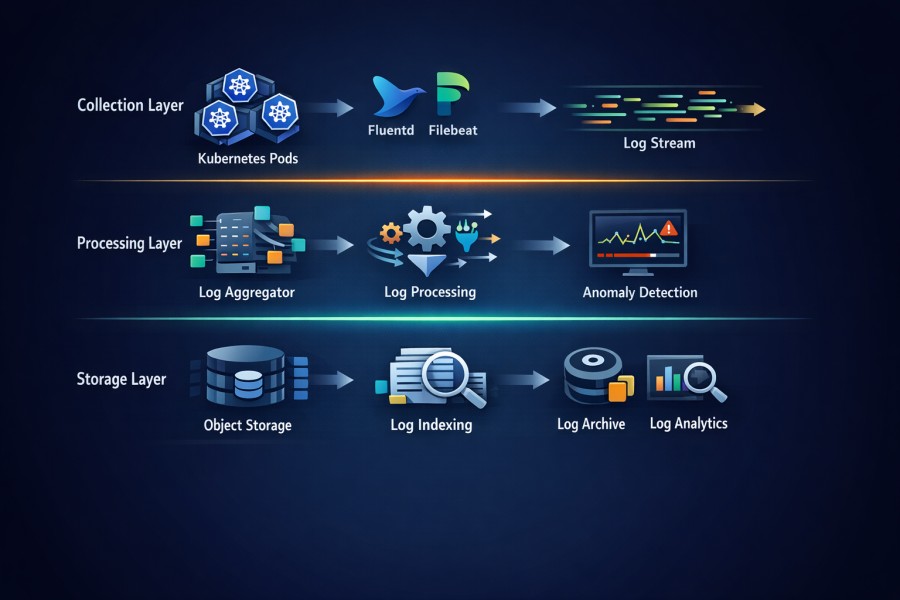
Many teams believe they have retention because logs show up in dashboards. That is temporary visibility, not retention. Real retention architecture ensures three things:
- Logs survive pod churn and node failure
- Searchable storage stays economically bound
- Archive storage remains retrievable and defensible
If any of those fail, retention fails. Retention architecture is about enforcing discipline automatically and validating that enforcement continuously. If your lifecycle policies are not monitored, they are assumptions.
Collection Layer
In Kubernetes, containers are disposable, but logs are not. Pods restart, nodes drain, and autoscaling replaces entire replica sets in minutes. If logs remain on the node disk, you are not retaining data.
- Most production clusters rely on DaemonSet-based collectors. They scale with nodes and centralize collection logic. They are efficient and operationally predictable.
- Sidecars provide tighter workload isolation, but they increase resource overhead and complexity. At scale, hundreds of sidecars amplify CPU usage and memory pressure. You feel that cost during traffic spikes.
The key question is whether your collection layer survives:
- Node replacement
- Burst scaling events
- Network partitions
If the collection drops logs during those moments, your retention policy becomes a document detached from reality.
Processing Layer
Every field you index becomes a liability. Kubernetes metadata is rich. Namespace, pod name, container ID, deployment version, and custom labels. Without discipline, cardinality explodes.
In systems like Elasticsearch or OpenSearch, high-cardinality fields increase heap usage and index size. You do not notice it immediately. You notice it when query latency rises and storage doubles. Mature teams filter aggressively before indexing:
- Drop redundant health checks
- Remove verbose debug entries in production
- Redact sensitive fields before they ever hit storage
Dynamic log level control matters more than most teams admit. If you cannot adjust verbosity without redeploying, you will either over-retain noise or under-retain signal. In addition, sampling must reflect architecture. High-frequency informational logs can be sampled. Authentication failures should never be sampled.
Storage Layer
Searchable storage and archival storage serve different purposes. Treating them the same is expensive. Indexed storage in Elasticsearch or OpenSearch delivers speed. It also consumes memory, CPU, and disk aggressively. Every additional day of indexed retention increases cluster pressure.
Loki shifts some economics by minimizing index footprint and storing bulk data in object storage. That reduces index strain but does not remove retention responsibility. Long-term archive in S3 or equivalent object storage lowers cost significantly. It increases retrieval latency. That is acceptable for compliance and historical review, but not for active incident response.
Experienced teams are very clear about these issues:
- Short indexed window for debugging in real time
- Longer archive window for proof and audit
Methods for Enforcing Retention
Elasticsearch and OpenSearch’s index lifecycle policies take care of rolling over and deleting automatically. Without them, indices accumulate silently. Object storage lifecycle rules transition data from hot storage to colder tiers and eventually delete it. Without review, the archive becomes indefinite storage.
Retention lock and immutability controls matter for regulated environments. PCI DSS Requirement 10 and similar frameworks expect audit logs to remain intact. Immutability prevents accidental or intentional tampering.
The most common failure seen over the years is neglect. Lifecycle policies get configured once. No one reviews them. Six months later, indexed retention has quietly expanded. Archive retrieval has never been tested. Costs climb. Audit readiness weakens.
Cost Optimization Strategies for Kubernetes Log Retention
Cost in Kubernetes logging explodes because teams index too much data for too long. Indexed storage is the most expensive tier in your pipeline. Every extra day in the searchable window multiplies the cost across shards, replicas, memory, and compute. Archive storage in S3 or similar object stores costs a fraction of indexed storage, but teams often treat both the same.
If you want cost control, you start at ingestion and index design.
Real-World Cost Impact Example
Consider a production cluster ingesting 200 GB of logs per day. That translates to roughly 6 TB per month. If you retain 30 days of fully indexed logs in Elasticsearch or OpenSearch, you are maintaining approximately 6 TB of searchable data at any time, excluding replicas and overhead. With one replica, that becomes 12 TB of indexed storage footprint.
Now extend indexed retention from 30 days to 60 days without adjusting architecture. You double-indexed storage pressure instantly. Query latency increases. Heap pressure rises. Hardware footprint grows. Compare that with archive storage in S3. Object storage costs per GB are significantly lower than indexed storage infrastructure costs. Even conservatively, indexed retention can cost two to three times more per GB when you account for compute, memory, and redundancy.
The financial lesson is simple. Every extra day in the indexed tier has a measurable monthly impact. Archive retention does not. Cost control begins with deciding how long logs truly need to remain searchable.
Ingestion Control Before Storage
The log that doesn’t get indexed is the cheapest one. DEBUG verbosity across all services is not often needed in production environments.
- Make sure that log levels are followed.
- Set INFO as the default.
- Only turn on DEBUG for a short time during controlled investigations.
- Get rid of libraries that make too much noise and log too much.
Many frameworks log routine health checks or retries of dependencies at a high rate. Before they get to indexed storage, filter out events that can’t be acted on. Stop keeping heartbeat logs that are the same over and over again and trace-level entries that don’t help with operations.
Think carefully about how you use structured logging. Structure helps querying, but unnecessary fields increase storage and indexing cost. Only capture metadata that improves investigation. If ingestion is not controlled, retention windows become irrelevant. You will overpay even with short retention.
Reduce Indexing Footprint
Kubernetes encourages rich labeling. Namespace, pod name, container ID, deployment hash, and custom annotations can explode the index size if mapped indiscriminately.
- Avoid dynamic label expansion. Do not index fields that change per request unless they are operationally necessary.
- Keep indexed retention and raw storage retention separate. You don’t have to index every field to store it. If you can, archive raw logs with as little indexing as possible.
High-cardinality fields use more memory and slow down performance in Elasticsearch and OpenSearch environments. In Loki environments, how you design labels has a direct effect on how well and how much it costs to run queries.
Continuous Cost Monitoring
Cost governance requires visibility and accountability. When teams treat log retention as an economic control system rather than a storage setting, cost becomes predictable. When they ignore ingestion and indexing discipline, storage pricing becomes irrelevant.
- Monitor ingestion volume daily. Sudden spikes often signal verbose logging after a deployment or misconfigured services.
- Alert on abnormal growth in indexed storage. If index size grows faster than log ingestion, the mapping or shard strategy may be flawed.
- Attribute cost by namespace or service. When teams see their own log footprint, behavior changes.
- Review retention drift quarterly. Indexed windows tend to expand quietly over time. Archive growth often goes unreviewed.
A Practical Retention Framework for Modern Clusters
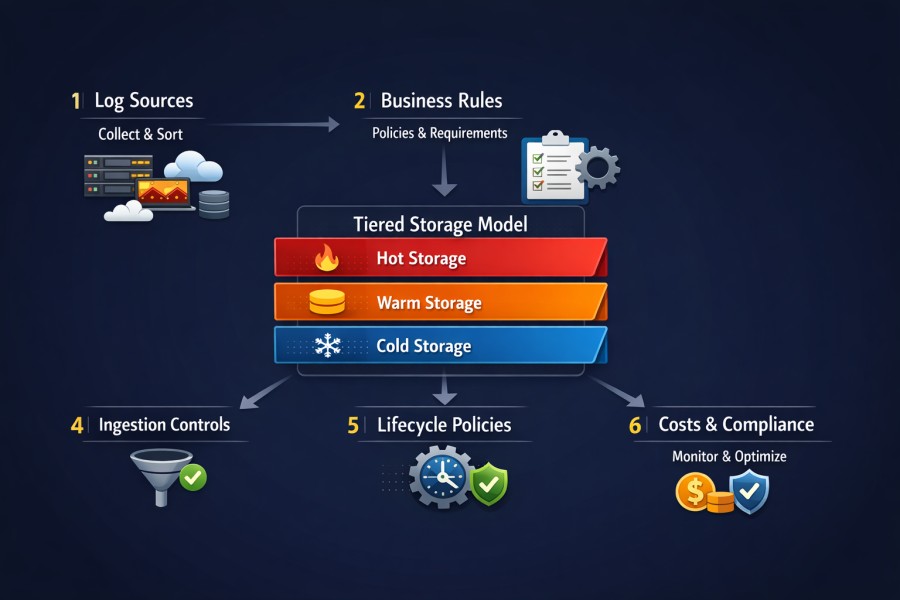
Retention works when it becomes a controlled system. Mature teams apply the same discipline to retention that they apply to security or reliability. The framework below reflects what holds up under scale and audit pressure.
Step 1: Make a list of log sources and sort them
Visibility is the first step in retention governance. Policies are random if there is no classification. So, make sure you understand these things first:
- Find all the sources, such as application workloads, Kubernetes control plane components, node logs, audit logs, and security systems.
- Connect each log source to revenue paths, authentication flows, payment systems, and internal tools.
- Sort logs into groups based on whether they are regulatory-critical, customer-impacting, operational, or diagnostic.
- Find out which services keep logs steady and which ones spike when autoscaling happens.
- Set up platform teams to enforce rules, service teams to keep logs in order, and compliance teams to make sure that rules are being followed.
Step 2: List the rules and requirements for the business
Retention must be in line with what is legal and what works. Make sure that searchable retention matches the real timelines for investigations. Also, take into account:
- 1-year audit trail requirements of PCI DSS
- Audit controls of HIPAA
- Monitoring requirements of SOC 2
- Storage limitation principles of GDPR
You can even set a time for deletion to stop and say who can do it. Data minimization means keeping only what is legally and operationally necessary. Write down how lowering searchable retention windows will affect the business.
Step 3: Design a tiered storage model
Costs should go up or down based on how much work is needed. And older logs don’t often need premium storage. The levels of storage should match the value of the investigation.
- Set the time period during which logs can be fully searched.
- Lower index pressure while keeping access open
- For compliance, keep long-term logs in object storage like S3.
- Give authentication and payment logs longer retention times and low-risk systems shorter ones.
To avoid fragmentation, use the same policy in all regions and clusters.
Step 4: Make sure ingestion controls are in place.
Before indexing, cost discipline begins. Every field that is indexed becomes a cost that happens over and over again. Ingestion control stops growth without sound.
Set the default to INFO in production and limit the use of DEBUG. To cut down on noise, get rid of health checks that happen over and over, and long framework logs.
At ingestion, get rid of any personal or payment information that isn’t needed. Take samples of repetitive informational logs, but keep security and failure events. Don’t index dynamic request identifiers or metadata that changes quickly.
Step 5: Set up automated lifecycle policies
Retention enforcement needs to be automated and controlled. Automation with supervision stops gaps in compliance and growth. Set up rollover and deletion policies in Elasticsearch or OpenSearch for the index lifecycle. Use S3 rules for moving and deleting archive tiers, and turn on retention lock when rules say that data cannot be able to be changed.
Use stricter retention policies in production than in development. Requirements for operational governance:
- Set rules for who can change lifecycle settings
- Get written permission for changes to retention
- Keep records of changes to the lifecycle configuration
- Check from time to time to make sure that lifecycle policies work as they should.
- Make sure that the documented retention matrix matches the technical lifecycle rules.
Step 6: Keep an eye on costs and compliance all the time.
Governance of retention is ongoing. Policies need to change on purpose as clusters grow and rules change. Keep an eye on the daily log volume and look for strange spikes.
- Separate the cost of indexed storage and archives by service or namespace.
- Check indexed retention windows every three months.
- Check the controls for restoring archives and making them unchangeable.
- Show leadership the current retention posture, cost trends, and how well the company follows the rules.
Strategic Role of Observability Platforms in Retention Governance
It is difficult to be consistent when logs, metrics, and traces are stored in different systems with different prices and default retention settings.
Retention Must Span All Signals
Investigations do not happen in isolation. Engineers move between logs, traces, and metrics in a single workflow. If logs expire before traces, you lose context. If traces are sampled while logs are complete, you lose correlation. If metrics are retained for a year but logs for two weeks, your historical visibility becomes uneven.
Mature teams align retention windows across signals intentionally. They define how long a full-fidelity context must exist. They do not let defaults decide that for them. When observability platforms expose cross-signal visibility, retention becomes measurable.
Cost Visibility Changes Behavior
Most cost overruns in logging are invisible until invoices arrive. If your platform does not show indexed storage growth separately from archive storage, you will not notice drift. If cost cannot be attributed by namespace or service, verbose teams will never adjust their logging habits.
When teams see that one service generates 40 percent of indexed volume, they fix it. When cost is abstract, it grows. Economic transparency is a governance control.
Sampling Is a Retention Decision
Sampling is often treated as a performance tuning knob. In reality, it is a financial and architectural control. If trace sampling removes 80 percent of spans but logs are retained at full fidelity, you may reduce one cost while increasing another. If you sample authentication failures, you create audit risk.
Sampling is about preserving the signal where it matters and reducing the noise where it does not. Experienced teams coordinate sampling with retention tiers. High-frequency informational events can be reduced. Security events remain complete. Trace sampling and log retention must support the same investigative window.
Deployment Model Shapes Retention Control
Retention strategy must reflect who controls the lifecycle engine. Self-hosted observability platforms provide full control over lifecycle policies, archive duration, and immutability enforcement.
SaaS platforms abstract infrastructure, but they often have retention tiers that are based on price. Those limits change how people act. Teams might shorten retention to keep costs down, not because the risk went down.
Pricing Models Affect Technical Architecture
Having different prices for logs, metrics, and traces makes the incentives wrong. It may seem cheaper for teams to aggressively cut back on log retention while leaving low-value telemetry alone.
Over time, the observability stack reflects the pricing model rather than operational need. A unified economic model encourages rational retention decisions. It allows organizations to ask a better question: how much historical context do we need, and at what cost?
Retention governance succeeds when observability platforms reinforce alignment across signals, cost visibility, and lifecycle enforcement.
Common Log Retention Mistakes We’ve Seen in Kubernetes Environments
Retention problems in Kubernetes mostly come from habits that seem harmless at a small scale and become expensive or risky at a cluster scale. Here are the patterns that surface repeatedly.
- Long-lived DEBUG logging: Teams enable DEBUG during an incident and never revert. Log volume quietly doubles. Indexed storage expands. Query performance degrades. Cost increases over several billing cycles before anyone traces it back to that configuration change.
- No cost attribution by namespace: Multiple teams share the same cluster, but log volume and indexed storage are not broken down per namespace or service. One noisy workload distorts overall cost. Platform teams respond with blanket retention reductions, which create investigative blind spots for everyone.
- Lifecycle policies configured once and forgotten: Index rollover and deletion rules are deployed during initial setup and never reviewed. Retention windows drift. Archive transitions misalign with policy. Automation continues to run, but no one validates whether it still matches documented requirements.
- Archive configured but never tested: Logs transition to object storage such as S3, and the bucket shows healthy size growth. Retrieval paths are never exercised under real conditions. During an audit or post-incident review, restore procedures are slow, incomplete, or undocumented.
- Retention equated with compliance: Organizations retain logs for a year and assume regulatory alignment. Frameworks such as PCI DSS, SOC 2, HIPAA, and GDPR require integrity controls, access governance, and documented enforcement. Duration alone does not provide defensibility.
None of these failures appear dramatic at first. They accumulate quietly until scale, incident pressure, or audit scrutiny exposes them.
How CubeAPM Handles Log Retention
Most retention strategies fail because the platform makes trade-offs invisible. Indexed storage grows quietly and cost and compliance drift apart. The archive also becomes disconnected from investigation workflows.
CubeAPM approaches retention as an architectural control. Searchable windows are bounded. Archive lives in infrastructure you control. Lifecycle enforcement follows policy. It results in predictable retention that scales with workload growth.
- Tiered retention without an index explosion: CubeAPM keeps searchable retention separate from long-term archive, so indexed storage doesn’t grow out of control. You can still search through logs completely within the indexed retention window you set. As data gets older, it moves from the expensive indexed tier to object storage that you control. This stops the common pattern of index clusters quietly growing every three months and forcing hardware scaling.
- Controlled search window: You can change how long searchable retention lasts based on real incident response timelines. You keep indexed logs for 14 or 30 days if your teams usually look into problems during that time. Older data is still in the archive, but it doesn’t use up expensive search infrastructure.
- Integration of archives that works well: Archive storage is stored in your own cloud account or infrastructure. Logs move to archive storage without needing to be indexed all the time or stored in expensive duplicate storage tiers. Long-term storage of archives doesn’t lead to proportional growth of the index because the archive storage is separate from the index infrastructure.
- Unified cost visibility: Logs, metrics, and traces all work in a predictable per-GB model. You can see retention decisions in terms of how much data they hold and how much storage they use, not just in terms of host counts or feature bundles. Before the cost goes up, teams can see how extending indexed retention affects the amount of storage space they need.
- Automated lifecycle enforcement: Instead of cleaning up manually, rollover, archive transition, and deletion follow set retention policies. The way things work over time matches the documented retention windows. This makes it less likely that the written policy and the actual data behavior will be different.
- Self-hosting: CubeAPM runs in your own cloud or on-premises environment, giving you control over your data. Your controlled boundary does not allow log data to leave. This meets regulatory requirements for residency, auditability, and internal security review without giving up control of retention to an outside SaaS provider.
- Custom retention flexibility: Depending on the service, namespace, or compliance requirement, retention can be different. Authentication systems can keep archives that are longer and can’t be changed. Shorter indexed windows can be used for internal diagnostics. Retention strategy is based on business risk, not on vendor tier limits.
Conclusion
In Kubernetes environments, workloads scale dynamically and telemetry grows rapidly. Without clear controls, log retention expands quietly in both cost and risk. Instead of becoming a debugging aid, it becomes an uncontrolled storage burden.
Log retention helps teams decide if they can investigate incidents effectively and meet compliance obligations with confidence. So, retention windows, lifecycle enforcement, and immutability controls must be defined intentionally.
Mature teams must treat retention as part of system architecture. They should align searchable windows with real investigation timelines, archive with regulatory requirements, and automate lifecycle policies to prevent drift. When governance and architecture move together, retention becomes predictable.
Disclaimer: The information in this article reflects the latest details available at the time of publication and may change as technologies and products evolve.
Frequently Asked Questions (FAQs)
1. How long should Kubernetes logs be retained in production environments?
Indexed logs should typically be retained for 7 to 30 days, depending on how long teams realistically investigate incidents. Archive retention should align with regulatory requirements, often 6 to 12 months or longer. The key is separating short-term searchable retention from long-term compliance storage.
2. What is the difference between index retention and object storage retention?
Index retention keeps logs in searchable systems like Elasticsearch, OpenSearch, or Loki for active troubleshooting. Object storage retention keeps older logs in lower-cost storage such as S3 for compliance and audit purposes. Indexed storage supports investigations; object storage supports long-term evidence.
3. How can logs from short-lived pods be reliably retained?
Logs must be externalized immediately using cluster-level collectors such as DaemonSet-based agents or OpenTelemetry pipelines. Relying on pod or node disk is unreliable because short-lived pods can terminate before logs are preserved.
4. Can object storage alone satisfy compliance requirements?
Object storage can support compliance if paired with lifecycle policies, immutability controls, and documented governance. Simply storing logs is not enough. Organizations must demonstrate retention enforcement, access control, and auditability.
5. How do you reduce Kubernetes log storage costs without sacrificing visibility?
Focus on ingestion discipline and index control. Enforce appropriate log levels, filter non-actionable data, manage label cardinality, and limit indexed retention to the operational window. Archive older logs to lower-cost storage instead of keeping everything searchable.