









The main difference between Grafana, Better Stack, and CubeAPM lies in how they handle observability at scale, including pricing approach, and deployment options.
Grafana and Better Stack are commonly used for monitoring and observability, but costs and operational effort often increase as telemetry grows. CubeAPM instead offers a unified, OpenTelemetry-native platform with ingestion-based pricing, managed self-hosting, and full data control.
In this guide, we compare Grafana vs Better Stack vs CubeAPM across pricing, deployment models, sampling strategies, data retention, support response times, and overall operational complexity.
Grafana vs Better Stack vs CubeAPM Comparison
| Features | CubeAPM | Grafana | Better Stack |
| Known For | Unified OpenTelemetry observability. | Visualization layer for external backends. | SaaS monitoring focused on uptime. |
| Multi-Agent Support | Yes (OTel, New Relic, Datadog) | Partial (OpenTelemetry) | Partial (OpenTelemetry) |
| MELT Support | Full MELT | Full MELT | Full MELT |
| Setup | Self-hosted but vendor-managed | SaaS & Self-hosted | SaaS only |
| Pricing | Ingestion-based pricing of $0.15/GB | Logs: $0.50/GB Traces:$0.50/GB APM:$0.04/host/hour | Free Tier: 30 days APM: $29/month Logs: $0.10/GB |
| Sampling Strategy | Smart sampling | Tail + Head | Head + Tail + Log sampling |
| Log Retention | Infinite Retention | Free Plan: 15-day Pro Plan: 30-day | Logs: 30 days Metrics: 13 months |
| Support TAT | <10 min avg TAT | 2hrs to 6hrs | hrs to days |
Grafana vs BetterStack vs CubeAPM: Feature-by-Feature Breakdown
Multi-Agent Support
CubeAPM: Offers true multi-agent compatibility, supporting OpenTelemetry, Prometheus, Datadog, New Relic, and Elastic agents. This lets teams migrate without re-instrumenting code and unify telemetry from mixed environments under one backend.
Grafana: Offers broad plugin and exporter flexibility but relies mainly on OpenTelemetry and Prometheus integrations. It can connect to other data sources through community exporters, yet it does not support vendor agents like New Relic and Datadog, as it does with CubeAPM.
Better Stack: Supports only OpenTelemetry Collectors and SDKs for data ingestion. While setup is simple, it doesn’t qualify as multi-agent since it can’t directly receive data from other vendor agents like New Relic, Datadog.
MELT Coverage
CubeAPM: Provides complete MELT visibility — Metrics, Events, Logs, and Traces — with APM, infrastructure, RUM, and synthetic monitoring in one platform. This eliminates tool sprawl and improves correlation across telemetry types.
Grafana: Achieves MELT coverage using multiple LGTM components (Loki, Grafana, Tempo, Mimir). The stack is powerful but requires configuration, adding operational overhead.
Better Stack: Provides full MELT coverage through a managed telemetry stack, ingesting metrics, logs, and traces from multiple agents and generating events from alerts and incidents, without requiring users to manage the backend.
Deployment Options

CubeAPM: Supports SaaS and Self-Host/BYOC deployment, ensuring data stays in your own cloud and eliminating egress charges. It’s designed for teams that prioritize compliance and data control.
Grafana: provides both managed Grafana Cloud and open-source self-hosting. Cloud simplifies setup, while self-hosted gives flexibility at the cost of maintenance overhead.
Better Stack: Better Stack operates as a SaaS-only platform, with telemetry data hosted outside the customer’s environment. While this reduces setup and maintenance effort, it may not align with strict data residency or compliance needs in regulated sectors.
Pricing and Cost for Different Team Sizes
*Disclaimer: Pricing comparisons are based on standardized Small/Medium/Large team profiles defined in our internal benchmarking sheet. Actual costs may vary by usage, region, and plan. Please verify current pricing with each vendor.
An APM host is a host that is actively generating trace data, and an Infra host is any physical or virtual OS instance that you monitor with any observability tool.
Cost for Small Teams (~30 hosts)
- CubeAPM: $2,080/month
- Grafana: $3,870/month
- Better Stack: $5,723/month
Cost for Mid-Sized Teams (~125 hosts)
- CubeAPM: $7,200/month
- Grafana: $11,875/month
- Better Stack: $20,550/month
Cost for Large Teams (~250 hosts)
- CubeAPM: $15,200/month
- Grafana: $26,750/month
- Better Stack: $43,350/month
CubeAPM: Cost for Small, Medium, and Large Teams
CubeAPM keeps pricing simple — $0.15 per GB of ingested data covering logs, metrics, traces, and events. There are no hidden fees for users, infrastructure, or retention. This predictable structure makes CubeAPM ideal for engineering teams that want cost stability without paying extra for scale, data localization, or compliance.
CubeAPM Pricing
- Pricing: $0.15/GB ingested
Estimated Monthly Costs
- Small (~30 hosts): $2,080
- Mid (~125 hosts): $7,200
- Large (~250 hosts): $15,200
Organizations switching from Grafana Cloud or Better Stack often save up to 70% on observability costs while maintaining full ownership of their telemetry data.
Grafana Cloud: Cost for Small, Medium, and Large Teams
Grafana follows a modular pricing model where logs, metrics, and traces are billed as separate services. While this offers flexibility to scale individual components, costs can rise quickly as data volumes grow across multiple telemetry types.
Grafana Cloud Pricing
- Logs: $0.50/GB ingested
- Traces: $0.50/GB ingested
- Base Plan: $19/month (Pro)
Estimated Monthly Costs
- Small (~30 hosts): $3,870
- Mid (~125 hosts): $11,875
- Large (~250 hosts): $26,750
Better Stack: Cost for Small, Medium, and Large Teams
Better Stack uses a bundle-based model that combines logs, traces, and metrics with optional incident management. It’s simple for small teams but scales unevenly, as retention and data overages add up at higher ingest volumes.
Better Stack Pricing
- Logs/Traces: $0.10/GB ingest
- Retention: $0.05/GB-month
- Bundles: Start at $30/month
Estimated Monthly Costs
- Small (~30 hosts): $5,723
- Mid (~125 hosts): $20,550
- Large (~250 hosts): $43,350
While Better Stack offers a modern incident response workflow, its cost can become high as data retention and bundled limits expand with team size.
Sampling Strategy
CubeAPM uses Smart Sampling (≈95% compression), dynamically retaining latency and error-heavy traces while reducing noise. This keeps high-value data accessible without driving up storage or ingestion cost.
Grafana: Grafana supports both head-based sampling, where traces are sampled at the start of a request, and tail-based sampling, where complete traces are evaluated to retain higher-value data such as errors or slow requests.
Better Stack: Supports head-based and tail-based sampling for traces, along with log sampling to help control data volume while preserving high-value telemetry.
Data Retention

CubeAPM: Offers unlimited retention, with all data stored inside the user’s cloud. This supports compliance, auditability, and long-term analytics without egress cost.
Grafana: Retains data for 14 days on Free, 30 days on Pro, and longer durations under Enterprise plans. Extending retention often increases storage cost per module.
Better Stack: includes 30-day log retention and 13-month metric retention in bundles, with optional S3 storage for extended history. It’s convenient but adds recurring retention fees.
Support & TAT
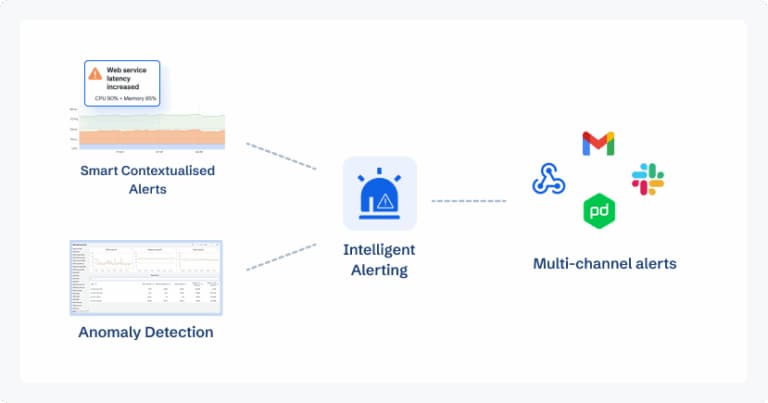
CubeAPM: Provides direct Slack and WhatsApp access to core engineers with response times measured in minutes. This fast feedback loop helps teams resolve performance issues before they escalate.
Grafana: Offers community and email, and Slack support. Response times vary by plan. Paid plans provide 24/7 support with initial response targets of about 2 business hours for P1 issues, 4 business hours for P2, and 6 business hours for P3. Enterprise plans offer faster SLAs, with P1 responses as low as 30 minutes.
Better Stack: Integrates support directly into its incident workflows via Slack and Teams. The TAT for Better Stack varies, typically within minutes to days.
Known For
CubeAPM is known for OpenTelemetry-native architecture, predictable pricing, and complete data control through BYOC deployment. It’s favoured by enterprises seeking unified observability with compliance and cost transparency.
Grafana stands out for its visualization depth and plugin ecosystem, ideal for teams already managing Prometheus or OTel pipelines. However, achieving full MELT coverage requires multiple paid modules.
Better Stack focuses on modern incident response with lightweight log and trace visibility. It suits startups or small teams that value simplicity over deep custom observability.
Which Tool Is Best for You? Why Brands Choose CubeAPM

CubeAPM is built for teams that need deep, OpenTelemetry-native observability with complete ownership of their data and a pricing model that never surprises. It brings together Metrics, Events, Logs, and Traces (MELT) under one system that covers APM, infrastructure, RUM, and synthetic monitoring — replacing fragmented, multi-vendor setups with one unified platform.
Benefits of Choosing CubeAPM
- Predictable pricing: A single, transparent rate of $0.15 per GB for all telemetry types — logs, traces, metrics, and events.
- Smart sampling efficiency: CubeAPM’s adaptive sampling filters out low-value data and keeps what matters most, achieving up to 95% compression without losing diagnostic detail.
- End-to-end MELT observability: View application performance, infrastructure health, and real user experience in one correlated interface for faster troubleshooting.
- Bring Your Own Cloud (BYOC): Host CubeAPM within your own cloud or on-prem setup to retain full data sovereignty and meet regional compliance requirements.
- Unlimited retention: Store observability data as long as needed for audits, SLA tracking, and long-term performance analysis without additional storage tiers.
- Broad agent compatibility: Works natively with OpenTelemetry, Prometheus, Datadog, and New Relic agents, making migration seamless across hybrid environments.
- API-first design: Access or automate any telemetry stream through open APIs — flexible, secure, and integration-ready.
- Designed for scale: A lightweight ingestion layer and high-compression pipeline keep performance consistent and costs predictable — even at multi-terabyte data volumes.
Grafana vs Better Stack vs CubeAPM: Use Cases
Each platform targets different stages of observability maturity. Here’s when teams typically choose Grafana, Better Stack, or CubeAPM, based on environment scale, data control needs, and pricing flexibility.
Choose CubeAPM if:
You need end-to-end observability (MELT) across APM, infrastructure, logs, RUM, and synthetic monitoring — all within one OpenTelemetry-native platform. CubeAPM fits mid-size to enterprise teams that demand predictable pricing ($0.15/GB), smart sampling (~95% compression), and zero egress costs with full data ownership.
It’s the best choice for organizations seeking compliance, scalability, and long-term cost control, while eliminating the need to stitch multiple observability tools together.
Choose Grafana if:
You’re already invested in Prometheus or OpenTelemetry pipelines and need advanced dashboarding and visualization. Grafana Cloud works well for SRE and DevOps teams that monitor performance metrics and visualize complex data sources.
It’s best for organizations that value custom dashboards, modular flexibility, and plugin support, but can handle per-module pricing and configuration overhead at larger scales.
Choose Better Stack if:
You want a lightweight, incident-focused observability suite that combines logging, tracing, and uptime monitoring. Better Stack is ideal for startups and agile DevOps teams that need quick setup, modern UI, and integrated alerting via Slack or Teams.
However, its bundle-based pricing and limited self-hosting make it less suited for enterprises with strict data residency or compliance requirements.
Conclusion
Grafana, Better Stack, and CubeAPM each solve observability in their own way. Grafana focuses on dashboards and visualization flexibility, Better Stack simplifies uptime and incident management, while CubeAPM unifies the entire MELT stack for end-to-end visibility.
As data volumes grow, modular and per-stream pricing models quickly become unpredictable. Teams are moving toward unified, OpenTelemetry-based platforms that deliver transparency, control, and scalability — all without vendor lock-in.
CubeAPM combines the advantages of both approaches — deep APM visibility, infrastructure insights, real-user monitoring, and synthetics — all within a single backend. With predictable $0.15/GB pricing, smart sampling, and self-host or BYOC deployment, it’s the most balanced choice for teams seeking observability that’s powerful, compliant, and cost-stable at scale.
Disclaimer: The information in this article reflects the latest details available at the time of publication and may change as technologies and products evolve.
FAQs
1. Is CubeAPM a better alternative to Grafana and Better Stack
CubeAPM is a strong alternative for teams that want logs, metrics, and traces in one platform without managing multiple components or relying on SaaS-only deployments. It is especially suited for teams prioritizing cost predictability and data control.
2. Which option is easiest to operate at scale
Better Stack minimizes setup with a SaaS model, while Grafana can become operationally complex due to multiple backends. CubeAPM reduces long-term effort by managing the full observability stack as a single platform inside the customer’s environment
3. Which platform is best for OpenTelemetry-first teams
CubeAPM is built natively on OpenTelemetry, making it ideal for teams standardizing on OTEL.
4. Which alternative is best for full-stack observability use cases
CubeAPM is better suited for full-stack observability because it unifies logs, metrics, traces, and events in a single platform.
5. How do deployment and data residency options differ
Grafana supports both cloud and self-hosted deployments, while Better Stack is SaaS-only. CubeAPM runs inside the customer’s own cloud or on-prem environment, giving full control over data residency and retention