









The main difference between Dynatrace, Splunk, and CubeAPM is that Dynatrace is an AI-driven full-stack observability platform built around automatic instrumentation and topology mapping, Splunk is a data analytics platform focused on large-scale log indexing and search across observability and security data, and CubeAPM is an OpenTelemetry-native observability backend designed for unified MELT correlation with predictable ingestion-based pricing.
As systems grow, feature parity becomes less of a differentiator than how pricing models behave under real production load. Once telemetry volume increases beyond early-stage usage, especially in environments with sustained traffic, high-cardinality logs, and expanding microservices, observability spend shifts from a relatively stable tooling line item to a variable operational expense that requires forecasting and control.
In this guide, we compare Dynatrace vs Splunk vs CubeAPM across architecture, MELT coverage, OpenTelemetry support, deployment model, sampling strategy, retention, pricing behavior, and support responsiveness.
Dynatrace vs Splunk vs CubeAPM: Comparison Table
The comparisons below reflect behavior observed from public documentation and common production usage patterns. Pricing, sampling, and retention characteristics can change depending on workload size, data shape, and operational configuration.
| Features | CubeAPM | Dynatrace | Splunk |
| Known for | Unified, OpenTelemetry-native observability with predictable cost and full data control | AI-driven full-stack observability with automatic discovery and Smartscape topology | Enterprise-grade analytics across logs, observability, and security |
| Multi-Agent Support | Yes (OTel, New Relic, Datadog, Elastic) | Limited (OpenTelemetry,OneAgent SDK) | Broad (OpenTelemetry, Splunk Forwarder, custom agents, third-party integrations |
| MELT Support | Full MELT | Full MELT | Full MELT |
| Setup | Self-hosted but vendor-managed | SaaS & Self-hosted | SaaS & Self-hosted |
| Pricing | Ingestion-based pricing of $0.15/GB | Infra: $29 /mo per host* Full-Stack: $58/mo/ 8 GiB host* | Infra: $15 per host/month App & Infra: $60 per host/month End-to-End: $75 per host/month |
| Sampling Strategy | Smart sampling (95% compression) | Head + Tail + adaptive traffic management + partial trace sampling | Tail + Head-based + probabilistic sampling |
| Log Retention | Infinite Retention | Log monitoring: 35 days | Usage Data: 13 months Traces: 8 days |
| Support TAT | < 10 minutes | 30 minutes to 4 days | P1: 30 minutesP4: 1 business day |
Dynatrace vs Splunk vs CubeAPM: Feature-by-Feature Breakdown
Known for
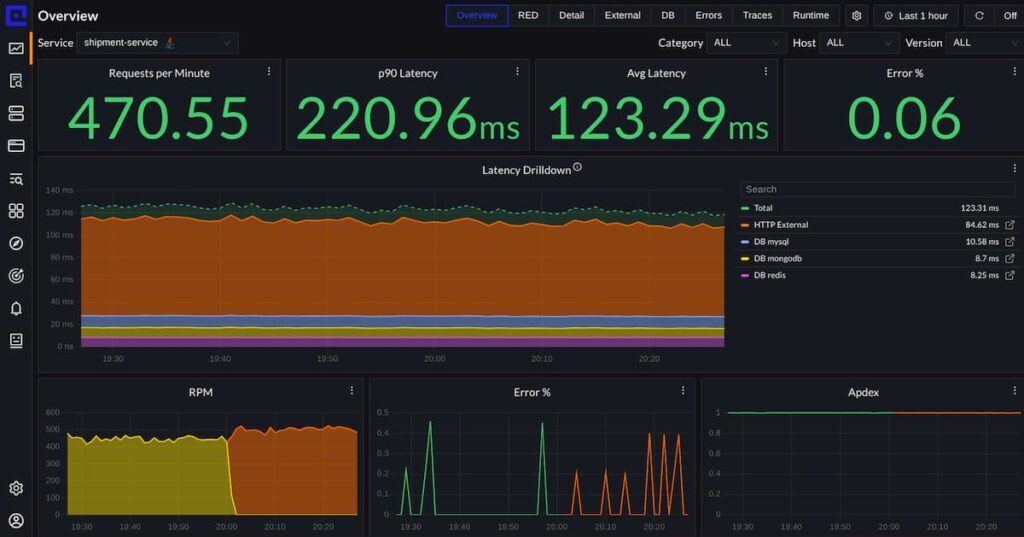
CubeAPM: Known for OpenTelemetry-native observability with predictable ingestion-based pricing and centralized telemetry control. CubeAPM is designed around unified MELT correlation under consistent OpenTelemetry semantics, allowing teams to manage sampling, retention, and ingestion behavior from a single backend. It is particularly aligned with Kubernetes-heavy and multi-cloud environments where cost predictability and signal consistency matter at scale.
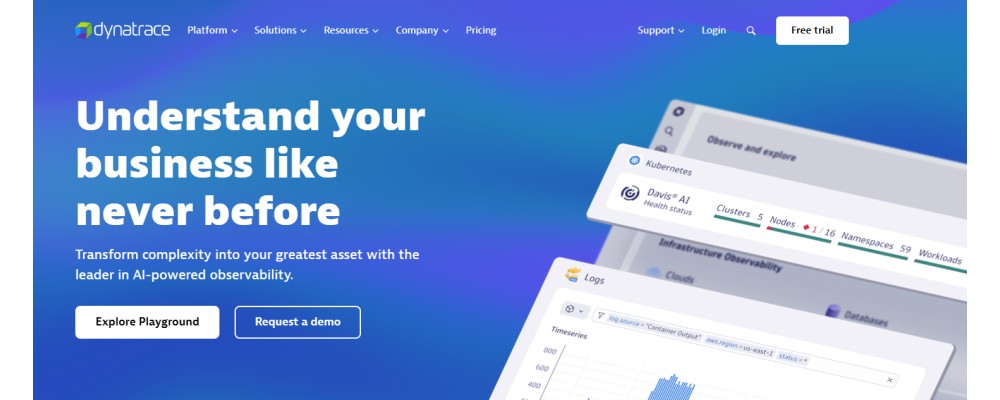
Dynatrace: Known for enterprise-grade full-stack observability with automatic instrumentation and topology-aware analytics. Its OneAgent automatically discovers services, infrastructure, and dependencies, building a real-time map of system relationships that supports AI-assisted root cause analysis in complex distributed environments. This makes it especially suited for large enterprises that want automated visibility without manually stitching together telemetry across layers.
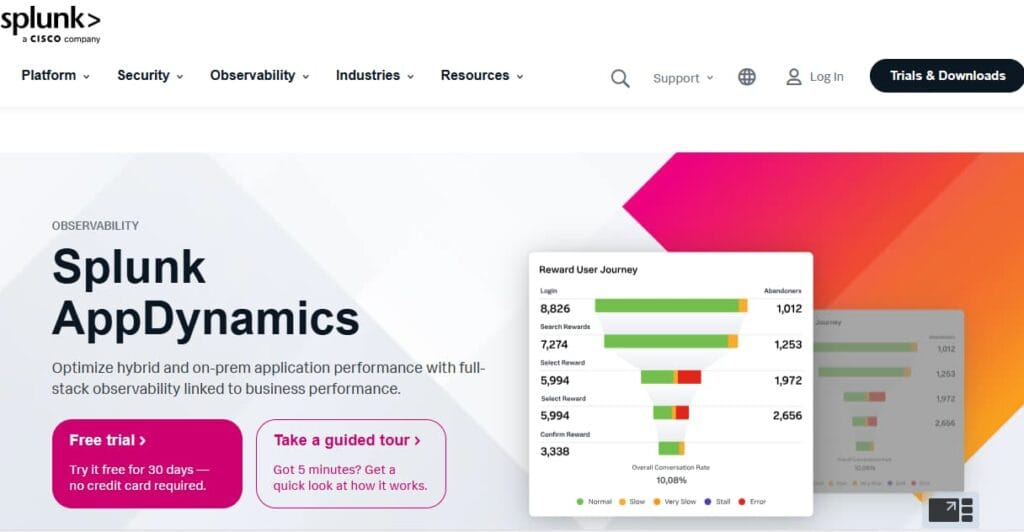
Splunk: Known for large-scale data indexing and search across logs, observability signals, and security telemetry. Splunk’s strength lies in flexible querying and correlation across massive data volumes, making it popular in organizations where operational monitoring and security analytics share a common data platform. Its architecture is particularly strong in log-centric investigations where deep historical search and custom analytics workflows are required.
Multi-Agent Support
CubeAPM: Supports native telemetry from OpenTelemetry SDKs and collectors as the primary ingestion path. It can also ingest data forwarded through sidecar or host agents that emit OpenTelemetry-compatible signals, enabling telemetry from multiple sources to flow into a unified backend model without proprietary lock-in.
Dynatrace: Supports telemetry ingestion from multiple agent types. Its OneAgent provides automatic instrumentation across applications and infrastructure, while the platform also accepts OpenTelemetry-formatted metrics, logs, and traces via the OpenTelemetry ingestion framework. Prometheus-formatted metrics can be ingested directly using Dynatrace’s Prometheus integration, allowing Prometheus exporters to feed into the observability pipeline without requiring OneAgent instrumentation for every target.
Splunk: Supports multiple ingestion methods for metrics, logs, and traces. In addition to the Splunk Universal Forwarder, HTTP Event Collector, and native SDKs, Splunk has documented support for the OpenTelemetry Collector to receive and normalize telemetry. Splunk also offers direct Prometheus integration, enabling Prometheus-style metrics to be collected and forwarded into the Splunk observability ecosystem alongside other signal streams.
MELT Support (Metrics, Events, Logs, Traces)
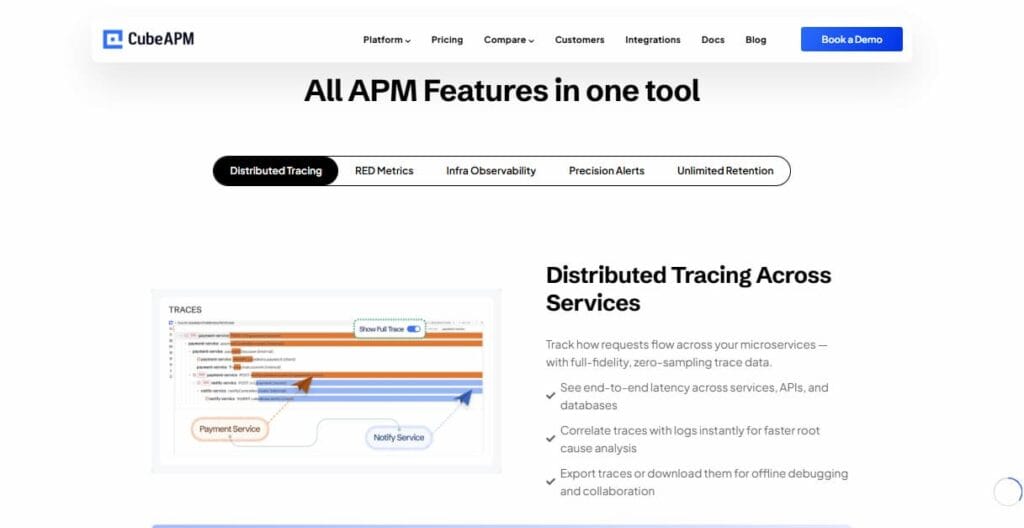
CubeAPM: Provides unified support for metrics, events, logs, and traces under a single OpenTelemetry-native backend. All signals share consistent resource attributes and trace context, allowing navigation from infrastructure metrics to application traces and correlated logs without switching data models. Because telemetry is processed under common OTel semantics, cross-signal correlation does not depend on separate indexing systems or proprietary schemas.
Dynatrace: Delivers full MELT coverage across infrastructure, applications, logs, user experience, and distributed tracing. Metrics, logs, and traces are automatically correlated through Dynatrace’s topology model, which maps services, processes, containers, and hosts in real time. Events such as deployments, configuration changes, and anomalies are integrated into the same analytical context to support root cause workflows.
Splunk: Supports metrics, events, logs, and traces across its platform. Log and event data are processed through Splunk’s data ingestion and search architecture, while metrics and traces are supported through Splunk Observability capabilities built around streaming telemetry analytics. Cross-signal correlation is enabled through dashboards, trace-log linking, and shared metadata, allowing teams to investigate issues across different telemetry types within the broader Splunk ecosystem.
Deployment Model
CubeAPM: Offers a self-hosted deployment that runs inside the customer’s infrastructure while being vendor-managed. The platform is deployed within the customer’s VPC or on-prem environment, giving full control over data residency and storage location, while CubeAPM manages updates, scaling, and operational maintenance. This model combines infrastructure ownership with reduced operational overhead.
Dynatrace: Provides both SaaS and self-hosted options. Dynatrace SaaS is fully operated by Dynatrace, while Dynatrace Managed allows deployment within customer-controlled infrastructure, including on-premises or private cloud environments. This enables organizations to choose between fully managed delivery and environment-level data control.
Splunk: Splunk: Offers both SaaS and self-hosted deployment models. Splunk Cloud Platform is delivered as a fully managed SaaS service. Splunk Enterprise is the self-hostedversion installed and managed on customer infrastructure or in customer-controlled cloud environments. In the self-hosted option, the organization is responsible for hardware provisioning, installation, upgrades, security patches, backup management, and scaling, which provides full control but requires dedicated operational resources.
Pricing: Approximate Cost for Small, Mid-Sized & Large Teams
*All pricing comparisons are calculated using standardized Small/Medium/Large team profiles defined in our internal benchmarking sheet, based on fixed log, metrics, trace, and retention assumptions. Actual pricing may vary by usage, region, and plan structure. Please confirm current pricing with each vendor.
*An APM host is a host that is actively generating trace data, and an Infra host is any physical or virtual OS instance that you monitor with any observability tool.
Below is a cost comparison for small, mid-sized, and large teams.
| Approx. Cost for Teams | Small (~30 APM Hosts) | Mid-sized (~125 APM Hosts) | Large (~250 APM Hosts) |
| CubeAPM | $2,080 | $7,200 | $15,200 |
| Dynatrace | $7,740 | $21,850 | $46,000 |
| Splunk | $2,290 | $8,625 | $17,750 |
What This Comparison Reveals at Scale
At small team sizes, cost differences are noticeable but rarely disruptive. Infrastructure footprints are limited, telemetry volume is manageable, and observability scope is typically focused on core services. At this stage, platform familiarity and deployment preference often weigh as heavily as pricing structure.
As environments move into mid-sized territory, pricing architecture begins to compound. Host-based licensing models scale with infrastructure growth, ingestion-based models scale with telemetry volume, and log-heavy workloads can materially shift total spend. Kubernetes expansion, higher trace depth, and increasing log retention begin to stress forecasting models.
At large scale, the gap becomes structural rather than incremental. When clusters autoscale, microservices multiply, and trace fan-out increases across distributed systems, pricing behavior is amplified. The difference is no longer just feature access but how predictably cost scales with workload shape. Platforms tied to host units grow with infrastructure count, while ingestion-based models grow with data generation patterns.
The key takeaway is that observability cost is not truly tested at onboarding. It is tested when telemetry volume, service count, and traffic intensity expand simultaneously. At that point, the pricing model itself becomes part of the architectural decision.
CubeAPM: Cost for Small, Medium, and Large Teams
CubeAPM follows an ingestion-based pricing structure, where observability spend is directly tied to the volume of telemetry processed rather than the number of hosts or feature tiers enabled. This approach aligns cost with actual data generation patterns, which becomes increasingly relevant in Kubernetes and autoscaling environments where host counts can fluctuate frequently.
Pricing :
- Predictable pricing of $0.15 per GB ingested
Using standardized production workload assumptions across comparable environments, estimated monthly costs typically fall within the following ranges:
- Small teams (~30 APM hosts): ~ $2,080
- Mid-sized teams (~125 APM hosts): ~ $7,200
- Large teams (~250 APM hosts): ~ $15,200
As environments grow, total spend is primarily influenced by telemetry architecture decisions such as log volume, trace sampling policies, and retention configuration. Because pricing scales with ingestion rather than infrastructure units, it makes financial forecasting more closely aligned with traffic patterns and data design rather than raw host count growth.
Dynatrace: Cost for Small, Medium, and Large Teams
Dynatrace uses a host-based pricing structure. Licensing is tied to monitored host units, with different rates depending on whether infrastructure-only monitoring or full-stack observability is enabled. Because pricing scales with host capacity, both the number of instances and their size influence total spend.
Pricing model:
- Infrastructure: $29 /mo per host
- Full-Stack: $58/mo per 8 GiB host
Based on standardized workload assumptions across comparable production environments, estimated monthly costs typically align with the following ranges:
- Small teams (~30 APM hosts): ~ $7,740
- Mid-sized teams (~125 APM hosts): ~ $21,850
- Large teams (~250 APM hosts): ~ $46,000
As environments expand, total spend grows alongside infrastructure footprint. In Kubernetes or autoscaling setups, increases in host count, memory allocation, or environment duplication directly influence cost. Cost forecasting therefore depends heavily on infrastructure growth patterns in addition to telemetry depth.
For a live breakdown of how Dynatrace pricing scales based on your infrastructure, telemetry volume, and log usage, explore our detailed Dynatrace pricing calculator to model real-world costs.
Splunk: Cost for Small, Medium, and Large Teams
Splunk’s observability pricing in this comparison is structured around a host-based model, where cost scales with the number of monitored hosts and the selected monitoring tier. Different capability bundles carry different per-host rates depending on the level of visibility enabled across infrastructure and applications.
Pricing model:
- Infrastructure Monitoring: $15 per host/month
- App & Infrastructure Monitoring: $60 per host/month
- End-to-End Monitoring: $75 per host/month
Using standardized workload assumptions across comparable production environments, estimated monthly costs typically align with:
- Small teams (~30 APM hosts): ~ $2,290
- Mid-sized teams (~125 APM hosts): ~ $8,625
- Large teams (~250 APM hosts): ~ $17,750
As environments grow, total spend increases with monitored host count and selected capability tier. Infrastructure expansion, broader application coverage, and deeper visibility across services directly influence overall cost.
Sampling Strategy
CubeAPM: Uses Smart Sampling, a context-aware, real-time sampling approach designed to retain high-value traces rather than applying fixed percentage quotas. Instead of “collect everything,” Smart sampling evaluates signals such as latency spikes, rising error rates, and anomalous behavior, prioritizing traces that reflect degradation or performance impact. Lower-value traffic is selectively reduced to control ingestion volume. Because sampling is centrally managed at the backend, policies can be adjusted without redeploying instrumentation, allowing teams to balance visibility and predictable spend while preserving critical incident context.
Dynatrace: Dynatrace supports multiple sampling approaches for distributed tracing. Standard options include head-based sampling (making decisions at trace start) and tail-based sampling (retaining traces based on post-completion conditions). Dynatrace also offers adaptive traffic management to adjust capture rates dynamically during load fluctuations. In addition, Dynatrace’s partial trace sampling approach focuses on retaining key spans within traces while reducing overall trace size, helping balance trace fidelity and data volume. This layered sampling strategy gives teams flexibility to capture detailed diagnostics under high load without ingesting full trace payloads for every transaction.
Splunk: Supports head-based, tail-based, and probabilistic sampling through its OpenTelemetry Collector distribution and ingestion pipeline configuration. Sampling policies can be defined to retain traces based on conditions such as error status or applied as probabilistic filters to manage volume. This allows teams to tune data fidelity and ingestion behavior according to workload scale and cost objectives.
Data Retention
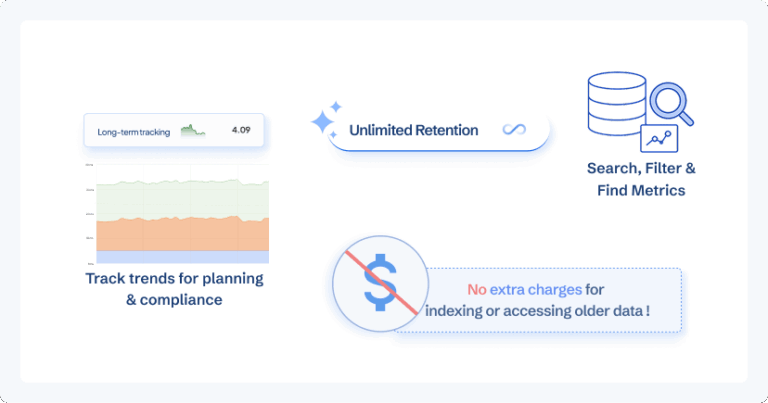
CubeAPM: Provides unlimited retention across logs, metrics, and traces. Retention policies are not restricted by predefined vendor expiration windows and can be aligned with internal compliance, forensic investigation, or historical analysis requirements. Because the platform runs in customer-controlled infrastructure, storage duration is governed by organizational policy and capacity planning rather than signal-specific platform caps. This allows teams to maintain consistent retention across telemetry types without switching between retention tiers.
Dynatrace: Retention varies by data type and storage model. For example, Log Monitoring Classic retains logs for 35 days, while Metrics powered by Grail retain data for 15 months (with Metrics Classic supporting up to 5 years depending on aggregation level). Distributed tracing retention differs by mode, with Classic traces retained for 10 days. Retention policies are therefore signal-specific and bounded by configuration and licensing tier rather than unlimited by default.
Splunk: Applies retention limits based on telemetry type and configuration. Infrastructure metrics are typically retained for up to 13 months depending on resolution level, while APM trace retention is shorter, with default trace retention around 8 days. Log data ingested into Observability Cloud also follows time-bound retention unless archived to external storage. Organizations requiring extended historical visibility often integrate additional storage layers or archival strategies beyond the platform’s default observability retention windows.
Support Channels & Response Time (TAT)
CubeAPM: Provides support through Slack and email, with direct access to engineering-led assistance. For production-impacting incidents, typical response time is under 10 minutes. Support is not segmented across multiple SLA tiers, allowing teams to escalate issues quickly without navigating severity-based gatekeeping.
Dynatrace: Provides support through its web portal, email, and enterprise collaboration channels depending on plan. For Severity 1 (Critical) issues, initial response time is 4 business hours under Standard Support and 30 minutes under Enterprise Support. For lower-severity issues such as Severity 3 (Medium) and Severity 4 (Low), response times range from 2 to 4 business days under Standard Support and 1 to 2 business days under Enterprise Support. Response commitments vary based on support tier and severity classification.
Splunk: Provides support through its support portal, email, and phone escalation for critical cases. For P1 (Critical production impact) issues, initial response time is 2 hours under Standard Support and 30 minutes under Premium/Enterprise Support. For lower-priority cases such as P3 and P4 issues, response times extend to business-day-based targets depending on the contracted support program. SLA guarantees are tied to severity level and selected support tier.
How Teams Evaluate These Platforms at Scale
In early stages, evaluation often revolves around feature breadth: tracing depth, log search, alerting capabilities, and integrations. At scale, the focus shifts from features to behavior under sustained production load. Teams begin asking how the platform performs when service count doubles, when clusters autoscale aggressively, or when telemetry volume spikes during incidents.
Cost modeling becomes central to the evaluation. Host-based licensing grows with infrastructure footprint, while ingestion-based pricing grows with telemetry volume. As environments expand across regions and microservices increase trace fan-out, pricing structure influences long-term budgeting more than entry-level feature comparisons. Forecasting accuracy becomes as important as raw functionality.
Operational responsibility is another deciding factor. Self-hosted deployments require internal ownership of upgrades, scaling, storage planning, and patching. Fully managed SaaS reduces infrastructure overhead but may introduce data residency considerations. Vendor-managed self-hosted models attempt to balance control and operational simplicity. At scale, leadership evaluates how much infrastructure ownership the organization is prepared to absorb.
Finally, telemetry governance determines long-term sustainability. Sampling strategy, retention limits, and cross-signal correlation directly affect investigation depth and storage growth. Mature teams assess whether the platform preserves critical traces during degradation, maintains consistent log–metric–trace context, and supports controlled data growth without sacrificing visibility.
Dynatrace vs Splunk vs CubeAPM: Use Cases
Choose CubeAPM if:
- You operate Kubernetes-heavy or autoscaling environments and want cost to scale with telemetry volume rather than host multiplication.
- You require unlimited retention without signal-specific expiration limits.
- You are standardizing on OpenTelemetry and want unified ingestion under consistent semantics.
- You prefer vendor-managed self-hosted deployment with infrastructure-level data control.
- You want centralized sampling control to preserve high-value traces during incidents.
Choose Dynatrace if:
- You manage large enterprise environments and want automated service discovery and topology mapping.
- You prioritize AI-assisted root cause analysis across complex distributed systems.
- You require configurable retention tiers across different telemetry types.
- You prefer structured SLA tiers with defined severity-based response windows.
- You want both SaaS and self-hosted deployment options depending on regulatory needs.
Choose Splunk if:
- You operate log-heavy environments where search and analytics depth are critical.
- You want flexible ingestion pipelines with OpenTelemetry and probabilistic sampling support.
- You need tiered support programs with defined response targets for critical incidents.
- You require hybrid deployment flexibility across SaaS and self-managed infrastructure.
- You prioritize strong integration between observability and security analytics workflows.
Conclusion
Dynatrace, Splunk, and CubeAPM represent three distinct approaches to observability architecture and scale behavior. Dynatrace emphasizes automated instrumentation, topology mapping, and structured enterprise SLAs. Splunk focuses on powerful data ingestion and analytics capabilities with flexible deployment and sampling options. CubeAPM centers on OpenTelemetry-native ingestion, centralized smart sampling, unlimited retention, and predictable ingestion-based pricing.
At small scale, differences may appear incremental. As environments grow, however, pricing structure, sampling control, retention limits, and operational ownership begin to materially influence sustainability. Kubernetes expansion, increasing telemetry volume, and distributed trace depth expose how each platform handles growth under production load.
For CTOs and DevOps leaders, the decision is less about feature checklists and more about long-term alignment between architecture, cost behavior, and telemetry governance.
Disclaimer: The information in this article reflects the latest details available at the time of publication and may change as technologies and products evolve.
FAQs
1. What is the main difference between Dynatrace, Splunk, and CubeAPM?
Dynatrace focuses on automated full-stack instrumentation and topology-aware analytics. Splunk emphasizes large-scale data ingestion and search across logs, metrics, and traces. CubeAPM is built around OpenTelemetry-native ingestion with centralized sampling control and predictable ingestion-based pricing. The primary difference lies in architectural approach and pricing model behavior at scale.
2. Which platform is more cost-effective at scale?
Cost efficiency depends on pricing structure. Dynatrace primarily uses host-based licensing, where costs rise with infrastructure growth. CubeAPM uses predictable ingestion-based pricing tied directly to telemetry volume. In large, autoscaling environments, this model is typically more cost-effective and easier to control as scale increases.
3. Do all three platforms support OpenTelemetry?
Yes. Dynatrace supports OpenTelemetry ingestion alongside its OneAgent instrumentation. Splunk supports OpenTelemetry through its collector distribution and ingestion pipelines. CubeAPM is built as an OpenTelemetry-native backend, using consistent OTel semantics across metrics, logs, and traces.
4. How do Dynatrace, Splunk, and CubeAPM differ in data retention?
CubeAPM offers unlimited retention governed by infrastructure capacity. Dynatrace and Splunk apply signal-specific retention limits, with defined timeframes for logs, metrics, and traces depending on configuration and licensing tier. Long-term historical storage in Splunk or Dynatrace may require specific plans or additional configuration.
5. Which platform is better for Kubernetes environments?
All three platforms support Kubernetes monitoring, but their approaches differ. Dynatrace provides automatic discovery and topology mapping. Splunk offers flexible ingestion and sampling pipelines. CubeAPM aligns closely with OpenTelemetry-based Kubernetes instrumentation and centralized sampling control. The best fit depends on deployment preference, telemetry governance needs, and pricing model alignment with cluster growth.