









The main difference between Dynatrace, Splunk AppDynamics, and CubeAPM is their architectural model and pricing philosophy.
Dynatrace is an AI-driven enterprise SaaS platform built for large-scale, automated root cause analysis. Splunk AppDynamics focuses on deep business transaction monitoring within traditional enterprise IT environments. CubeAPM is a self-hosted, OpenTelemetry-native full-stack observability platform designed around predictable ingestion-based pricing, unlimited data retention, and strict data residency control.
Choosing between them depends less on feature checklists and more on long-term cost exposure, deployment control, and compliance requirements. In this guide, we compare Dynatrace vs Splunk AppDynamics vs CubeAPM across architecture, pricing, sampling strategy, data retention, and real-world use cases.
Dynatrace vs Splunk AppDynamics vs CubeAPM Comparison
The comparison below is based on publicly available vendor documentation, pricing pages, and product specifications at the time of writing, along with CubeAPM product documentation and internal research. Pricing and retention policies may vary by region, contract type, and enterprise agreement. Always validate final numbers directly with the vendor during procurement.
| Feature | CubeAPM | Dynatrace | Splunk AppDynamics |
| Known for | Unified MELT, native OTEL, self-hosting, cost predictability | Enterprise observability, AI-driven automation, deep visibility | Enterprise APM with business transaction monitoring & dependency mapping |
| Multi-Agent Support | Yes (OTel, New Relic, Datadog, Elastic, etc.) | Limited (OneAgent, OTel) | Yes (AppDynamics agents, OTel collector or dual-signal agents) |
| MELT Support | Full MELT coverage | Full MELT coverage | Full MELT coverage |
| Deployment | Self-hosted with vendor-managed | SaaS-based & self-managed | SaaS & self-hosted |
| Pricing | Ingestion-based: $0.15/GB | Full-stack:$0.01/GiB-hour; infra:$0.04/ host-hour; Logs: $0.20/GiB; RUM: $0.00225/session | Infra: $6/vCPU/ month;APM+infra:$33/vCPU/month; Enterprise: $50/vCPU /month |
| Sampling Strategy | Smart sampling, automated, context-aware | Adaptive Traffic Management (ATM), head/tail-based sampling via OTel | Agent-based with configurable rules; head- & tail-based (via OTel) |
| Data Retention | Unlimited Retention | Metrics: 15m; logs: 35d; Traces: 10d; RUM/synthetics: 35d | Events: 8d; Metrics: 8d-13m (SaaS); 4h-13m (on-prem) |
| Support Channel & TAT | Slack, WhatsApp; response in minutes | Chat & web ticket; Standard: 4d-4 hrs; Enterprise: 2d-30min | Support portal (paid); TAT: 2d to 30 min based on tier (P1-P4) |
Dynatrace vs Splunk AppDynamics vs CubeAPM: Feature Breakdown
Known For
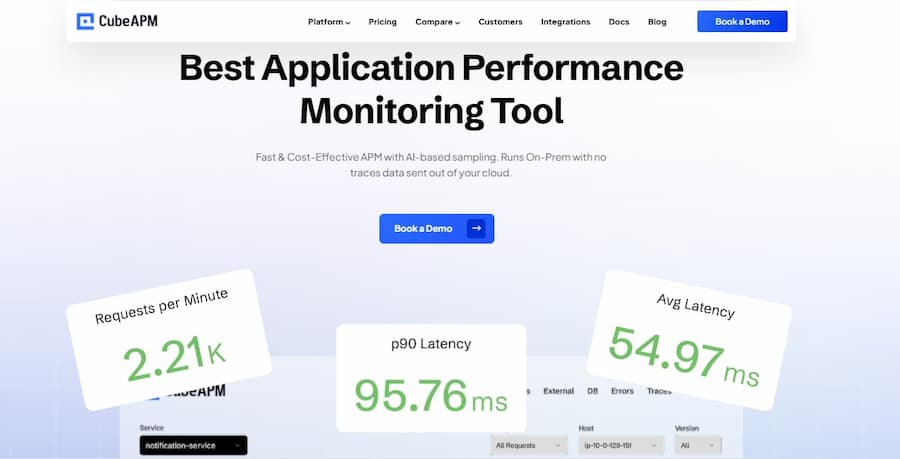
CubeAPM: CubeAPM is known for unified full-stack observability built natively on OpenTelemetry with self-hosted deployment options. It emphasizes predictable ingestion-based pricing, unlimited data retention, and deployment within the customer’s own cloud infrastructure. CubeAPM provides integrated coverage across metrics, events, logs, and traces while supporting compatibility with multiple telemetry agents.
Dynatrace: Dynatrace is known as an AI-powered observability and application security platform that delivers full-stack visibility across infrastructure, applications, logs, digital experience, and security. Its platform centers around the OneAgent technology for automatic discovery and instrumentation, combined with Davis AI for automated root cause analysis and causal problem detection. Dynatrace positions itself as a unified software intelligence platform for enterprise-scale environments.
Splunk AppDynamics: Splunk AppDynamics is known for enterprise application performance monitoring with strong business transaction monitoring capabilities. It automatically discovers application flows and correlates performance metrics with business KPIs, enabling organizations to understand how application performance impacts revenue-critical services. AppDynamics emphasizes transaction-centric visibility and dependency mapping across distributed architectures.
Multi-Agent Support
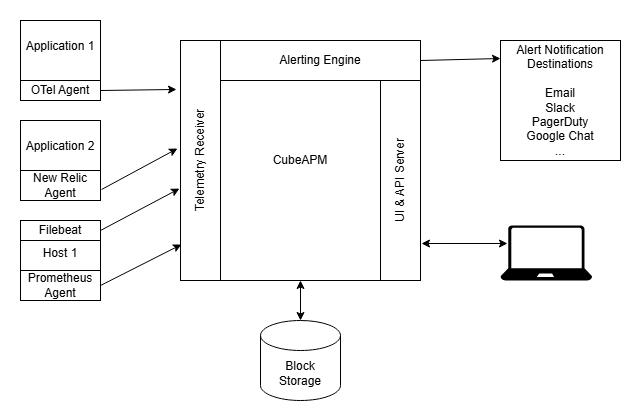
CubeAPM: CubeAPM supports a broad set of telemetry sources through native OpenTelemetry ingestion and compatibility with common vendor agents. This allows customers to send data from OpenTelemetry SDKs, OpenTelemetry Collector, and existing agents compatible with New Relic, Datadog, Elastic, and other observability vendors. The flexibility helps teams migrate incrementally from other platforms without massive re-instrumentation.
Dynatrace: Dynatrace primarily uses its proprietary OneAgent for automatic instrumentation across applications, infrastructure, and services. The OneAgent automatically discovers components and captures telemetry without manual configuration. Dynatrace also supports OpenTelemetry ingestion via the Dynatrace OneAgent or via the OpenTelemetry Collector to extend telemetry sources.
Splunk AppDynamics: Splunk AppDynamics supports both its native AppDynamics agents for application instrumentation and distributed tracing, as well as OpenTelemetry Collector integration for sending telemetry. The platform can receive signals from AppDynamics agents and from OpenTelemetry-compatible sources, offering flexibility for hybrid instrumentation strategies.
MELT Support
CubeAPM: CubeAPM provides unified support for Metrics, Events, Logs, and Traces (MELT) within a single observability platform. Because it is built natively on OpenTelemetry, telemetry from all signals is ingested, correlated, and stored under a consistent schema, enabling cross-signal context without separate silos.
Dynatrace: Dynatrace delivers full MELT coverage across infrastructure metrics, application traces, logs, and events within a unified platform. The Dynatrace Data Explorer and Smartscape technologies correlate these signals in real time, and their log analytics capabilities (including Grail) allow logs to be searched alongside metrics and traces.
Splunk AppDynamics: Splunk AppDynamics provides comprehensive support for Metrics, Events, Logs, and Traces, with native application metrics and trace collection from AppDynamics agents, and logs via the Splunk Observability Cloud or integrated logging pipelines. AppDynamics correlates these signals to provide end-to-end observability in distributed systems.
Deployment

CubeAPM: CubeAPM is deployed within the customer’s own cloud or on-premises infrastructure, meaning telemetry data remains inside the organization’s environment. This model is best described as customer-hosted with vendor support, rather than pure SaaS. It enables strict data residency control and infrastructure-level governance.
Dynatrace: Dynatrace is primarily delivered as a SaaS platform hosted and managed by Dynatrace. However, it also offers Dynatrace Managed, which allows customers to deploy the Dynatrace cluster within their own data center or cloud environment while still using the Dynatrace software stack.
Splunk AppDynamics: Splunk AppDynamics offers both SaaS and self-hosted deployment models. Customers can use the AppDynamics SaaS offering hosted by Splunk or deploy the AppDynamics Controller within their own infrastructure.
Pricing for Small, Mid, and Large Teams
To summarize the pricing:
*All pricing comparisons are calculated using standardized Small/Medium/Large team profiles defined in our internal benchmarking sheet, based on fixed log, metrics, trace, and retention assumptions. Actual pricing may vary by usage, region, and plan structure. Please confirm current pricing with each vendor.
| Approx. cost for teams (size) | Small (~30) | Mid-Sized (~125) | Large (~250) |
| CubeAPM | $2,080 | $7,200 | $15,200 |
| Dynatrace | $7,740 | $21,850 | $46,000 |
| Splunk AppDynamics | $2,290 | $8,625 | $17,750 |
CubeAPM Costs in Detail
CubeAPM charges $0.15 per GB of telemetry ingested. There are no separate host-based, per-user, or feature-tier charges. Cost scales directly with the volume of data sent to the platform. Pricing for different teams:
- Small teams (~ 30): $2,080
- Mid-sized teams (~ 125): $7,200
- Large teams (~250): $15,200
Dynatrace Cost in Detail
Dynatrace uses a usage-based platform subscription model with published unit rates:
- Full-stack monitoring: $0.01 per GiB-hour (memory consumption of monitored hosts)
- Infrastructure monitoring: $0.04 per host-hour
- Logs: $0.20 per GiB ingested
- Real User Monitoring (RUM): $0.00225 per user session
- Synthetic monitoring: $0.001 per synthetic request
Customers typically commit to an annual platform subscription and consume against these unit rates. Final pricing may vary by contract volume and region. Pricing for different teams:
- Small teams: $7,740
- Mid-size teams: $21,850
- Large teams: $46,000
Check out our Dynatrace pricing calculator to understand how its pricing scales.
Splunk AppDynamics Cost in Detail
Splunk AppDynamics uses a vCPU-based licensing model:
- Infrastructure monitoring: $6 per vCPU per month
- APM + Infrastructure monitoring: $33 per vCPU per month
- Enterprise tier: $50 per vCPU per month
Additional modules such as end-user monitoring or database monitoring may be priced separately depending on the contract. Pricing is typically finalized through enterprise sales agreements. Pricing for different teams:
- Small teams: $2,290
- Mid-size teams: $8,625
- Large teams: $17,750
As telemetry volume grows, pricing model differences become more visible. What begins as a manageable monitoring expense can evolve into a meaningful operational cost in environments with sustained traffic, high-cardinality logs, or expanding microservice architectures. At that point, observability spend often requires active forecasting and governance rather than being treated as a fixed tooling line item.
Sampling Strategy
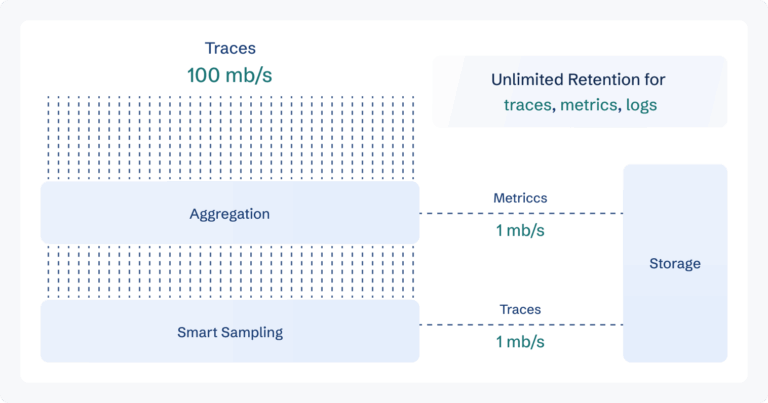
CubeAPM: Smart, context-aware sampling that prioritizes traces based on contextual signals such as latency and error conditions. Instead of uniformly dropping traces, the system retains high-value traces that indicate performance degradation or failures. Because pricing is ingestion-based, sampling also helps teams optimize telemetry volume without losing critical diagnostic data.
Dynatrace: Adaptive Traffic Management (ATM) and distributed trace sampling that dynamically controls trace volume within the Dynatrace platform. Dynatrace supports head-based and tail-based sampling through OpenTelemetry integration, while OneAgent automatically captures and analyzes distributed traces with built-in traffic management capabilities.
Splunk AppDynamics: Agent-based configurable sampling with OpenTelemetry support, allowing administrators to define sampling policies through native agents and configure head-based or tail-based sampling via OpenTelemetry Collector integration. Sampling rules can prioritize specific business transactions or performance thresholds to align trace collection with operational goals.
Data Retention

CubeAPM: Unlimited retention for all telemetry signals (metrics, events, logs, traces) because data is stored within the customer’s own infrastructure. There are no forced retention windows or charges based on retention duration.
Dynatrace: Defined retention windows depending on signal type: metrics retained for 15 months, logs retained for 35 days, traces retained for 10 days, and RUM/synthetics retained for 35 days under standard plans. Extended retention options may be available through additional storage configurations.
Splunk AppDynamics: Retention varies by signal and deployment model. Events are typically retained for 8 days; metrics range from 8 days up to 13 months in SaaS; on-prem deployments can be configured for 4 hours up to 13 months, depending on resource allocation and storage settings.
Support Channel & Response Time
CubeAPM: Direct support via Slack and WhatsApp with rapid response expectations measured in minutes for most inquiries. The support model emphasizes real-time engagement with product teams rather than traditional ticket queues.
Dynatrace: Support is provided through chat and web tickets with tiered service level agreements. Standard support response times range from 4 days to 4 hours, depending on severity, while Enterprise support offers faster response times from 2 days to 30 minutes for critical issues under higher support tiers.
Splunk AppDynamics: Support is provided via the Splunk support portal with tiered service levels. Critical issue (P1) response targets can be as fast as 30 minutes, while lower-priority cases may see same-day to multi-day response times (up to 2 days) depending on support tier and contract.
How Teams Evaluate These Platforms at Scale
Choosing between Dynatrace, Splunk AppDynamics, and a customer-hosted observability platform is rarely a purely technical decision. At scale, the evaluation extends beyond features into cost modeling, governance requirements, operational risk, and long-term architectural alignment.
Who Is Involved
- Engineering teams: Platform engineers, SREs, and DevOps teams assess instrumentation depth, sampling controls, Kubernetes integration, OpenTelemetry compatibility, and how quickly incidents can be diagnosed. Their focus is on reliability, trace visibility, and reducing mean time to resolution.
- Finance teams: FinOps and finance stakeholders model telemetry growth, infrastructure expansion, and multi-year cost exposure. They evaluate whether pricing scales with hosts, vCPUs, sessions, or ingestion volume, and how predictable that spend remains as traffic and microservices increase.
- Security and compliance teams: Security leaders assess data residency, encryption standards, access controls, auditability, and regulatory alignment. Deployment architecture, particularly SaaS versus customer-hosted models, becomes a major factor in regulated industries.
What Questions Block Decisions
- Cost scalability: What happens when telemetry volume doubles or triples? Does pricing remain linear and predictable, or does it introduce new tiers and commitments?
- Retention flexibility: How long can traces, logs, and metrics be stored without upgrading licenses or purchasing additional storage?
- Data control: Where is telemetry data physically stored, and does it align with regional compliance requirements?
- Migration complexity: Can the organization migrate gradually without fully re-instrumenting applications?
- Incident fidelity: Does the sampling strategy preserve the traces that matter most during production outages?
These questions often surface once organizations move beyond early-stage deployments and begin forecasting sustained growth.
Why Comparisons Alone Aren’t Enough
Feature matrices are helpful for initial filtering, but they rarely reflect real-world operational conditions. They do not capture telemetry spikes during incidents, the impact of high-cardinality logs, cross-region data transfer costs, or the effort required to maintain instrumentation at scale.
As a result, mature teams typically run pilots, simulate high-ingestion workloads, test real incident scenarios, and model long-term cost growth before making a final decision. At enterprise scale, the evaluation shifts from feature comparison to architectural fit and financial predictability.
Dynatrace vs Splunk AppDynamics vs CubeAPM: Use Cases
Each platform is optimized for different operational realities. The right choice depends on deployment model, compliance posture, architecture complexity, and how your organization models long-term observability cost.
Choose CubeAPM if:
CubeAPM is suited for teams that prioritize data control, predictable ingestion-based pricing, and OpenTelemetry-native architecture.
- You need strict data residency and compliance control: Because CubeAPM runs inside your own cloud or on-prem environment, telemetry never leaves your infrastructure. This is useful for BFSI, healthcare, government, or region-specific compliance requirements.
- You want predictable pricing as telemetry scales: Based on published pricing ($0.15 per GB ingestion), cost scales directly with data volume rather than host count or vCPU licensing. For high-growth SaaS teams, this simplifies forecasting when traffic increases.
- You require unlimited retention: Since storage remains under customer control, retention is not limited by vendor-imposed tiers. This is beneficial for long forensic investigations, audit trails, or compliance-driven log retention.
- You are standardizing on OpenTelemetry: CubeAPM is natively built on OpenTelemetry and supports ingestion from multiple agents. This reduces vendor lock-in and allows gradual migration from other platforms.
- You run Kubernetes-heavy microservices environments: In clusters with sustained traffic and high-cardinality logs, ingestion-based pricing and context-aware sampling help manage trace volume without losing critical signals.
- You want end-to-end tracing across distributed services: For microservices architectures, CubeAPM provides full MELT correlation across metrics, logs, and traces within a single platform.
- You need Java-specific performance monitoring: For Java and JVM-based services, teams can instrument using OpenTelemetry Java agents and correlate JVM metrics, garbage collection behavior, thread pools, and transaction latency. This supports performance tuning for Spring Boot, Jakarta EE, and other Java microservices.
- You are a startup or mid-market SaaS optimizing MTTR: Lightweight deployment and vendor-supported onboarding reduce time-to-value while preserving long-term scalability.
Choose Dynatrace if:
Dynatrace is suited for enterprises seeking AI-assisted automation and deep infrastructure-to-application visibility at global scale.
- You want AI-driven root cause analysis: Dynatrace’s Davis AI automatically correlates dependencies, anomalies, and performance degradations across services, reducing manual investigation effort.
- You operate at global enterprise scale: Large multi-cloud environments with thousands of hosts benefit from OneAgent auto-discovery and automated topology mapping.
- You prefer a SaaS-first deployment model: Dynatrace’s SaaS architecture reduces operational overhead for managing observability infrastructure.
- You require automated dependency mapping: For complex service meshes and hybrid infrastructure, Dynatrace provides real-time service mapping through its Smartscape technology.
- You need deep infrastructure monitoring tied to memory consumption models: Dynatrace pricing scales with GiB-hour consumption and host monitoring, which may align with enterprises already budgeting observability per infrastructure footprint.
- You want integrated digital experience monitoring: Dynatrace includes Real User Monitoring and synthetic capabilities integrated within the broader AI platform.
Choose Splunk AppDynamics if:
Splunk AppDynamics is suited for enterprises focused on business transaction monitoring and application-to-business KPI alignment.
- You prioritize business transaction visibility: AppDynamics automatically defines and tracks business transactions, allowing teams to tie application latency directly to revenue-impacting flows.
- You operate in traditional enterprise IT estates: Organizations running large Java, .NET, and legacy workloads often leverage AppDynamics’ agent-based monitoring for deep application diagnostics.
- You already use Splunk in your observability stack: Integration with the broader Splunk ecosystem can simplify log aggregation and operational reporting.
- You prefer vCPU-based licensing: Pricing tied to infrastructure footprint may align with enterprises that already budget software per core or per host.
- You require tiered enterprise support models: AppDynamics offers structured SLA tiers suitable for large organizations with formal incident management processes.
- You need granular JVM monitoring for Java workloads: AppDynamics provides deep JVM visibility, including heap usage, garbage collection metrics, thread analysis, and transaction snapshots, which can be beneficial in large enterprise Java environments.
Conclusion
Dynatrace, Splunk AppDynamics, and CubeAPM each address observability from a different architectural perspective. Dynatrace emphasizes AI-driven automation and enterprise-scale visibility. Splunk AppDynamics focuses on business transaction monitoring and application-centric diagnostics. CubeAPM centers on OpenTelemetry-native observability with customer-hosted deployment and ingestion-based pricing.
At scale, the decision often comes down to deployment control, retention flexibility, and cost predictability. Teams balancing growth, compliance, and long-term telemetry expansion typically evaluate how pricing models and architecture align with their infrastructure roadmap.
For organizations prioritizing data control, unlimited retention, and predictable pricing alongside full MELT coverage, CubeAPM presents a strong alternative. Explore a demo to evaluate which model best fits your environment.
Disclaimer: The information in this article reflects the latest details available at the time of publication and may change as technologies and products evolve.
FAQs
1. Which platform is easier to migrate to from another observability tool?
Migration depends on instrumentation. Platforms that support OpenTelemetry allow teams to reuse existing SDKs and collectors instead of reinstalling proprietary agents. This can reduce disruption during phased transitions.
2. Which tool works best for Kubernetes-native workloads?
All three support Kubernetes, but deployment models differ. Agent-based platforms rely on node-level agents, while OpenTelemetry-native approaches integrate directly with cluster telemetry pipelines. The choice often depends on flexibility and operational overhead.
3. How do these platforms support multi-cloud environments?
Dynatrace and AppDynamics provide built-in integrations across major cloud providers. Customer-hosted platforms centralize telemetry from multiple clouds into a single environment while maintaining infrastructure-level data control.
4. Which solution is better for high-traffic web applications?
For consumer-facing applications, pricing models matter. Dynatrace includes per-session charges for Real User Monitoring, AppDynamics may require additional modules, and ingestion-based pricing allows cost to scale directly with telemetry volume.
5. Which option offers more predictable long-term cost control?
Dynatrace pricing scales with host memory usage and signal consumption. AppDynamics scales with vCPU licensing. CubeAPM uses predictable ingestion-based pricing at $0.15 per GB, allowing teams to forecast cost based on expected telemetry growth.