






When your analytical queries are running slow and your data warehouse bill keeps climbing, choosing the right database becomes critical. ClickHouse and Amazon Redshift are two of the most widely used columnar databases for analytical workloads, but they serve different needs, have different architectures, and come with very different cost models.
This guide breaks down ClickHouse vs AWS Redshift across performance, pricing, architecture, scalability, and use cases to help you make an informed decision. Whether you are querying billions of rows for real-time dashboards or running complex BI reports on structured data, this comparison covers what actually matters.
🔑 Key Takeaways
- ClickHouse is open-source and excels at real-time analytics, delivering sub-second queries on billions of rows using columnar storage and vectorized execution.
- Amazon Redshift is a fully managed, AWS-native data warehouse best suited for structured data, complex BI queries, and teams already invested in the AWS ecosystem.
- ClickHouse is typically 2 to 5x faster than Redshift on most analytical queries, based on benchmarks including ClickBench.
- Redshift limits concurrency to 50 across all queues, making it unsuitable for high-concurrency real-time applications.
- ClickHouse Cloud starts at $1/month on a consumption-based model. Redshift provisioned nodes start at $1.22/hour for RA3.4xlarge.
- For observability and APM workloads on top of ClickHouse, CubeAPM provides an OpenTelemetry-native, self-hosted APM at flat-rate pricing.
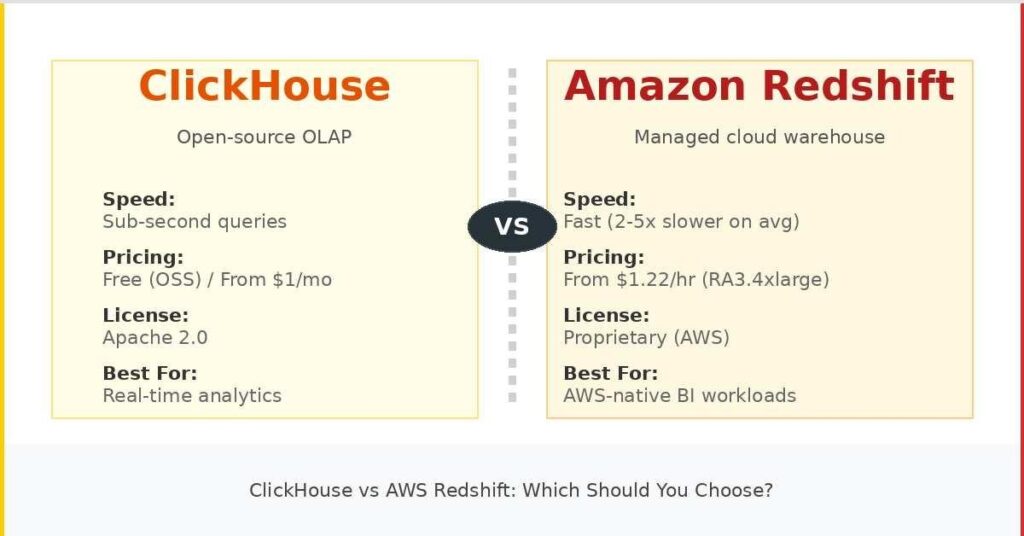
ClickHouse vs AWS Redshift at a Glance
What Is ClickHouse?
ClickHouse is an open-source, column-oriented OLAP (Online Analytical Processing) database management system originally developed by Yandex for Yandex.Metrica, a web analytics platform. It was open-sourced in 2016 and is now maintained by ClickHouse Inc. with contributions from a large community.
ClickHouse is built for fast analytical queries on large datasets. It uses vectorized query execution and columnar storage to process billions of rows per second. The database supports SQL and integrates with tools like Kafka, Spark, dbt, and most BI platforms.
Key strengths of ClickHouse include:
- Speed: Sub-second query performance on billions of rows
- Compression: Built-in data compression reduces storage costs significantly
- Open source: Apache 2.0 license; free to self-host
- Cloud option: ClickHouse Cloud available on AWS, GCP, and Azure
- Flexible deployment: On-premises, cloud, or Bring Your Own Cloud (BYOC)
What Is Amazon Redshift?
Amazon Redshift is a fully managed, cloud-native data warehouse launched by AWS in 2012. It uses columnar storage and massively parallel processing (MPP) to handle large-scale analytical workloads. Redshift is tightly integrated with the AWS ecosystem, including S3, Glue, Kinesis, and Lambda.
Redshift is available in two main deployment modes: provisioned clusters (including RA3 nodes with managed storage) and Redshift Serverless, which automatically scales compute resources based on demand. It uses a PostgreSQL-compatible SQL interface, making it familiar to most data teams.
Key strengths of Amazon Redshift include:
- AWS integration: Native connectivity with S3, Glue, Lambda, Kinesis, and QuickSight
- Managed service: No infrastructure management required
- Familiar SQL: PostgreSQL-compatible interface
- Materialized views: Supports near-real-time dashboard workloads
- Security and compliance: Enterprise-grade encryption, IAM, and VPC support
Architecture Comparison
Understanding the architecture of each database helps explain their performance characteristics and suitability for different workloads.
ClickHouse Architecture
ClickHouse uses a shared-nothing architecture with columnar storage. Each column is stored separately, enabling the database to read only the columns needed for a query rather than full rows. This dramatically reduces I/O for analytical queries.
ClickHouse Cloud introduces a SharedMergeTree engine, which enables full separation of compute and storage. In 2025, ClickHouse added a Warehouses feature that allows multiple isolated compute services to share the same data, further improving workload isolation and scalability.
ClickHouse also uses vectorized execution, processing data in batches (vectors) rather than row-by-row, which allows modern CPUs to use SIMD instructions and maximize throughput.
Amazon Redshift Architecture
Amazon Redshift uses a leader node and multiple compute nodes in an MPP architecture. The leader node coordinates query execution across compute nodes, which each store a portion of the data and process queries in parallel.
RA3 nodes introduced separation of compute and storage using Amazon S3 as managed storage, allowing teams to scale compute and storage independently. However, compared to ClickHouse Cloud, Redshift offers limited workload isolation.
One notable characteristic of Redshift is that it compiles query execution plans before running them. This adds overhead for first-time queries. While compiled plans are cached, this approach creates latency challenges for interactive applications with variable or unpredictable query patterns.
ClickHouse vs AWS Redshift: Side-by-Side Comparison
| Feature | ClickHouse | Amazon Redshift |
|---|---|---|
| Type | Open-source OLAP database | Managed cloud data warehouse |
| Architecture | Columnar, shared-nothing / SharedMergeTree (Cloud) | MPP with leader + compute nodes; RA3 for storage separation |
| License | Apache 2.0 (open source) | Proprietary (AWS) |
| Cloud support | AWS, GCP, Azure, self-hosted | AWS only |
| Query language | SQL (ClickHouse dialect) | SQL (PostgreSQL-compatible) |
| Performance | Sub-second on billions of rows; 2 to 5x faster than Redshift | Fast for BI workloads; slower on real-time ad-hoc queries |
| Concurrency | High (no fixed limit) | Limited to 50 concurrent queries across all queues |
| Pricing model | Free (OSS) / Consumption-based (Cloud from $1/month) | Per-node provisioned ($1.22+/hr) or Serverless on RPU |
| Data compression | Built-in, high compression ratios | Columnar compression; less aggressive than ClickHouse |
| Real-time ingestion | Native Kafka, HTTP, S3 integrations | Via Kinesis, Glue; not optimized for real-time inserts |
| AWS ecosystem fit | Moderate (integrations available) | Excellent (native S3, Glue, Lambda, QuickSight) |
| Best for | Real-time analytics, log analytics, event data | Structured BI, reporting, AWS-native workloads |
| G2 rating | 4.5/5 (23 reviews) | 4.3/5 (402 reviews) |
Performance: How Does ClickHouse Compare to Redshift?
Performance is where the two databases diverge most clearly. According to ClickBench, an open-source analytical benchmark, ClickHouse consistently outperforms Amazon Redshift on most query types. On a majority of queries, Redshift is approximately 2 to 5x slower than ClickHouse.
The primary reasons for this gap are:
- Query compilation overhead: Redshift compiles a query plan before execution, adding latency to first-time and variable queries. ClickHouse does not have this overhead.
- Vectorized execution: ClickHouse processes data in batches using CPU SIMD instructions. Redshift uses a different parallel model that is less suited to modern hardware for analytical scans.
- Concurrency limits: Redshift caps concurrent queries at 50 across all queues. ClickHouse has no fixed concurrency ceiling, making it far better for user-facing analytics products.
- Compression efficiency: ClickHouse achieves higher compression ratios, meaning it reads less data from disk for the same query.
That said, Redshift has closed the gap on certain workloads. Features such as AQUA (Advanced Query Accelerator) and AutoMV (automatic materialized views) improve performance for structured BI queries and repeated patterns. For teams running predictable, scheduled BI reports on structured AWS data, Redshift can be a practical and well-integrated choice.
Pricing: ClickHouse vs AWS Redshift
ClickHouse Pricing
ClickHouse open-source is free to deploy and self-host with no licensing fees. ClickHouse Cloud uses a consumption-based pricing model starting at $1/month on the Basic tier. Compute is charged per unit consumed, and storage is charged separately.
BYOC deployments (Bring Your Own Cloud) allow teams to run ClickHouse Cloud inside their own AWS, GCP, or Azure account, giving them cost control and data residency.
Amazon Redshift Pricing
Amazon Redshift pricing varies by deployment mode:
- Provisioned: RA3.4xlarge starts at $1.22 to $3.26 per hour (on-demand, 1-year, or 3-year reserved), per G2 pricing data. Costs scale with the number and type of nodes.
- Serverless: Charged by Redshift Processing Units (RPU) per second, with a minimum charge of 32 RPUs. Good for intermittent workloads, but can be expensive at sustained high concurrency.
Reserved instance pricing significantly reduces costs for teams with predictable workloads.
Cost Comparison Summary
For a growing team doing real-time analytics on event data, ClickHouse Cloud can be significantly cheaper due to better data compression (which reduces storage costs), higher query efficiency (which reduces compute time), and no per-node pricing model. Redshift becomes cost-competitive for teams already invested in AWS, running scheduled BI reports on structured data with predictable concurrency.
When to Use ClickHouse
ClickHouse is the better choice when:
- You need sub-second query performance on billions of rows for real-time dashboards or user-facing analytics
- Your workload involves high-volume event data, logs, time-series metrics, or click-stream data
- You have high concurrency requirements and cannot work within a 50-query limit
- You want an open-source database you can self-host or deploy on any cloud
- Your team needs flexibility to run across AWS, GCP, or Azure without vendor lock-in
When to Use Amazon Redshift
Amazon Redshift is the better choice when:
- Your team is heavily invested in the AWS ecosystem and needs native integration with S3, Glue, Lambda, and QuickSight
- Your workload is primarily structured BI reporting with predictable, scheduled query patterns
- You want a fully managed service with no infrastructure management overhead
- You need enterprise-grade compliance, IAM integration, and VPC security out of the box
- Your concurrency requirements are moderate (under 50 simultaneous queries)
Can You Use ClickHouse and Redshift Together?
Yes, and this is more common than it might seem. Many organizations use Redshift as their primary data warehouse for structured BI workloads while deploying ClickHouse as a “speed layer” for high-concurrency, real-time queries.
In this architecture, data from Redshift is replicated or mirrored into ClickHouse for latency-sensitive queries, while Redshift handles complex joins, compliance reporting, and scheduled analytics. This pattern is particularly common in e-commerce, SaaS products, and media companies that need both structured reporting and real-time user-facing analytics.
📌 Monitor Your Analytics Infrastructure with CubeAPM
If you are running ClickHouse or managing observability data pipelines, you need visibility into your application performance. CubeAPM is a self-hosted, OpenTelemetry-native APM and observability platform with flat-rate pricing at $0.15/GB. No per-host fees, no per-user charges, no hidden costs.
CubeAPM gives your team:
- Distributed tracing, metrics, and log correlation in one platform
- OpenTelemetry-native ingestion compatible with all OTel SDKs
- Predictable pricing that scales without surprises
→ Book a demo today
Conclusion
ClickHouse and Amazon Redshift are both strong columnar databases for analytical workloads, but they are optimized for different scenarios. ClickHouse wins on raw query speed, concurrency, cost efficiency, and flexibility for real-time analytics. Amazon Redshift wins on AWS ecosystem integration, managed infrastructure, and suitability for structured BI workloads.
If you are building a real-time analytics product, processing high-volume event streams, or looking to reduce your data warehouse costs without compromising on query speed, ClickHouse is the better choice. If your team is AWS-native and primarily running scheduled BI reports on structured data, Redshift remains a solid and well-supported option.
For teams that need application performance monitoring alongside their analytics infrastructure, CubeAPM provides an OpenTelemetry-native, self-hosted APM solution that integrates with your existing stack at a predictable flat-rate cost.
⚠️ DisclaimerPricing information in this article is based on publicly available data from vendor websites and third-party review platforms including G2 and AWS documentation. Cloud pricing changes frequently. Verify current rates at clickhouse.com/pricing and aws.amazon.com/redshift/pricing before making purchasing decisions. Performance benchmarks are indicative and may vary based on query patterns, cluster configuration, and data volume.
FAQs
1. Is ClickHouse faster than Amazon Redshift?
Yes, in most cases. ClickHouse is typically 2 to 5x faster than Amazon Redshift on analytical queries, based on ClickBench benchmarks. ClickHouse benefits from vectorized execution, higher data compression, and no query compilation overhead. Redshift has improved with features like AQUA and AutoMV, but ClickHouse still holds a clear performance advantage for real-time and ad-hoc workloads.
2. Is ClickHouse free to use?
Yes. ClickHouse is open-source under the Apache 2.0 license, meaning you can self-host it for free with no licensing costs. ClickHouse Cloud, the managed service, uses a consumption-based pricing model starting at $1/month. Amazon Redshift is a proprietary AWS service with no free tier beyond a limited trial.
3. Can ClickHouse replace Amazon Redshift?
ClickHouse can replace Redshift for real-time analytics, log analytics, event data, and high-concurrency workloads. However, if your team relies heavily on native AWS integrations such as Glue, QuickSight, or Lake Formation, migrating away from Redshift involves additional work. Many teams use both: Redshift for structured BI and ClickHouse as a speed layer for real-time queries.
4. What is the concurrency limit of Amazon Redshift?
Amazon Redshift limits concurrency to 50 queries across all queues by default. This makes it unsuitable for user-facing applications with high concurrency needs. ClickHouse does not impose a fixed concurrency limit, making it better suited for products where many users query the database simultaneously.
5. Which database is better for real-time analytics: ClickHouse or Redshift?
ClickHouse is significantly better for real-time analytics. It supports sub-second queries on billions of rows, native Kafka ingestion, and high concurrency without recompiling query plans. Redshift was designed for batch BI workloads and adds latency due to query compilation. Teams building real-time dashboards or event-driven analytics products consistently prefer ClickHouse for this reason.