









If your team is debating whether to use OpenTelemetry or the ELK Stack for observability, you are asking a question that comes up constantly in platform, SRE, and DevOps conversations. The short answer is that they solve different problems, which is why many production teams end up using both. This guide breaks down what each tool actually does, where each one fits, and how to decide which approach makes sense for your environment.
🔑 Key Takeaways
- OpenTelemetry is a CNCF-backed, vendor-agnostic framework for collecting traces, metrics, and logs. It does not store or visualize data on its own.
- The ELK Stack (Elasticsearch, Logstash, Kibana) is a full-stack log management and search platform built and maintained by Elastic.
- OpenTelemetry excels in distributed tracing and unified instrumentation for microservices and cloud-native environments.
- ELK excels at centralized log aggregation, full-text search, and rich Kibana dashboards for security and operations teams.
- The two are not mutually exclusive. Many teams use OpenTelemetry as the collection layer and ship data into Elasticsearch for storage and visualization.
- For self-hosted APM that is natively built on OpenTelemetry and avoids the operational overhead of running ELK, CubeAPM is worth evaluating.
OpenTelemetry vs ELK at a Glance
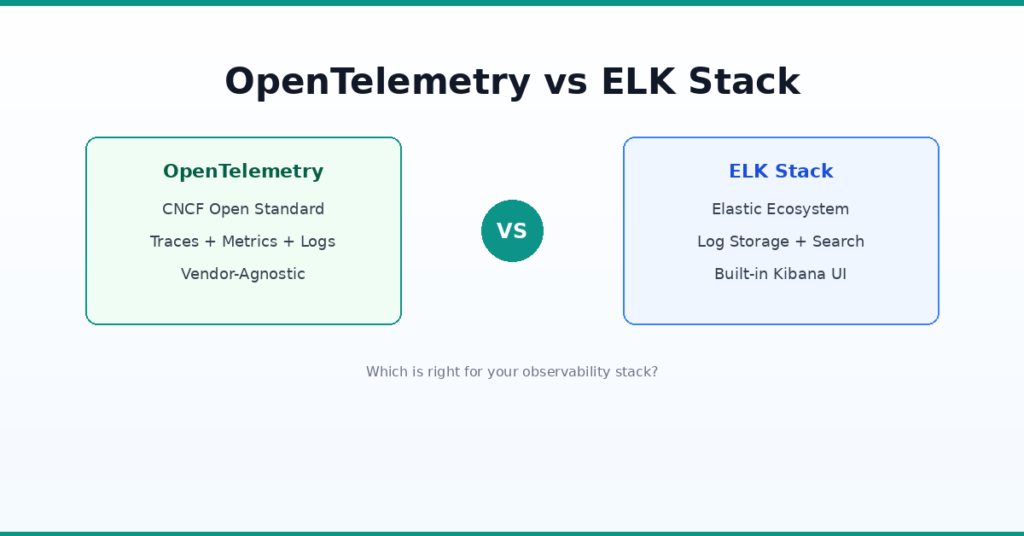
OpenTelemetry is a data collection standard. ELK is a data storage and visualization platform. When you put them together, OpenTelemetry handles the instrumentation and pipeline, while Elasticsearch and Kibana handle the persistence and analysis. Understanding this layered model is the foundation for making the right choice.
What Is OpenTelemetry?
OpenTelemetry (often shortened to OTel) is an open-source observability framework hosted by the Cloud Native Computing Foundation (CNCF). It provides a unified set of APIs, SDKs, and the OpenTelemetry Collector for generating and routing telemetry data: traces, metrics, and logs. The project reached stable status for traces and metrics and is now widely adopted by cloud providers, APM vendors, and infrastructure platforms.
The core value proposition is vendor neutrality. You instrument your application once using OTel SDKs (available for Go, Java, Python, Node.js, .NET, and others), and the Collector forwards that data to any compatible backend: Jaeger, Prometheus, Grafana Tempo, Elastic, Datadog, or a self-hosted APM like CubeAPM. You are not locked into a specific storage or visualization tool.
OpenTelemetry Core Components
- API: Defines how telemetry data is created. Language-specific and backward-compatible.
- SDK: Implements the API and handles batching, sampling, and context propagation.
- Collector: A standalone service that receives, processes, and exports telemetry data to one or more backends. It supports OTLP, Prometheus, Jaeger, and dozens of other formats.
What Is the ELK Stack?
ELK stands for Elasticsearch, Logstash, and Kibana. Together, they form one of the most widely deployed log management and search platforms in the industry. A fourth component, Beats (lightweight shippers like Filebeat and Metricbeat), is often included, making the stack sometimes referred to as the Elastic Stack.
ELK Stack Core Components
- Elasticsearch: A distributed, RESTful search and analytics engine. It stores indexed log data and responds to full-text and structured queries. Built on Apache Lucene.
- Logstash: A server-side data processing pipeline that ingests, transforms, and ships logs. It uses grok patterns and filters to parse unstructured text into structured JSON.
- Kibana: The visualization layer. It provides dashboards, log views, alerting, and Elastic APM integration for performance analysis.
- Beats / Elastic Agent: Lightweight shippers (Filebeat, Metricbeat, Packetbeat) that collect data at the host level and forward it to Logstash or directly to Elasticsearch.
Note on licensing: Elasticsearch and Kibana were re-licensed under the Server Side Public License (SSPL) and the Elastic License 2.0 in January 2021. They are not Apache 2.0-licensed. OpenSearch, a community fork backed by AWS, maintains the Apache 2.0 license for users who require it.
OpenTelemetry vs ELK: Head-to-Head Comparison
| Feature | OpenTelemetry | ELK Stack |
| Type | Observability framework / standard | Full-stack log analytics platform |
| Primary function | Data collection and routing | Data storage, search, visualization |
| Data signals | Traces, metrics, logs | Logs (primary), metrics, traces via APM |
| Vendor neutrality | Fully vendor-agnostic (CNCF) | Elastic ecosystem; some lock-in |
| Visualization | Requires a separate backend | Built-in Kibana dashboards |
| Instrumentation | Code-level SDK + auto-instrumentation | Agent-based (Beats, Elastic Agent) |
| Storage | No built-in storage | Elasticsearch |
| Cloud-native fit | Excellent (Kubernetes-native) | Good, heavier resource footprint |
| License | Apache 2.0 | SSPL / Elastic License 2.0 (Elasticsearch) |
| Self-hosted cost | Free (backend costs vary) | Free OSS tier; costs scale with data |
Architecture and Data Flow
Understanding the architecture of each tool makes the decision much clearer.
OpenTelemetry Data Flow
Application code is instrumented with OTel SDKs (or auto-instrumented via agents). The SDK sends telemetry data to the OTel Collector over OTLP (OpenTelemetry Protocol). The Collector processes the data (sampling, filtering, enrichment) and exports it to a backend of your choice. The entire pipeline is stateless from the application’s perspective.
ELK Data Flow
Logs are shipped from hosts using Filebeat or Elastic Agent to Logstash (or directly to Elasticsearch). Logstash parses and transforms the data, then indexes it into Elasticsearch. Kibana queries Elasticsearch and renders dashboards, searches, and alerts.
Key Architectural Difference
OpenTelemetry is a collection and transport layer. It has no storage engine and no built-in dashboards. ELK is a complete data platform. It ingests, stores, and visualizes data but is primarily optimized for log-centric workloads. Traces require the addition of Elastic APM, and metrics require Metricbeat or the Elastic Agent integration.
Distributed Tracing: OpenTelemetry Wins by Design
For microservices architectures, distributed tracing is not optional. You need to follow a request across services, identify which hop introduced latency, and understand the full call chain. OpenTelemetry was designed from the ground up for this use case.
OTel traces use a context propagation model based on the W3C TraceContext standard. Each service adds a span to the trace and propagates the trace ID to downstream calls. The Collector batches and exports spans to a backend like Jaeger, Grafana Tempo, or CubeAPM.
ELK supports distributed tracing through Elastic APM. The APM Server receives trace data from Elastic APM agents, which are language-specific agents that must be installed alongside your application. Elastic APM is not compatible with the OpenTelemetry protocol natively without a translation layer, though newer versions of Elastic APM Server do support OTLP input. Even so, the tracing experience in ELK is tightly coupled to the Elastic APM agent ecosystem.
Log Management: ELK Has the Edge
If centralized log aggregation is your primary need, ELK has a much larger feature set out of the box. Elasticsearch’s inverted index provides millisecond full-text search across billions of log lines. Kibana’s Discover interface, KQL (Kibana Query Language), and pre-built dashboards make it easy for operators and security teams to work with logs without writing code.
OpenTelemetry does handle logs. The OTel log signal reached stable status and the Collector has a robust filelog receiver for parsing files, as well as receivers for syslog, journald, and other sources. However, OTel’s log handling is fundamentally about routing structured data to a backend. It does not provide its own storage or search interface.
For organizations that primarily need log aggregation and search (SIEM, compliance, audit trails), ELK’s built-in capabilities are hard to beat. For teams that need logs to be correlated with traces and metrics in a unified pipeline, OpenTelemetry is the better foundation.
Vendor Lock-In and Licensing
OpenTelemetry is governed by the CNCF and licensed under Apache 2.0. The specification, SDKs, and Collector are fully open. Switching backends requires only a configuration change in the Collector. There is no proprietary data format.
The ELK Stack is a commercial product maintained by Elastic. While Logstash and Beats remain Apache 2.0-licensed, Elasticsearch and Kibana use the Elastic License 2.0 (ELv2) and SSPL for certain features. This means you cannot offer ELK as a managed service without a commercial agreement with Elastic. The licensing change in 2021 was the direct trigger for the creation of OpenSearch.
If long-term open-source freedom matters to your organization (especially for managed or embedded deployments), OpenTelemetry plus an Apache 2.0-licensed backend like OpenSearch or a CNCF-compatible APM is the lower-risk path.
When to Use OpenTelemetry
- You are building or running microservices and need distributed tracing across service boundaries.
- You want to instrument applications once and retain the freedom to change observability backends later.
- Your team works with cloud-native infrastructure (Kubernetes, Istio, service meshes) where OTel integrations are built in.
- You need traces, metrics, and logs to be correlated in a single unified pipeline.
- You are migrating away from a proprietary APM tool and want a vendor-neutral foundation.
When to Use ELK Stack
- Your primary use case is centralized log aggregation, full-text search, and Kibana dashboards.
- Your team includes security or compliance engineers who need SIEM-style log analysis.
- You already have an Elastic deployment and want to add APM without introducing a new collector.
- You work primarily with monolithic or traditional server-based applications where log-based observability is sufficient.
- You need machine learning anomaly detection over log data (available in Elastic’s paid tiers).
Using OpenTelemetry and ELK Together
The two tools are not mutually exclusive, and many teams combine them. The most common pattern is to use the OpenTelemetry Collector as the universal ingestion agent and export data into Elasticsearch for storage and visualization in Kibana.
The OpenTelemetry Collector has an Elasticsearch exporter (part of the otelcol-contrib distribution). You configure receivers for OTLP and other sources, run processing steps (attribute enrichment, sampling), and send the output to Elasticsearch over HTTP. This gives you OTel’s standardized instrumentation and ELK’s powerful search and dashboards in the same pipeline.
Reference: https://github.com/open-telemetry/opentelemetry-collector-contrib/tree/main/exporter/elasticsearchexporter
Example Collector Configuration (Simplified)
receivers: otlp: protocols: grpc: endpoint: 0.0.0.0:4317exporters: elasticsearch: endpoints: ["https://your-es-host:9200"] logs_index: otel-logsservice: pipelines: logs: receivers: [otlp] exporters: [elasticsearch]Cost and Operational Overhead
Running ELK at scale requires significant operational investment. Elasticsearch is memory-hungry: a production cluster typically needs 3 or more nodes, each with 16 to 64 GB of RAM, depending on data volume. Index management (ILM policies, shard sizing, mapping templates) requires expertise to get right. Logstash adds additional CPU and memory requirements.
OpenTelemetry itself is free and lightweight. The Collector is a single Go binary with a small resource footprint. The cost is in whatever backend you choose to receive the data. A self-hosted APM like CubeAPM or an open-source backend like Jaeger and Prometheus can reduce total cost of ownership significantly compared to a full ELK deployment.
Elastic Cloud (managed ELK) starts around $95 per month for the smallest deployment and scales with data volume and node count. Source: https://www.elastic.co/pricing
Community and Ecosystem
OpenTelemetry has rapidly become the de facto instrumentation standard. It is backed by contributions from Google, Microsoft, Datadog, Splunk, Dynatrace, and hundreds of other organizations. The GitHub repository is one of the most active in the CNCF ecosystem. Most major APM and observability vendors now accept OTLP natively.
ELK has one of the largest observability communities in existence, with over 15 years of production use. The Discuss.Elastic.co forum, extensive Kibana dashboard library, and Logstash plugin ecosystem (200 plugins) make it easy to get started. Elastic also provides official paid support and training.
📌 Looking for an OpenTelemetry-native APM that avoids ELK complexity?
If you need full-stack observability (traces, metrics, and logs) without the operational burden of running and tuning an ELK cluster, CubeAPM is purpose-built for that use case. It runs on-premises, is natively compatible with OpenTelemetry, and lets your team ship telemetry data from any OTel-instrumented application without a separate Logstash pipeline or Elasticsearch cluster to manage.
→ Explore CubeAPM docs to see how it fits into an OpenTelemetry-first observability strategy.
Conclusion
OpenTelemetry and ELK are complementary tools, not direct competitors. OpenTelemetry standardizes how you collect and route telemetry data. ELK provides a powerful platform for storing, searching, and visualizing that data. Choosing one over the other depends on your primary use case: distributed tracing and vendor-neutral instrumentation favor OpenTelemetry, while deep log analytics and search favor ELK.
For teams that want the flexibility of OpenTelemetry instrumentation without the operational complexity of managing an Elasticsearch cluster, a purpose-built self-hosted APM like CubeAPM offers a simpler path to full-stack observability.
⚠️ Disclaimer .Pricing, licensing, and feature details change frequently. Verify current information on official vendor sites before making architectural or purchasing decisions. This article reflects publicly available information as of June 2026.
FAQs
1. Is OpenTelemetry a replacement for ELK?
No. OpenTelemetry handles data collection and routing. ELK handles storage, search, and visualization. They operate at different layers of the observability stack and can be used together. The OpenTelemetry Collector can export data directly into Elasticsearch.
2. Can OpenTelemetry send data to Elasticsearch?
Yes. The OpenTelemetry Collector Contrib distribution includes an Elasticsearch exporter. You can configure it to send logs, traces, or metrics to an Elasticsearch endpoint over HTTP. See the exporter documentation at https://github.com/open-telemetry/opentelemetry-collector-contrib/tree/main/exporter/elasticsearchexporter
3. Is the ELK Stack free?
The basic Elasticsearch and Kibana tiers are free under the Elastic License 2.0. However, advanced features (machine learning, security, cross-cluster search, alerting beyond basics) require a paid subscription. Elasticsearch is not Apache 2.0-licensed. OpenSearch is the Apache 2.0-licensed community fork maintained by AWS.
4. Which is better for Kubernetes observability?
OpenTelemetry has a clear advantage in Kubernetes environments. The OTel Collector deploys as a DaemonSet or Deployment and automatically scrapes Kubernetes pod and node metrics. Many service meshes (Istio, Linkerd) emit OTel-compatible trace data natively. ELK requires the Elastic Agent or Filebeat DaemonSet plus additional configuration for traces and metrics.
5. What is OTLP and does ELK support it?
OTLP (OpenTelemetry Protocol) is the standard wire protocol for sending telemetry data from OTel SDKs and the Collector. Newer versions of the Elastic APM Server (7.13 and above) support OTLP as an input, which allows OTel-instrumented applications to send data directly to an ELK-backed APM setup without a separate translation step. Check the Elastic APM documentation for the exact endpoint and configuration details.