









OpenTelemetry and Grafana are two of the most widely discussed tools in the modern observability space, yet they are not alternatives to each other. They solve different problems at different stages of the telemetry pipeline.
OpenTelemetry is an open-source observability framework under the CNCF that handles how your applications generate, collect, and export telemetry data, including traces, metrics, and logs. Grafana is an open-source analytics and visualization platform that takes data already stored in backends such as Prometheus, Loki, or Tempo and turns it into interactive dashboards and alerts.
In simple terms: OpenTelemetry feeds data into a pipeline, and Grafana displays it at the other end. Understanding this distinction helps you build a more coherent, cost-effective observability stack without duplicating effort or choosing the wrong tool for the job.
This article breaks down what each tool does, where they differ, how they complement each other, and which combination works best for common observability architectures.
🔑 Key Takeaways
- • OpenTelemetry is an instrumentation and data collection framework; Grafana is a visualization and alerting platform.
- • They are complementary, not competing tools. Most production observability stacks use both.
- • OpenTelemetry collects traces, metrics, and logs via vendor-neutral SDKs and exports data through OTLP.
- • Grafana queries storage backends (Prometheus, Loki, Tempo, Mimir) to render dashboards and fire alerts.
- • Grafana Alloy is an OTel-compatible collector distribution that bridges both ecosystems.
- • For self-hosted teams, pairing OpenTelemetry with an OpenTelemetry-native APM like CubeAPM eliminates the need for multiple separate backends.
OpenTelemetry vs Grafana at a Glance
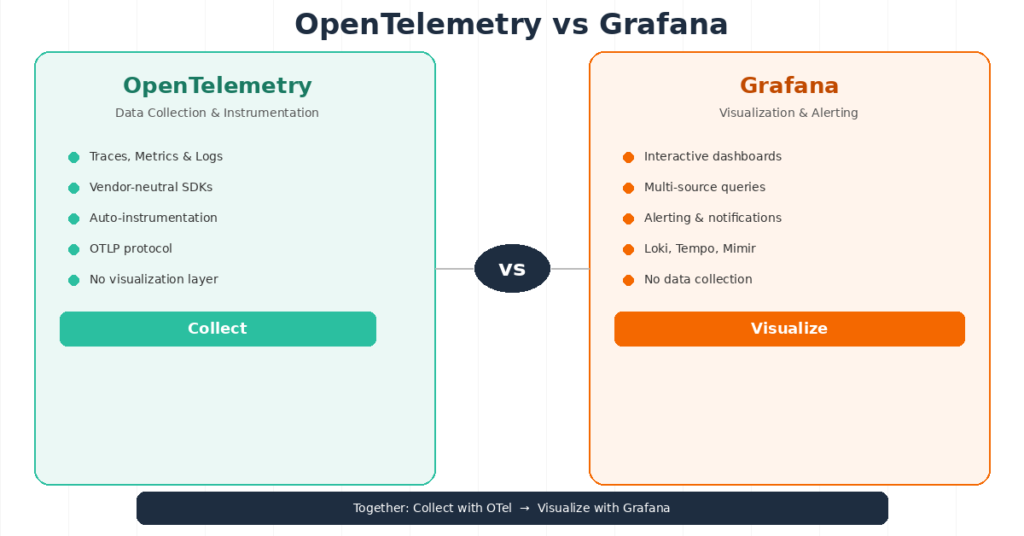
Figure: OpenTelemetry handles collection; Grafana handles visualization. Together they form a complete observability pipeline.
What Is OpenTelemetry?
OpenTelemetry (often abbreviated as OTel) is an open-source observability framework that provides a standardized way to instrument applications and collect telemetry data. It emerged in 2019 from the merger of two earlier CNCF projects, OpenCensus and OpenTracing, and is now one of the most active projects in the CNCF ecosystem.
At its core, OpenTelemetry consists of:
- APIs and SDKs available in over a dozen languages including Java, Python, Go, .NET, JavaScript, Ruby, PHP, Rust, C++, and Erlang.
- The OpenTelemetry Collector a vendor-agnostic agent and pipeline that receives, processes, and exports telemetry data.
- OTLP (OpenTelemetry Protocol) the wire protocol used to transmit traces, metrics, and logs between components.
- Semantic Conventions standardized naming rules for spans, attributes, and metrics so telemetry is consistent across services and languages.
OpenTelemetry does not store data and does not visualize data. Its sole responsibility is collecting telemetry and routing it to a backend of your choice such as Jaeger, Prometheus, Elasticsearch, or a managed APM platform.
According to the Grafana Labs OpenTelemetry 2026 update, the OpenTelemetry project had over 4,000 contributors in 2025, and the CNCF community is actively working towards OpenTelemetry reaching Graduated status in 2026, the highest maturity level in the CNCF ecosystem. Source:
What Is Grafana?
Grafana is an open-source analytics and visualization platform, first released in 2014. It connects to a wide range of data sources and renders their data as interactive dashboards, graphs, heatmaps, histograms, and alert rules.
Grafana does not collect or generate telemetry data. Instead, it acts as a query and display layer on top of storage backends. Common data sources include:
- Prometheus (metrics)
- Loki (logs)
- Tempo (distributed traces)
- Mimir (long-term metrics storage)
- Elasticsearch, InfluxDB, MySQL, PostgreSQL, and many others via plugins
Grafana Labs, the company behind the open-source project, also offers Grafana Cloud, a managed observability platform, and several open-source backends (Loki, Tempo, Mimir) as part of what it calls the LGTM stack.
Grafana OSS is fully self-hostable. Its plugin ecosystem allows extending functionality for additional data sources, custom panels, and alerting channels. Source:
OpenTelemetry vs Grafana: Key Differences
The table below summarizes the primary technical and functional differences between the two tools:
| Dimension | OpenTelemetry | Grafana |
| Primary Role | Instrumentation & data collection | Visualization & alerting |
| Data Signals | Traces, metrics, logs | No data generation; connects to backends |
| Protocol | OTLP (push & pull) | Queries Prometheus, Loki, Tempo, Mimir |
| Visualization | None built-in | Rich dashboards, heatmaps, histograms |
| Alerting | None built-in | Native alerting with multi-channel routing |
| Storage | No built-in storage; exports to backends | Connects to Mimir, Loki, Tempo |
| Vendor Neutrality | Fully vendor-neutral (CNCF) | Open source core; Grafana Cloud is SaaS |
| Self-Hosted? | Yes | Yes (Grafana OSS) |
| CNCF Member? | Yes (Incubating, 2026) | No |
| Best Used For | Standardizing telemetry collection | Building operational dashboards |
How OpenTelemetry and Grafana Work Together
In most modern observability stacks, OpenTelemetry and Grafana are used together rather than in place of each other. A typical pipeline looks like this:
Developers add OpenTelemetry SDKs to their application code. Many popular frameworks support auto-instrumentation, meaning the SDK automatically captures spans, metrics, and log records without requiring manual code changes. This is especially well-supported in Java, Python, .NET, and Node.js.
The OpenTelemetry Collector receives telemetry from instrumented services, applies processors (filtering, batching, sampling, attribute enrichment), and exports the data to one or more backends. For example, it might send metrics to Prometheus, logs to Loki, and traces to Tempo or Jaeger.
Prometheus stores metrics with its time-series engine. Loki indexes logs for fast querying. Tempo stores distributed traces. These backends are optimized for their respective data types and are designed to be queried efficiently by Grafana.
Grafana connects to Prometheus, Loki, and Tempo as data sources. Engineers build dashboards with PromQL queries for metrics, LogQL queries for logs, and TraceQL queries for traces. Grafana unified alerting can fire notifications to Slack, PagerDuty, email, or webhooks when thresholds are exceeded.
This four-layer architecture gives teams complete observability coverage across all three telemetry signal types while keeping each component focused on a single responsibility.
Grafana Alloy: Where the Two Ecosystems Converge
Grafana Labs introduced Grafana Alloy as its OTel-compatible collector distribution. Alloy is built on the OpenTelemetry Collector framework and extends it with additional capabilities for routing data directly to Grafana Cloud or self-hosted Grafana backends.
Teams that already use Grafana can use Alloy instead of the standard OTel Collector to simplify their pipeline. Alloy supports OTLP ingestion, Prometheus scraping, and direct integration with Loki and Tempo, reducing the number of separate agents needed in a deployment.
The choice between the standard OpenTelemetry Collector and Grafana Alloy typically comes down to ecosystem preference: teams deeply invested in the broader OTel ecosystem may prefer the standard Collector for maximum compatibility, while teams primarily using Grafana Cloud or the LGTM stack benefit from Alloy’s tighter integration.
When to Use Each Tool
Use OpenTelemetry When You Need
- A consistent, vendor-neutral instrumentation standard across services written in multiple languages.
- Distributed tracing in microservices or Kubernetes environments to visualize request flows across service boundaries.
- Flexibility to route telemetry to different backends simultaneously, or to switch backends without re-instrumenting your code.
- Compliance with an organization-wide observability standard that is not tied to any single vendor.
Use Grafana When You Need
- Interactive, customizable dashboards that unify metrics, logs, and traces in a single UI.
- Alerting based on complex multi-signal queries, with routing to multiple notification channels.
- A self-hosted visualization layer that connects to existing open-source backends like Prometheus and Loki.
- Long-term trend analysis and data exploration across large datasets stored in Mimir or Tempo.
Use Both Together When
- You are building a production-grade observability stack for cloud-native or microservices applications.
- You want to avoid vendor lock-in at both the collection and visualization layers.
- Your team needs full-stack visibility: traces for request flows, metrics for resource utilization, and logs for event debugging.
The OpenTelemetry and LGTM Stack
A popular self-hosted observability architecture combines OpenTelemetry with the LGTM stack: Loki for logs, Grafana for visualization, Tempo for traces, and Mimir for long-term metrics storage.
In this architecture:
- OpenTelemetry SDKs instrument services and emit OTLP data.
- The OTel Collector (or Grafana Alloy) fans out data to Loki, Tempo, and Prometheus or Mimir.
- Grafana acts as the single query interface for all three signal types.
This stack is fully open source, avoids per-seat or per-host SaaS pricing, and gives engineering teams complete control over data retention, sampling, and access policies.
OpenTelemetry Updates Relevant to Grafana Users in 2025 and 2026
According to the Grafana Labs OpenTelemetry 2026 update, several milestones directly improve how OpenTelemetry and Grafana work together:
- Database Semantic Conventions marked as stable: Whether you use PostgreSQL or MySQL, your database telemetry now looks identical across instrumentation libraries, making Grafana dashboards and alerts more reliable.
- Prometheus OTLP endpoint: You can now promote predefined lists of OpenTelemetry resource attributes as Prometheus metric labels, improving compatibility between OTel-emitted metrics and Grafana PromQL dashboards.
- Prometheus Receiver stabilization: The Prometheus Receiver in the OTel Collector is nearing stable status, making it safe to use as a primary gateway for teams running Prometheus-based Grafana dashboards.
- OTel eBPF Instrumentation (OBI): Grafana Labs donated its Beyla project to OpenTelemetry as OTel eBPF Instrumentation, enabling zero-code instrumentation for services without SDK changes.
- Declarative YAML configuration: OTel SDKs in Java, Go, PHP, JavaScript, and C++ are moving toward YAML-based configuration, reducing boilerplate and making collector setups easier to manage.
Pros and Cons: OpenTelemetry vs Grafana
OpenTelemetry Pros
- Vendor-neutral: no lock-in to any backend or vendor at the instrumentation layer.
- Supports all three core telemetry signals (traces, metrics, logs) under a single framework.
- Wide language support with auto-instrumentation for popular frameworks.
- Active CNCF community with contributions from Google, Microsoft, Splunk, Grafana Labs, and many others.
OpenTelemetry Cons
- No built-in storage or visualization; requires separate backends.
- Initial configuration of the Collector pipeline can be complex for new teams.
- No native user management or multi-tenancy; those features must come from the backend.
Grafana Pros
- Powerful, flexible visualization with dozens of panel types and dashboard customization options.
- Native support for Prometheus, Loki, Tempo, Mimir, and many other data sources via plugins.
- Built-in unified alerting with multi-channel routing.
- Strong multi-tenancy and user management for enterprise environments.
Grafana Cons
- Does not collect or generate telemetry data on its own..
- Complex dashboards with large datasets can become resource-intensive.
- Some advanced features (Grafana Enterprise, Grafana Cloud) are behind commercial licenses.
📌 Looking for a Self-Hosted Observability Platform That Speaks OpenTelemetry Natively?
CubeAPM is an OpenTelemetry-native APM built for teams that want full observability without SaaS pricing or vendor lock-in. Unlike cloud-hosted tools, CubeAPM runs entirely on your own infrastructure, supports OTLP natively, and works seamlessly with the Grafana-based dashboards you already use.
It gives you traces, metrics, and logs in one place, with zero data leaving your environment.
→ Explore CubeAPM Today
Conclusion
OpenTelemetry and Grafana occupy different but complementary positions in the observability pipeline. OpenTelemetry standardizes how your services emit and ship telemetry data, while Grafana standardizes how that data is queried, visualized, and acted upon. Using them together gives you a complete, vendor-neutral observability stack with no gaps between data collection and insight.
If you are building or refining an observability architecture, the practical question is not “OpenTelemetry or Grafana” but rather “which backends sit between them, and do I want to manage those backends myself or run a platform that handles it for me.”
For teams that want the simplicity of OpenTelemetry-native instrumentation without managing a full LGTM backend stack, self-hosted APM platforms like CubeAPM provide a purpose-built alternative that speaks OTLP natively and reduces infrastructure overhead.
Disclaimer.The information in this article is accurate as of June 2026 based on publicly available documentation from OpenTelemetry (opentelemetry.io) and Grafana Labs (grafana.com). Product features, pricing, and roadmap details may change over time. Always verify the latest information from the official sources before making architectural decisions.
FAQs
1. Are OpenTelemetry and Grafana the same thing?
No. OpenTelemetry is an instrumentation and data collection framework that generates and exports telemetry data. Grafana is a visualization platform that queries data already stored in backends like Prometheus or Loki. They serve different stages of the observability pipeline and are typically used together.
2. Can OpenTelemetry send data directly to Grafana?
OpenTelemetry can send data directly to Grafana Cloud via OTLP endpoints. For self-hosted Grafana, OpenTelemetry routes data to intermediate backends (Prometheus for metrics, Loki for logs, Tempo for traces), and Grafana then queries those backends. Grafana Alloy simplifies this integration by acting as an OTel-compatible collector with native Grafana backend support.
3. Do I need both OpenTelemetry and Grafana?
For full observability coverage you typically need both, or their equivalents. OpenTelemetry handles instrumentation and data routing; Grafana handles visualization and alerting. You could replace either with alternatives (for example, a managed APM for collection, or Kibana for visualization), but the OpenTelemetry plus Grafana combination is one of the most widely adopted open-source observability stacks.
4. What is Grafana Alloy and how does it relate to OpenTelemetry?
Grafana Alloy is Grafana Labs’ OpenTelemetry Collector distribution. It is built on the OTel Collector framework and extends it with tighter integration into Grafana Cloud and self-hosted Grafana backends. Alloy supports OTLP ingestion, Prometheus scraping, and direct export to Loki, Tempo, and Mimir, making it a convenient choice for teams already using Grafana infrastructure.
5. Is OpenTelemetry replacing Prometheus?
No. OpenTelemetry complements Prometheus rather than replacing it. The OpenTelemetry Collector includes a Prometheus Receiver that can scrape Prometheus-format metrics and forward them via OTLP. The Prometheus Receiver is nearing stable status in 2026. Many teams run both: OpenTelemetry for instrumentation and trace collection, and Prometheus for metrics scraping and storage, with Grafana providing the dashboard layer for both.