









The main difference between SigNoz, IBM Instana, and CubeAPM is how they balance openness, automation, and cost. SigNoz offers OpenTelemetry-native full-stack observability via SaaS or self-hosting, IBM Instana focuses on automated enterprise APM, and CubeAPM delivers full-stack observability with predictable pricing and managed deployments inside your infrastructure.
Modern observability now directly impacts cost control, data residency, and mean time to resolution. Teams must balance open standards, automation, and operational simplicity while ensuring telemetry stays secure, costs remain predictable, and incidents are resolved quickly at scale.
Teams begin to notice cost differences as telemetry volume grows beyond early usage. In environments with sustained traffic, high-cardinality logs, or many microservices, observability spend often shifts from a fixed tool cost to a variable expense that needs closer tracking.
In this guide, we compare SigNoz, IBM Instana, and CubeAPM across architecture, deployment model, pricing, sampling, retention, and real-world use cases.
SigNoz vs IBM Instana vs CubeAPM: Feature Comparison
The comparison below is based on publicly available documentation and typical production usage patterns. Actual pricing, sampling, and retention behavior may vary depending on workload characteristics and system configuration.
| Features | CubeAPM | SigNoz | IBM Instana |
| Known for | Unified OpenTelemetry-native observability with predictable pricing | OpenTelemetry-first, open-source observability | Automated, enterprise-grade APM with real-time discovery |
| Multi-Agent Support | Yes (OTel, New Relic, Datadog, Elastic) | Limited (OTel, Prometheus) | Limited (OTel, Prometheus) |
| MELT Support | Full MELT | Full MELT | Full MELT |
| Setup | Self-hosted but vendor-managed | SaaS & Self-hosted | SaaS & Self-hosted |
| Pricing | Ingestion-based pricing of $0.15/GB | Logs: $0.3/GB Traces: $0.3/GB Metrics: $0.1/mil samples | Essentials: $20/MVS/ month Standard: $75/MVS/ month |
| Sampling Strategy | Smart sampling | Head + Tail-based | zero-sampling |
| Log Retention | Infinite Retention | 15 days | 7 days |
| Support TAT | < 10 minutes | No details | 1hr to 1 business day |
SigNoz vs IBM Instana vs CubeAPM: Feature-by-Feature Breakdown
Known for
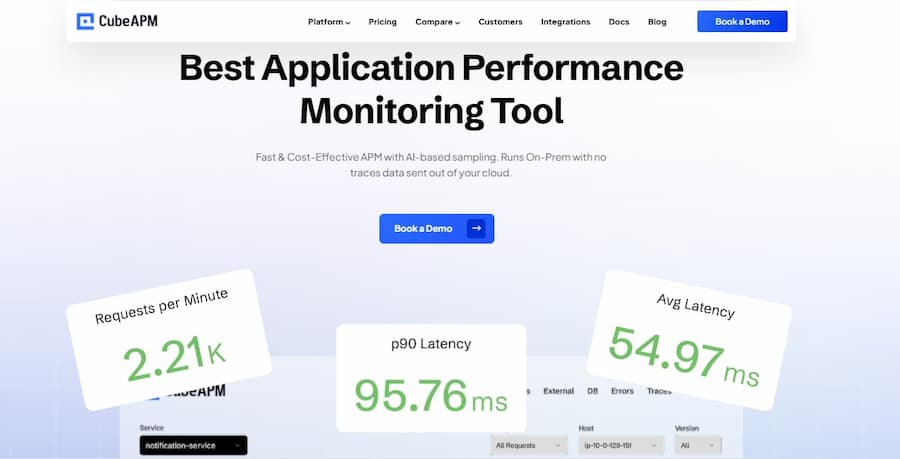
CubeAPM: Known for unified observability across logs, metrics, traces, and synthetic monitoring. It is OpenTelemetry-native full-stack observability with predictable, ingestion-based pricing. It runs self-hosted inside your VPC or on-prem but is managed like SaaS, giving teams full data control without operational overhead. It’s commonly chosen by SRE and platform teams that need MELT visibility, unlimited retention, and fast MTTR without vendor lock-in.
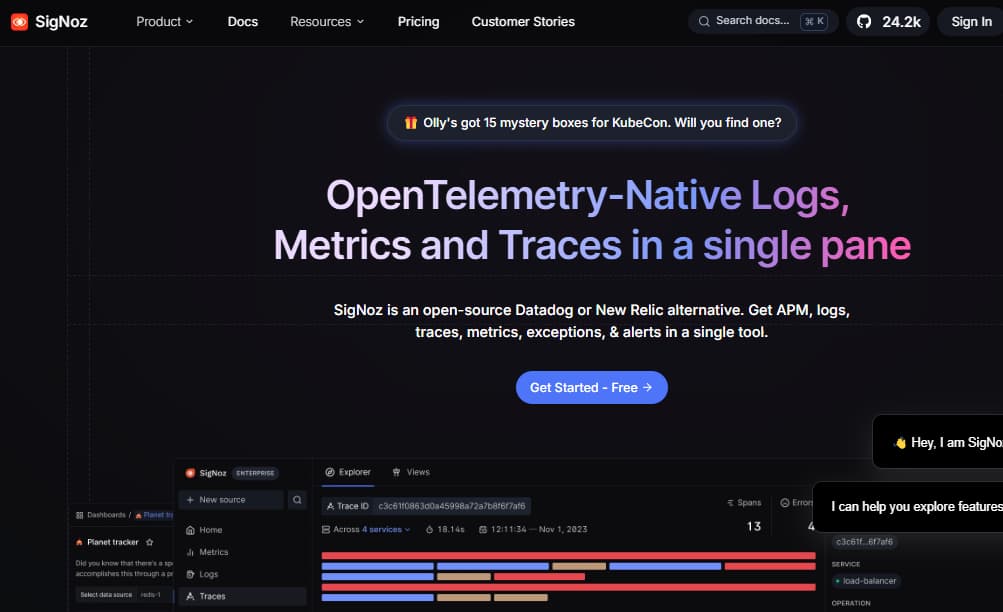
SigNoz: Known for OpenTelemetry-native observability with flexible deployment options, including SaaS and self-hosted. It appeals to teams that want visibility across logs, metrics, and traces using open standards, especially those comfortable managing parts of the observability stack themselves for the self-hosted option.
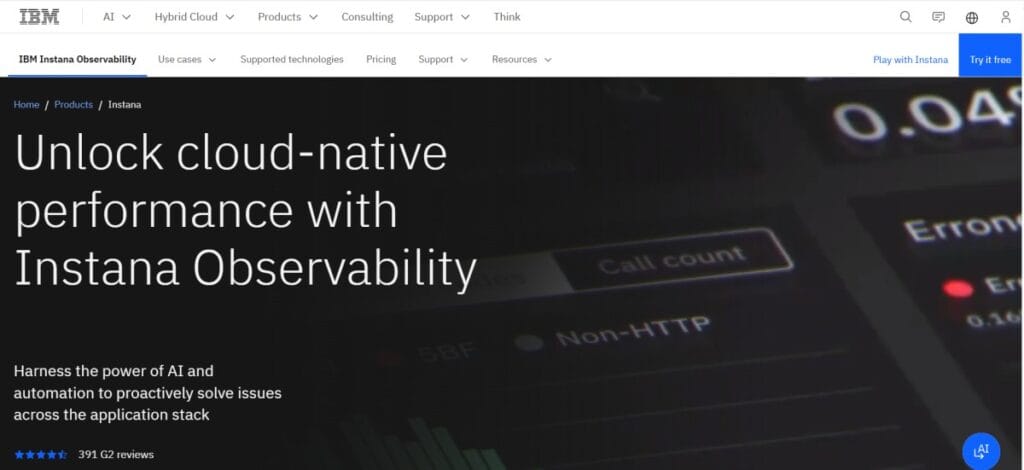
IBM Instana: Known for automated, enterprise-grade application performance monitoring with real-time service discovery and dependency mapping. It is typically adopted by large enterprises that prioritize automation, AI-assisted insights, and deep application intelligence across complex hybrid environments.
Multi-Agent Support
CubeAPM: Supports true multi-agent environments. It works natively with OpenTelemetry and also accepts data from existing Datadog, New Relic, and Elastic agents. This allows teams to migrate incrementally without re-instrumenting services, which is especially valuable in large or hybrid environments.
SigNoz: Supports OpenTelemetry as its primary ingestion mechanism. Based on publicly available documentation, there is no supported guidance for running multiple vendor agents, such as Datadog or New Relic, in parallel with SigNoz. It is best suited for teams standardizing fully on OpenTelemetry.
IBM Instana: IBM Instana supports OpenTelemetry ingestion for traces and metrics via OTLP (for example, through an OpenTelemetry Collector or the Instana host agent). Public documentation is clear on OTel ingestion, but it does not clearly document “multi-vendor agent coexistence” scenarios (for example, running Datadog/New Relic agents in parallel as a supported migration path).
MELT Support (Metrics, Events, Logs, Traces)
CubeAPM: Delivers full MELT support in a single, unified backend. Metrics, logs, traces, and events are correlated by default, allowing teams to move from high-level symptoms to root causes without switching tools. This unified view is especially useful for SRE and platform teams troubleshooting distributed systems and Kubernetes workloads.
SigNoz: Supports full MELT using OpenTelemetry as its core foundation. Metrics, logs, and traces are available across both SaaS and self-hosted deployments, with built-in correlation between signals. It works well for teams adopting OpenTelemetry end-to-end and building observability pipelines around open standards.
IBM Instana: Provides full MELT coverage with a strong focus on application and infrastructure correlation. It automatically discovers services and dependencies, helping teams understand complex environments quickly. This approach is commonly used in large enterprises and hybrid infrastructures where manual instrumentation is difficult.
Deployment Model (SaaS, Self-Hosted, BYOC)
CubeAPM: Deployed self-hosted inside your VPC or on-prem, but operated as a vendor-managed platform. Teams keep full control over telemetry data while avoiding Day-2 tasks like upgrades, scaling, and maintenance. This model works well for organizations with strict data residency or compliance requirements that still want SaaS-like simplicity.
SigNoz: Available as both a SaaS offering and a self-hosted deployment. The SaaS option reduces setup effort and operational responsibility. In the self-hosted model, teams run SigNoz entirely in their environment and are responsible for operating the backend, including managing the ClickHouse backend.
IBM Instana: Supports SaaS as well as a self-hosted Standard Edition. IBM fully manages the SaaS deployment, simplifying operations. In the self-hosted model, customers install and operate the Instana backend themselves, which provides data control but requires managing infrastructure, upgrades, and ongoing performance tuning, adding operational overhead.
Pricing: Approximate Cost for Small, Mid-Sized & Large Teams
*All pricing comparisons are calculated using standardised small/medium/large team profiles defined in our internal benchmarking sheet, based on fixed log, metrics, trace, and retention assumptions. Actual pricing may vary by usage, region, and plan structure. Please confirm current pricing with each vendor.
*An APM host is a host that is actively generating trace data, and an Infra host is any physical or virtual OS instance that you monitor with any observability tool.
Below is a cost comparison for small, mid-sized, and large teams.
| Approx. Cost for Teams | Small (~30 APM Hosts) | Mid-sized (~125 APM Hosts) | Large (~250 APM Hosts) |
| CubeAPM | $2,080 | $7,200 | $15,200 |
| SigNoz | $4,600 | $16,000 | $34,000 |
| IBM Instana | $4,950 | $17,375 | $37,000 |
Teams switching to CubeAPM save roughly 55% compared to SigNoz and about 59% compared to IBM Instana for mid-sized environments, based on approximate cost estimates for ~125 APM hosts.
What this comparison reveals at scale
As observability usage scales, distinctions between platforms are shaped more by underlying design choices than by individual features. Pricing models, retention policies, sampling approaches, and deployment options start to affect reliability workflows, cost stability, and governance outcomes. Teams that assess observability as long-term infrastructure often make more resilient platform choices.
CubeAPM: Cost for Small, Medium, and Large Teams
CubeAPM follows a simple, predictable ingestion-based pricing model with no user-based, host-based, or feature-based charges.
Pricing details:
- Ingestion pricing of $0.15 per GB across logs, metrics, and traces
Based on comparable production workloads, the approximate monthly costs are:
- Small teams (~30 APM hosts): $2,080
- Mid-sized teams (~125 APM hosts): $7,200
- Large teams (~250 APM hosts): $15,200
Because CubeAPM supports self-hosted and BYOC deployments, telemetry data remains inside the customer’s infrastructure, enabling predictable scaling without additional charges for retention or access.
SigNoz: Cost for Small, Medium, and Large Teams
SigNoz follows a usage-based pricing model, with costs driven by data ingested across different telemetry signals.
Pricing details:
- Logs: $0.30 per GB
- Traces: $0.30 per GB
- Metrics: $0.10 per million samples
Based on comparable production workloads, the approximate monthly costs are:
- Small teams (~30 APM hosts): $4,600
- Mid-sized teams (~125 APM hosts): $16,000
- Large teams (~250 APM hosts): $34,000
In self-hosted deployments, teams are also responsible for operating and scaling backend components such as ClickHouse, which can add infrastructure and operational overhead beyond ingestion costs.
IBM Instana: Cost for Small, Medium, and Large Teams
IBM Instana uses a usage-based pricing model measured in MVS (Monitoring Virtual Servers), where each monitored host or VM typically maps to one MVS unit.
Pricing details:
- Essentials tier: $20 per MVS per month
- Standard tier: $75 per MVS per month
Based on comparable production workloads and assuming the Standard tier for full-stack observability, the approximate monthly costs are:
- Small teams (~30 APM hosts): ~$4,950
- Mid-sized teams (~125 APM hosts): ~$17,375
- Large teams (~250 APM hosts): ~$37,000
For self-hosted deployments, customers are responsible for operating the Instana backend, including infrastructure provisioning, upgrades, tuning, and ongoing maintenance, which can increase the total cost of ownership beyond licence fees.
Sampling Strategy
CubeAPM: Uses smart, context-aware sampling that prioritizes high-value data such as errors, latency spikes, and anomalous traces. This reduces telemetry volume while retaining important signals for root-cause analysis, helping teams control costs without losing visibility in high-traffic environments.
SigNoz: Allows teams to control trace volume using OpenTelemetry sampling techniques. It supports head-based sampling (where decisions are made early in the trace) and tail-based sampling (where spans are dropped after full trace context is available), giving teams flexibility to balance visibility and volume. Users can configure probabilistic sampling rates or drop spans based on attributes or routes using OpenTelemetry processors.
IBM Instana: Offers automatic distributed tracing with zero sampling by default, meaning it captures full traces across the application stack without dropping spans. This “zero-effort” approach ensures complete visibility into every application call, which can be valuable for detailed performance diagnostics but may increase telemetry volume.
Data Retention & Storage

CubeAPM: Supports unlimited retention without increasing ingestion costs. Because data is stored inside the customer’s infrastructure, teams can retain logs, metrics, and traces long term for audits, trend analysis, and incident reviews without paying higher per-GB rates. This makes historical analysis, SLO tracking, and security investigations possible without pruning data to control cost.
SigNoz: Applies limited default retention. Logs are retained for about 15 days, traces for up to 15 days, and metrics for roughly 1 month. Increasing retention raises per-GB ingestion pricing. For example, extending log or trace retention from default levels toward 90 days can increase pricing from around $0.40 per GB to about $0.60 per GB, which significantly impacts cost as data volumes scale.
IBM Instana: Applies limited default retention with signal-specific retention policies. Logs, applications, and trace data are typically retained for about 7 days, while core service and endpoint metrics are kept for around 31 days. Infrastructure metrics are stored at high resolution for short periods and as aggregated data for longer windows, with some metrics retained for several months to over a year, depending on aggregation level and configuration. Extending retention beyond defaults depends on the plan and setup and can increase overall cost.
Support Channels & Response Time
CubeAPM: Offers real-time support via Slack and WhatsApp with minute-level response times. Teams receive direct access to engineering support for configuration, troubleshooting, and escalation with no documented delay windows.
SigNoz: Support for self-hosted users is available through email, Slack, and the GitHub community. There are no publicly documented response time guarantees for self-hosted support, and response times can vary.
IBM Instana: Support is available through ticketing and enterprise support channels with defined response time objectives. For critical issues, the response time objective is 1 hour. For minimal severity issues, the response time objective is 1 business day, with response expectations tied to severity levels and support agreement terms.
How Teams Evaluate These Platforms at Scale
As teams compare SigNoz, IBM Instana, and CubeAPM, evaluation criteria tend to change as systems mature and telemetry volume grows. Early decisions are often guided by fast onboarding and basic visibility. At scale, priorities shift toward how costs evolve, how long data can be retained, and how much control teams have over their observability stack.
In production environments with sustained traffic and high-cardinality telemetry, teams focus on how pricing responds to ingestion growth, whether retention can be extended without sharp cost jumps, and how deployment models affect operational ownership. At this stage, observability is no longer an experiment. It becomes an ongoing operational and governance concern, favouring platforms with predictable cost behavior and flexible deployment options.
SigNoz vs IBM Instana vs CubeAPM: Use Cases
Choose CubeAPM if:
- You want full MELT observability across applications, infrastructure, and microservices in a single, unified platform
- You operate in environments where data residency, compliance, or internal data control is important
- You need predictable observability costs as telemetry volume grows, without pricing tied to users or hosts
- You want long-term access to historical telemetry for audits, trend analysis, SLO tracking, and post-incident reviews
- You are migrating from existing APM tools and want to reuse current instrumentation across multiple agent ecosystems
- You prefer a self-hosted or BYOC deployment with managed operations and minimal Day-2 overhead
Choose SigNoz if:
- You are standardizing on OpenTelemetry and want a platform built natively around open standards
- You need flexibility to run observability either as SaaS or fully self-hosted
- You want fine-grained control over sampling, pipelines, and telemetry configuration
- You are comfortable managing backend components and tailoring retention and storage for the self-hosted option
- You want visibility across logs, metrics, and traces using an OpenTelemetry-first data model
Choose IBM Instana if:
- You operate large-scale or hybrid environments and need automated discovery of services, dependencies, and infrastructure
- You want enterprise-grade application performance monitoring with minimal manual instrumentation
- You value real-time service maps and contextual performance insights across applications and infrastructure
- You prefer an observability platform with built-in automation for tracing, dependency mapping, and root-cause analysis
- You require defined enterprise support processes with documented response-time objectives
- You are running mission-critical workloads where consistent, high-fidelity telemetry is essential
Conclusion
All three platforms support full-stack observability, but they are optimized for different operating models as systems scale. SigNoz emphasizes OpenTelemetry-native visibility with flexible deployment options. IBM Instana focuses on automated, enterprise-grade observability with strong service discovery and predefined operational workflows. CubeAPM centres on unified observability with predictable cost behaviour and flexible deployment inside customer-controlled environments.
Choosing between SigNoz, IBM Instana, and CubeAPM depends less on individual features and more on how observability requirements evolve over time. As telemetry volume grows, teams increasingly evaluate platforms based on cost scalability, retention needs, and operational ownership. Assessing these factors early helps ensure the observability stack continues to fit both technical and governance needs at scale.
Choosing the right Platform as Observability Scales
As observability matures, teams move beyond ease of setup and focus on how platforms behave under sustained production load. Evaluation shifts toward how tools handle rising traffic, growing service complexity, and increasing volumes of telemetry data.
At scale, pricing models, data retention, and control over ingestion and sampling become more important than individual features. These elements directly influence cost stability, the ability to investigate incidents over time, and overall compliance posture.
The most suitable platform is usually the one that supports continued growth without introducing trade-offs between visibility, cost predictability, and operational responsibility.
Disclaimer: The information in this article reflects the latest details available at the time of publication and may change as technologies and products evolve.
FAQs
1. What is the main difference between SigNoz, IBM Instana, and CubeAPM?
SigNoz focuses on OpenTelemetry-first observability with flexible deployment. IBM Instana emphasizes automated, enterprise-grade observability with defined SLAs. CubeAPM combines full-stack observability with predictable pricing and vendor-managed, self-hosted or BYOC deployments.
2. Which tool is best for OpenTelemetry-native observability?
SigNoz and CubeAPM are both OpenTelemetry-native. SigNoz is built directly around OpenTelemetry pipelines, while CubeAPM also supports multiple agent ecosystems to simplify migrations. IBM Instana supports OpenTelemetry ingestion alongside its native agent.
3. How do pricing models differ between SigNoz, IBM Instana, and CubeAPM?
CubeAPM uses a single ingestion-based model across all telemetry types for easier cost forecasting. SigNoz pricing scales with increased retention limits and data volumes. IBM Instana uses host-based pricing measured in Monitoring Virtual Servers(MVS).
4. Which platform offers the longest data retention by default?
CubeAPM supports unlimited retention since data stays in the customer’s infrastructure. SigNoz and IBM Instana apply default retention limits, with extended retention affecting cost or plan requirements.
5. Which tool is better suited for enterprises with strict compliance or data residency requirements?
CubeAPM is well suited because telemetry remains inside the customer’s cloud or on-prem environment. IBM Instana also supports self-hosted deployments but requires customer-managed operations. SigNoz self-hosting provides control with operational responsibility.